Showing posts with label Round-tailed Ground Squirrel. Show all posts

Tuesday, February 11, 2020

Turning Over A New Leaf

Western Screech-Owl near my work site
I am healing.  I am getting stronger, but it's slow. You'd think I was out every day looking for birds, but I am not.  I have three really important goals right now.  Walk more.  Lose this stubborn belly fat.  And drop the weight. 

A pack of Javelina or Collared Peccary cross a pumpkin patch to get to a river
On the financial level.  Save money.  Stay at home.  Make this year about birding Pima County well. It's a huge county, but I know where to go.  There are just a few people who know Pima a little better.  But I've made notes over the years for a year like this one.  And it has paid off so far locating certain difficult bird species. 


This brillaint Lillian's Eastern Meadowlark is a favorite of mine
I had habitat picked out.  Just never had the time to do the slow investigation that was needed.  But I'm glad I made the notes as it has made my job so far a breeze.  Some birders get angry that I hide my reports about certain rare birds.  That's ok. I learned my lesson a long time ago.  I told someone and they told others.  And then the bird was never seen again. I'm a quick learner. If you are a true birder, you know and understand a bird's habitat requirements. And with that knowledge, you can find the bird you are looking for. I need birders to know that the bird's safety comes first. So far, I've been excited by the owl discoveries.  From Long-eared Owls to Barn Owls to Burrowing Owls, the trickiest in my county, to the easier Western Screech-Owl and nesting Great Horned Owls.

The Round-tailed Ground Squirrel peaks up from a hole to make sure it's safe to search for food
This slow methodical approach has really allowed me to absorb all the habitats more.  Take my time.  Explore new mapped out spaces for certain species. Granted the beginning of the year is always the easiest. 


Work has taken up much of my time allowing me to bird once or twice a week. 


It has been a wonderful time connecting with birders.  Just sitting on a bench and helping a visitor ID a new bird or a difficult sparrow.  There is nothing new anymore here in Arizona except for the personal connections I make with birders and their love for birds.  It makes me smile.  The more I do this; the more I realize I'm beginning to fill in vacant roles that were once filled by birders who are no longer with us. In a way, it's a very sobering thought.

The subtle beauty of a Lincoln's Sparrow
I have changed as a teacher this year as well.  I am more relaxed than I have ever been with my students.  We talk and I teach.  When I'm done with my lesson, a student shares with me a bird they've seen.  They show me a picture and I ask them about the bird and if they know what kind of bird it is, etc etc.  

A Common Raven comes in for a sip of water
 I speak to a new friend on the phone.  An opportunity arises for my students.  I am excited.  So we begin to brainstorm.  I begin to write down a strategy to see if we can maybe make this student trek to our national park happen. What if it was an overnight 2 day event?  And what if we could give them the hands on experience necessary to excite their minds for a future of protecting our beautiful and sacred Sonoran desert?  I am very grateful for the conversation and also for the opportunity to get to know another kindred spirit.

A Pied-billed Grebe hunts for larvae in the murky water
 At home, I find a Canyon Tree Frog in my garden!  I watch my new friend sit every day on one of my Mexican pots as it bathes in the sun.  The nights get cold and I wonder if the frog will make it.  In the morning as I put oranges out for my Verdins, I check to make sure the frog is okay.  And there the frog is.  And I smile. 


A wonderful and shocking surprise in my garden, the Canyon Tree Frog, sits on top of my Mexican pots.  Where did it come from?  I never touch that part of my garden.  Has it lived in the soil of that pot for a long time?
 In the quiet of my office, I research and plan for my July trip to the Darien Gap in Panama.  I purchase a ticket for the entire month.  The first half will be grueling as we hunt for the Harpy Eagle.  The second half will be my vacation. I'll sit in my rocker on the veranda overlooking the gardens and coffee plantations in Boquete wearing my sweatpants sipping on something warm. I will meet up again with Ivan in Gamboa.  And I sense I'll finally get to meet some "friends" from Facebook for the first time in person. 

A Botta's Pocket Gopher comes up to grab a bite of grass
Each year is a new chapter in our life.  We can let it pass us by or we can make each day an event. After being stuck at home to heal for several months, it's good to feel stronger.  And it's good to get out again and be a part of the community.  The pause in my life was a good thing. 


There are goals to be achieved for sure during this important year of 2020. We'll meet up with Nancy and her sister for a wonderful hummingbird hunt in March. We'll explore new birding hotspot, the Canoa Ranch and do a Hawk Watch in March with Tucson Audubon. We'll also visit the garden at El Presidio as I add several new native plants to our property. Then our friend Dr. Steve from Wales comes in April to chase Arizona lifers.  Our Tucson Audubon Big Day will be some time in April/May as we, the Wrenegades, try to find as many bird species as we can in one day. And there are so many more things that will happen.  But for now, I'm birding at my own pace.  I'm sleeping in during the mornings as much as I can.  I'm still a birder but a much more relaxed one now. Until next time.....

Monday, June 11, 2018

Parts Unknown

These two Cactus Wrens gave me a good laugh at sunset. 
During these past few hot Arizona days, I've been walking around nearby parks and practicing with my light settings in the dark conditions to prepare for Trinidad.  This will be my final post from Tucson for awhile. 

Our monsoon may start early this year. 
As I walk the known, I prepare mentally for the unknown.  It is part of the life journey we all take.  Sometimes we do it alone.  Sometimes we share it. This is the way of all things. 


There are nights when I lose sleep because I am both excited and anxious.  Everything has been set up and yet still, I wonder, What am I forgetting? What's out there?!

Round-tailed Ground Squirrels live the life in this terrible heat
Would I ever have gone to Trinidad in my lifetime if it weren't for the birds?  Probably not. I am forever addicted to the Spanish and Portuguese speaking cultures. But if I am to find birds on this planet, I can't limit myself to what is comfortable. I am forced into parts unknown. Trinidad is close to Venezuela and is known as the gateway to the South American birding world while still maintaining a fantastic blend of Caribbean birds. The place I will be visiting, from my research, suggests that I'll be living the island culture similar to what I experienced when I lived on the islands of  Cape Verde, West Africa.  It is different. The words for the dances are different.  Instead of Praia's(Cape Verde) Funana, it will be the Trinidadian Calypso.  Instead of the secretive martial art dances of Capoeira, they practice a similar form known as Kalinda.  


Making my favorite meal.....Cachupa on the Cape Verdean island of Santiago
My experience on Cape Verde sheds a little insight on the cultural similarities where in history, island slave trade had happened. But Trinidad was also a huge trading center for many other things like spice. Today, Trinidad is truly a blend of so many different cultures weaved into one. While the days of old are gone, we can still find history hidden in the language spoken.  In Cape Verde, it's the Portuguese based kriolu. Not quite Portuguese at all.  And not a written language!


I was more teacher than birder during this time of my life.  I did look at birds and try to take pics of them with my terrible camera at the time:)  We still used FILM!!!
My very first chapters as a teacher began training students and teachers alike in language and language design for the classroom on the islands of Santiago and then later Sal. Now I will go to Trinidad, another island with similar histories. I'm always fascinated by what makes the culture different from other places I've been. I purposely rented an apartment for one week out of the nature area to study language, food and the people. It's more than just birds.  For me, it's also about the community that surrounds the birds. While English is spoken there, the familiar words are peppered with strange and new exotic ones.  An English based creole!


Black-crowned Night Heron
And here's the thing.  I can play it safe.  Or push myself to do better.  Be better.  This is the nature of birding.  It's a bittersweet emotion knowing that it may be the only time in this life of mine that I'll be visiting this island.  So I need to make it count. Rushing into an area to see the birds and then leave isn't fun at all.  I want the "cultural flavor" from the birding experience. 

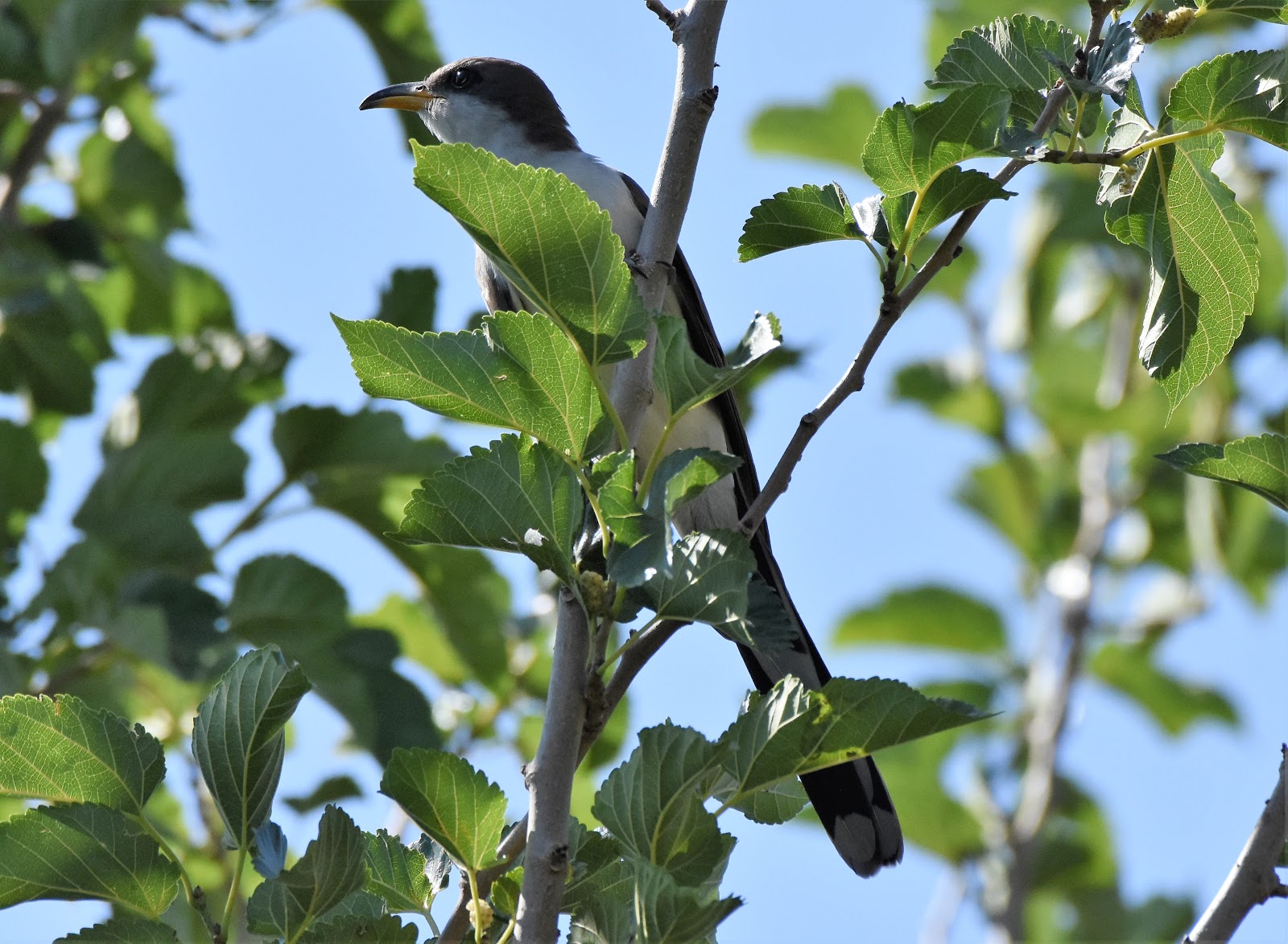
An early and exciting Yellow-billed Cuckoo, a favorite bird of mine
I have my office space and desk.  I have my big meeting with the nature center getting all my birds set up.  It's a rather civilized approach to birding.  Meals are all prepared.  Transportation is there.  All I have to do is go outside my room and they take me away to the birding hotspots. It seriously is a great deal for birders.  Asa Wright can be a bit pricey but after the stress I had this year, I am treating myself to a birder's version of a "massage".  There's even tea time and some of this island adult flavored fruit punch:) So I'll be one week at Asa Wright and one week in Arima doing my cultural studies(and some light birding). 

I'll miss my girls.  Callie rests her head on my chest during the early morning hours.
This summer we'll be exploring island culture on Trinidad and Hawaii during the months of June and July.  I'll be meeting with people and their birds.  I have found that understanding culture is also key to the success of optimal birding.  Now, the birds are pushing me into unknown lands.

A Cassin's Kingbird at a local park
When we speak another language, whether it be bird, Spanish, Russian, Mandarin, etc, we have a deeper meaning of their behaviors and culture.  Something always gets lost in translation, but when I speak Spanish or Portuguese, it gives me a deeper insight into the culture.  But as the birds and non-latin countries go, I am forced to start all over again.  

During the day, I am bored and trapped inside my house waiting for the terrible heat to subside. Instead I clean and research for the trip. PS. Catnaps are sacred.
On my last days in Tucson, I walk the familiar parks saying good-bye to my birds and play with light settings for a cave journey I'll be making for the Oilbird colony at the Asa Wright Nature Center. At first birding is easy. Then one has to travel (and) it's still relatively easy if you go to new areas.  But the nature of birding gets trickier the longer we play the game.  The hard part is picking up the endemics(which there are several on Trinidad) 


The tables that changed my life forever.  A balmy fire fly lit night near the Pipevine Road at our stay introduces me to birders who share their excitement and discoveries with us. 
My life's journey is about understanding people, their culture and the birds surrounding it all. The picture above is an important one. I snapped the pic to remember the clarity of thought that happened in this moment during our Panama visit. 


A Snail Kite sits next to me near our bench at the Pipevine Road
7 years ago, this month, I began my serious journey into the birding world. I changed. This blog changed. The photography changed. I let most of my negative attachments go in this world. My job became my job. And the birding and human experiences became my passions.


I discover the dangers of birding and realize that I loved it. On Coiba Island
I watched two birders have a candle lit dinner at a table next to ours in that Panama Canal style home. It was that specific moment that changed the way I saw everything. After our stay in Gamboa, Panama, we went to Coiba Island and discovered manakins. And that's where the addiction began! I know that wherever I go, I will fall in love because there are birds. I am a gypsy at heart.  One who likes good mole, a smoke filled tapas bar, a nice spicy bowl of kakik, and/or a simple breakfast of gallo pinto.  Now the cuisine will change.  The languages will be difficult in both bird and human forms. And I will somehow figure it all out.  The Trinidad adventures begin next week.  This post is dedicated to the memory of Anthony Bourdain.  I recently watched his show on Trinidad to give me a little background on Trinidadian cuisine and culture. He will be missed. 

Tuesday, June 5, 2018

June Birding in Southern Arizona


Watering holes, like this one, are very important for wildlife like this Arizona Gray Squirrel during the month of June
During the first weeks of June, I lose my sense of purpose.  I find projects that force me to stay birding.  Over the past week, I've learned to sleep a little more and bird when I could. 

This pic from a local Arivaca Cafe caught my attention and I got lost in the image
On one project, this was personal, I went to check up on nesting Gray Hawks at the Empire Ranch in the grasslands.  Last year, an off duty border patrol agent was target practicing during the driest month of the year (with an explosive target of all things!) and admitted to starting a major fire that swept miles across the grassland burning several structures. Thankfully no one was hurt, but it did have an affect on riparian corridor bird species. It also destroyed some historic Arizona Cottonwoods that people had come to love.  The nesting Gray and Zone-tailed Hawks were not seen in their usual spots last year. The White-tailed Kites moved location. So I did a follow up.

Wildflowers love the sun and add a lovely splash of color along pounds or founds.  They also are a source of food for hummingbirds and insects like butterflies and bees
The good news?  The Gray Hawks were back in the remaining living patches of the riparian area of the Empire Gulch.  I did not detect the Zone-tailed Hawks, but we didn't explore that sector of the grasslands due to the heat.  The sun and heat were much too strong to be outside for long. At 107 degrees, we have to be careful. It always begs the question, how does the wildlife do it?


Wildlife aficionados around the Tucson area help out Mother Nature by placing fountains and other water sources out for their critters.  In this harshest of months, the wildlife and native vegetation are put to the test.  


I would have missed this night blooming cacti flower had I not gotten up early enough.  In the morning, the flower closes up. 
We are currently suffering drought conditions around the state which stresses out the wildlife even more.  So anything we can do to help can make a difference to their survival. So my 2nd project has been my gardens. 

The Mediterranean House Gecko enjoys the warm summer nights around lights as bugs like moths are drawn to the lights
Every night, I go out to my bird feeders and water stations and refill them for the morning's flurry of activity.  There I sit watching all my wonderful critters in Midtown Tucson go crazy.  So while I can't bird long hours like in the fall, winter or spring, I can enjoy my backyard for birding. 


The sun is bright and strong.  The heat is unbearable.  Humans exist within their a/c run structures.  The curtains are drawn to reflect the sun and heat from outside.  For wildlife, they stay near the few water sources that exist.  Most cling to the shade or their burrows during the day.  At night, humans and other mammals leave their homes for a walk or an outdoor dinner event.  We here in Tucson turn into vampires at night(minus the blood sucking).  

Arizona Song Sparrow or what some call the Desert Song Sparrow

It never hurts to ask. I was bored.  There was a golf course in Tucson that had a body of water.  I walked to the visitor center and heard lots of bird song, but I turned around and got back into my car.  Then I said to myself "screw it".  I drove all the way there and for what? To turn around and drive home? Heck no. So I went to the front desk and asked to see their pond.  The owner looked at me weird and eyed my camera wearily.  In fact, I've noticed over the last several weeks that people have been hypersensitive about the camera.  One lady even told me that my camera looked like a gun.  So I have become sensitive to my public presence. I don't want to scare people (even though some would say that it's my right to carry a concealed weapon).  The thing is that it's just a big and heavy scary looking camera:)  But I think it's good that the public is noticing. 

The hidden pond of Roger Enke Golf Course

 Anyhow, the manager looked at me strangely and I smiled and told him I was doing a bird count in the area and wondered if I could check the pond.  I reassured him that I'd stay out of the way of the golfers and then he told me, "No problem." So it never hurts to ask.


Round-tailed Ground Squirrels are active in the shade
I was able to collect nesting and breeding data from the golf course and I was thankful for the opportunity.  

Neotropic Cormorants are found around our local watering holes in Tucson
Then it was back to Reid Park for my weekly bird check.  I try to monitor the park once a week for a count.  It's close to home.  


While we both are researching, our cats love to "help out". Typing can be a real challenge.  And if I'm not watching carefully, they'll do some typing for me!


Band-tailed Pigeon!  This year has been a good year for them!
The Elegant Trogon survey, with Tucson Audubon, is happening right now.  Jennie MacFarland is leading the efforts to help keep tabs on our trogons in Southern Arizona.  She asked if I would be interested and I said yes:)

The lovely sanctuary known as Ramsey Canyon
The mornings are still nice in some areas like around the foothills of our mountains.  They didn't have anyone to survey Ramsey Canyon so I jumped at the chance.  For the first time, I was able to bird Ramsey Canyon alone without all the walking and talking people.  


Common Ground-Dove

It was pretty magical and it was the largest count I've ever had in that area without all the people around.  So it goes to show that human activity does have an affect on wildlife.  Also it helped birding early.  Here in Southern Arizona, bird numbers and activity are highest between the hours of 4 AM until 8 AM.  Yeah.  It's early. Miss that window and you'll have to wait until 5 PM for everything to sort of pick up again.  

The interior sub-species of White-breasted Nuthatch
Creating these projects, whether they be with organizations or personal, are important contributions for your communities and your own bird data.  It's fun and forces one to get out and keep birding in the worst of conditions:)

Western Wood-Pewee

Go early.  Freeze water bottles the night before to stay cool. Or if you have a water cooler, pack it with ice.  It will melt:) Stay shaded as often as you can.  Wear sun protections like a hat or sunscreen.  A lot of birds are on nests right now and it's pretty exciting to see.  

The Red-shafted Northern Flicker

For Arizona birders, June is often the month to travel to other worlds.  I'll be flying out soon.  But for now, it's house chores and travel prep.  


For my surveys, click on the "here". 
For the Gray Hawks at Las Cienegas, click here.
For the Trogon Survey at Ramsey Canyon, click here.
For my weekly patch count at Reid Park, click here.
Until next time....


Bullock's Oriole

Wednesday, May 10, 2017

Seek And You Shall Find


Brian searches for the distant Common Crane
Talk about a spontaneous and fun weekend!!  A Common Crane (rare to the US) was spotted at Mormon Lake near Flagstaff, AZ.  Every birder,both in and out of the state, came to view this rare Eurasian migrant.  A scope was needed to spot this bird.

A little help with a scope.
Now, I've seen this bird twice.  Once in Europe and the other time in Roswell, New Mexico.  But I needed it for a state bird.  Anytime a new bird arrives into Arizona (and I don't have it on my state list), I go chase it.
.

Common Crane
It's a pretty amazing crane as far as cranes go.  Once we spotted the bird, we had to make a decision.  Bird Flagstaff or bird Oak Creek Canyon. 

West Fork Campground at Oak Creek Canyon/Haddie, the dog, takes Magill for a walk
We made a great decision and decided to explore the incredibly beautiful Oak Creek Canyon near Sedona.  This place was FULL of our Western Warblers!


Red-winged Blackbird
Along the way we counted birds in the often chilly and shaded canyon.


In fact, this week has been an amazing one in that the weather has been COLD!  We had rain and overcast skies allowing us to enjoy our birding treks.  It has been unbearably hot this spring with one May day reaching 106 degrees!  Way too early for those temps. 

Jon heads near an area searching for rarities

During the week, I noticed something happening everywhere.  Warbler fallout.  It was a visible sign that a storm was soon arriving to our state. And it was moving from the Gulf of Mexico!  So we kept our eyes out for eastern rarities and migrants......

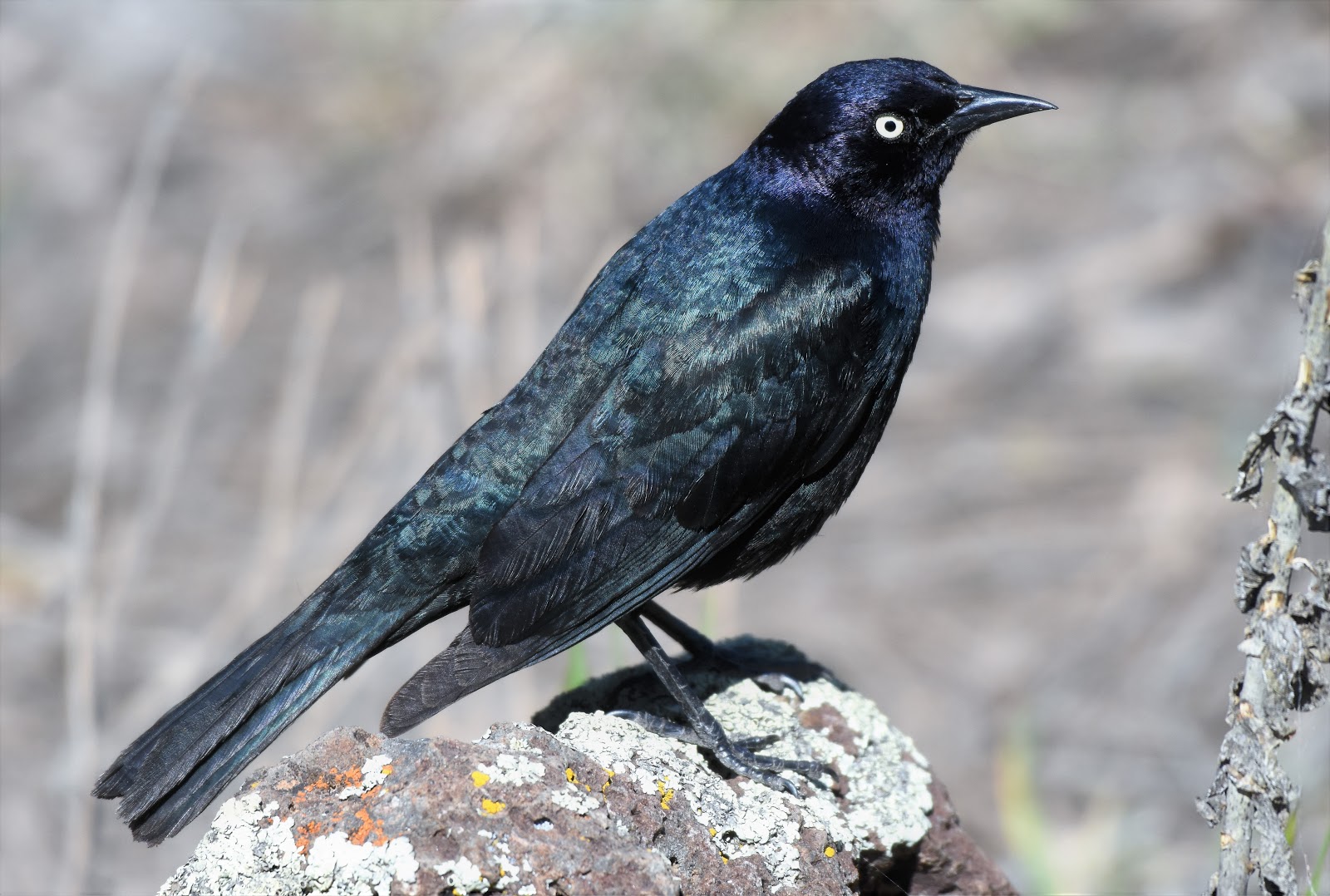
The brilliant colors of a Brewer's Blackbird in full sun
Back in the desert, little birds were beginning to leave their nests. 

Juvenile Black-tailed Gnatcatcher

It's easy to fall in love with the little fledglings as they learn how to become adult birds.  BUT, I have to be aware of the dangers around me.

Western Diamondback Rattlesnake
I nearly messed myself when I saw this rattlesnake.  I like reptiles but snakes make my skin crawl.  Why was this snake hiding?


It was eyeing up these young Round-tailed Ground Squirrels nearby.  Meanwhile, the warblers began to grab my attention.  They were EVERYWHERE!  Every bush and every tree were full of them.  Normally they are difficult to spot but not this week!

Wilson's Warbler
Then it happened.  The second state bird arrived the following day after our Common Crane spot.  It was the rare and beautiful Blackpoll Warbler. 

Blackpoll Warbler
I stood for a couple hours trying to get these pictures of this very rare migrant.  This male is heading up to Alaska to breed but for some reason, he chose Tucson's Sweetwater Wetlands for a stop.


He stayed for several days and made several birders very happy.


After observing this bird for quite awhile, I packed up my gear and felt really happy. In fact I glowed for the next several days afterwards.  It's almost impossible to get two new state birds in one weekend anymore.  So it was a very satisfying weekend:)


Life is amazing.  And it's only getting better.  Until next time.....