Showing posts with label Yellow-billed Cuckoo. Show all posts

Monday, September 23, 2019

Southeast Arizona Birding Festival 2019

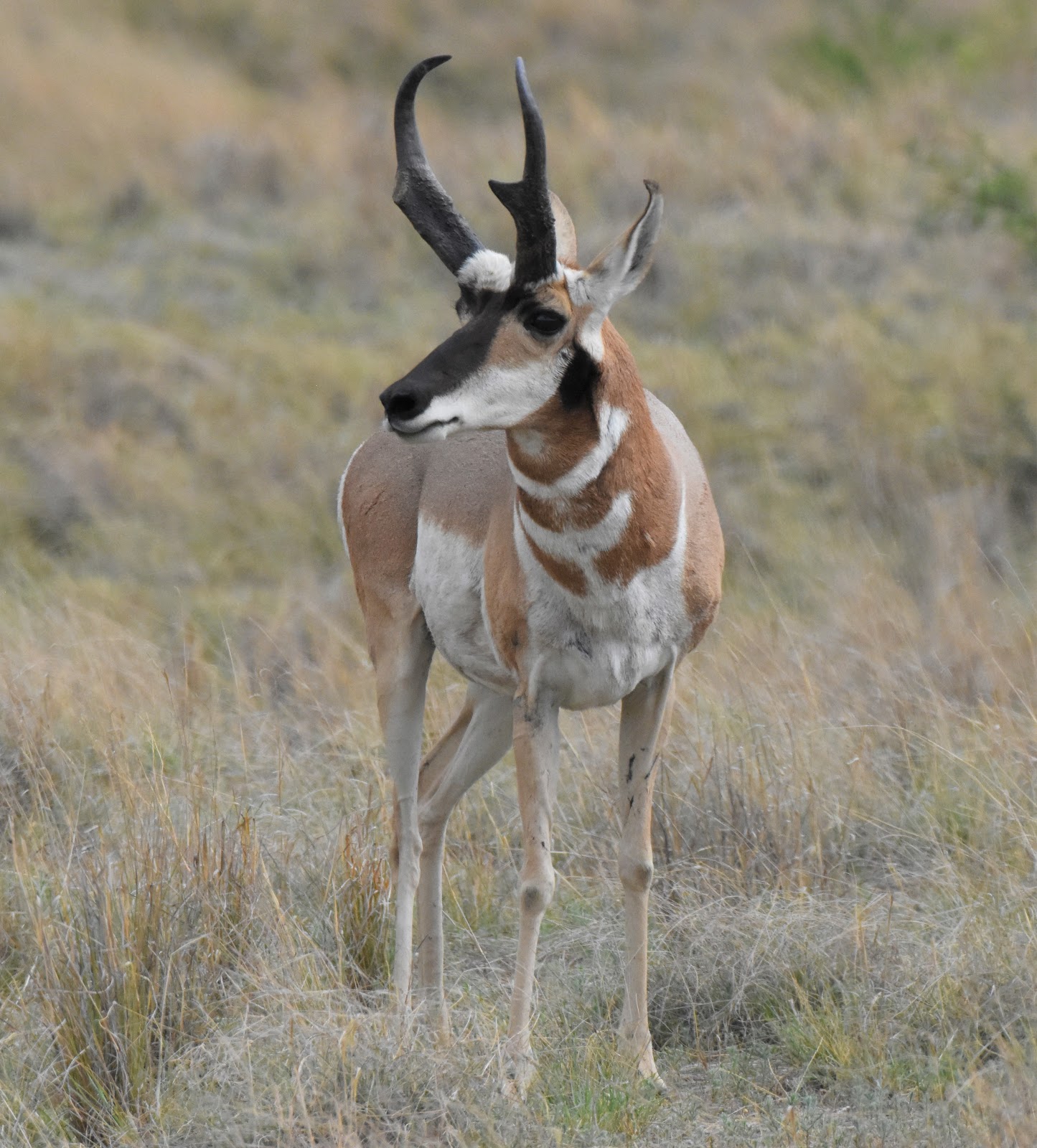
Pronghorn
This year I once again had the pleasure of guiding for Tucson Audubon during their Southeast Arizona Birding Festival.  The grassland trek out to the Empire Ranch was a success.  


Every year, I do my usual run through the grasslands and teach people about sparrows.  Sparrows are the birds I know best and it's a great time of year for birders to see many different species in the grasslands. 

We spot a very accommodating raccoon at Sweetwater Wetlands during my Wednesday morning walks
The weeks leading up to the festival were spent with Ms. Hollie, my partner in crime.  She is amazing and helps out with all the driving and prep work that goes into our outings. We offer our usual grassland outing on Saturday and then on Sunday, we do something different.  Last year, we trekked Huachuca Canyon.  This year, we took people to one of my favorite birding hotspots, the San Pedro House in Sierra Vista.  I also did some guiding on Wednesday mornings with Tucson Audubon to get myself mentally prepared for the larger group walks. 

White-nosed Coati get into hummingbird feeders like Winnie the Pooh gets into honey:)
I've gotten better about not getting stressed out with larger groups of people on these walks.  I've learned to let everyone enjoy nature and if they have questions about what they are observing, I'm there to help point out what it is that they are viewing. 

Black Vulture perched during the brutal humid and hot temps of the early Arizona afternoon

The Cienegas Grasslands were a thrill this year.  We had wicked monsoon weather developing all around us.  Lightning was on the outskirts of our adventure flashing and booming in the distance. I was a tad worried about "whether" or not we'd be rained out on our morning outing.  Thankfully, everything worked out fine.  Just as we left, the rain came down in buckets.

This was a fun crew full of younger birders.  It was really fun to have that energy mixed into our birding.
Sparrows were incredible.  This year, birders had great views of  Grasshopper, Cassin's, Botteri's, Lark, Rufous-winged and Black-throated Sparrows. I'm sure I'm missing a few others but it didn't just stop there!


Grasshopper Sparrow
We were able to find other incredible birds like a nesting Yellow-billed Cuckoo!


While I've seen these birds many many times, I always have to remember that there are many others who have not and it's my job to try and get them onto the birds. This brings me happiness and gives me a challenge. 

Yellow-billed Cuckoo carrying food
Our Sunday crew was a unique blend of birders.  We had new birders and photographers.  We also had several people who stayed back to watch feeders.  It was quite the diverse group of people and was actually a lot more challenging keeping everyone together. But I think they had a fun time. 

Our crew at the San Pedro House
As I type this post, I am scratching and itching from all the chigger bites.  This time of year is terrible for these bugs.  It's a catch 22 really.  If I wear long pants, I am miserable from the heat.  If I wear shorts, I get bit up by lots of bugs. It's a no win scenario.  Normally I would never go to these places in the summer.  But there are good birds hiding in these spaces for people who have never these feathered gems. 


Yellow-breasted Chat
I have been in love with Arizona's grasslands for many years.  It's where I find my greatest peace. It's also the group of birds I know best.  Our festival was a success and Tucson Audubon raised a lot of money to help protect Southeastern Arizona's bird habitat for future generations.  


And I'm sorry, but not sorry, for all the Pronghorn shots today.  This mammal has got to be one of my favorites.  There are several herds that are often seen along the road while we are counting birds.  Next week we meet a new friend by the name of Cheroot.  Until next time friends......

Monday, June 11, 2018

Parts Unknown

These two Cactus Wrens gave me a good laugh at sunset. 
During these past few hot Arizona days, I've been walking around nearby parks and practicing with my light settings in the dark conditions to prepare for Trinidad.  This will be my final post from Tucson for awhile. 

Our monsoon may start early this year. 
As I walk the known, I prepare mentally for the unknown.  It is part of the life journey we all take.  Sometimes we do it alone.  Sometimes we share it. This is the way of all things. 


There are nights when I lose sleep because I am both excited and anxious.  Everything has been set up and yet still, I wonder, What am I forgetting? What's out there?!

Round-tailed Ground Squirrels live the life in this terrible heat
Would I ever have gone to Trinidad in my lifetime if it weren't for the birds?  Probably not. I am forever addicted to the Spanish and Portuguese speaking cultures. But if I am to find birds on this planet, I can't limit myself to what is comfortable. I am forced into parts unknown. Trinidad is close to Venezuela and is known as the gateway to the South American birding world while still maintaining a fantastic blend of Caribbean birds. The place I will be visiting, from my research, suggests that I'll be living the island culture similar to what I experienced when I lived on the islands of  Cape Verde, West Africa.  It is different. The words for the dances are different.  Instead of Praia's(Cape Verde) Funana, it will be the Trinidadian Calypso.  Instead of the secretive martial art dances of Capoeira, they practice a similar form known as Kalinda.  


Making my favorite meal.....Cachupa on the Cape Verdean island of Santiago
My experience on Cape Verde sheds a little insight on the cultural similarities where in history, island slave trade had happened. But Trinidad was also a huge trading center for many other things like spice. Today, Trinidad is truly a blend of so many different cultures weaved into one. While the days of old are gone, we can still find history hidden in the language spoken.  In Cape Verde, it's the Portuguese based kriolu. Not quite Portuguese at all.  And not a written language!


I was more teacher than birder during this time of my life.  I did look at birds and try to take pics of them with my terrible camera at the time:)  We still used FILM!!!
My very first chapters as a teacher began training students and teachers alike in language and language design for the classroom on the islands of Santiago and then later Sal. Now I will go to Trinidad, another island with similar histories. I'm always fascinated by what makes the culture different from other places I've been. I purposely rented an apartment for one week out of the nature area to study language, food and the people. It's more than just birds.  For me, it's also about the community that surrounds the birds. While English is spoken there, the familiar words are peppered with strange and new exotic ones.  An English based creole!


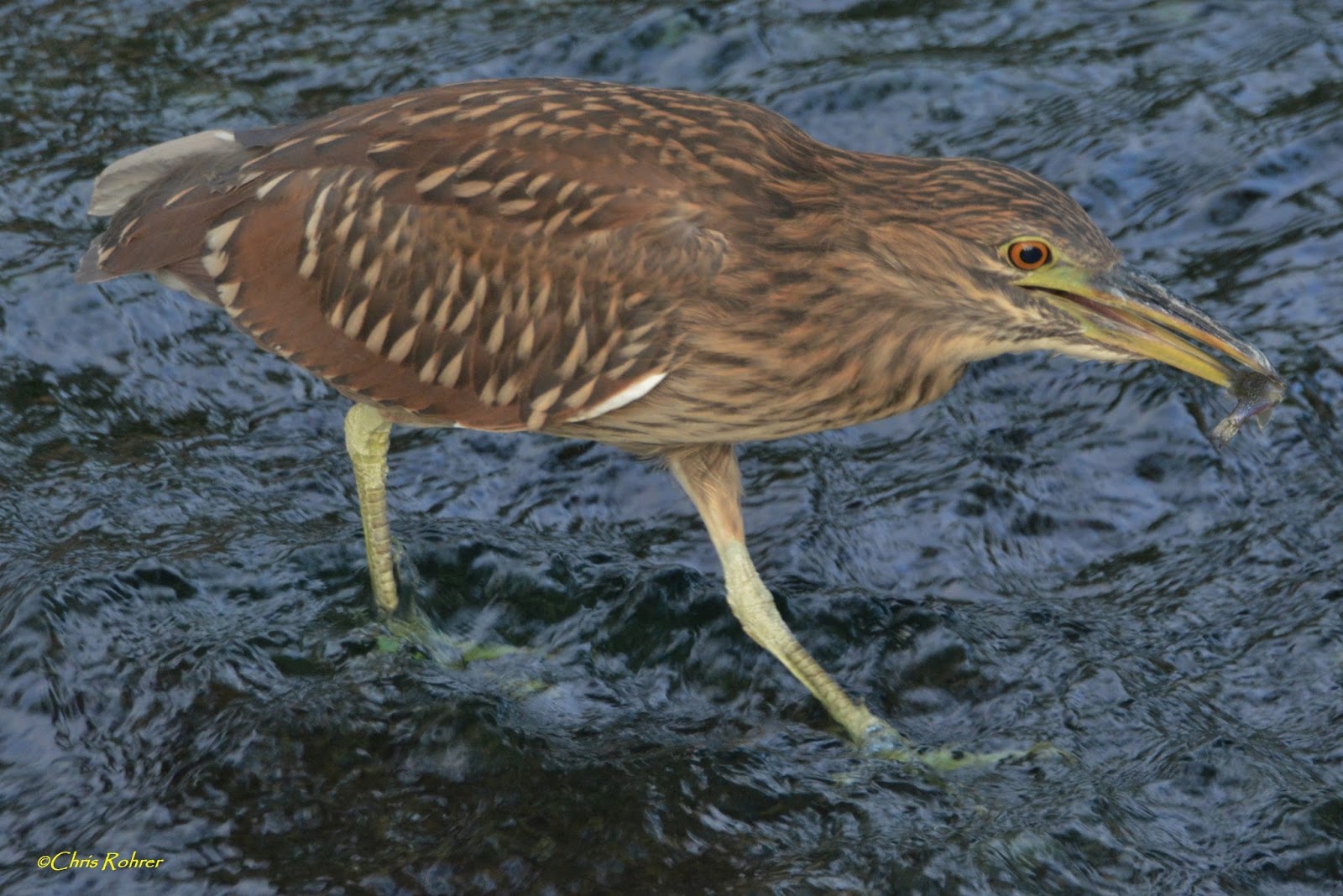
Black-crowned Night Heron
And here's the thing.  I can play it safe.  Or push myself to do better.  Be better.  This is the nature of birding.  It's a bittersweet emotion knowing that it may be the only time in this life of mine that I'll be visiting this island.  So I need to make it count. Rushing into an area to see the birds and then leave isn't fun at all.  I want the "cultural flavor" from the birding experience. 

An early and exciting Yellow-billed Cuckoo, a favorite bird of mine
I have my office space and desk.  I have my big meeting with the nature center getting all my birds set up.  It's a rather civilized approach to birding.  Meals are all prepared.  Transportation is there.  All I have to do is go outside my room and they take me away to the birding hotspots. It seriously is a great deal for birders.  Asa Wright can be a bit pricey but after the stress I had this year, I am treating myself to a birder's version of a "massage".  There's even tea time and some of this island adult flavored fruit punch:) So I'll be one week at Asa Wright and one week in Arima doing my cultural studies(and some light birding). 

I'll miss my girls.  Callie rests her head on my chest during the early morning hours.
This summer we'll be exploring island culture on Trinidad and Hawaii during the months of June and July.  I'll be meeting with people and their birds.  I have found that understanding culture is also key to the success of optimal birding.  Now, the birds are pushing me into unknown lands.

A Cassin's Kingbird at a local park
When we speak another language, whether it be bird, Spanish, Russian, Mandarin, etc, we have a deeper meaning of their behaviors and culture.  Something always gets lost in translation, but when I speak Spanish or Portuguese, it gives me a deeper insight into the culture.  But as the birds and non-latin countries go, I am forced to start all over again.  

During the day, I am bored and trapped inside my house waiting for the terrible heat to subside. Instead I clean and research for the trip. PS. Catnaps are sacred.
On my last days in Tucson, I walk the familiar parks saying good-bye to my birds and play with light settings for a cave journey I'll be making for the Oilbird colony at the Asa Wright Nature Center. At first birding is easy. Then one has to travel (and) it's still relatively easy if you go to new areas.  But the nature of birding gets trickier the longer we play the game.  The hard part is picking up the endemics(which there are several on Trinidad) 


The tables that changed my life forever.  A balmy fire fly lit night near the Pipevine Road at our stay introduces me to birders who share their excitement and discoveries with us. 
My life's journey is about understanding people, their culture and the birds surrounding it all. The picture above is an important one. I snapped the pic to remember the clarity of thought that happened in this moment during our Panama visit. 


A Snail Kite sits next to me near our bench at the Pipevine Road
7 years ago, this month, I began my serious journey into the birding world. I changed. This blog changed. The photography changed. I let most of my negative attachments go in this world. My job became my job. And the birding and human experiences became my passions.


I discover the dangers of birding and realize that I loved it. On Coiba Island
I watched two birders have a candle lit dinner at a table next to ours in that Panama Canal style home. It was that specific moment that changed the way I saw everything. After our stay in Gamboa, Panama, we went to Coiba Island and discovered manakins. And that's where the addiction began! I know that wherever I go, I will fall in love because there are birds. I am a gypsy at heart.  One who likes good mole, a smoke filled tapas bar, a nice spicy bowl of kakik, and/or a simple breakfast of gallo pinto.  Now the cuisine will change.  The languages will be difficult in both bird and human forms. And I will somehow figure it all out.  The Trinidad adventures begin next week.  This post is dedicated to the memory of Anthony Bourdain.  I recently watched his show on Trinidad to give me a little background on Trinidadian cuisine and culture. He will be missed. 

Thursday, July 21, 2016

The Toad Witch


The invasive Bullfrog
I know I know.  You're all saying, "Um, frogs?"  Well, I better clarify.  It's frogs, toads and a snake with some birds:)  I did my yearly bird survey at the Aribabi Ranch in Mexico during the first week of July. Somehow, the tiny developing Herper inside of me showed some interest:)

Anny holds her target study, the Sonoran toad.  Here is a breakdown of the frogs and toads seen here.  Left side top to bottom-Sonoran Toad, Red-spotted Toad.  Middle, top-bottom, Lowland Leopard Frog, Sinaloa Toad, Spadefoot Toad. Right, top-bottom. Bullfrog, Woodhouse's Toad

It was hot and miserable.  There were also plenty of bugs to add to the uncomfortable nature of our stay.  BUT.  I went with a group studying the Sonoran Toad(also known as the Colorado River Toad).  While they were doing their investigations, I did my own.  They were a wonderful group and made the trip down a whole lot of fun. 


The target species-the Sonoran Toad
Below is a pic of the crew during our dinner event.  The young lady at the corner of the table is Anny.  She is a graduate student who will be working with the venom of the Sonoran Toad to help develop a treatment for such things as drug addiction.  It was fun watching the crew brainstorm and put this project together as a team.  Meanwhile, I was with the herp guy, Jim Rorabaugh.  He's into everything "nature" but he really really likes lizards, toads, frogs and snakes. Over time, I've learned to appreciate them more thanks to Jim's work out in the field. 


I've seen most of the birds on this ranch so getting the bird survey done was a snap.  And I had great views of some birds that would be considered "rare" for the US.  During the nasty heat, a Summer Tanager sits down on a fence and poses. 


As he sings quite proudly, a Broad-billed Hummingbird sails past him. 


During the early morning hours, I would run my survey.  During the afternoon, I'd hide away from the nasty sun.  And during the evening, I went out with Jim and crew to look for frogs and toads!

Sinaloa Toad
In the process, Jim ID's his first ever Sinaloa Toad at the ranch!  There's nothing quite like finding a new species at a place we have surveyed for several years.  Jim has been coming to Aribabi for years and it was a first for him.  To watch him get excited was great fun.  Surprises are the best. This toad was very rare for the area. 

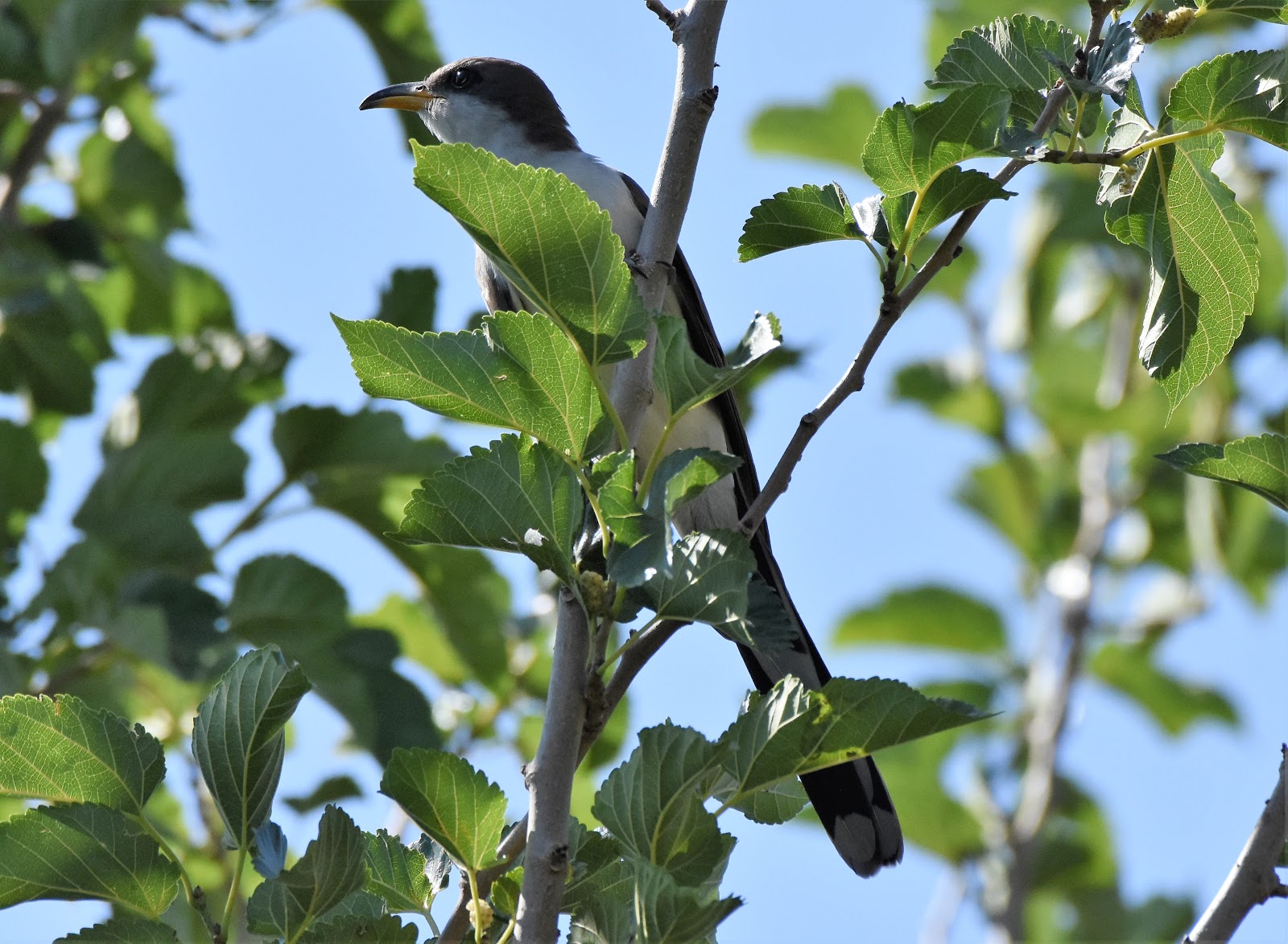
Yellow-billed Cuckoo
Also rare?  the Western sub-species of Yellow-billed Cuckoos.  I've been to the ranch over several summers and haven't had more than two pair calling from the Cocospera River.  This year, we had an amazing 3+ pairs of cuckoos!


The first night, it looked like it would storm but it didn't.  Instead, it stayed muggy and I didn't sleep at all.  The second night was better.  We did have a storm blow into the area, but we didn't get any rain from it.  However, the temps cooled way down! 

Spadefoot Toad
During that night, the crew went under barbed wire fences and into grassy areas to look for toads and frogs.  Or whatever else came our way.  People went after frogs in nasty water.  I'd flash lights and bugs would run into me.  I am definitely a birder.  This business of picking up frogs in poopy cattle ponds is not my idea of fun.  However, watching frogger people get into the whole activity was fun. Night time photography is the worst!  50 photos for one decent one.  

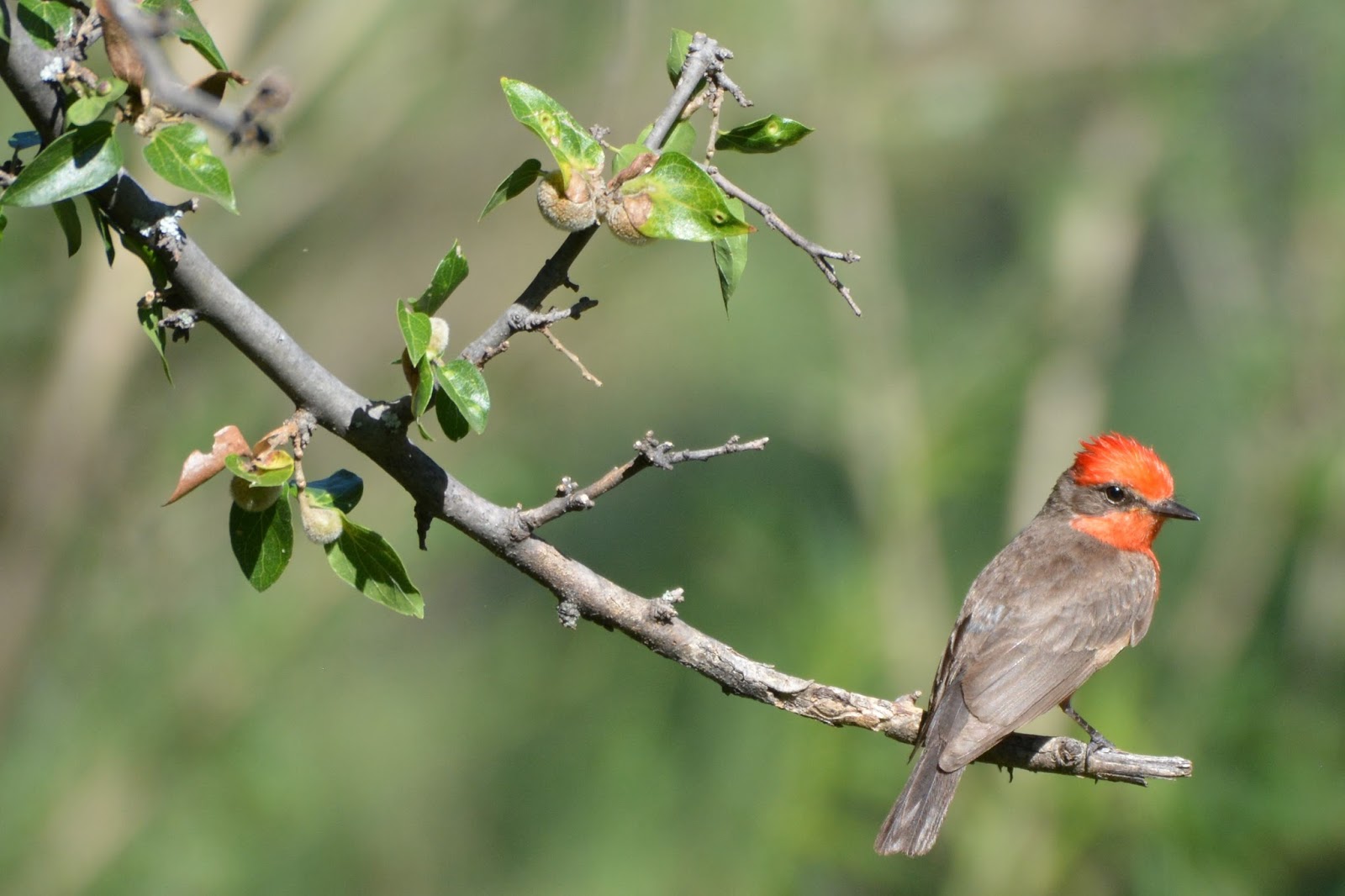
Vermilion Flycatcher
During the day time, I relaxed as I casually saw my birds. 

Sinaloa Wren
I made an effort to track down the very vocal Sinaloa Wrens.  They appear to be working on a second clutch for the summer.  The nesting sites were active. 


Here is one of those nests.  It hangs down from the tree.  The hole of the nest is underneath this basket.  Pretty cool!


There were also several other birds I needed to track.  

Woodhouse's Toad-note scary "spider" behind the toad! 
The Thick-billed Kingbirds were back again nesting. 

Thick-billed Kingbird
AND I finally heard and saw the Rose-throated Becards that are always reported from this area. This bird is significant because it is only found around healthy riparian areas.  Their populations have been said to be in decline, but thankfully on this trip, two adults and two juveniles were seen!  I was SO happy.  This is the 4th time I've seen this species in my life.  Maybe one day, I'll finally get to see one in Arizona.

Rose-throated Becard
Then it's time for a muffled scream, followed by a cooooool moment.  If I know there are snakes, I'm okay.  Had I not known about this tiny snake, I would have freaked out.  But Jim gave us a heads up. 

Sonoran Lyresnake
I stand back and try to get a decent photo of the snake for documentation purposes. I can't help feeling the heebie jeebies.  It's a way cool critter and I know it.  But I have this stupid human reaction to snakes.  I wish I could control it, but I can't.  Maybe it's the way they sneakily slink silently along the vegetation. 


Anyhow, our crew got the job done and we were ready to head back home to the cooler temps.  I wish Anny the best of luck on her grad project.  It sounds like a lot of fun.  


Life is an adventure.  Where will we go next?  Stay tuned for more......


Wednesday, August 19, 2015

Close Inspections

I found a magical fairy village in the middle of the woods!
August is a whole month of crazy.  Monsoon is in full swing and so is migration.  It's the one time of year when everything all comes together.  But the temps are brutal in the desert and surrounding areas. 


Enjoying the cool breeze of a monsoon storm in Sierra Vista along the San Pedro River

And it is during this time of year that I collect my data for migrating warblers, shorebirds and birds listed as endangered or in decline.  Did they nest?  Are there juveniles? Are there more or less of these birds coming through the area right now?  After chasing life birds in Chiapas, I just felt I needed to connect more with "my birds" and do quality study. 


The monsoon clouds build over Cochise Lake in Wilcox
While I love the grasslands, I'm not a huge fan of the chiggers and bugs.  Right around the first couple weeks of August, we hit the peak season of monsoon.  It's during this time of year we begin to see some early migrants passing through our area while also observing difficult birds, like the Cassin's Sparrow, out in the open doing their "larking display".  There isn't a certain date for this peak.  It's just something I feel out each year.  Each weekend during the month of August, I carefully pick the spots to do my studies.  In this post, we stopped at the Wilcox Lake for migrating shorebirds, Mt. Lemmon for warblers, St. David for nesting Yellow-billed Cuckoos, and my work site in Oro Valley(weekly patch study) for the nesting Purple Martins specific to our Sonoran Desert.  It has been a quality month of research and birding.  None of it is boring.  The hikes are incredible and the treks are some of the most scenic on this planet. 

Black-necked Stilts
We headed down to Wilcox and explored "Cochise Lake" first.  We picked up two Stilt Sandpipers, one Semipalmated Plover and Sandpiper.  While these birds were wonderful to spot, our best observation happened with a cranky Northern Mockingbird and Swainson's Hawk. 

A Northern Mockingbird chases a Swainson's Hawk off the post.  That takes some huevos. 
After awhile, we headed out because it looked like it was going to rain in the area.  

Black-tailed Jackalope Jackrabbit:)
I wanted to check up on our now fledged Mississippi Kites, Yellow-billed Cuckoos and Yellow-breasted Chats.  Along the way, we observed lots of great birds around the countryside. 

White-winged Dove perches on an Ocotillo
We'd stop and look and then move onto the next area. 

A male Northern Cardinal sits on top of a Saguaro.  Talk about a strange sight!
After a summer of chasing crazy new birds in Mexico, I was happy to just stand in MY world with MY birds and let them fly around me.  I know this world best.  Every habitat.  And almost every bird.  It's great.  They are my secrets.  My escape. It is very comforting to know that many made it back in one piece.

Gila Woodpeckers are LOVING the sugar water right now.  Sorry hummingbirds!
The Gila Woodpeckers fought the hummingbirds for nectar. 


Spiders hid on leaves.  And chats.....did a lot of chatting:)

Yellow-breasted Chat
I went to St. David and followed up on the Cuckoos and Kites.

A Yellow-billed Cuckoo flies over my head.  I have a special connection with this bird as it followed me around last year in the trees:)  And it was back again in the same area where we hung out for awhile watching each other.  
Thankfully, they were all there safe and sound.


Here's my friend who is still around
Currently the western variety of the Yellow-billed Cuckoo is in danger. It is listed as threatened and near the threshold of endangered. Tucson Audubon currently has surveys going on around their nesting areas in Southern Arizona.  They are collecting data about this declining species so that they can designate areas for their protection. "The loss and degradation of native riparian habitat throughout the western Yellow-billed Cuckoo's range has played a major role in the bird's decline"(source)


Back at my work site, I do a weekly survey of the birds found around the campus.  The Purple Martins were concerning for me because they are clear cutting major areas of desert next to the school and wash.  Normally, I see these birds before school is out but I hadn't seen them before summer break.  However, I was SO happy when I discovered this desert subspecies flying around the Saguaro cactus at the start of our new school year.


I don't know how they did it with all the chaos around them but they raised another wonderful family.  They had 3 young at the time but have now begun their migration.  I hope they return next year.  It's crazy how connected I have become with my local birds.


Black-crowned Night Heron
On a particularly hot day, I wanted to bird but not far from home.  So I went to my other regular patch at a nearby park to count the juvenile Black-crowned Night Herons.  The Herons have had a good year!  4 juveniles were seen on this 100+ degree evening.


The heat can be intense!  Thankfully warbler migration begins on top of Mt. Lemmon in August and this is where I'll finish my reporting.

Townsend's Warbler
It was hot in Tucson at around 113 degrees.  Mt. Lemmon was sunny with a slight breeze in the 80's.  This was a no brainer.


On this beautiful day, we had 11 of the 13 warbler species on the mountain.  The Wilson's, Townsend'ss and Hermit warblers were AMAZING!  It was a successful outing indeed!

Wilson's Warbler
Warblers are pretty cool birds.  Yes, they are difficult to see, but they are little gems that dance underneath the shadows of leaves. 

Hermit Warbler in flight
Overall, it has been a great month out and the data collected was a success.  I realize not all years will have such positive reports but this one was one of the best thanks to lots of wonderful rain.


Birding can be quite meaningful. With this collection of data, I become stronger and better at being not just a birder but a true citizen scientist.  


Over the next two weeks, we'll meet new friends on the trails.  Las Aventuras is about to begin Chapter 3 of "Americano".  Stay tuned for more friends:)