Showing posts with label Ramsey Canyon. Show all posts

Tuesday, June 5, 2018

June Birding in Southern Arizona


Watering holes, like this one, are very important for wildlife like this Arizona Gray Squirrel during the month of June
During the first weeks of June, I lose my sense of purpose.  I find projects that force me to stay birding.  Over the past week, I've learned to sleep a little more and bird when I could. 

This pic from a local Arivaca Cafe caught my attention and I got lost in the image
On one project, this was personal, I went to check up on nesting Gray Hawks at the Empire Ranch in the grasslands.  Last year, an off duty border patrol agent was target practicing during the driest month of the year (with an explosive target of all things!) and admitted to starting a major fire that swept miles across the grassland burning several structures. Thankfully no one was hurt, but it did have an affect on riparian corridor bird species. It also destroyed some historic Arizona Cottonwoods that people had come to love.  The nesting Gray and Zone-tailed Hawks were not seen in their usual spots last year. The White-tailed Kites moved location. So I did a follow up.

Wildflowers love the sun and add a lovely splash of color along pounds or founds.  They also are a source of food for hummingbirds and insects like butterflies and bees
The good news?  The Gray Hawks were back in the remaining living patches of the riparian area of the Empire Gulch.  I did not detect the Zone-tailed Hawks, but we didn't explore that sector of the grasslands due to the heat.  The sun and heat were much too strong to be outside for long. At 107 degrees, we have to be careful. It always begs the question, how does the wildlife do it?


Wildlife aficionados around the Tucson area help out Mother Nature by placing fountains and other water sources out for their critters.  In this harshest of months, the wildlife and native vegetation are put to the test.  


I would have missed this night blooming cacti flower had I not gotten up early enough.  In the morning, the flower closes up. 
We are currently suffering drought conditions around the state which stresses out the wildlife even more.  So anything we can do to help can make a difference to their survival. So my 2nd project has been my gardens. 

The Mediterranean House Gecko enjoys the warm summer nights around lights as bugs like moths are drawn to the lights
Every night, I go out to my bird feeders and water stations and refill them for the morning's flurry of activity.  There I sit watching all my wonderful critters in Midtown Tucson go crazy.  So while I can't bird long hours like in the fall, winter or spring, I can enjoy my backyard for birding. 


The sun is bright and strong.  The heat is unbearable.  Humans exist within their a/c run structures.  The curtains are drawn to reflect the sun and heat from outside.  For wildlife, they stay near the few water sources that exist.  Most cling to the shade or their burrows during the day.  At night, humans and other mammals leave their homes for a walk or an outdoor dinner event.  We here in Tucson turn into vampires at night(minus the blood sucking).  

Arizona Song Sparrow or what some call the Desert Song Sparrow

It never hurts to ask. I was bored.  There was a golf course in Tucson that had a body of water.  I walked to the visitor center and heard lots of bird song, but I turned around and got back into my car.  Then I said to myself "screw it".  I drove all the way there and for what? To turn around and drive home? Heck no. So I went to the front desk and asked to see their pond.  The owner looked at me weird and eyed my camera wearily.  In fact, I've noticed over the last several weeks that people have been hypersensitive about the camera.  One lady even told me that my camera looked like a gun.  So I have become sensitive to my public presence. I don't want to scare people (even though some would say that it's my right to carry a concealed weapon).  The thing is that it's just a big and heavy scary looking camera:)  But I think it's good that the public is noticing. 

The hidden pond of Roger Enke Golf Course

 Anyhow, the manager looked at me strangely and I smiled and told him I was doing a bird count in the area and wondered if I could check the pond.  I reassured him that I'd stay out of the way of the golfers and then he told me, "No problem." So it never hurts to ask.


Round-tailed Ground Squirrels are active in the shade
I was able to collect nesting and breeding data from the golf course and I was thankful for the opportunity.  

Neotropic Cormorants are found around our local watering holes in Tucson
Then it was back to Reid Park for my weekly bird check.  I try to monitor the park once a week for a count.  It's close to home.  


While we both are researching, our cats love to "help out". Typing can be a real challenge.  And if I'm not watching carefully, they'll do some typing for me!


Band-tailed Pigeon!  This year has been a good year for them!
The Elegant Trogon survey, with Tucson Audubon, is happening right now.  Jennie MacFarland is leading the efforts to help keep tabs on our trogons in Southern Arizona.  She asked if I would be interested and I said yes:)

The lovely sanctuary known as Ramsey Canyon
The mornings are still nice in some areas like around the foothills of our mountains.  They didn't have anyone to survey Ramsey Canyon so I jumped at the chance.  For the first time, I was able to bird Ramsey Canyon alone without all the walking and talking people.  


Common Ground-Dove

It was pretty magical and it was the largest count I've ever had in that area without all the people around.  So it goes to show that human activity does have an affect on wildlife.  Also it helped birding early.  Here in Southern Arizona, bird numbers and activity are highest between the hours of 4 AM until 8 AM.  Yeah.  It's early. Miss that window and you'll have to wait until 5 PM for everything to sort of pick up again.  

The interior sub-species of White-breasted Nuthatch
Creating these projects, whether they be with organizations or personal, are important contributions for your communities and your own bird data.  It's fun and forces one to get out and keep birding in the worst of conditions:)

Western Wood-Pewee

Go early.  Freeze water bottles the night before to stay cool. Or if you have a water cooler, pack it with ice.  It will melt:) Stay shaded as often as you can.  Wear sun protections like a hat or sunscreen.  A lot of birds are on nests right now and it's pretty exciting to see.  

The Red-shafted Northern Flicker

For Arizona birders, June is often the month to travel to other worlds.  I'll be flying out soon.  But for now, it's house chores and travel prep.  


For my surveys, click on the "here". 
For the Gray Hawks at Las Cienegas, click here.
For the Trogon Survey at Ramsey Canyon, click here.
For my weekly patch count at Reid Park, click here.
Until next time....


Bullock's Oriole

Tuesday, February 13, 2018

For The Journeys Ahead

Northern Harrier
Sometimes we wait in a holding pattern.  But it's the anticipation of the next big adventure that excites the imagination. 

The Knob Hill Fire burns in the Dragoon Mountains
In the meantime, I scout areas and collect data for several birders who will be coming to Southern Arizona for their own adventures.  They too are excited about finding new birds to add to their life lists. It's a job I take seriously.  

Sandhill Crane comes in for a landing. 
The winter months are the only times we are able to observe certain birds.  Every year, I head down to Willcox and Cochise Lake to be among the Sandhill Cranes.  Everyone says to go to the Whitewater Draw.  I love it there too, but it's not the same as Willcox.  If you are a photographer, you head to Willcox.  The birds fly right over your head and land just a few feet away.  It's pretty spiritual. 


Our wildfire season is early this year.  Fire started this weekend on private property and spread over 2 thousand acres on the Dragoon Mountains. While observing the cranes, we watched the fire spread over a section of the mountain.  


Another fun challenge was finding ONE Eurasian Wigeon in the near thousand population of American Wigeons. 

American Wigeons
Can you find the bird?:)

A Eurasian Wigeon
I have written this before and I'll write it again.  I wish I could bird in this weather all the time. It was comfortable.  


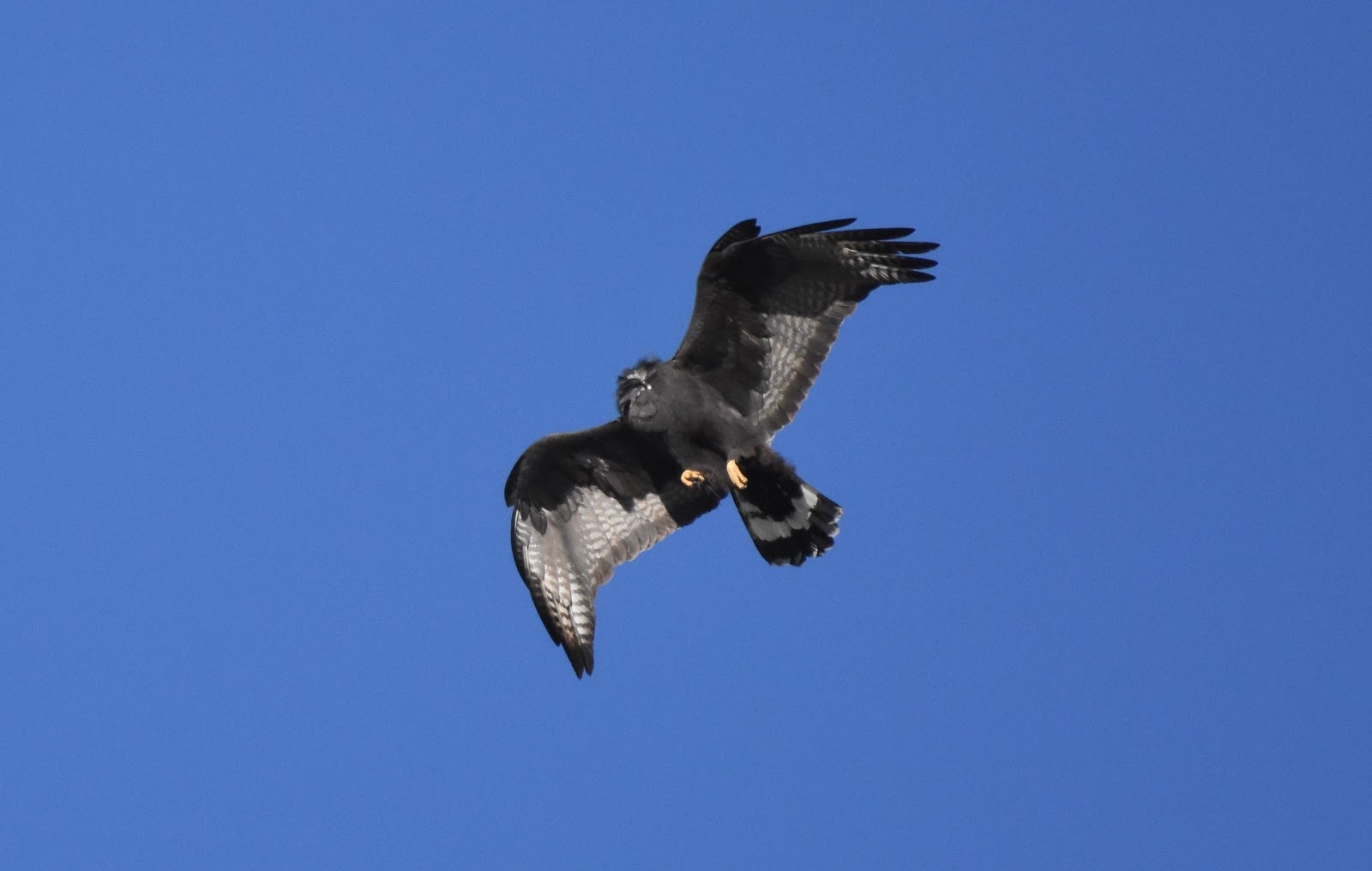
On my weekly observation at Reid Park in Tucson, I watched our beautiful wintering Zone-tailed Hawk take flight and stay in the air for nearly 2 hours!  Often it flew right over my head looking for prey. Other times it looked like it just wanted to fly for enjoyment. 

Zone-tailed Hawk
During one moment, I thought the bird had lost its head. 


However, the hawk was just preening.  This is the second observation that I've seen of this species preening in flight. This bird is an acrobat!


On another outing during the week day, I just wanted to bird in a different location.  So I went to Agua Caliente Park for an evening count. 

Agua Caliente Park
I hadn't researched this location.  I just wanted to bird.  Birding keeps my skills sharp for the people who rely on me to find their birds.  Maybe you've noticed this about yourself with certain species of birds?  I tend to glance over some species while with others, I look at more closely.  Such is the case with sparrows. My gaze lingers a little longer with these bubbly happy-go-lucky birds. 

a beautiful Swamp Sparrow
I enjoy sparrows.  I don't know why. Most people don't get into these birds but I could spend hours watching them hop around bushes.  During that evening, there were a couple Lincoln's Sparrows in the area and I was enjoying their fine plumage design when I noticed this Swamp Sparrow(above and below) next to them!  Wow!  It's a rare bird for Pima County in the winter, but it was a most welcome sight!


We went on other adventures, mostly for the walk.  I just needed to bird pretty spaces after those past couple weekends of gross agricultural habitat.  It was really really nice. 

We take a lovely stroll in Ramsey Canyon of the Huachuca Mountains
While up on Mt. Lemmon, I met two people who signed up for our trip with Tucson Audubon to the Huachucas in August.  I had a blast getting to know them and we had a great time finding birds. It was fun hearing their excitement as I got them on great birds. My reports are below. 

Northern Flicker
This year's theme is all about family and friends in other places.  I am working on one trip now and looking forward to the challenges ahead.  While I wait, I will continue to count birds around the state.  I try to balance it all out. People in my life will sometimes say, "I wish I could travel like you do."  A lot of them could, but often it seems like it's outside of their personal comfort zones. I've just made it a personal mandate.  I've earned it.  There's no looking back.  Only forward.  You only get one life.  Own it and find happiness.  Until next time.....

For Agua Caliente Park, click here
For Willcox Lake, click here
For Mt. Lemmon, click here
For Reid Park, click here

Sunday, January 24, 2016

White Winter Hymnal


The brisk cold winds of change came soon after my return to Arizona. One week after the warm border searches, it was time for some mountain fun. Winter had indeed arrived to Southern Arizona. 

the snowy Huachucas
With state birds in mind, I joined a walk I had been wanting to do for awhile in Sierra Vista. Last week it was the Streak-backed Oriole and today, I was hoping to find the secretive American Bittern at the Sierra Vista EOP(or Environmental Operations Park) It's a secured area with group lead access only on Sunday mornings. With the recent snowfall during the weekend, I couldn't resist the photography bit in both the Huachuca mountains and Cienagas Grasslands.  And this is where our story takes place today.

A Loggerhead Shrike at work.  It's Vole dinner
On our way through the gates, a participant in the group noticed a vole speared onto a branch.  It was evidence that the "Butcherbird" (aka Loggerhead Shrike) was nearby.  While the group examined the fresh kill, we tried locating the bird. No luck!  But as we left, we noticed that the vole was gone:)  

Loggerhead Shrike
Afterwards, I took a solitary walk on the snowy paths of Ramsey Canyon.  There, melting snow fell upon my head.  I was a tad wet when I left this winter wonderland.  BUT WOW!

My favorite tree in all of Arizona.  It's old and ancient.  Someday I'd like my ashes to be placed around this very large tree. I call it the Heart Tree.  It's at the center of Ramsey Canyon, one of my top ten favorite places in Arizona.
During my walk, I was surprised by how quiet the birds were.  I can only imagine how dangerous it might be as a small bird dodging the huge snow chunks falling from the trees. It was dangerous for people! I suppose it would be the equivalent to an aerial avalanche.  I made note and realized that most birds flew just below the snowline where they were active and feeding.


In the soft crunch of snow beneath my shoes, I watched a Coati run towards me on our now shared route.  We both stopped for a moment and watched each other before he turned off and headed towards the nearby abandoned cabin.


I very much like the cold.  I don't like the eternal gray skies that can sometimes come with the snow, but I do prefer the frosty temps over the hot sweltering ones of our summer months.


One path leads to another.  I stopped in the nearby grasslands and hiked some more.  Birds were present, but I was more interested in quiet reflection.  Things are changing.  I can sense it coming and I need to be ready for those changes.

Lesser Goldfinches mob the thistle feeder
"They" say change is good and inevitable. Sometimes it's about saying good-bye to the ritual and people involved around these loving spaces dedicated to birds and wildlife.  I sat at the now named Tucson Audubon's Paton Center for Hummingbirds alone.  Thankfully Tucson Audubon was able to purchase this home for current and future generations of birders.  It's a great spot for all kinds of birds and a traditional stop for many birders and tourists coming through the Patagonia area.  It's a piece of feathered folklore written in a sacred text for those who worship the bird.

The Violet-crowned Hummingbird-an established resident of Tucson Audubon's Paton's Center for Hummingbirds
Before Tucson took over, a guy by the name of Larry Morgan kept the feeders running for years after the homeowners, the Paton's, passed away.  You'd see him outside with his smiling face helping people spot their lifer Violet-crowned Hummingbird.  When Larry and his wife said they were leaving to begin a new chapter in their lives, I was both happy and sad. It wasn't quite the same without him there on this last visit.  It just proves once again how we all can make a difference for so many people. And how Larry has made a huge impact for thousands of birders across the world.  How can I write down this feeling in my Cheesehead lingo?  It's like having coffee cake with your friends on Saturday morning for many years and then.....no more Saturday morning get togethers.  You eat the coffee cake alone.  And it doesn't taste as good.  Anyhow, I'm going to miss Larry and my Patagonia routine.  He's one of the nicest people you'll ever meet! He's in Tucson now so hopefully we'll get to do some birding together now that he's closer:)


My reflections continued into the Ciénagas Grasslands near Empire Gulch where I walked alone against the biting wind. I strayed into the old abandoned buildings looking for owls and other goodies.  This is another top 10 favorite spot for me in Arizona.  There are 3 grassland sectors in this general region.....the San Rafael Grasslands, the Ciénagas Grasslands and Buenos Aires Grasslands.  ALL are spectacular!


The overall weekend was a lot of fun and full of quality alone time.  Every person has their favorite place to bird(or just visit!) While all birds are amazing, their locales are sometimes not:)  This weekend was about connecting with the places I love the most.


And as for my new state bird?  Yes, I achieved my goal.  I found that rare stinker of an American Bittern that has been hiding out for several months in Sierra Vista. The bird would have silently flown off had I not heard the rustle of reeds nearby. I was able to get everyone onto the bird before it disappeared into the far distance. I'd like to thank our group leader Bill Brown for the opportunity to bird this spot in depth.  He did an outstanding job with everyone involved. And it's always a plus working with people who are kind and friendly. Bill is as we say in Wisconsin "good people". Leading a bird tour isn't is as easy as it looks as I'd soon get to experience personally.  But that story is for next time. 

American Bittern in flight during our Sierra Vista EOP walk 
On a final note, one of the things I do with new birds is study them in various locations around the country.  The picture above is from the actual bird we saw.  It is countable. The one I studied in Utah, below, is not as it was in a large aviary.  I do hours of study on each new bird before trying to find them in the field.  And this is where I think aviaries are important as they can be a living classroom for birders and people interested in wildlife. I can read about birds and memorize their sounds, but understanding their movement and behaviors in a closed setting helps me "observe" better out in the field. 

American Bittern
From volunteer to participant to bird guide, my January continues in a most spectacular way. My quest within the state of Arizona for new state birds takes me north into unexplored territory. Stay tuned for more.....