Showing posts with label Blackpoll Warbler. Show all posts

Monday, June 24, 2019

"Maine-iac Birders"


I had arrived at the tail end of migration yet again. The minute I saw Blackpoll Warblers, I knew the game was over. My quest for Bay-breasted and Cape May Warblers would have to wait for another day. 

How does one say gaudy in Maine-ish?
But that didn't stop our grand adventures.  Birding around Maine is as scenic as it gets in the US.  However, the bugs were relentless.  Black flies, mosquitoes and ticks were in full force.  And I thought Wisconsin was bad.  Maine, besides maybe Florida, beats most of the states for crazy bug attacks. Although, I've heard Alaska is a nightmare in summer. They say bird along the coast, but honestly, the coast was just as bad. 


Broad-winged Hawk
Between the odd and fantastical, we discovered many incredible birds together. I loved seeing several bird species better.  Several were on my list of "must see again". 


As Kathie and I both explored beautiful spaces near her home, we observed many birds singing and moving about branches. 

Blackpoll Warblers are one of the last warblers to migrate
Many birds were setting up territories. 

Bobolink males call and set up their territories
And between the constant attack of the blackfly, I was able to get off a couple shots here and there.  It's no wonder why warblers love Maine.  There's plenty of food for them there:)


Then an amazing thing happened!  I was able to get wonderful observations of a bird I had only seen briefly ONCE, the Scarlet Tanager. 


When they are breeding, they are super difficult to observe.  Luckily we hit a fantastic observation window where they were still moving and calling out in the open.  I not only got to see this bird once but MANY times.  We even rescued an injured one!


Purple Finches are wonderfully colored and were in good numbers everywhere we went. 

A finch dipped in raspberry jam, the Purple Finch
Vireos made me cringe.  They all sound similar.  My job was to find a Philadelphia Vireo and separate it from the Red-eyed and Warbling Vireos in the area. 

A pair of Red-eyed Vireos
Some birds are super tricky.  I had some work ahead of me.  Every day we went out and counted birds. 


Even though the migration was coming to an end, there were still a lot of great warblers out there. 


Chestnut-sided Warbler
A Veery popped out into the open. 

Veery
The exciting shrill, "Free Beer!", of the Alder Flycatcher made us smile. 

Alder Flycatcher
The picturesque Cedar Waxwings posed often in budding Apple Trees. 


Cedar Waxwings
Baltimore Orioles collected cattail fuzz for their nests. 

female Baltimore Oriole
Gray Catbirds appeared from behind our backs always watching us from the shadows. 

Gray Catbird
Black-throated Blue Warblers were loudly calling inside the forests. 

Black-throated Blue Warbler
And this Ruby-throated Hummingbird fiercely protected his feeder from other hummingbirds. 

Ruby-throated Hummingbird
The electronic warble of the Bobolink was a common sound among the wildflower tinged grasses.


In short.  It was nice revisiting several bird species that I don't get to see often in Arizona.  Once we finished our first sweep of the common birds, we began our journey for the harder ones.  And those stories will be told over the next several weeks. So until next time, use some bug spray:)  This wet and cold summer of the North has arrived. 

Wednesday, May 10, 2017

Seek And You Shall Find


Brian searches for the distant Common Crane
Talk about a spontaneous and fun weekend!!  A Common Crane (rare to the US) was spotted at Mormon Lake near Flagstaff, AZ.  Every birder,both in and out of the state, came to view this rare Eurasian migrant.  A scope was needed to spot this bird.

A little help with a scope.
Now, I've seen this bird twice.  Once in Europe and the other time in Roswell, New Mexico.  But I needed it for a state bird.  Anytime a new bird arrives into Arizona (and I don't have it on my state list), I go chase it.
.

Common Crane
It's a pretty amazing crane as far as cranes go.  Once we spotted the bird, we had to make a decision.  Bird Flagstaff or bird Oak Creek Canyon. 

West Fork Campground at Oak Creek Canyon/Haddie, the dog, takes Magill for a walk
We made a great decision and decided to explore the incredibly beautiful Oak Creek Canyon near Sedona.  This place was FULL of our Western Warblers!


Red-winged Blackbird
Along the way we counted birds in the often chilly and shaded canyon.


In fact, this week has been an amazing one in that the weather has been COLD!  We had rain and overcast skies allowing us to enjoy our birding treks.  It has been unbearably hot this spring with one May day reaching 106 degrees!  Way too early for those temps. 

Jon heads near an area searching for rarities

During the week, I noticed something happening everywhere.  Warbler fallout.  It was a visible sign that a storm was soon arriving to our state. And it was moving from the Gulf of Mexico!  So we kept our eyes out for eastern rarities and migrants......

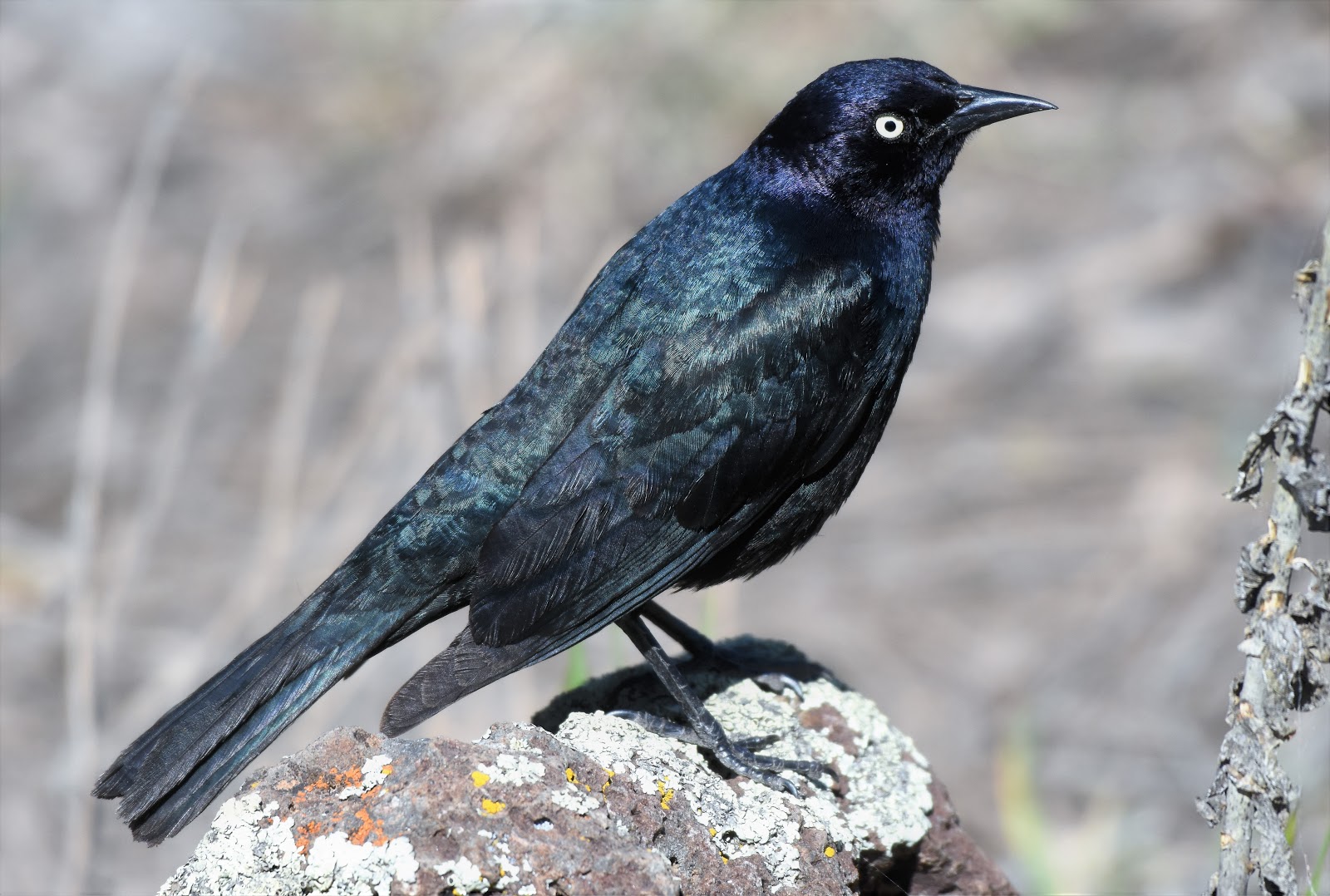
The brilliant colors of a Brewer's Blackbird in full sun
Back in the desert, little birds were beginning to leave their nests. 

Juvenile Black-tailed Gnatcatcher

It's easy to fall in love with the little fledglings as they learn how to become adult birds.  BUT, I have to be aware of the dangers around me.

Western Diamondback Rattlesnake
I nearly messed myself when I saw this rattlesnake.  I like reptiles but snakes make my skin crawl.  Why was this snake hiding?


It was eyeing up these young Round-tailed Ground Squirrels nearby.  Meanwhile, the warblers began to grab my attention.  They were EVERYWHERE!  Every bush and every tree were full of them.  Normally they are difficult to spot but not this week!

Wilson's Warbler
Then it happened.  The second state bird arrived the following day after our Common Crane spot.  It was the rare and beautiful Blackpoll Warbler. 

Blackpoll Warbler
I stood for a couple hours trying to get these pictures of this very rare migrant.  This male is heading up to Alaska to breed but for some reason, he chose Tucson's Sweetwater Wetlands for a stop.


He stayed for several days and made several birders very happy.


After observing this bird for quite awhile, I packed up my gear and felt really happy. In fact I glowed for the next several days afterwards.  It's almost impossible to get two new state birds in one weekend anymore.  So it was a very satisfying weekend:)


Life is amazing.  And it's only getting better.  Until next time.....


Sunday, July 20, 2014

A Birder's Bird


A quick note on this post today. If you're eating breakfast, lunch, etc, wait until after your done.  There's a fascinating nature pic in this  post, but I personally wouldn't want to be eating and reading at the same time on this photo journey. You've been warned:) So let's begin this birding adventure......


Beth explores the Alpine Garden
The day began well.  We met up with the lovely Beth Standard to find a bird that not only is hard to ID but also difficult to locate inside the dense evergreen forest.  The Bicknell's Thrush.  


Dark-eyed Junco
The night before, I researched field notes and sightings around the Mt. Washington area. Beth had gone on a field study of the birds some time back.  Together, we all hoped to locate this bird. 


Pic courtesy of Wikipedia
The Bicknell's Thrush is not by any means a dazzling bird.  There are no reds or blues or long tailed feathers. It's also a cryptic species in that it looks practically identical to another thrush known as the Gray-cheeked Thrush. However, the Bicknell's is smaller in size. And because it's practically unknown to the general public, it is known as the "Birder's Bird".  Or a bird that is of interest to birders.


Luckily, the Gray-cheeked Thrush was far north up into Canada and Alaska on their breeding grounds. The Bicknell's, however, breed in the highest mountains of the Northeast like Maine, New Hampshire, Vermont and a place called Canada.  It's range is very limited and therefore the bird is listed as Vulnerable.  During the winter months, it lives in the higher altitudes of Cuba, Haiti and the Dominican Republic. 


A windy top!

But this experience, for me, was frustrating for so many reasons. This isn't a place I'd recommend for birders.  As the Mt. Washington Auto Road suggests, it's for people who like to drive to the top and back down again. The noise pollution interfered with my ability to listen to the very tricky call of the Bicknell's. Because this was a one time event, we had to locate the bird early and before other motorists arrived.  


Blackpoll Warbler....Life bird!!!  Field note: Orange legs and feet
We arrived to the entrance station where a very brassy guy moved to put Kathie's car into first gear.  She knew exactly where first gear was located and didn't need a man doing it for her!  The nerve! Oh but that was just the start. The sticker price for this trip was EXPENSIVE!!!   With 4 individuals, it was around 50 bucks.  In my mind, I'm thinking that this was ridiculous. For one bird!  Yet there were several of these special thrushes located around the 3.5 mile marker and we needed to get to that spot before they stopped calling.  There is a window for these birds....early morning or before sunset.  If we missed it, we would have dipped. 


Dark-eyed Junco around the alpine level
The other option is to hike the steep mountain sides super early in the morning, but our team was not up for that one.  


Along the way, we heard so many wonderful birds calling but we couldn't stop.  The 3.5 marker first.  Then bird.  Target birding is tricky business and can be frustrating at times. Also frustrating? Motor vehicles and very few pull offs in the wrong spots! If we tried to stop, there would be a car or motorcycle right behind us.  The forest was beautiful and the vista was incredible.  We eventually reached the marker and pulled over.  Immediately we were able to hear the thrushes calling.  It was around 8 AM.  But the question was, "Was it a Swainson's or Bicknell's calling?"  I had Veery and Hermit Thrushes nailed at this point.  We were too high for the Wood Thrush so I could eliminate that call.  


One of the most fascinating finds of the day.  It's gross and cool at the same time.  This one goes out to my friend Donna who has taught me to investigate everything with a careful eye.  The colorful beetles are known as Sexton beetles.  It's a Carrion or Burying beetle and I'll leave it at that.  
But the other two?  Eventually after their repetitive calling, we could hear the frequency difference. Plus the Swainson's has a call that goes up.  BUT THE CARS AND PEOPLE!!!  Random people would stop and say, "Seeing anything good?"  My anger and frustration began to rise.  Kathie, who is all things patient and good, took over and spoke with the drivers and their running cars.  This bird was an expensive gamble and I wanted to make sure we were hearing it.  


Eastern Phoebe
Once we positively ID'd the birds, we tried to locate them in the thick of the trees.  Beth, Micheal, and Kathie all were able to get their eyes on one or two. But I wasn't going to call the bird if I didn't get a glance at it.  I became quiet.  Kathie and Micheal know me best and they could feel that I wasn't doing well. I, of course, created this stupid drama inside my head. I can call an owl or nightjar by sound and count it, why couldn't I do this with the Bicknell's Thrush? Probably because there were two flitting around the Spruce and Balsam Fir trees! Oh I saw them flitting but I wanted detailed observations!  But the cars wouldn't stop! Not much makes me react, but the trip up this cheesy road with a stupid bumper sticker that said "This car climbed Mt. Washington" made my blood boil.  Really? Just how much effort does it take for a person to put their foot on a gas pedal all the way to the top? Absolutely stupid. Nothing says tacky like this sticker does.
  
I'd like to stick this somewhere
Further down the road, we stopped and hiked a side trail. It was here my moment with the Bicknell's would happen. I was still skeptical of the near lookalike known as Swainson. But I breathed a deep sigh of relief when I heard the bird call and saw the bird briefly fly mid-level on a tree.  It was like, "I'm here!  Don't stress!" And then it flew away back into the trees.  


Two thrushes.  Behavior, habitat and altitude can dictate everything.  The Bicknell's Thrush is located in the lower right hand corner and prefers mid to lower levels of the tree near the ground.  In the upper left?  A Swainson's Thrush.  It is a thrush that feeds higher up in the trees.  It also behaves similar to a flycatcher at times and that behavior alone separates itself from other thrushes. 
All of this drama for one bird. It really is a beautiful mountain with some epic landscape, but I will never go on this road again.  If someone wants to go hiking, I'm up for it.  The motorists and talkative, fast paced hikers along the trails really make the birding tough.  By the time you get your eye on a bird, somebody is rumbling by and there goes the bird.  For the hikers reading this post, this is an absolute MUST!  YES!  Great accommodations for you! New England was epic, but I can say that I will NEVER return to the Auto Road of Mt. Washington.  Everything else that followed was fun and exciting.  The Bicknell's Thrush definitely lives up to its' title.....A Birder's Bird.  


Hikers stop here for a steep climb up at Pinkham Notch Visitor Center.  Really nice place with showers, etc for the hiking crowd.  This is at the base of Mt. Washington.....a very different experience than the Auto Road. 
For an interesting video on the Bicknell's Thrush, click here. Like everything, the Bicknell's Thrush was an experience that won't be forgotten anytime soon.  I blog from the heart because that's what it's all about.  I know there will be more challenges ahead.  I can say that what came before and followed the Bicknell's experience was truly wonderful.  Stay tuned for more from our New England adventures.....