Thursday, December 8, 2011

The Grand Canyon

 Thirty years ago, I went to visit this natural wonder of the world.  I was a child and the entrance to the park was only 7 dollars.  Today a car entering the park is 25 dollars and worth every cent.  The drive from Tucson was long and interesting.  Eventually we reached our destination of the culturally enlighted sky island of Flagstaff.  I hadn't been to Flagstaff in awhile so it was refreshing to make a return to the much cooler temps of the world.   It was here that we set up camp for an early Saturday morning departure to the Southern Rim of the Grand Canyon.  And when we did, it was like leaving Arizona altogether and entering the international community.  There were all kinds of people from different countries like Japan, Germany, Alabama, Spain, and Portugal.....and that's just the short list!!!
It was stepping back in time.  It was walking the same place that my grandparents walked when they were alive.  It was going back to 1975 when Smoky the Bear and Fred Flintstone ruled the airwaves of our grainy TV sets.  In fact, there were those OLD signs from our past and they made me smile in a nostalgic kind of way:)  That was until we got to the entrance of the ranger station and had to pay 25 dollars.....then the reverie ended:)  Internet and radio waves were taken over by a more international style type radio station.  It was fun to listen to the all the things our state had to offer but after non stop advertising, I eventually put in the classic music.
The Grand Canyon is our state's symbol.  It's what identifies us from the rest of the country and what makes Arizonans well.....Arizonans.  I think this place and the Saguaro cactus are two of our geographical and natural landmarks the separate us from the rest of the world.  The rest of the world of course happened to be visiting the park the same day we did and it was interesting to see the mobs of crazy Turks and the quiet  pairs of French people:) Not only was it nature day; it was a day to people watch which happens to be one of my favorite things to do!  By the afternoon it got packed.  Me and the better half, Pat, separated ourselves from the crowd.  Sometimes it was a bit too much and we were there for some fun hiking.
So with our cameras, we took lots of shots around the rim of the Canyon.  Everywhere we turned there was a shot just waiting to be discovered.  This picture was taken while a family of 4 was hiking behind us.  The soccer lady mom was ridiculous and her husband was patient.  We listened because the drama was so ridiculous.  These people brought their dog with them but the lady was freaking out because she wanted to take the dog off the leash(which is a no no), but the dog would jump off the cliff and she couldn't stand the thought of that terrible tragedy.  So she wanted her husband to walk the dog back, but he kept saying, "Let's keep the puppy on the leash."  But the crazy lady would have nothing to do with it.  So she obsessed about it and began yelling at her husband.  She stormed off and her husband called after her asking her to wait and come up with a plan.  But being impulsive, like she was, she grabbed the leash and left her husband and two kids behind without discussing anything.  We were irritated by all of this stupidity and tried to escape on the path from these idiots, but the woman would keep walking past us and bringing her drama with her.  At one point, she was near the cliff......:)
So we continued having fun along the miles of trails and snapped lots and lots of pictures.  The above pic shows an area highly populated by tourists.  The best time for a quiet walk is at night when the magic really happens. Elk come out.  Birds fly around you for berries.  People are tired and exhausted and too lazy to walk.  Photographers are trying to get those sunset shots....and there is this serenity!!  It does get warm and the sun is intense so bring a hat and some sunblock.
For the real hikers looking for an Inkan trail experience, get your passes early to hike on down into the canyon.  People were coming up that steep trail exhausted after this famous several day hike.  It's something I would love to do in the future.
Artsy fartsy.  I was a little leary of the shot below as these were my only means of seeing on this trip.  Yes, these glasses are on the edge and the wind could have easily picked them up and flung them over the side of the cliff.....but I will concede, it is a great shot.  Families looking to unload a spouse or several children off the rim should be warned that it is illegal to do so as it is one of the parks rules. I guess they just don't want you to pollute the natural environment.  I'd personally argue that it would help the Condor population increase....but I'm just a Spanish guy.
I can't do a post without some background info. If you want to cut costs, bring food in a cooler.  The cafeteria is expensive. Parking is plentiful, but during summer months, get there early as the park will be packed. Make sure you have some good hiking shoes.  There are really 3 parts to the canyon...well 4.  If you were to do the whole thing, it would take you weeks.  Most people visit the South Rim.  The North Rim is far!! and an extra 215 miles away.  If you want to do the North Rim, plan an extra day.  There is, of course, the hike into the canyon.  Make sure you bring plenty of water and have a guide.  Passes are given out by the park system.  No matter where you go, bring water with you because it's only located in a few places here and there along the rim.
The hike can be rated anywhere from easy, moderate, or to difficult.  It just depends on what you want. You can also do the traditional mule ride down into the canyon.  These are offered daily.  There is a "free" shuttle service that will take you to the various hotspots around the park.
I'd like to recommend practicing using your camera before going to the park.  I almost lost out on several shots because I didn't play with my new camera before we left. However, I brought my old camera and it came in hand when the most amazing Moon Over the Grand Canyon happened.  But the shots could have been better because I had a camera that could take those shots.  Work on the night option and consider bringing your tripod.
We saw something going on down the trail and we all had a good look at the exhausted hikers limping up the trail from the deep canyon floor.
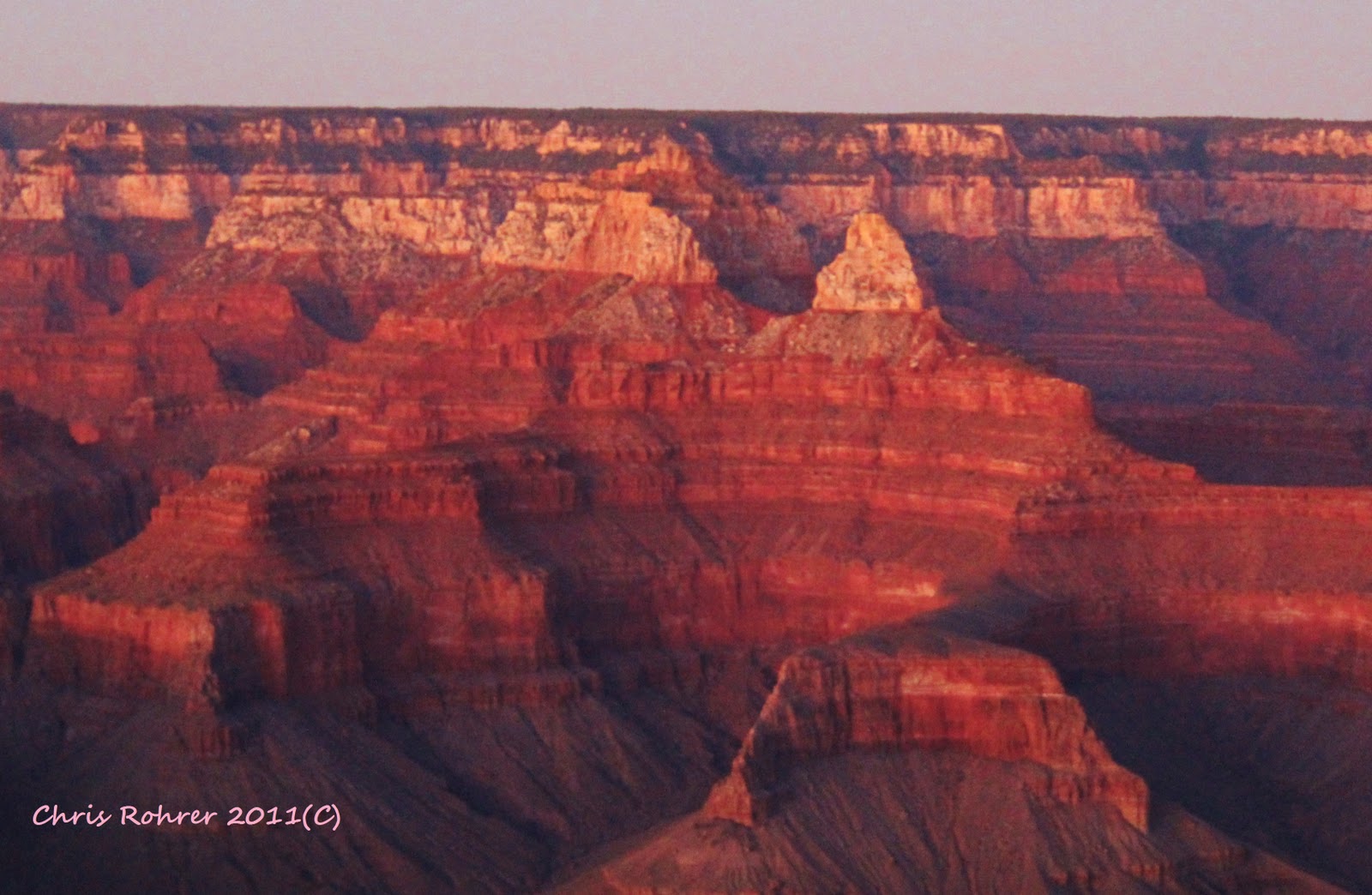
I love how the light played with the shadows of the rock formations.  If you are a Geologic nut, you'll love the Canyon.
Keep your eyes open for wildlife...my most prized moments.  This is a Western Scrub Jay below at sunset.
Western Scrub Jay
Old structures are found around the grounds.  And I'm sorry, but I have to say it......so are the cheesy tourist shops.
The colors of the canyon at sunset......
Everywhere you turn, there is something to discover. 
I found the evening to be the best time to capture the wildlife shots.  There were too many people around during the morning.  We saw Elk, birds, mice, rats, and all kinds of fun around sunset.  There are several photo opportunities to consider.  There are the wildlife shots, the moon rising over the canyon shots, the canyon shots, the people shots, and of course the popular sun rising/setting shots.
Mountain Chickadee
Tomorrow we'll explore another great area.....but in Colorado Springs! Until then.....


Wednesday, December 7, 2011

The Condor Corridor

Pics courtesy of Wikipedia.org
Over a two week period, we did some truly intense road tripping.  While it was fun and educational, it was also exhausting.  Tomorrow we'll be visiting the Grand Canyon and taking a look at this natural wonder of the Earth. Today's post is really a continuation on nature from yesterday's write on endangered/extinct animals.  And there is hope for the California Condor.  During our trip to the Grand Canyon, we went to an outdoors lecture on this extremely large and ugly scavenger:) In 8th grade, I remember learning that this bird was extremely endangered at around 22 birds left in the wild and I remember feeling really depressed.  The first time I heard the word "extinction" was from a class in kindergarten during a kid discussion on dinosaurs, but I didn't think it still happened in the world....until 7th grade.  That's when I felt the sadness and eventual anger from its meaning.  I remember it all too well during a talk on pesticides affecting bird eggs and how humans caused ALL of it.  The California Condor was the central topic and I truly felt there wasn't any hope at all for these incredibly ugly birds.  I sat making projections on the birds with my child mind and I got depressed because it all looked hopeless.  Fast forward to the future 30 years later.....
Note the tags on the wings of the condor.  This helps identify with the population study.
And the news is positive and the conservation efforts are looking great.  There are two genetically diverse populations now in both California and Arizona.  Why is it called the California Condor and not the Arizona condor?  Simple.  The last condor in the wild, at the time, was caught in California thus carrying the state's name. The last of the 22 condors were captured and placed into different areas to begin their breeding efforts.  As previously mentioned, condors produce 1 egg every year, but a researcher discovered that if you take the egg from the nest, the condor will lay another egg.  If you take that 2nd egg, the condor will lay another.  And if you take that 3rd egg, it WON'T lay another:)  Understanding this pattern helped increase the condor population quicker.  Two eggs would be held in an incubator and raised by human hands while the 3rd egg would be left for the parents to nest upon.   Egg shells at the time were extremely soft and had to be treated with extreme care.  The Condor program also had to create Momma and Daddy condor puppets to feed the new hatchlings.  Today the wild California Condor population stands at 356.  Two genetically diverse populations exist both in California and Arizona where their populations continue to grow undisturbed.
There are still breeding programs at several zoos in San Diego, Los Angeles, and Portland.    Today the condors still face lead poisoning along the northern rim of the Grand Canyon where hunting is permitted.  They also are treated occassionaly for "detoxification" and released back into the wild.  You may ask like we did, "How are they still being poisoned in such a natural and pristine area?"  The hunters use lead in the bullets.  When a bullet is shot and hits the target, the lead ball breaks up and scatters throughout the carcass of the animal killed.  Condors, being scavengers, eat the leftovers and absorb the lead from the animal.  The solution?  Conservationists and researchers now mandate copper bullets along the rim.  Condors are interesting birds because they will follow the hunters knowing that there is food awaiting them:)  They live in the sky caves along this immense canyon.  And here's one more thing that I thought was interesing about the scavenger bird community.....and a Pocahontas moment....the web of nature if you will and how they all connect together.  The Grand Canyon is home to so much life.  When something dies, the Raven finds the carcass.  The Turkey Vulture follows the Raven.  And the California Condor follows the Turkey Vulture.
Our presenter was fun and interesting.  I love success stories and I hope the conservation efforts continue for this incredibly beautiful part of our state.  I forgot about Phoenix and our embarrassement of a governor and thought....yes, we do have something positive that can make an Arizonan proud! I left this presentation with a smile on my face knowing that our condor friends were in good hands. More tomorrow....

Tuesday, December 6, 2011

The Antelope Near Colorado Springs

We're getting closer to our Colorado Springs journey as well as our Grand Canyon trip.  Today's post is an interesting one for me.  I've lived in different parts of the world, but nothing quite prepared me for what I would see in northern New Mexico and Colorado.  I have a good eye for spotting things that don't quite blend in with the landscape or something that sticks out on the landscape....like these Antelope.  For one instant moment, I thought I was back in Africa again.  Our trip would reveal lots of antelope.....all over!!!  We have established Pronghorn back in Southern Arizona again and through excellent conservation work between the US and Mexico, they are slowly growing back in numbers near the Buenos Aires bird refuge.
But this was a shock!!  I had been looking for elk or deer...something....just not this.  The previous weekend, there had been elk walking along the rim of the Grand Canyon, but this was unexpected.  Some random thoughts that went through my head were......."Wow!"  "How many are there out there?", "What do they eat?", "How do they survive out here?", "Do ranchers/farmers get irritated that they share the land with horses, buffalo, and cattle?" "Did they escape from a refuge?"
Here is what I know.  Most antelope are NOT native to the US.  Many ranches have these animals around for hunting purposes.  However, because of their amazing jumping skills, some escaped and began to create wild colonies around the states of Texas, Utah, Colorado, New Mexico, etc.  The antelope hang out in the grassland areas and follow the rain as they similiarly do on the African savanna.  So they are pretty resilient creatures....
I then imagined these exotic critters and their influence on our American soils.  Has the mountain lion population benefited from this additional food source on the plains of New Mexico?  A parting thought for today as I have been just disgusted by our human race as of late.  Two more rhino species are now listed as extinct...the white rhino and the black rhino although some remain in zoos.  Conservation efforts are hopeful, but the white rhino doesn't breed often due to some behavioral elements.  Several of the antelope species face extinction in Asia and Africa due to hunting and poaching practices.  Hope is not lost, but it does dim every time we lose a species on this planet.  It will ultimately be the end of our own species if we do not take care of this planet.  At a population of 7 billion, our planet cannot sustain much more.  At first, it will start with squabbles and mini wars.  The greedy richer countries will claim it's to protect national interests, but it will really be about controlling limited resources.  Eventually it will lead to a total collapse of our global resources....and an end to the human race.  One last thought.  How can the world maintain a capitalistic attitude? If we keep taking more and more and more....there won't be anything left.  I know....this is a rant, but it's frustrating.  Sometimes, like when I glimpsed these antelope in New Mexico and Colorado, I feel like perhaps nature will try and work itself out.  Humans are the shepherds of this planet and if we don't protect this treasure, we face our own extinction.
However, I'd like to end this post on a more positive note.  Conservation efforts are happening around the world and some truly wonderful things are happening out there.  Recently we went to a presentation on the California Condor along the rim at the Grand Canyon.  I'll be presenting that information with you tomorrow.  Nature is an amazing thing to behold and anytime I can be a part of it, I'm one happy camper. More tomorrow!!!

Monday, December 5, 2011

Urban Design

Clean.  Unique. Repeating form.  This summer in San Diego during our Comicon adventure, I spotted this cool feature on the stairs of the convention center downtown.
Stepping back, this whole section added a little color and form to the drab staircase next to it.  But what I loved most about it all was how it was set up.  Here in Tucson, this look can be achieved with many of our cacti and agaves.  In San Diego, you have a large succulent choice.  I currently use this idea with our cacti garden.  Do you use repetition in your garden?  How do you do it? And what plants do you use to accomplish this look?

Sunday, December 4, 2011

The Funky Caterpillar

On my journey this summer to Panama, and on the way to the outdoor bathroom, I discovered this caterpillar by accident.  It's known as the Tetrio Sphinx Caterpillar.  You'd think this large bug would stand out on the branches, but instead, it blended in quite effortlessly with its surroundings.
It belongs to the moth family and when in moth form, looks similiar to our own local desert Sphinx moth that comes from the hornworm caterpillar....you know....the giant green alien looking one:)  Here is a post titled  Who's in My Garden? from last year that features a similiar type of caterpillar moth.  It feeds on the Plumeria species.  While the moth form is beautiful, the caterpillar has the color.  Here is an observation while working with both moths and butterflies from over the years.  Many moth caterpillars are colorful while their butterfly counterparts are not.....and yet when they switch into moth or butterfly form, the roles reverse with the butterfly having more color. There are exceptions of course.   Have you seen this caterpillar in your garden? I think I've also used the word "caterpillar" enough in this write:)
Photo courtesy of Wikipedia


Saturday, December 3, 2011

Just Chillin'

 Today is a bit chilly in the Old Pueblo.  Here are some pics outside my dining room window on this cold day.  Our hummingbird is chillin' and relaxing on a Jacaranda branch while this Finch is taking time to grab a snack before our next rain event. Those of you on the outlying areas of Tucson may want to protect your plants tonight as temps may dip below freezing. 

The Attractive Cecropia

One of the most perfect examples of how interconnected everything is to one another in nature is thru the example of the Cecropia tree. While in Panama this past summer, I furthered my studies on tropical plants and their importance to different species of animals, insects, and birds. Today's post focuses on the importance one species can have on the world.  Remove it and the balance is destroyed.  When a species goes extinct on this planet, something else is affected.  At first, it may not be noticed, but eventually it will catch up with what I'd like to call the "cascade effect".  While the Cecropia is an easy example to use for biodiversity, it's certainly not the only tree or plant that serves multiple purposes in our natural environment.  I could write about the importance of the Saguaro cactus in the Sonoran desert and how it plays an important role for mammals, insects, and birds alike, but I took these pictures and wanted to use them in my write!
Cecropia
This tree is host to the Cecropia moth, sloth, and ants!  These trees are characteristic features of many American tropical rainforest ecosystems and may be among the dominant tree species in some places. Being aggressive, rapid growth trees, whose succulent fruits are readily sought by various animals, they tend to be among the first pioneer species to occupy former forest areas cleared for pasture or altered by human activity.Cecropia hololeuca, known in Brazil as "silver cecropia", has broad, silver-hue leaves that make it to be used as an ornamental plant for landscaping projects, as is the case also with the similar species C. pachystachya.  Source:  Wikipedia
Here's an example on how interconnected everything is.  Inside the Cecropia, a type of ant lives.  If any movement is felt on the bark of the tree, the ants will come out and attack.  In a sense, they become the guardians of the tree in a very healthy symbiotic way. If you tap the tree, the ants will immediately come out from the bark and attack!  So you may ask, "Then how does the sloth live off this tree?"  Well the sloth is so SLOOOOOOOOOW moving that it is unaffected by the ants. While we were in Panama, it appeared that every one of these Cecropia trees had a sloth hanging out in it! 
There are a lot of varieties out there. Some have larger leaves while others have smaller forms.Cecropia species are used as food plants by the larvae of some Lepidoptera species, including  the Cecropia Moth (Hyalophora cecropia). The leaves and buds are also eaten by sloths as their main source of food. But many herbivores avoid these plants: most Cecropia are myrmecophytes, housing dolichoderine ants of the genus Azteca, which will vigorously defend their hostplant against getting eaten.
Cecropia fruit, known as snake fingers, are a popular food of diverse animals however, including bats like the Common Fruit Bat (Artibeus jamaicensis) or Carollia species, the Central American Squirrel Monkey (Saimiri oerstedii), and birds like the Green Aracari (Pteroglossus viridis), the Keel Bill Toucan (Ramphastos sulfuratus)pic below, and many other birds.The seeds are not normally digested and thus these animals are important in distributing the trees. Some birds – e.g. the Lesser Potoo (Nyctibius griseus) – nest in Cecropia trees. The Elfin Woods Warbler (Dendroica angelae) is notable for using Cecropia leaves as nesting material, which no other New World Warbler (family Parulidae) seems to do.
Keel Billed Toucan at a Refuge Center.  I also have a photo of this bird in the wild at this link.
I've found the Panama series to be very rewarding and educational for me.  If you are interested in the Panama journals, head over to the month of August where you'll find daily accounts of our adventures there.  I'd like to thank our landscaping guide Steve for his insightful background at La Loma on Isla Bastimentos in Bocas Del Toro.  Steve gave me a guide on the thousands of tropical trees that were found around Panama.  During a tropical downpour, I took his book and a candle where I hung out in a hammock and read....and read.  Each time I travel, I focus on a new group of trees that I learn about...and slowly I add each tree to my list of trees discovered.  I still have a long ways to go, but that's the part I love about all of this.  More tomorrow....

Friday, December 2, 2011

Got Hummingbirds?

At the Boyce Thompson Arboretum
This year has been a revelation for me in a lot of areas that surround my life.  Today, I'm going to make it official and "out myself" as an amateur birder.  It was inevitable.  I've always loved birds, but I really started getting into it more during our trip to Panama.  Ivan, if you are reading this, you knew it was going to happen:)  This is a series of shots from over the year in Panama, around Arizona, and in my backyard. 
Outside my dining room window
First off, if you want hummingbirds, you need to get a feeder.  This pic above is from my dining room window.  If you are beginning, keep your feeder somewhere close to your windows so that you enjoy the action.  The feeders are much cheaper than the regular bird feeders that require an expensive mixture of bird seed:) Hummers are attracted to reds and oranges and that's why most feeders are red.  Don't put red dye in the water and DO change out your feeder every week to prevent bacteria from building up.  You don't want your new friends to get sick.
The recipe is simple.    Boil 4 cups of water.  Add one cup of sugar. Mix together. Let cool and add to feeder.  Any leftover, put in fridge for switch out later on. The solution will last one week in the fridge. Simple and easy. And if you begin feeding the hummingbirds, remember to be consistent and regular with your feeding.  So no missing weeks:)  I kind of look at them as my adopted friends.  In fact, the birds now wait for me to come out and switch up their food for them and it makes me happy.  I love birds but I don't like seeing them in cages.  Birds were meant to fly.
I now am a proud gardener of 4 hummingbird families that swarm around the feeders.   If you live in Tucson or surrounding areas, you absolutely MUST try this out.  We are home to MANY hummers and you'll be rewarded for your efforts. 
The Sonoran Desert Museum

Things started happening for me when I put birdseed outside our window.  The birds came and with it, their music and antics.  I made the El Presidio Gardens come alive and actually feel like a real bird sanctuary.  Over the past years, we've had many visitors, but not like this.  Today we have lots of birds hanging around waiting for some food and fun.   Our dining room window has become the "big screen TV" for our cats.  It also captures the attention of our guests and friends around the grounds.  Everyone has been enjoying the visits from our new feathered friends.
Shots taken in Panama
There are so many kinds of hummingbirds that vary from color, size, and shape that it can be overwhelming for first timers.  And if that isn't confusing enough, the male and female look different from one another which can add to the confusion.
And let's not forget about the plants we use in our gardens.  Hummingbirds are attracted to long tubular flowered plants.  Several great plant choices for your landscape are.....the Blue palo verde, Foothills palo verde, Cascalote, Desert willow( I have my feeder on this tree as well!), Baja red fairy duster, Chuparosas, Hummingbird trumpet, Mexican honeysuckle, Penstemon species, Salvia species and Yellow bells are just some examples.
Some cacti and succulents include Ocotillo, Aloe species, and the Hesperaloe species(Red Yucca is a hummer magnet)!!!!  While yellow, orange, pink, and red blossom are a hummingbird favorite, they will also visit plants with blue flowers as well.
Most of our hummers have small nests located in our Live Oaks around the property.  The nest is tiny and adorable.  When babies emerge, they look like those large black bees flying out of their nests. I've found nests in the Xylosma, Live Oaks and Bamboo forests on the side of our home.
I have the feeling that this year is the beginning of my urban wildlife gardening in the Old Pueblo.  I also tend to think they are super intelligent creatures that are very territorial.  They've gotten so comfortable that they'll fly right next to me while I'm watering the garden and just hang out.  When I put the feeder out with fresh juice, they'll feed right next to me.  Of course, several of these little guys are the hatchlings from our nests on the property.
So what's your personal experience with these little critters?

Thursday, December 1, 2011

December Gardening in Tucson

It's December and I'm kinda sad because this finishes up the monthly gardening "to do list" posts from last January.  We have experienced an interesting year in weather patterns and while the garden has survived, it has also changed here.  This month I have several surprises on writes from different areas I traveled to over October and November.  As I wrap up this year on Las Aventuras, I'll be shifting back to the El Presidio garden again during spring as I work on several major projects that I began from last year.  It should be interesting to see how it all turns out.   There's a lot of data here for Tucson Gardeners and I hope they'll find it useful.   Without further adeu, here is the December "to do" list in Tucson....and our last monthly post on Tucson gardening tips for the month.
Interestingly enough, there isn't much to do during the month of December.  It's what you SHOULDN'T do during this month.  For example, no pruning.  Cold frost biting temps will be a regular occurrence and plants must keep their dead foliage until March to protect their root systems.  The quickest way to kill a plant, like Bougainvillea, is pruning it back to the ground.  With several nights of below 32 degree weather,  your established or newly established Bougainvillea will find a quick death.  Leave the branches intact until March when it is acceptable to trim and prune plants.  You shouldn't put new plants into the garden.  Instead wait until March to do this.  There are exceptions of course which would be bare root roses or bare root fruit trees.  So here's what you should do.....
1.  Protect your plants from frost
2.  Keep your grounds clean
3. Plant bare-root roses/fruit trees(Remember to soak 24 hours in a bucket of water before planting)
4. Plant your cool-season veggies like beets, carrots, radishes, turnips, spinach, collard and mustard greens, chard leaf lettuce, kale and bok choy.  Transplant or sow seeds for cabbage, broccoli and cauliflower.
5.  Tranplant six-packs or 4-inch annual flowers for faster color in the garden.  Nasturtium, dianthus, pansy, viola, Johnny-jump-up, signet marigold, borage, calendula, and shungiku chrysanthemum are just some examples.
6.  Most herbs, like cilantro, dill, and parsley thrive in pots during this cool weather!!  For basil, pull plants and collect seed.
7.  The citrus issue.  Because of our nasty freeze this past February, most of us won't have large crops of citrus.  You may ask me what did well for me....well, I have crops of kumquat and tangelos.  I don't have ANY oranges or grapefruit.  If you do have crops this year, taste-test navel and Arizona sweet oranges, mandarins and tangelos to determine if they are ready to harvest.  I'd wait on the grapefruit until next month to pick.

Well that's it!!  The end of the monthly to do series!  I hope those readers who search for Tucson gardening tips have found these posts helpful.  I've spent years collecting this info from other gardeners, my own practice and experience, and gardening guides. If you love cilantro, you should plant it now.....I've had great success with this delicious herb.
PS.  It's a good thing that gardening is low key this month because the holidays are in high gear for most of us.  More tomorrow friends...