Showing posts with label Southern Arizona. Show all posts

Thursday, December 27, 2012

Year In Review-Southern Arizona

 This year, I did a lot of travel around Southern Arizona. There are almost too many places to see, but here are some memorable experiences.  Whether it be from Ramsey Canyon above or along the San Pedro River below.....
 .....or in the magical world of Portal.........
.....near Buenos Aires wildlife preserve......
 ....or watching the thousands of Sandhill Cranes at the Whitewater Draw......
 .....driving and hiking around Picacho Peak.....
 .....or exploring the skies of Kitt's Peak.......
 ......or looking down onto Tucson from Wasson Peak......
.....in and around both sides of Saguaro National Park........
.......or trekking the arroyo in Tucson..........
......Southern Arizona is a treasure that must be seen.

Friday, November 2, 2012

The Land of Mañana

Sulphur Butterfly
"You're in the land of mañana, my friend", said the gas clerk in the strange town of Animas, New Mexico.  Where the hell was I?  Why was there only 1 gas station in a 50 mile radius?  No ATM's and even fewer people.  It was scary.  Isolating.  A step back in time by about 40 years. 
Yet I came here to escape humanity.  And while the trip was extremely rewarding, it had a bit of danger to it.  So I took the walking stick to protect myself, put on my sun hat and began searching for everything.
And while I spent my time in Portal, AZ, I attended a lecture with Roberta and Michael.  Practically the entire human community showed up on this cool night to listen to a couple of Chiricahuan researchers.   One was a New Yorker and hilarious:)
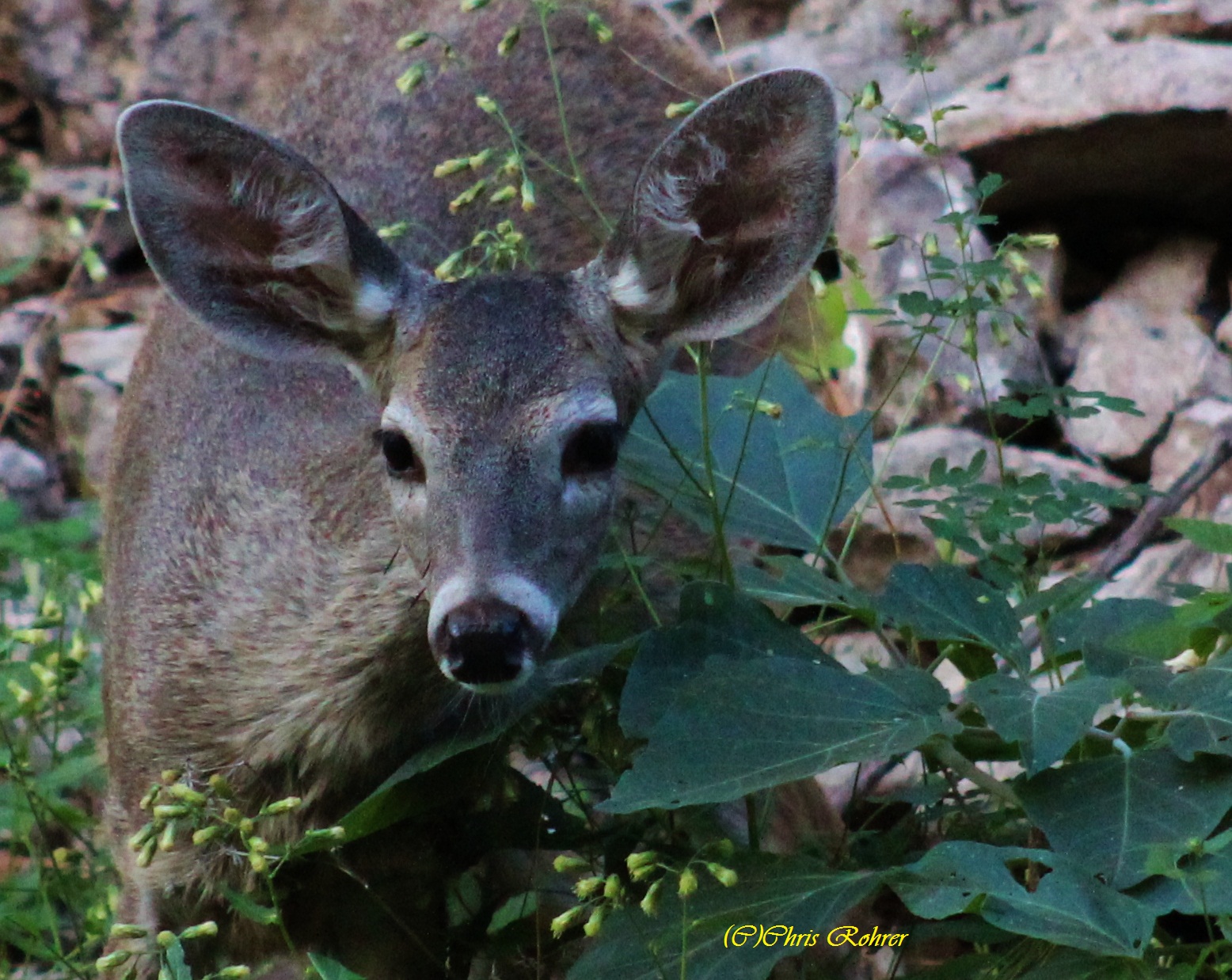
Mule Deer
Check out this data!  Did you know?
1.  Of the 43 bats found in the US, 24 species are found in these mountains.
2.  Of the 950 birds found in the US, 375 can be found in the Chiracahuas.
3. Of the 400 mammals in the US, 90 live here.   
The "Sky Islands" were unaffected by the last Ice Age and the critters were allowed to continue their evolution.   The Chiracahuan Leopard frog is an example of this evolutionary step forward.  Or the endangered, thought to be extinct but rediscovered, Mt. Graham Red Squirrel.
The Chiracahua Mountains are 40 miles long and 20 wide.   It is one of 42 Sky Islands that exist between Mexico and the US.  They are known as the Madrean Archipelago. All have a unique biodiversity found nowhere else in this world but here in these forgotten parts of the world.  Each different from one another. 
Acorn Woodpecker
Home to Jaguars, Jagarundi, Ocelots, Mountain Lions, and Bobcats.  It's one of the few places where these cats still roam together as they once did in other parts of Southern Arizona.
While the fires on top of these mountains have done damage, I'm happy to report that the Aspens are now human height.  These are the first trees to sprout after wildfires.  And it's also the reason many of the bears were coming down to visit:)  Portal is truly an exciting experience full of wildlife minus the people.  So remember to bring cash, your birding guide, and a full tank of gas because this truly is the "Land of Mañana."


Sunday, October 14, 2012

The Sonoran Pronghorn


I'm BACK from an overdue R & R vacation which required all gadgets to be gone, a book, some light birding, and some healthy hikes. And I feel much much better. This past week I was in the middle of nowhere-ville and surrounded by bears.  It was an amazing time.  I'll be back catching up with everyone again.  But back to this post! So I've waited a long time to find these amazing creatures and on our day of birding, it would happen.  It was truly one of the most exciting finds of the day.  The Sonoran Pronghorn.
Ranchers settled Arizona lands in the early 1900's and wiped out the Pronghorn from our grasslands as cattle took over and established themselves around this land.  Fences were placed all around these massive grassland properties and blocked many of the routes for these animals in Southern Arizona. Put up a border fence and it was even more difficult for the species to enter and leave the country. The Pronghorn and Jaguar almost completely disappeared. In 2002, drought and habitat loss reduced the pronghorn to only 21.  At that point, a captive breeding program began and US Fish and Wildlife intervened to prevent their extinction. 
The habitat of the Arizona Pronghorn Antelope are prairies and grasslands and are most abundant in the North Central plains of the state. Herds are often seen just north of Prescott Valley and those that travel on Interstate 17 can frequently see herds in the wild between Cordes Junction and the edges of Camp Verde, Arizona. They also inhabit the high elevation meadows between forested areas in East Central areas of Arizona. There is a sub-species of "Sonoran Pronghorn" that are on the endangered list that exist in small numbers in the desert areas of Southwestern Arizona. Antelope are grazing animals primarily feeding on grasses, weeds, cactus and small Juniper Pine.

Known as "prairie ghosts" because they are so elusive, the Sonoran pronghorn (Antilocapra americana sonoriensis) is the fastest land mammal in North America. Smaller and lighter in color than other pronghorn subspecies, it is uniquely adapted for survival in harsh arid conditions.Kathie and I were tipped off by a ranger that the Pronghorn had crossed a dirt road.  We quickly drove to the spot reported and were lucky to glance these amazing creatures from a distance.
Approximately 100 Sonoran pronghorn remain in the wild in the United States. There is also a small population held in a captive breeding program on the Cabeza Prieta National Wildlife Refuge in southwest Arizona. There are approximately 650 pronghorn in Mexico.
A slow recovery is happening around these areas but it is very slow. However today they are much more visible than they were 10 years ago.  You can find them near Portal, Sonoita, or the Buenos Aires Wildlife Preserve.  They also live in the state of Sonora, Mexico.  Meanwhile, most of the thousands of miles of fence have been taken down over the past ten years around the Buenos Aires Wildlife Preserve.  The grasslands are making a comeback and it appears that a balance may soon be achieved.  As that happens, species that once roamed these areas like the Ocelot and Jaguar have had more sightings now that things are getting "fixed".  More tomorrow from our adventures....