|
| Gambel's Quail-male; he is territorial and watching out for his partner and little ones |
In Part 3 from my blog series on Arizona birds, we'll examine the chicken like birds that hang out in the state. This is a popular group of birds that visitors and locals alike hope to spy on their walks. We'll once again examine what's countable and where we can find them. This group of birds is unique in that humans have played a role in some of the species living here in the state. Let's get started with the native and local species first. The Gambel's Quail.
 |
| The female Gambel's Quail carefully takes the little ones to safety while the male keeps an eye out for Cooper's Hawks |
Gambel's Quail are one of the most easily seen quail in the state. They are found in local parks, around the deserts and foothills of the Arizona landscape. Most often they are vocal and seen in larger coveys. But don't get too cozy. The rest of the quail species can be tricky!
 |
| This male Scaled Quail is looking for love from within his territory |
Over the years, I have gotten to know the Scaled Quail better. This quail can be difficult to find during certain times of years. And while locals who live in their habitat range say that they are backyard birds and easy to spot, this isn't always the case. They are common and widespread in Southeastern Arizona in the grassland range around places like Cochise Lake in Willcox or along the San Pedro Riparian area of Sierra Vista. And even then, they can be shy.
 |
| These two birds feed safely under the vegetation out of hawk sight |
As a birder, I'd give this quail a rating of 3 on the 1-5 difficulty range(5 being most difficult). People have been known to dip on this quail. When the males are calling, it's easy. Quail and Grouse CAN be easy to spot during their breeding season ANYWHERE. But the thing is, birders don't always have the luxury of visiting during their most vocal and visual time period. So let's go onto EXTREMELY difficult.
 |
| the male Montezuma Quail sits completely still on a rock watching me watching him; there we scream inside of our heads with excitement over our discovery! YES! But we barely breath while looking at the bird:) |
Montezuma Quail. Birders say that you never should look for them. Instead, they'll find you when the time is right. But what if you don't have a lot of time to spare?! This bird is a FIVE on the difficulty scale. It is a common bird. But don't take the word "common" to mean that they're easy to spot. This quail is super intelligent and is quick to disappear at the slightest sound. And if they can't escape, they will remain completely still until you almost step on them.....and then as you are about to step on them, they BLAST off giving you a near heart attack. And if you feel stupid for not having better eyes, DON'T. This happens to so many birders of all skills.

The good thing is that these birds are often times vocal and have an eerie martian call. Most of the time they are heard nearby but never seen. Over the years, I have played games with these birds as they have played games with me. Like the Flammulated Owl(in a later post), it sometimes takes a team to triangulate their positions. The good part is that they will freeze hoping you won't see them. If you get great views of this bird, consider yourself blessed by the bird gods.
 |
| The female tries to hide from me. My team mate signals with his hand that the female is exposed! It took two of us to triangulate her position before she gave up and flew off. |
So for now, I'd like to address the OTHER 2 quails that have been reported in Arizona. The first 3 are native species and common in their habitat range. The California Quail below was introduced on a hunting ranch many years ago up in the White Mountains. The habitat in that area is unique and not very large. But it was enough to sustain a population of countable California Quail over the years. These birds are native from California and up along the Pacific Coast. They can be found in Utah and Idaho. They were also introduced in Chile and other countries around the world. But in Arizona, there is only one spot you can go to see them and count them on your ABA list. Most of the time, they are heard only birds because the vegetation is thick around the Wenima area where they live. Arizona birders will chase these birds to come back with only a recording of their calls as a reward for their hard work. Difficulty level is a 4 or 5 due to the location.
 |
| The California Quail, as seen in Pacific Northwest, feed in a large covey |
The OTHER quail is known as the Elegant Quail. It's a beauty and a common bird for Mexico. Many years ago, one was recorded in the town of Douglas. Many believe it was an exotic bird released from a cage. And yet the possibility is that this one bird strayed quite a ways outside of its northern most range and got mixed up with a covey of Gambel's Quail. Quail don't migrate or fly long distances outside of their ranges so for one to show up in Arizona is suspicious. Either way, one was recorded in this state.
 |
| The Gould's Wild Turkey of the Santa Rita Lodge in Madera Canyon put on a show for us. This tom is looking for a lady! |
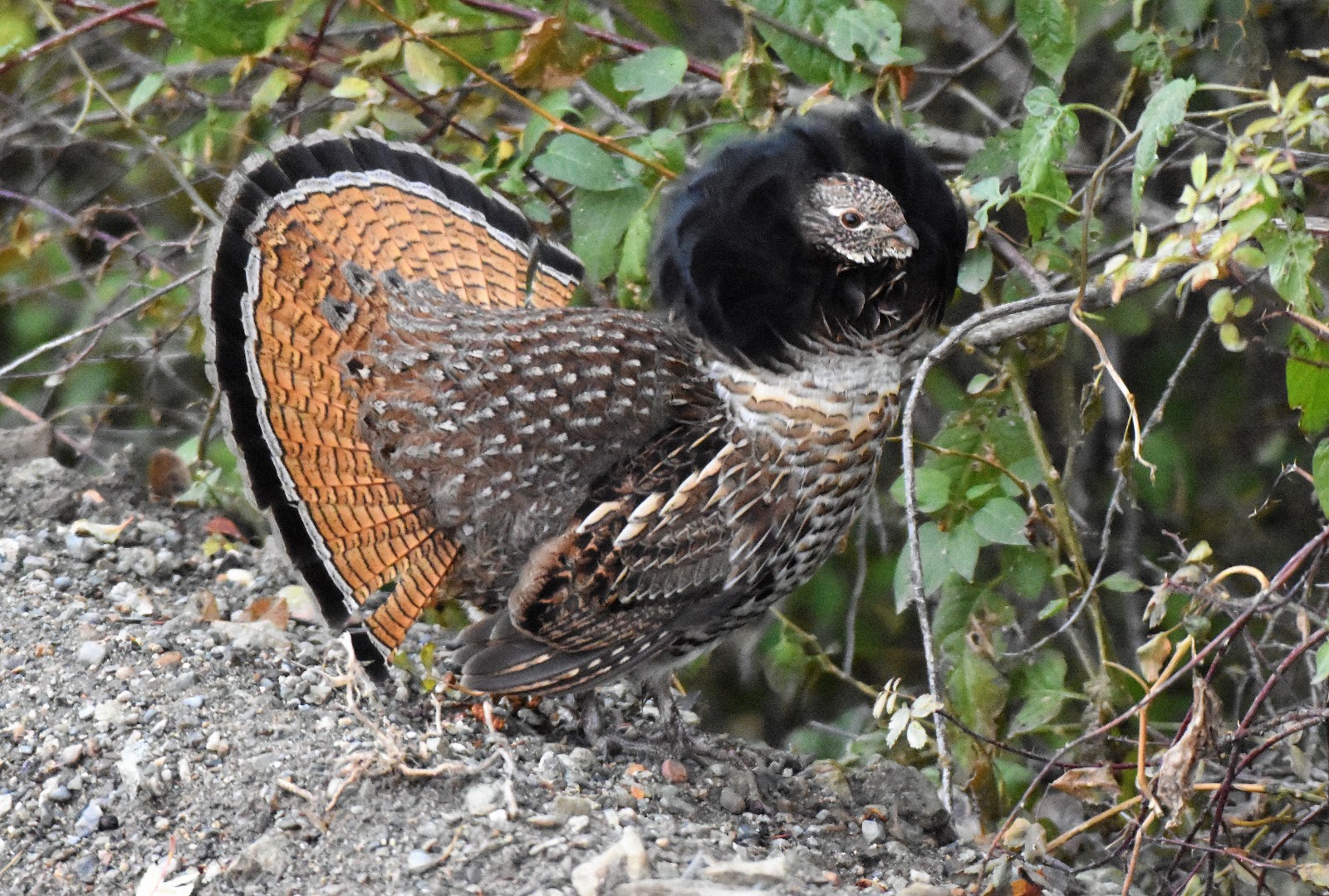
Now let's move onto grouse and turkeys. A nemesis bird for me over the years has been the Dusky Grouse. It's the ONLY grouse found in Arizona and it's normally seen in the northern parts of the state around places like the North Rim of the Grand Canyon, the San Francisco Peaks near Flagstaff and near Greer in the White Mountains.

Wild Turkeys were once almost hunted to extinction in North America. Today, thanks to conservation efforts, their numbers are healthy and growing. In Arizona, there are two subspecies of Wild Turkey, the Merriam's(common to most states) and the Gould's(common for Southern Arizona, New Mexico and Northern Mexico). If you're a bird nerd like me, you'd want to see the differences between the subspecies. Most people wouldn't care because a turkey is a turkey. But to find this Merriam's subspecies, we went to the North Rim of the Grand Canyon. To find the Gould's Wild Turkey of Southern Arizona, you'll need to head to the foothills on up into the forests of the sky islands. Further south towards the border, they can be found along riparian corridors.
 |
| Ring-necked Pheasant |
Now. Let's go through the rest of the "game" birds. Ring-necked Pheasants were introduced to the US decades ago for hunting purposes. Eventually, several states saw them "naturalize" and become permanent residents around the US. Today, they continue to release these birds for hunting purposes. In Arizona, the ONLY countable population is found around farm fields bordering California, Mexico and the Colorado River near Yuma, AZ. If they are found anywhere else in the state, they are not ABA countable.
 |
| Chukar on Antelope Island near Salt Lake City, Utah |
Chukars. Another introduced bird to the US. Again, several populations naturalized in states like Oregon, Utah and Idaho. Here in Arizona, the only countable Chukar would be the one found near the Arizona/Utah border. Chukars have been found in other places around the state but are considered survivors from hunters releasing them into the wild for target practice.
 |
| a wild Indian Peafowl at a park in Orange County, CA |
Indian Peafowl are not countable. In California, they are breeding. But in Arizona, they are considered escapees.
 |
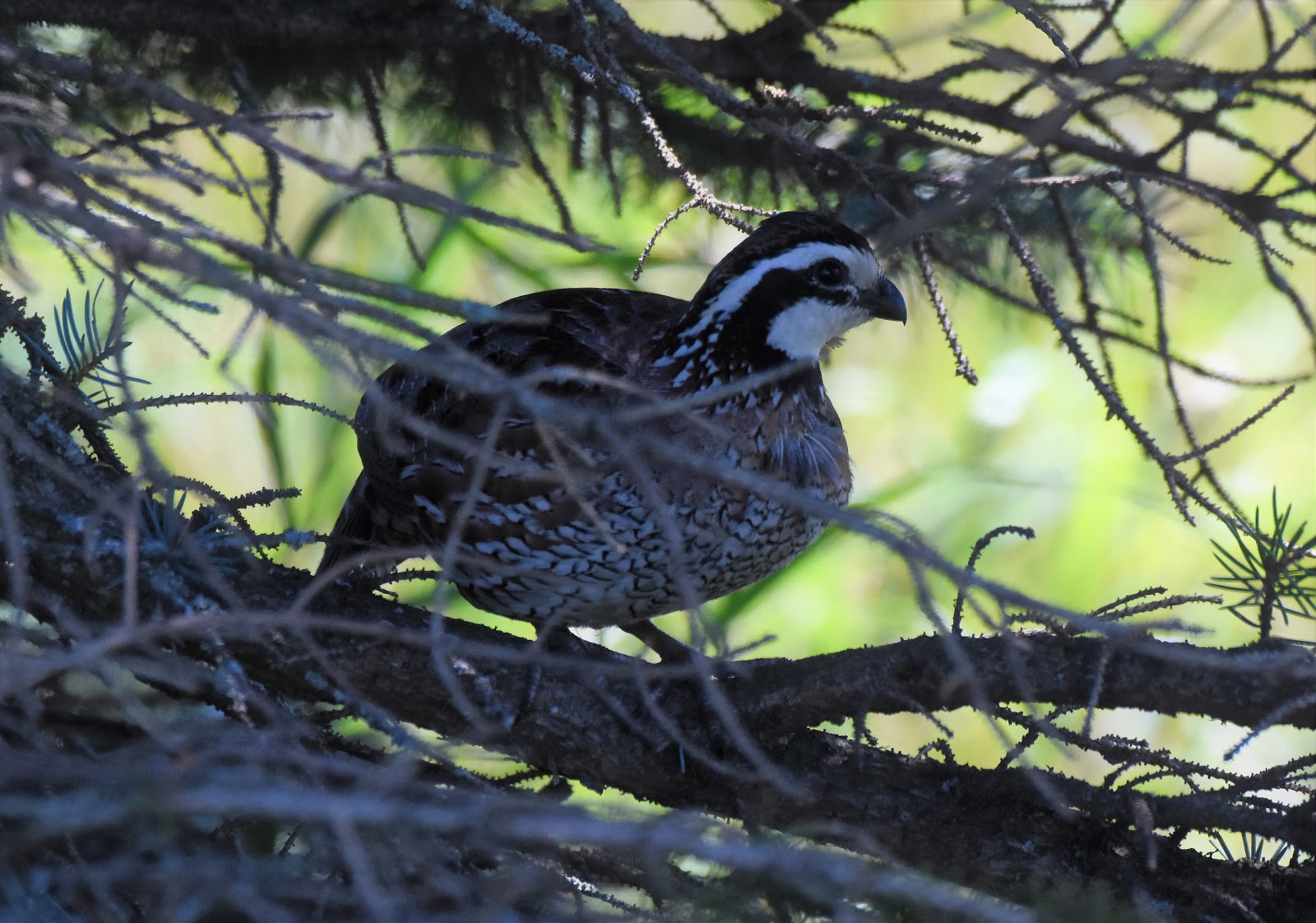
| a Northern Bobwhite in Wisconsin |
Finally. There are two great mentions here. We cannot forget these Arizona birds. And it's important to note their status. The Northern Bobwhite was once commonly found in the southern grasslands of Arizona. Some even say that there are still small populations that continue along the US/Mexican border. They are a unique subspecies of Northern Bobwhite that are often called Masked Bobwhite.
 |
| Similar to the Masked Bobwhite, this is another subspecies of Northern Bobwhite in Chiapas, Mexico |
This subspecies of bobwhite was wiped out from the area due to cattle grazing. Today as the Federal Government restores the grasslands of the Buenos Aires Wildlife Refuge, it faces the huge task of reintroducing this species back onto their former grasslands. They have a facility that contains 98% of the world's population of Masked Bobwhite. The Phoenix and San Diego Zoos are also involved now to protect these birds from another possible avian flu epidemic. It has been a decades struggle and their reintroduction has hit many bumps which include disease and domestication. Today, workers are trying something new and perhaps, Arizona will one day have a wild and special population of Northern Bobwhite living freely in the grasslands along the border.
 |
| Greater Sage-Grouse in the Pacific Northwest |
And finally, it is important to note that Arizona was once home to a small population of Greater Sage-Grouse in the very northern regions of the state along the Utah border. I remember asking myself this question years ago. Why couldn't there be Greater Sage-Grouse here? Over time, I discovered from study and conversations that their ranges across the US and Canada have seen drastic changes over the decades as housing and farming developments destroyed a lot of their habitat.....and leks. In a recent report, their populations have risen sharply which gives me hope for their future. Will they ever return back to Arizona? Is there a lek we don't know about along the border? These are questions that only time will answer.
 |
| Photo not mine. This is from Tucson Daily Photo |
I love the chicken birds. In Arizona, you can reliably count on 5 species of grouse, quail and turkey. The question is. Can you find them all? I still need to find that darn Dusky Grouse! My next series will be on Grebes and Loons. Until next time.....


 Posts