Showing posts with label Scaled Quail. Show all posts

Tuesday, June 30, 2020

Revisiting Old Friends

Montezuma Quail
This past week, after the onslaught of birders searching for the Eared Quetzal without any luck, they abandoned their hopeful searches and turned their eyes to our other specialties. It was mayhem.  They still continue to search.  And a few birders have reported a female now.  So it's possible the Eared Quetzals are nesting somewhere on the mountain. Whatever the case, birders need to be aware that covid has spread among the community AND birders need to follow ethical protocols. There are times when some things should be kept secret, especially during their breeding season. Playback is terrible during this time of year and people should refrain from using it. 


I was back in those old birding routes that every new hopeful birder visits.  It was rather strange.  With covid abound everywhere, I was forced to stay home during this very nasty time in Arizona.  Many of us locals leave Arizona to go birding in cooler temps.  Guides, generally, don't offer their services during this month due to nesting conditions and of course, that sweltering heat.  Everything picks up again in July when our monsoon gets into full swing and bird life is ALIVE!  


Painted Redstart
There are still windows of opportunity to bird.  Early mornings are best.  Evenings are second best. Afternoons are a no no unless you are at higher elevations but one of my favorite places to take people is currently on fire.  And it's a tragedy. So many nesting birds gone, many of them warblers.  Between crazy birders chasing that quetzal, covid closures and covid in general, the heat and the fires, it is a bit too much to take.  I regulated my outings with my friend because I can't do those extreme chases anymore for an entire day.  One of the days, I felt heat exhaustion coming on in the 104 degree temps.  Yes, I wore sun screen, a hat and drank plenty of water, but there comes a point when your body just shuts down.  Words get blurry, that little headache begins and birds become a second thought.  


Lucifer Hummingbird
There were also flashbacks during our treks.  A sadness that only one would know had they grown up as a birder with the people they once knew.  Take for example the Lucifer's Hummingbird.  Nearly every birder has gone to Mary Jo's Bed and Breakfast for their lifer Lucifer's Hummingbird.  Mary Jo passed away a little over a year now.  I haven't gone back because there are a lot of fond memories with that lady.  But we went because it's the one reliable place for birders who like photography, such as myself, to observe the secretive Montezuma Quail and of course that very special hummingbird.  Her place is now a sanctuary and it's still very special.  But I sat and looked at her home where the volunteers stay now. And it was a different experience.  The volunteers were wonderful, but Mary Jo wasn't there.  Or her African Gray Parrot. 

Least Tern
I took a day off to just work on house stuff and hang out with my neighbors.  On that day, a Least Tern showed up at Canoa Ranch.  It was a fun and fast trek to see the bird fly over the waters there. The following day, we went to search for some difficult birds.  You have to prioritize your birds.  So you choose your targets carefully.  Sometimes you spend an entire morning on ONE bird.  And that's what we did.  Anything after that window is a gift.  We achieved our targeted goals.  We stopped at another great birdy area, the Holy Trinity Monastery.  Another formerly owned Catholic property and magnet for incredible birds like the Gray Hawk, Mississippi Kite, Tropical Kingbirds and other special birds. But on the day we went there, the place looked unkept.  The shop was closed.  The pond was overgrown with algae. Broke my heart.  I sat in the meditation garden and noticed several of the wonderful shady trees were gone.  


Lesser Nighthawk

During our travels, we noticed Lesser Nighthawks hunting in broad daylight.  'Tis the season for feeding babies.  Normally these birds are only seen at dawn or dusk and at night around lights catching bugs. 

Ferruginous Pygmy-Owl
There are several birds in Arizona that are well protected and kept secret.  However, those secrets get leaked and then coordinates appear.  Such is the case with the Ferruginous Pygmy-Owl, a very sensitive species in AZ.  The species is another Holy Grail for birders, ABA'ers, state listers, county listers, etc.  There are few spots in the US that you can see them.  Texas is the best place for them.  Arizona has many but they are located in VERY difficult access places far away from civilization. The best place for these owls is still Organ Pipe National Monument in a VERY accessible place.  And that's all I will say:)


Scaled Quail
I think the most exciting part of our journeys came from observing all three quail species.  It was a lot of fun revisiting these old sites for some great birds.  Currently my plans are on hold.  As we see a spike in covid around the country, it has once again messed with travel plans.  Testing in this country is a joke. I'll leave it at that.  

juvenile Gambel's Quail

Stay cool everyone. And stay safe! Until next time....

Monday, April 16, 2018

Feathered Dinosaurs


The gorgeous Tanque Verde Wash is full of bird life!
Arizona is on fire this year, in a good way!  I've never seen so many energized birders on the trails around the state like I have this year.  I definitely get the sense that birding is becoming a cool "thing" with people.


Buff-breasted Flycatcher
Over the past two weekends, I've had a blast doing some personal birding with friends around Southern Arizona.  Each weekend, we've found something fantastic, and although the birds have been incredible, it wasn't a bird that left an impression on me. Instead, it was an enthusiastic young kid and his parents who were eavesdropping on our dinner conversation . 

Greater Short-horned Lizard
The birding community, like any group, is full of strange and cool humans.  I wasn't a birder since childhood like most of the birders I know.  I stumbled onto the birding craze because of my studies abroad and my attraction to the culture and nature surrounding the places.  That's not to say that I didn't love birds when I was younger because I did.  I would chase Killdeer across fields and secretly follow Ring-necked Pheasants to their roosts at my Grandparent's house.  So what connection do I have to these birders?  I know I'm one of them, but how?

Northern Beardless Tyrannulet-now that's a real dinosaur sounding name!
While on the trails, we've been followed by annoying birders, cool birders, secretive birders and photographers pretending to be birders. But hey, they all love birds so it's ok.  I've been contacted on and off the listserv about birds that I've refound by someone else or have been finding on my own.  

I imagined myself hopping up on that horse and running off away from that birder!
One birder, who I barely know, followed us on the trail and TALKED the entire time. I thought to myself, How in the world are we going to find birds, if you're talking all the time!?!!?  We tried to politely lose the person but it didn't work. You have to understand that there is history with this person. Another birder friend of ours, who was also on the trail, smiled at our attempts to shake this birder but ultimately she knew we'd fail.  This birder was trying to argue field mark points on random birds while we were trying to focus on hawks!  At one point, we did eventually break free, but when I got home, I had an email from this person!  How did this birder get it?!!!  I blocked the birder and then proceeded to get another email later on!!!  I felt a tad violated.  The second attempt to block seemed to do the trick.


From the Carpenter Bee group
Generally birders are awesome people, but I think we all know a few people in our circles who try our patience.  In my world, there are about 3 birders who I try to avoid and most of the time, I'm successful.  My Wisconsin manners have me act polite which is good, but I'm finding it harder the older I get to keep from snapping at challenging people.  I'm like an Elegant Trogon marking my territory with a bark!


We get our shoes wet trying to refind and get photos of a Broad-winged Hawk.  I had seen it the day previous but fell with my camera trying to get pics.  I wasn't very graceful:)
During one weekend, I had a blast with my friend Gordon Karre.  He's like the older brother I've never had.  We have a healthy competitive side that keeps us going strong.  Both of us get buried deep into our birding worlds helping others find birds, etc.  So I am always appreciative of any time we get to spend together to go birding.  

Northern Pygmy Owl
We had a magical day out on Mt. Lemmon exploring the trails and finding lots of great birds. The day would sadly end and my work week would begin again.  Finals are approaching and the madness of my job begins.  

An early Red-faced Warbler
Then Friday came.  A new birding friend, Steve Bonta, wanted to explore the Huachuca Mountains on Saturday so we set up the time to do so.  I met Steve this December while working on a CBC up on Mt. Lemmon.  We also make a good team finding birds. 

Scaled Quail
Don't worry, I'm not rambling here.  This story has a beginning and an end, but I need to give you the backstory of this past week.  


One of the several Red Warblers I saw around the mountains of Central Mexico
Two MEGA rarities showed up in Arizona, the Red Warbler ( I just saw this species outside of Mexico City) and the Fan-tailed Warbler near Portal.  Steve went to chase the Red Warbler on Mt. Lemmon.  Only a handful of birders, like Steve, got to see this incredible warbler.  A hundred + did not.  It was a first time record for the US and every ABA lister wet their pants to get a chance to go observe this warbler.  Thousands of dollars were spent on airfare and the following day, birders from all across the country showed up.  No bird. 

Red Crossbill
Conspiracy theories began like crazy. The ones who did not see it began to rationalize that the bird must have been a caged bird because of the wear on the feathers, etc etc. Some of those who saw it maintain that the bird is wild.  Me?  Well, I know Mexicans like to cage their birds(and sell them near the border), but what I didn't know was whether or not Mexicans caged Red Warblers. I would think that warblers would not do well in confinement. In the US, I have heard people joke about single women having a household full of cats.  In Mexico, the same is also said of women but with caged birds.  I have found several of those stereotypes to be true.  But I'm married.  What's my excuse?! Who am I kidding, hoarding cats is awesome.

Swainson's Hawk
We spoke with a good guy who leads tours around Mexico.  For most of us, the Red Warbler was a shock.  None of us expected such a bird to cross the borders of the US.  A first time record in AZ of a White-tipped Dove or Rusty Sparrow would be more likely.  But not a Red Warbler.  According to this expert, the bird was probably caged and escaped or was released somewhere in Mexico near the border. The Red Warbler is apparently captured in the wild like many of the colorful birds and sold on the black market in the pet trade. The warbler found its' way into our sky islands and into the correct habitat where it was observed. It was a one day wonder. Who knows what the official bird people will decide?  But it was exciting(and sad) to imagine this warbler in Tucson up on Mt. Lemmon. I hope it survives. If it is indeed wild, it's further proof that global warming is pushing birds north OR that birds are getting pushed out of their already crowded habitat due to human caused expansion.  Another conspiracy theory that I heard was that some unethical person from the American Ornithological Society(AOS), who held their conferences in Tucson, may have released the bird up on the mountain to kick start their event.  Ohhhhhh, the joys of birding politics!

Way cool and out in the open of normally skittish Band-tailed Pigeons!!!
A much more real possibility showed up the same week, the Fan-tailed Warbler.  So Steve and I ditched our plans at the last minute and headed to Portal to go find several key birds. He didn't have to twist my arm because I love Portal.  Any opportunity to go bird in that area is fantastic!

The epic Fan-tailed Warbler
We found this stunning bird out in the open.  Normally, when I've seen it in Mexico, it's skulking around the dark foliage.  So to have it just happily and casually bopping around someone's yard was a trip.  I'd like to thank the Taylor's for being so kind and allowing us couple of bird nerds to see this amazing warbler!  


So what about the boy?  Did I forget about him?  No.  I haven't.  After another amazing weekend out, Steve and I both went to celebrate at a great Mexican restaurant in Willcox. We happily were discussing birds in this busy restaurant and going over several endemic Mexican species for future treks.  Yes.  My eyes are on Mexico now. Anyhow, little did I know, but there was a couple with a bright eyed little boy eavesdropping on our conversation.  


I assume most people like birds but don't get into it any further than "liking" them.  There's a whole lot of planning that goes into this stuff.  At the end of our meal, the young man came up to us both and explained to us that he also went after the Fan-tailed Warbler but turned around at the Private Property sign.  We had spoken to the locals in Portal previously and they said to go past the sign but not get out of the car.  Most birders did not know this however and turned around.  Anyhow, I felt a small human emotion as I watched this serious young man share with us all his passion for birds.  And it gets better.  HIS PARENTS were taking him out birding for his birthday!!!


Part of the beautiful Chiricahua Mountain range
I wanted to hug them.  We had to get back to Tucson, but I told the parents that ever since I began my adventures in birding, my life has changed for the better.  I thanked them for supporting their kid and fostering his passion for birds.  But I had a bigger question for this little bird man, "Why birds?"


At Cave Creek Lodge in Portal.  A really nice place to bird once you've done your hiking.  Or not hike:)
"I don't know.  I liked dinosaurs.  And then I liked birds."  Steve laughed and said that he played with dinosaurs when he was a kid.  I also played with dinosaurs and knew every crazy name.  So dinosaurs were what linked us all together.  Birds are essentially living dinosaurs! We walked out together and waved good-bye. I think that was the best part of my day. 


This road is magical and will take you into the beautiful Chiricahua Mountains
Until next time......


This is for my friend in England from her blog Ragged Robin's Nature Notes.  I know we've never met but I hope we do.  This is in your honor, a Blueberry Peach pie:)

Tuesday, November 7, 2017

No Day But Today

Vermilion Flycatcher during one of my weekly surveys at Reid Park in Tucson, AZ

"The heart may freeze or it can burn
  The pain will ease if I can learn

  There is no future
  There is no past
  I live each moment as my last 

  There's only us
  There's only this
  Forget regret-or life is yours to miss

  No other road
  No other way
  No day but today!"-Rent

Another routine check at El Río Preserve in Marana, reveals a mile long string of Yellow-headed Blackbirds passing by the moon at sunset

On the trails this week, I did a little bit of tactical, studied and artistic birding.  It was a crazy week full of super early mornings, even by a birder's standards.

a Scaled Quail at Cochise Lake

We came back from Colorado and stopped at the beautiful Cochise Lake in Willcox, AZ.  This was my artistic birding. We had to prioritize our stops. So we skimmed through New Mexico in order to watch the beautiful sunset over Cochise Lake.

a Javelina feeds from the grasses of the golf course at Willcox

It was so peaceful and beautiful.  As the sun went down, several hundred Sandhill Cranes flew above our heads.

Sandhill Cranes at sunset
That is the true art of birding. It was a magical way to end our day.

Greater White-fronted Geese at Willcox
Days would follow and it would be time for studied birding.  Studied birding is my way of doing regular visits to local hotspots and recording important information. This year I have chosen Reid Park and several other hotspots to do my weekly counts to better understand bird patterns.

juvenile male Rose-breasted Grosbeak
On this day, I went to the Santa Rita Lodge and sat with out-of-town birders helping them ID unusual birds.  Sometimes, I just throw myself into the mix.  They don't know who I am and I don't know who they are.  But it's the most natural way of meeting good people.  I spent my morning helping these birders ID female hummingbirds(which can be tricky).

Rufous-winged Sparrow
I also studied several lower elevation birds that weren't supposed to be at the feeders.  Across the map, we are noticing birds moving up in elevation due to global change.  Take for example the Rufous-winged Sparrow ^(a Southern Arizona favorite) and the Lark Sparrow below.  Both of these birds should be found at the lower elevations of the Santa Rita Mountain range.  But here they were.

Lark Sparrow
Then there's tactical birding.  Tactical birding can be interesting.  Or it can be terrible.  A Wood Thrush was reported in a very remote and unlikely place in our state.  I needed this bird for the state AND I also needed better views of this bird.  I've only heard these birds calling from the dark areas of the woods in Maine and in Wisconsin. 


I didn't want to drive nearly 2 hours to this place called Dateland.  But any chance to get better views of a bird that I had only heard in my life was worth the trek.  We gambled and were rewarded with stunning views of this normally secretive thrush.


Wood Thrush
People have asked me how I balance it all out.  It's tricky but I make the time.  Just like people make time to exercise, etc., I make sure I put in the time for my birds. So many birders have said, "You can rest when your dead." And they're right. There's work.  There's home.  There's family and friends.  And there's birding:) 


Until next time.....

Tuesday, September 26, 2017

Las Aventuras: Arizona Quail and Grouse

Gambel's Quail-male; he is territorial and watching out for his partner and little ones
In Part 3 from my blog series on Arizona birds, we'll examine the chicken like birds that hang out in the state. This is a popular group of birds that visitors and locals alike hope to spy on their walks.  We'll once again examine what's countable and where we can find them.  This group of birds is unique in that humans have played a role in some of the species living here in the state. Let's get started with the native and local species first.  The Gambel's Quail. 


The female Gambel's Quail carefully takes the little ones to safety while the male keeps an eye out for Cooper's Hawks
Gambel's Quail are one of the most easily seen quail in the state. They are found in local parks, around the deserts and foothills of the Arizona landscape.  Most often they are vocal and seen in larger coveys.  But don't get too cozy.  The rest of the quail species can be tricky!


This male Scaled Quail is looking for love from within his territory
Over the years, I have gotten to know the Scaled Quail better.  This quail can be difficult to find during certain times of years.  And while locals who live in their habitat range say that they are backyard birds and easy to spot, this isn't always the case. They are common and widespread in Southeastern Arizona in the grassland range around places like Cochise Lake in Willcox or along the San Pedro Riparian area of Sierra Vista.  And even then, they can be shy.  

These two birds feed safely under the vegetation out of hawk sight
As a birder, I'd give this quail a rating of 3 on the 1-5 difficulty range(5 being most difficult).  People have been known to dip on this quail. When the males are calling, it's easy.  Quail and Grouse CAN be easy to spot during their breeding season ANYWHERE.  But the thing is, birders don't always have the luxury of visiting during their most vocal and visual time period.  So let's go onto EXTREMELY difficult. 


the male Montezuma Quail sits completely still on a rock watching me watching him; there we scream inside of our heads with excitement over our discovery!  YES!  But we barely breath while looking at the bird:)
Montezuma Quail.  Birders say that you never should look for them.  Instead, they'll find you when the time is right. But what if you don't have a lot of time to spare?! This bird is a FIVE on the difficulty scale.  It is a common bird.  But don't take the word "common" to mean that they're easy to spot.  This quail is super intelligent and is quick to disappear at the slightest sound.  And if they can't escape, they will remain completely still until you almost step on them.....and then as you are about to step on them, they BLAST off giving you a near heart attack.  And if you feel stupid for not having better eyes, DON'T.  This happens to so many birders of all skills.   


The good thing is that these birds are often times vocal and have an eerie martian call. Most of the time they are heard nearby but never seen.  Over the years, I have played games with these birds as they have played games with me.  Like the Flammulated Owl(in a later post), it sometimes takes a team to triangulate their positions.  The good part is that they will freeze hoping you won't see them.  If you get great views of this bird, consider yourself blessed by the bird gods. 

The female tries to hide from me.  My team mate signals with his hand that the female is exposed! It took two of us to triangulate her position before she gave up and flew off. 
So for now, I'd like to address the OTHER 2 quails that have been reported in Arizona.  The first 3 are native species and common in their habitat range. The California Quail below was introduced on a hunting ranch many years ago up in the White Mountains. The habitat in that area is unique and not very large.  But it was enough to sustain a population of countable California Quail over the years.  These birds are native from California and up along the Pacific Coast.  They can be found in Utah and Idaho.  They were also introduced in Chile and other countries around the world.  But in Arizona, there is only one spot you can go to see them and count them on your ABA list.  Most of the time, they are heard only birds because the vegetation is thick around the Wenima area where they live.  Arizona birders will chase these birds to come back with only a recording of their calls as a reward for their hard work. Difficulty level is a 4 or 5 due to the location. 


The California Quail, as seen in Pacific Northwest, feed in a large covey

The OTHER quail is known as the Elegant Quail. It's a beauty and a common bird for Mexico.  Many years ago, one was recorded in the town of Douglas.  Many believe it was an exotic bird released from a cage.  And yet the possibility is that this one bird strayed quite a ways outside of its northern most range and got mixed up with a covey of Gambel's Quail.  Quail don't migrate or fly long distances outside of their ranges so for one to show up in Arizona is suspicious.  Either way, one was recorded in this state. 


The Gould's Wild Turkey of the Santa Rita Lodge in Madera Canyon put on a show for us.  This tom is looking for a lady!
Now let's move onto grouse and turkeys.  A nemesis bird for me over the years has been the Dusky Grouse.  It's the ONLY grouse found in Arizona and it's normally seen in the northern parts of the state around places like the North Rim of the Grand Canyon, the San Francisco Peaks near Flagstaff and near Greer in the White Mountains. 


Wild Turkeys were once almost hunted to extinction in North America.  Today, thanks to conservation efforts, their numbers are healthy and growing.  In Arizona, there are two subspecies of Wild Turkey, the Merriam's(common to most states) and the Gould's(common for Southern Arizona, New Mexico and Northern Mexico).  If you're a bird nerd like me, you'd want to see the differences between the subspecies. Most people wouldn't care because a turkey is a turkey. But to find this Merriam's subspecies, we went to the North Rim of the Grand Canyon. To find the Gould's Wild Turkey of Southern Arizona, you'll need to head to the foothills on up into the forests of the sky islands. Further south towards the border, they can be found along riparian corridors. 

Ring-necked Pheasant
Now.  Let's go through the rest of the "game" birds.  Ring-necked Pheasants were introduced to the US decades ago for hunting purposes.  Eventually, several states saw them "naturalize" and become permanent residents around the US.  Today, they continue to release these birds for hunting purposes. In Arizona, the ONLY countable population is found around farm fields bordering California, Mexico and the Colorado River near Yuma, AZ.  If they are found anywhere else in the state, they are not ABA countable. 

Chukar on Antelope Island near Salt Lake City, Utah
Chukars.  Another introduced bird to the US.  Again, several populations naturalized in states like Oregon, Utah and Idaho.  Here in Arizona, the only countable Chukar would be the one found near the Arizona/Utah border. Chukars have been found in other places around the state but are considered survivors from hunters releasing them into the wild for target practice. 


a wild Indian Peafowl at a park in Orange County, CA


Indian Peafowl are not countable.  In California, they are breeding.  But in Arizona, they are considered escapees. 


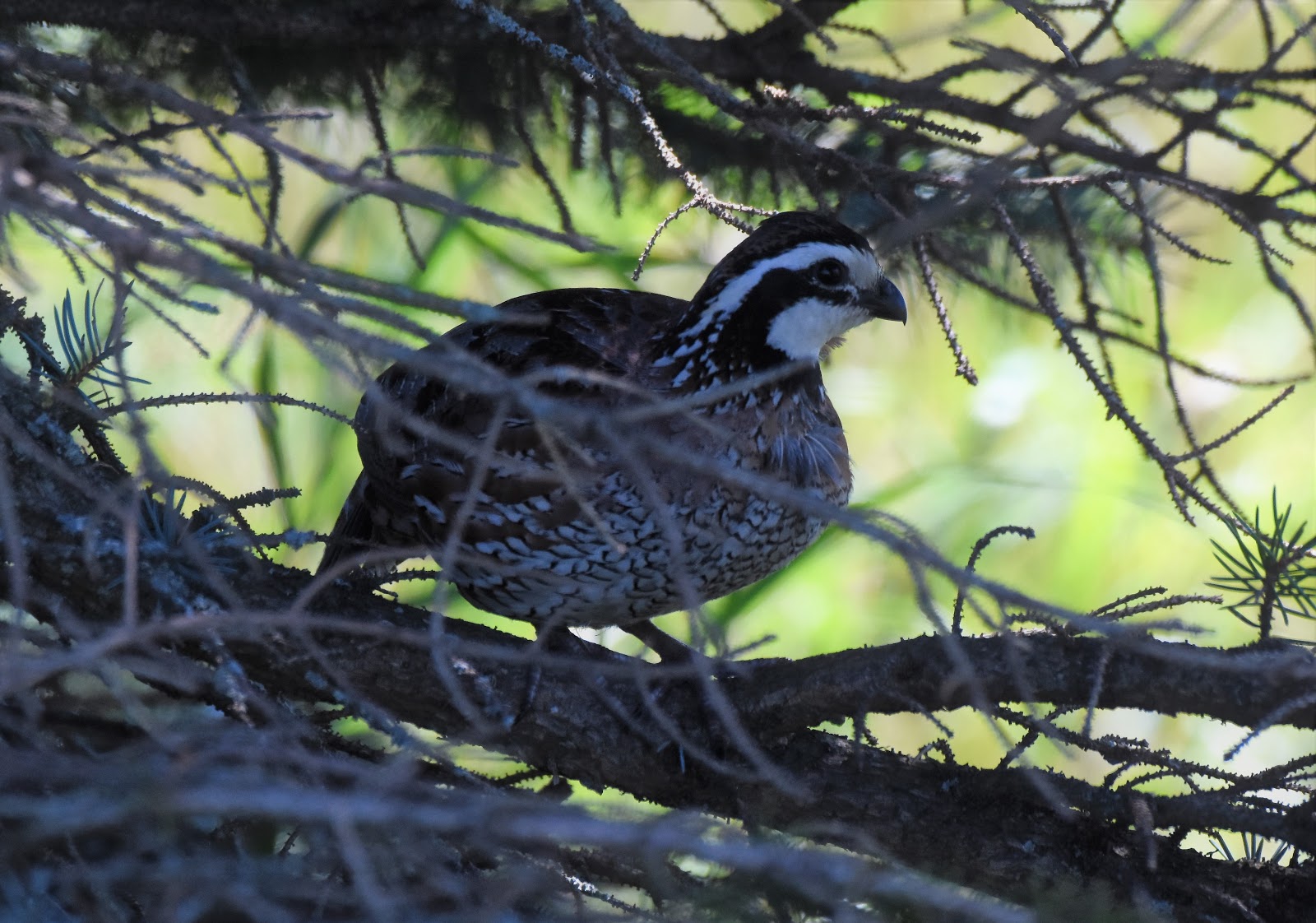
a Northern Bobwhite in Wisconsin
Finally.  There are two great mentions here.  We cannot forget these Arizona birds.  And it's important to note their status.  The Northern Bobwhite was once commonly found in the southern grasslands of Arizona.  Some even say that there are still small populations that continue along the US/Mexican border.  They are a unique subspecies of Northern Bobwhite that are often called Masked Bobwhite.  


Similar to the Masked Bobwhite, this is another subspecies of Northern Bobwhite in Chiapas, Mexico
This subspecies of bobwhite was wiped out from the area due to cattle grazing.  Today as the Federal Government restores the grasslands of the Buenos Aires Wildlife Refuge, it faces the huge task of reintroducing this species back onto their former grasslands. They have a facility that contains 98% of the world's population of Masked Bobwhite. The Phoenix and San Diego Zoos are also involved now to protect these birds from another possible avian flu epidemic.  It has been a decades struggle and their reintroduction has hit many bumps which include disease and domestication. Today, workers are trying something new and perhaps, Arizona will one day have a wild and special population of Northern Bobwhite living freely in the grasslands along the border. 


Greater Sage-Grouse in the Pacific Northwest
And finally, it is important to note that Arizona was once home to a small population of Greater Sage-Grouse in the very northern regions of the state along the Utah border. I remember asking myself this question years ago.  Why couldn't there be Greater Sage-Grouse here?  Over time, I discovered from study and conversations that their ranges across the US and Canada have seen drastic changes over the decades as housing and farming developments destroyed a lot of their habitat.....and leks.  In a recent report, their populations have risen sharply which gives me hope for their future.  Will they ever return back to Arizona?  Is there a lek we don't know about along the border?  These are questions that only time will answer.  


Photo not mine.  This is from Tucson Daily Photo
I love the chicken birds. In Arizona, you can reliably count on 5 species of grouse, quail and turkey.  The question is. Can you find them all? I still need to find that darn Dusky Grouse!  My next series will be on Grebes and Loons.  Until next time.....