Showing posts with label Costa Rica. Show all posts

Wednesday, July 5, 2017

Costa Rican Birding


Our summer series this year takes us to beautiful Costa Rica. It starts with a thought.  Then a rough draft follows with many hours of research to back up our proposed plan.  Areas are targeted for specific birds.  Transportation needs connect the dots and maximize our bird surveys so that we don't lose any valuable time.  Lodging is equally important as it needs to be centrally located to nearby birdy hotspots.  No guide is needed if you sketch it all out and research. And Costa Rica is one of the easiest countries to explore!

Yellow-green Vireo
In the very begininng, we had to choose a route that made sense.  Obviously, we couldn't cover the entire country in two weeks but we could maximize our birding efforts in many spots along a tightly planned cirquit.  Over the next several weeks, we'll go from the underbirded Liberia to the often birded areas of Playa Tamarindo, Arenal, CaƱo Negro, Monteverde, the Talamanca Highlands, Rancho Naturalista and the general San Jose area.  

Gordon carefully searches along the river for the Amazon Kingfisher
We began our trek in Liberia.  There are 2 airports in Costa Rica.  The cheapest option for us was Liberia.  Having never been there, I thought it would be fun to add data to the area since it was underbirded.  I gave Micheal the "lodging" task.  His mission?  Seek out places located in wide and varied habitat.  He'd present me 3 or 4 options for each place and then I'd contact Gordon to confirm if the price was right.   

Rufous-naped Wren
Coming from the desert right now, which is 110+ degrees, I needed something cooler.  While Liberia is NOT hot, it is very HUMID.  Situated near the Pacific Ocean and during rainy season made birding a challenge.  BUT.  There were birds:)

We explore the secret confines of a plantain grove.  The mosquitoes explore my legs. 
Our home for 3 nights would take place a little ways outside of Liberia.  There we'd have a wide variety of habitat to explore including farmland for Southern Lapwings, sugar cane fields for grassquits, seedeaters, rails and a certain Crested Bobwhite.  Little ponds around our place gave us a lot of observation of ducks, jacanas and kingfishers.  And only several feet away, we had a river flow nearby for caiman and other birds.  The property also contained pieces of untouched rain forest that is home to the forest birds.  


Micheal found a place on Airbnb that fit all of our criteria at Casita Del Lago.  Like it means in Spanish, this little home was situated near a pond. It had a kitchen and nice bedroom.  Unfortunately, for our friend Gordon, the pull out was not big enough and I worried about his sleep.  He doesn't sleep much anyway but when he did, I worried he wouldn't be able to recharge his batteries properly. We made it through the experience and the property was truly amazing.  Our hosts, Carmen and Steve were wonderful people and super helpful!  I really liked both of them.  Carmen took us to the supermarket where we bought all of our goodies.  And it was the only time on the trip that we had control of making our own food.  

Crested Bobwhite
We chose Liberia first because it would allow us to settle a little before the bigger treks.  It was also the roughest in terms of weather and bugs.  I have spoken with bird guides about how they set up their clients and we agree that the first part of the trek should be the roughest and by the end, it should be pure comfort:)  And that is how we did it. 

While bridges are not Gordon's thing, we often had to cross them during our treks
Because we were dealing with the humid conditions along farmland roads, the bugs were terrible. So was the mud.  BUT, we wouldn't have added a few specialty birds like Southern Lapwing and Crested Bobwhite to our lists.  It's funny how a Wood Stork will still make me go crazy.  I ran with Gordon through the swampy grasses and felt a...bite.  OH %$^#!  It felt like I had sprained my ankle but I have had this happen once before to know it was a bite.  My right foot had become quite swollen and looked terrible!  Micheal told me to elevate my foot at night and compress it during the day with tight socks and shoes.  So I did and it went away.  There is a bug that lives in that area that likes to lay eggs in human flesh.  We were in the right habitat when it happened so I worried that I'd be raising some unwanted aliens in my body.  


Southern Lapwing
If you've never done tropical birding before, and you are a photographer, you will probably find this one of the most challenging places to do your work.  Most people have told me it's nearly impossible to get good photos of these birds.  But I'll show you that it isn't impossible to capture these beautiful birds at all.  After several runs to Central and South America, I've learned a thing or two about lighting....and um....bumping up my ISO:)  No flash is used.

Black-bellied Whistling-Duck
Each day in Liberia, we'd head out and add new(and old) birds to the property list.  

Orange-fronted Parakeets
After our massive sweat session, we'd come home and freshen up for some good reads.....or for a chance to wind down. 


I found this book in the casita and discovered that there must be some science fiction fans out there. This superhero apparently possesses the power of lightning like my favorite superhero of all time, Storm!  Magical!  As for the revelation?  Well, I didn't have time to read the book.  However, I did find time to read my 2 pound novel, A Guide to the Birds of Costa Rica.  I'm still digesting all the info!  Powerful stuff!

Stripe-headed Sparrow
I quickly fell in love with the simplicity of Costa Rican cuisine.  It's not Mexican.  Nothing can ever be Mexican.  Mexican food is uniquely Mexican.  It's delicious and amazing.  Guatemala is a close 2nd to Mexican food.  But hey!  If you like rice, beans, plantains and chicken (and I do), you're going to love Costa Rican food. And you can add as much tabasco sauce or my fav, Lizano Sauce as you want.  Try their Casona(Cah-so-nah) for lunch or dinner. But whatever you do, always start your day with Gallo Pinto(Guy-oh Peen-toe).  And let's not forget Costa Rican coffee....


This is the adult(above) and juvenile(below) Bare-throated Tiger-Heron 


As a Spanish teacher and world traveler, I highly recommend Costa Rica to ANY birder thinking of leaving their country's comfort zones.  There are a lot of birds in this country.  There's also a lot of beautiful scenery. It's geared towards birders.  And for the most part, it's super safe.  However, common sense is always required anywhere you go.  

Rufous-browed Motmot
Costa Rica, to my surprise, accepts the US dollar EVERYWHERE you go!  A Costa Rican colon can be confusing at first. I think 1000 colones is like 2 dollars.  And the coins are the heaviest thing you've ever put in your pockets.  So during our trek, my mission was to get rid of the coins as quickly as I could.  My shorts almost fell off a couple times because of their heavy weight!  Thankfully, I had a belt. 

Streak-backed Oriole in nest
Generally speaking, the Costa Rican people are wonderful.  I forget the slower pace of life that happens outside of the US.  I forget that people have manners.  Where have ours gone?  I remember a time when people were polite to one another.  Oh sure, the cell phone issue is the same.  Everyone is addicted to them but overall, the people allowed for conversation to happen.  At dinner, it wasn't the waiter giving us our bill after we gulped down our food; it was me signalling to the waiter that it was time for us to leave.  I like that sense of, "Take your time. Enjoy. Digest." thinking.  However some days were exhausting and I almost fell asleep at dinner.  I'm pretty sure that is not appropriate:)

Roadside Hawk
I look forward to sharing with you all the places we visited.  Sometimes I'll expand on stories I heard from others in a creative manner while for my other writes, I'll give you the play by play.  But at the end of each of these posts, I'll put up our ebird checklists for the locations we visited so that if you do decide to explore Costa Rica, you have an idea about the birds you'll find in each of the areas. 


White-lored Gnatcatcher above and below. 


Each day I added lifebirds.  By the end of my trip, I added over 80 new birds bringing up my total life list to 842.  I began with 760. This blog is about finding 10000 lifebirds.  I hope to hit a thousand by next year. So yes, the trips have already been planned and I'm looking forward to the journalism that will follow these very special treks.  They will be quite unique, from a birder's point of view.  And I can't wait to see how the experiences will all play out surrounding the lifebird journey. 

Tropical Mockingbird
So for now, we'll look up into the canopy of the dark forest...... 

Malachite Butterfly
We'll listen for certain calls......


And let our eyes adjust to the green.  Because when we do, we'll find that there are creatures looking back at us:)

Iguana
Liberia was a blast.  So what are these two birds waiting for at the bus station?  Stay tuned for my next report.  Our ebird reports are below.  Until next time!


For the Casita Del Lago report, click here. 

For the Hilton/Airport report, click here. 


Tuesday, November 6, 2012

My First Real Bird Observation


Before I get started with today's write, I want to apologize.  Blogging has become difficult with everything going on here in Southern Arizona.  I have been extremely busy with work and along with cooler temps, I have been out in the field more working and doing photography shoots. I'm back today again and look forward to catching up with everyone.  I have some amazing stuff coming up.  On one shoot, I actually killed my battery for the first time in camera history.  Thankfully I now have a spare camera:) Now for today's write.
My first real bird outing began back in June of 1997.  I write this post because a funny thing happened.  I've begun to document the work from my world travel.  And for the first time EBIRD questioned my data.  This is okay.  Thankfully, I know I am not losing my mind because I have photography from my college days(before I could afford a great camera) that support my memories. I loved photography as much as I do today. Today I'll take you into my first trek as a birder.  And surprisingly, I hadn't a clue that this day would be the first of my birding documentation.  It also made me smile because another birder by the name of Phoebe Snetsinger was still out there birding.  And in some strange way it made me smile.  Perhaps we crossed paths at one point during my crazy travels.  She was one serious birder while the other(me) blindly went partying with the people absorbing language data:)

My friend Kathie taught me about using EBIRD.  And it's a GREAT idea!!!  But she also warned me that I may get emails from bird doctors and specialists studying data.  I understood that and have no problem whatsoever clarifying my work and observations.

Mostly all of it has photo documentation to go with it.  I feel that if I don't see the bird or animal, it doesn't count as a sighting.  And if I don't get it on camera, it does not count as a real sighting.  Recently, I submitted a special day in Costa Rica back in '97 dedicated to my mother who loves all things parrots.  I combed the beach for the last remaining flocks of Scarlet Macaws at Corcovado National Park. We raised Macaws from eggs at my house.  My mother is a crazy parrot lady and many times our house in Wisconsin would sound like the Amazon rain forest.  I am not one for birds in cages and wanted dearly to see these amazing birds in their natural habitat.  So I researched and found the last remaining areas where they roamed freely.  And in the summer of '97 I left for Costa Rica in search of the Scarlet Macaws.
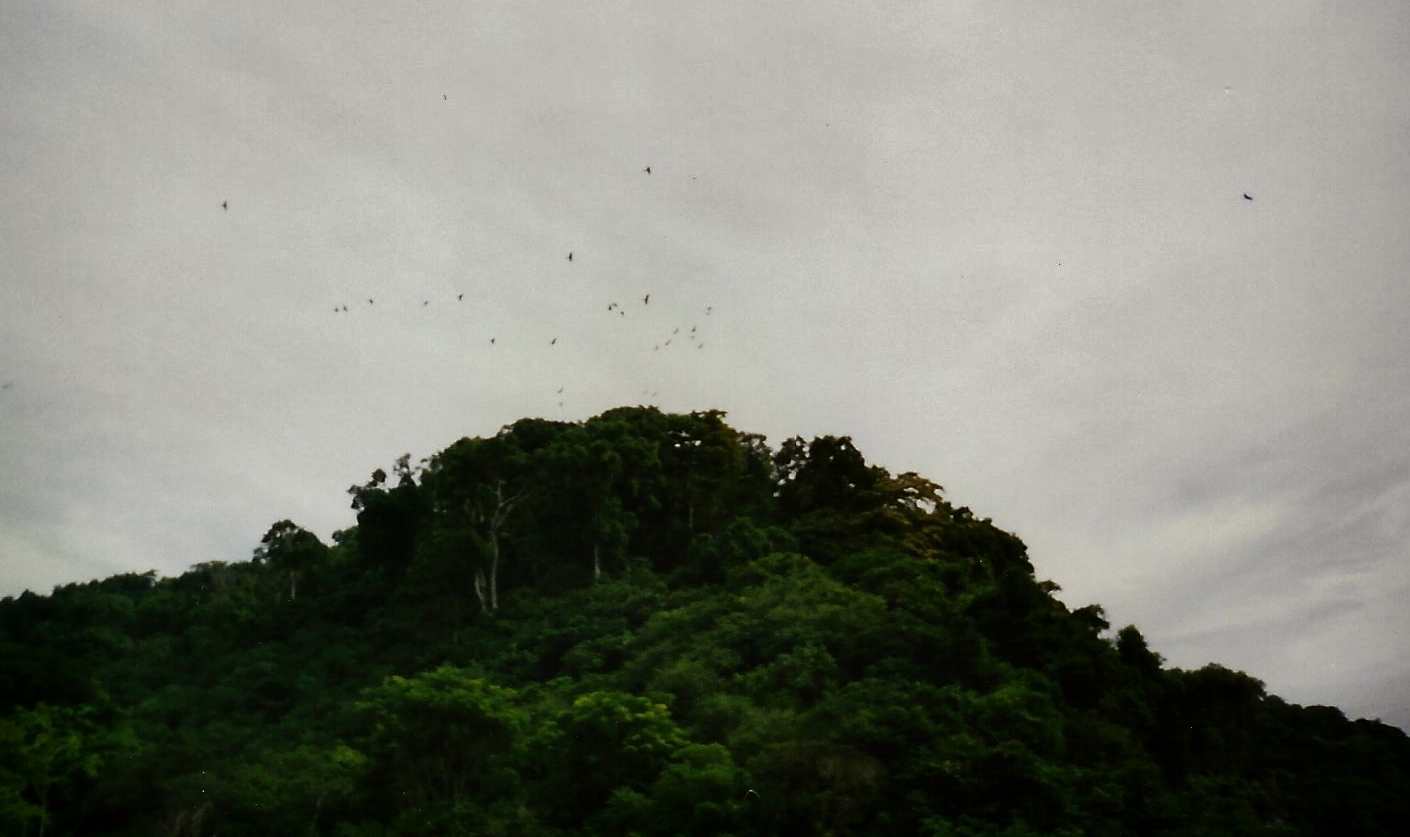
This is the 2nd flock with 26 macaws. You need to blow this pic up to see the specks:)
We arrived at the park via a truck early in the morning with our only food in a backpack and mosquito net.  We fought mosquitoes, boa constrictors, and caiman.  It was like the Lost World of Jurassic Park.  And my 3 friends and I walked alone along the coast of the Pacific Ocean.  One day I left them behind to observe Scarlet Macaws.  It would become my first serious documentation of birds and I needed pics to show my mother. I studied their flight patterns and eating habits.  I spoke with locals(thank you Spanish!) and figured out where they'd be hanging out.
First flock of 21.  There were more but the camera only caught part of the flock.
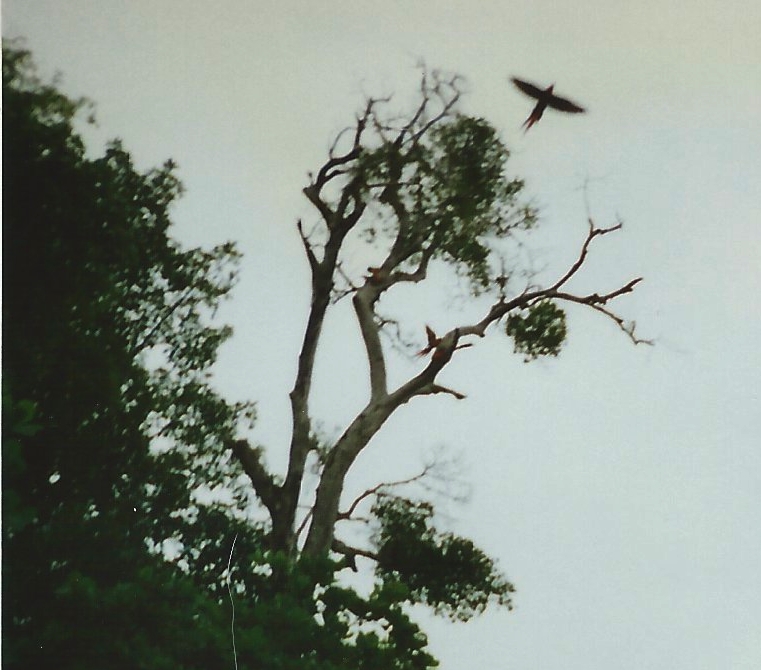
And I waited.  Loud squawking could be heard nearing my position. And it was exciting.  I'd see them....these magical birds.  3 flocks during my morning observation would pass over my head.  I'd track them to the trees and write down their behaviors etc to send a letter back home to my family.  In all I had counted near 80 of them and it was incredible. They were like scarlet clouds along the tropical edges of the forest.
The 3rd flock leaving.  
Back to EBIRD.  A question came back to me.  This number seems incredibly high.  I was saddened by the possibility that perhaps these birds do not number as they once did.

So I pulled out the old dusty photo album and counted the black specks in the air and confirmed that my numbers were accurate.  I was disappointed at the time because I wasn't able to get the shots that I do now, but somehow last night I was happy to be able to see the dark specs in the sky.
Since my journeys to Costa Rica, I have also spotted them in the Amazon Rain Forest during a breakfast with several curious monkeys:), and heard them on the isolated island of Coiba near Panama.  But since I am taking this birding thing seriously now, I can officially tell that for me, my documentation began during the summer of 1997 in Costa Rica.  While it was specific to only the Scarlet Macaw, it still counts as a valid bird outing.
 More tomorrow....

Thursday, May 26, 2011

A Costa Rican Adventure

The Coati
My friend and colleague, Cris Robson, just came back from a trip to Costa Rica.  She teaches Environmental Science and Biology at our school and LOVES what she does.  Cris got into teaching after she worked in the science field for awhile.  Today she's taking over this blog with her pics from the Costa Rica trip and you'll see some of the places she went to visit.  A first for Las Aventuras, here is guest photographer Cris Robson.......
The Coati can be found in Tucson.  Here they seem almost domesticated.  These animals are very much like racoons:)

I wonder if the tails up, like with cats, means....TREATS!  They look pampered:)

A termite nest

Look closely.....Iguanas on the move!

A form of gunnera....a very large plant and one of my favorites:)
This DOES NOT grow in Tucson:)  I know....I've tried.

The active volcano Arenal covered in clouds.

Costa Rican fun along the coffee side of the world.

Waterfalls are both mysterious and beautiful.


I look forward to sharing our Panama adventures with you.  When Cris came back, I was really excited to hear her stories about Costa Rica.  While I've been to these places, it's always fun to hear others reactions.  Tomorrow is another first of some fun photography shoots in Arizona.  I hope you enjoy as we take a break from the final part of my plant journal.


Friday, May 6, 2011

Extinction

A recent post that I read today in the midst of final exam review was from the MSN website. I think what shocked me the most was that there were several animals on this list that I wasn't aware were even extinct. Before we begin with my Mother's Day special, I thought I'd share this article as its message has lingered in my head all day. The article is titled Extinct in Our Lifetime and 11 Species We've Lost Forever. 


It's hard not to feel about such things like extinction. We must protect our Earth now.  I fear that people will only understand the importance of protecting habitat after the fact.  Something to think about when we create our garden spaces......

"Charles H. Smith / U.S. Fish and Wildlife Service
Golden Toad (1989)
The golden toad is not the only species to disappear in the past 40 years, but it might just be the brightest. This fluorescent amphibian was found in the high-altitude ridges of Costa Rica, but thanks to pollution, global warming and fungal skin infections, the species became extinct in 1989.
Read on to find out about 10 other incredible species we've lost in the last several decades.

Helle V. Goldman and Jon Winther-Hansen
Zanzibar Leopard (1996)
One of several subspecies of leopard, the Zanzibar leopard made its home on the Zanzibar archipelago of Tanzania. It's still unclear whether this large cat is technically extinct — there are occasional unconfirmed sightings.
Cause of extinction: Locals believed the leopards were kept by witches, and aggressively hunted them. The animals were seen as evil predators that must be exterminated — and even the government was in on the campaign. In the mid-'90s there was a short-lived conservation effort but it was deemed too little, too late.

Paul E. Baker / U.S. Fish and Wildlife Service
Po'ouli (2004)

A native of Maui, Hawaii, the Po'ouli, or Black-faced Honeycreeper, was only discovered in the 1970s. The birds inhabited the southwestern slope of Haleakala volcano. But the population declined rapidly, and by 1997 there were only three known Po'ouli left. Efforts to mate the remaining birds failed and the species was formally declared extinct seven years later.
Cause of extinction: Habitat loss, along with disease, predators and a decline in its food source — native tree snails — are all seen as reasons for the bird's demise.

A. E. Holt-White via Wikimedia Commons
Madeiran Large White (2007)

The stunning Madeiran Large White butterfly was found in the valleys of the Laurisilva forests on Portugal’s Madeira Islands. The butterfly's closest relative, the Large White, is common across Europe, Africa and Asia.
Cause of extinction: Loss of habitat due to construction as well as pollution from agricultural fertilizers are two major causes of the species' decline.

E. Theriot / U.S. Fish and Wildlife Service
Tecopa Pupfish (1982)

The Tecopa pupfish, a native of the hot springs of the Mojave Desert, has the distinction of being the first animal declared extinct under the provisions of the Endangered Species Act of 1973. The pupfish's decline was precipitated when its natural habitat was encroached upon by developers.
Cause of extinction: Destruction of natural habitat.


Pyrenean Ibex (2000)

The last Pyrenean ibex died in 2000. However, a cloned ibex, created from skin samples taken from the last Pyrenean ibex, was birthed in 2009. It died shortly after birth from lung complications.
Cause of extinction: Hunting of the ibex had caused the animal's numbers to seriously dwindle and conservationists blame the Spanish government for failing to act in time to save it.


West African Black Rhinoceros (2006)

The majestic West African black rhino was declared extinct in 2006, after conservationists failed to find any in their last remaining habitat in Cameroon. The West African black rhino was one of four subspecies of rhinoceros.
Cause of extinction: Poachers hunted the rhino for its horn, which is believed by some in Yemen and China to possess aphrodisiacal powers.


Javan Tiger (1979)

Similar in appearance to the Sumatran tiger, the Javan tiger was native to the Indonesian island of Java. In the 1800s they were so common they were considered pests by island natives, but as the island was developed their population dwindled. By the 1950s, only 20 tigers remained.
Cause of extinction: Loss of habitat and agricultural development led to severe population decline. Conservation efforts in the 1940s and '50s were unsuccessful due to a lack of adequate land and planning.
Spix's Macaw (2004)

Spix's Macaw, also called the Little Blue Macaw, was known for its beautiful blue feathers. While some still exist in captivity, these tiny blue birds are extinct in the wild.
Cause of extinction: Habitat destruction and illegal trapping and trade contributed to the macaw's dwindling numbers.


Round Island Burrowing Boa (1975)

Native to Round Island, a tiny island off the coast of Mauritius, the Round Island Burrowing Boa preferred to live on the topsoil layers of volcanic slopes. It was once found on several other islands around Mauritius, but its population had dwindled by the 1940s, and it could only be found on Round Island after 1949. It was last seen in 1975.
Cause of extinction: The introduction of non-native species of rabbits and goats to the island destroyed vegetation and upset the boa’s habitat.


Dutch Alcon Blue Butterfly (1979)

This Dutch butterfly — a subspecies of the Alcon Blue — was found mainly in the grasslands of The Netherlands. While closely related species (pictured here) still exist in parts of Europe and Asia, the last Dutch Alcon Blue was seen in the wild in 1979.
Cause of extinction: Increases in farming and building had a negative impact on the Alcon Blue's habitat and caused it to lose its main food source."
Source: http://lifestyle.msn.com/your-life/earth-day/staticslideshowdg.aspx?cp-documentid=23728241&GT1=32018