Showing posts with label Scarlet Macaw. Show all posts

Saturday, November 30, 2013

Sanctuary


Our bodies were exhausted.  Our minds, from the constant day to day challenges, were fried.  Camera straps bruised  my shoulder.  The constant carrying of equipment, guarding our gear and securing it all was draining.  On our last night, Lynda purchased a little piece of joy in the form of a 5 star hotel.


The place was secure, relaxing.......and a place to let our hair down.  Guatemala has lots of wonderful accommodations in Antigua and Flores, but they become harder to find as you leave these areas. We entered the dark monastery and discovered a peaceful retreat where we could finally sleep. Our showers were hot. And most of all, the place was hidden from the rest of the world. 

The hotel is built around former monastery ruins.  It is a place for the rich to relax and escape before heading home. For us, it was a treat to have just one night here.  In the background, recordings of chanting monks are played throughout the old stone hallways.


At night, the solitary blue green waters of the pool called to me. My body was sore and bruised from the bird hikes.  And I submerged into the steamy waters alone and let my body finally relax.  No more birds.  No more anything.  For two hours, I watched the monsoon skies light up the top of a volcano. And I allowed myself to clear all my thoughts so that nothing remained inside.  No stress.  No worries.  No words.  Just the deeper reflections in life that nothing is really THAT important nor worth the stress that we all carry within ourselves.  All that matters is now.  I watched water glide with the movement of my hands. Water evaporated from the pool like the mist does from the early morning hours on the Amazon river. A breeze carried the ancient songs from the Baroque period. A singular...solitary...moment.


For within this museum/hotel, I was reminded that it's all we have. It is strange to compare our now with their past.  Were not their emotions similar to our own?  How much of what we do truly matters? A universal truth for all of us.


My mind wanders much these days.  Perhaps it's the wildlife chases.  Perhaps it's about getting older. Perhaps it's that there isn't much to say that hasn't already been said before.  It's one historical repeat after another. Are we as different than those who came before us?  It's all a bit humbling.


On our last night and day in Guatemala, we walked the historical grounds of the hotel.  It was nice to have peace of mind after long and challenging treks both mental and physical. As one adventure ends, another is just waiting to be discovered.........


Tuesday, November 6, 2012

My First Real Bird Observation


Before I get started with today's write, I want to apologize.  Blogging has become difficult with everything going on here in Southern Arizona.  I have been extremely busy with work and along with cooler temps, I have been out in the field more working and doing photography shoots. I'm back today again and look forward to catching up with everyone.  I have some amazing stuff coming up.  On one shoot, I actually killed my battery for the first time in camera history.  Thankfully I now have a spare camera:) Now for today's write.
My first real bird outing began back in June of 1997.  I write this post because a funny thing happened.  I've begun to document the work from my world travel.  And for the first time EBIRD questioned my data.  This is okay.  Thankfully, I know I am not losing my mind because I have photography from my college days(before I could afford a great camera) that support my memories. I loved photography as much as I do today. Today I'll take you into my first trek as a birder.  And surprisingly, I hadn't a clue that this day would be the first of my birding documentation.  It also made me smile because another birder by the name of Phoebe Snetsinger was still out there birding.  And in some strange way it made me smile.  Perhaps we crossed paths at one point during my crazy travels.  She was one serious birder while the other(me) blindly went partying with the people absorbing language data:)

My friend Kathie taught me about using EBIRD.  And it's a GREAT idea!!!  But she also warned me that I may get emails from bird doctors and specialists studying data.  I understood that and have no problem whatsoever clarifying my work and observations.

Mostly all of it has photo documentation to go with it.  I feel that if I don't see the bird or animal, it doesn't count as a sighting.  And if I don't get it on camera, it does not count as a real sighting.  Recently, I submitted a special day in Costa Rica back in '97 dedicated to my mother who loves all things parrots.  I combed the beach for the last remaining flocks of Scarlet Macaws at Corcovado National Park. We raised Macaws from eggs at my house.  My mother is a crazy parrot lady and many times our house in Wisconsin would sound like the Amazon rain forest.  I am not one for birds in cages and wanted dearly to see these amazing birds in their natural habitat.  So I researched and found the last remaining areas where they roamed freely.  And in the summer of '97 I left for Costa Rica in search of the Scarlet Macaws.
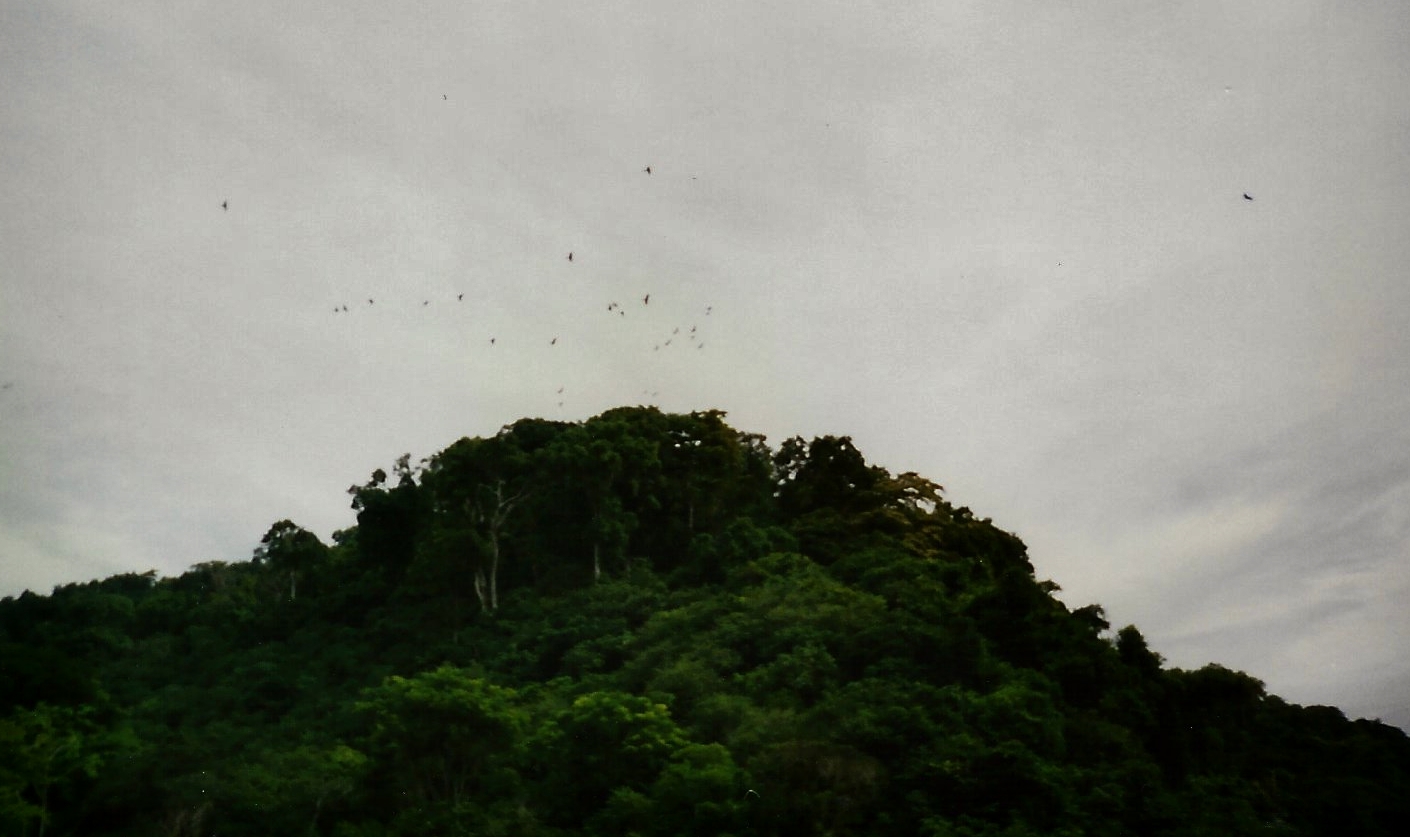
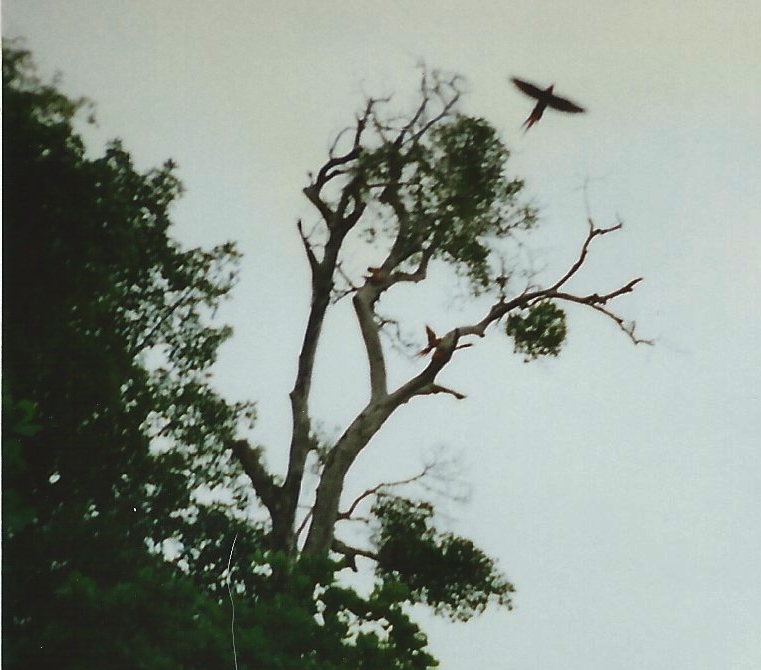
This is the 2nd flock with 26 macaws. You need to blow this pic up to see the specks:)
We arrived at the park via a truck early in the morning with our only food in a backpack and mosquito net.  We fought mosquitoes, boa constrictors, and caiman.  It was like the Lost World of Jurassic Park.  And my 3 friends and I walked alone along the coast of the Pacific Ocean.  One day I left them behind to observe Scarlet Macaws.  It would become my first serious documentation of birds and I needed pics to show my mother. I studied their flight patterns and eating habits.  I spoke with locals(thank you Spanish!) and figured out where they'd be hanging out.
First flock of 21.  There were more but the camera only caught part of the flock.
And I waited.  Loud squawking could be heard nearing my position. And it was exciting.  I'd see them....these magical birds.  3 flocks during my morning observation would pass over my head.  I'd track them to the trees and write down their behaviors etc to send a letter back home to my family.  In all I had counted near 80 of them and it was incredible. They were like scarlet clouds along the tropical edges of the forest.
The 3rd flock leaving.  
Back to EBIRD.  A question came back to me.  This number seems incredibly high.  I was saddened by the possibility that perhaps these birds do not number as they once did.

So I pulled out the old dusty photo album and counted the black specks in the air and confirmed that my numbers were accurate.  I was disappointed at the time because I wasn't able to get the shots that I do now, but somehow last night I was happy to be able to see the dark specs in the sky.
Since my journeys to Costa Rica, I have also spotted them in the Amazon Rain Forest during a breakfast with several curious monkeys:), and heard them on the isolated island of Coiba near Panama.  But since I am taking this birding thing seriously now, I can officially tell that for me, my documentation began during the summer of 1997 in Costa Rica.  While it was specific to only the Scarlet Macaw, it still counts as a valid bird outing.
 More tomorrow....

Monday, August 8, 2011

Monkey Business

The White Capuchin Monkey
What would a rain forest trip be without seeing monkeys?  Everyone goes expecting to see them and some people succeed.  My first time in the rain forest was the most disappointing because I NEVER got a good look at them.  They were high up in the trees and fast moving.  Over the years, I discovered that early mornings, sunsets, water and fruit were attractions for lots of monkeys.  But you had to keep your eyes open and your mouth shut.  Today is a fun post with A LOT of pics from the Wildlife Rescue and Rehab center known as La Jungla which is run by Dorothy "aka Queen of the Jungle".  She originally hails from Florida and began working the wildlife rehab in Boquete. Here are some random and fun facts from my travels abroad observing both wild and "tame" monkeys.  

First off, I have to mention that I went through massive withdrawals without my 5 cats.  So when I was at this rehab, I spent too much time with these very active monkeys.  Both of the monkeys in this particular area were former pets from owners who no longer had space for them.  They played as if they were siblings and it was really cute.  Handling monkeys is a strange experience....because they have tails that act like a 3rd hand.  They are also quite intelligent and possess skills that no ordinary dog or cat has. You have to wonder why people would kill or trap such a magnificent animal that is in so many ways like us.
Here he is on my arm for a brief moment before jumping off.  On this particular trip, I witnessed wild capuchin on Coiba Island.  They were throwing mangos at our cabin in the morning.  I'll show those pics during the Coiba highlights post.  Capuchin monkeys are very curious creatures.  In the wild, they watch from a distance.  As former pets, they are like a younger brother or sister:) I imagine my cabinets and fridge at home and the food all over the floor!!
This look(above) was for the camera....as in stop taking pics of me!  Panama has several species of monkeys which also include the very loud howler monkeys.  My first experience with a howler was with Pepe in the Amazon.  He was smelly, big, and at times dirty.  At night, he would take my underwear out of my backpack along with other clothes.  In the morning I would wake up to find them all over our bungalow!  Howlers have a very scary call that can send chills up and down your spine, but they are, for the most part, peaceful creatures.  One day we found Pepe eating out of a fruit bowl.  I filmed some video and it's on this blog from last year.  Just type in Peru and the Amazon and you should be able to find that vid.  In Panama, there are two types of howler....one is brown while the other is black and only found on Coiba island.  They are commonly found in most places where there is rain forest.
This is my friend Desiree.  Our Capuchin friend bounced all over the place because he was excited to see us.  Now that normally isn't the case in the wild.  Monkeys have been known to throw their feces at people from above.  They've also been known to bite.  In Cape Verde, during my Peace Corps years, I remember watching a green monkey attack a woman with a broom on top of her roof while trying to do her laundry.  I tried to keep a straight face while teaching the very boring English language. 

This guy was fast.  The White Faced Capuchin is also commonly found in Panama wherever there is rain forest.  While I question wildlife rescue and rehab places anywhere I go(including my own country), I do see a need for them.  Here's a thought to ponder.  It has been known that poachers will kill an animal for their fur and then discover a litter of babies.  They then take these babies to rehab centers and ask for money or they'll kill them.  I don't know what the answer to this is because my mother was/is kind of a rescue person for parrots herself.  People really need to think about what they're doing when they adopt a macaw or monkey!!  My house is full of macaws and African Gray parrots that were raised from eggs donated to my mother because the owners could no longer care for them.  My concern for this particular issue is....what happens when my parents pass?  Someone on this trip gave me the idea that I need to sit down with them and have a will made up for these magnificent birds....perhaps a local zoo where they could educate kids and live a full life?   Do you see the dilemna? If you don't know, parrots usually outlive their owners.  My 5 other siblings have expressed concern over these "other members" of our family.  I got the sense that Dorothy didn't do this kind of business, but she did say that lots of people now come to visit her because they have these animals that they no longer want.  What would you do?  I'm an animal lover and when an animal is hurt or suffering, my heart bleeds.  I'll do anything for them.  Why?  Because animals are pure beautiful beings. 
Here I am with my arms full of sand fly bites and two monkeys playing.  The bottom monkey is the "mono titi" or the squirrel monkey.  He is endangered unfortuneatly unlike his companion. They both wanted attention and were wrestling me for it.
This pic with Desiree reminds me of how my cats look at me when I am on the couch relaxing.  Look at that squirrel monkey's face!!
Human to monkey ratio.
Lots of monkey love! This little guy decided to eat banana and get it all over my shirt.  No table manners at all:)
Exhausted after playing with us for awhile.

The Jungla Rescue and Rehab is 20 minutes away from downtown Boquete. There was a black monkey that was severely beaten by its former owner and is currently in the rehab area.  There was a Tamarin monkey as well.  He was a bit shy, but I did get a nice shot of him.  Dorothy had several birds including a scarlet macaw.  Of these two species, both are critically endangered in the wild habitat of Panama.  Panama is certainly not Costa Rica in that it has decimated a lot of rain forest for agriculture. Different needs from different countries.  I'll get into more of that later on. But you do need to think about this....Costa Rica's number one focus is tourism.  Panama's is agriculture.  Only now is Panama trying to attract more tourists to the country and protecting several large and unexplored areas of rain forest....which is a postive thing.  The Tamarin monkey can still be found in the very dangerous and unexplored  Darien Gap.  We couldn't get there due to the heavy rains which flood most of this area during this time of year.  The Scarlet Macaw has a large colony that is increasing on the sacred island of Coiba.  I will be able to take you there.....all I can say is that it was magical.  When you walk into primary forest, nothing in the world prepares you for the sights and sounds of unmapped jungle.  We had a great time at Jungla and I'd like to thank Dorothy for the opportunity to get an up close and personal view of many amazing jungle critters. While we were there, several possums were being relocated to farms to help with the poisonous snake issues (because possums eat snake...and pretty much everything else:).  They found the family of possums in a home and normally they would be killed, but Dorothy convinced the homeowners that they could be relocated....and they were.    I created 4 videos that I will be presenting over the course of the next several weeks. Several video shots will include our visit to this very fun center.

the Tamarin Monkey with my Canon.....I love my camera!
This monkey is very shy in the wild. He did like marshmellows:) The Tamarin monkey is on the lower end of the totem pole when it comes to dominance in the rain forest.  Other monkeys will attack and kill these little guys.  Therefore they go to bed earlier than most monkeys.  They also sound like birds chirping in the wild allowing themselves to go unseen by predators.
Jungla Wildlife Rescue & Rehab
                                                                         Dorothy
Telephone 6968-6010
A donation is asked at the door


More tomorrow friends....

Wednesday, April 13, 2011

Coiba Island

Do you like mysteries?  I certainly do.  It's been awhile since I've written one of these posts, but you have to ask yourself, "Why would someone do this?" or "How did this happen?"  A penal colony was placed on an island in a tropical virgen forest! Today, during my research into the beautiful country of Panama, we stumbled on some information that grabbed our attention. And I want to know more!  The pics and info below are not my own, but we are investigating some great places to visit over the summer and this one has our team's interest.  It also seems a cancer fighting compound was found on Coiba from a plant indigenous and found only on this island.  The report was made public last month that a "Blue-green algae, or cyanobacteria, has yielded Coibamide A, which is extremely active against cancer cells; Veraguamide A, an anti-cancer compound named after Panama’s Veraguas Province."

Some of you may or may not know this, but we are going to be traveling to Panama this summer and during our investigations we've set up several awesome mini-trips within the big trip.  Don't worry as I'll be recording everything.  We have scored a week with the turtle conservation program in Bocas and will be in Gamboas on Pipeline road for some amazing bird and plant finds.  We'll be taking an amazing train ride to Colon and flying to the tropical islands around the Bocas area!

Unfortuneatly, the Darien Gap will not happen due to extremely rainy weather which put an end to the speculation of whether or not we'd do it.  During the month of June, when we'll be there, it rains constantly and the paths are not accessible.   Our trip begins June and will end the first week of July.  I have my writing all scheduled until August and then some:)  There's a lot to report.  I opened a world of endless possibilities by starting this blog.  Two major things that have my attention right now is our work with the turtle conservation program in Bocas and this fascinating island off the Panama Coast.  It's called....La Isla Coiba.

"The Coiba National Park (CNP), located in the Southeastern part of the Republic of Panama, encompasses over 2,700 square kilometers of islands, forests, beaches, mangroves and coral reefs. Among the spectacular marine and terrestrial environments of the CNP is Coiba Island, the largest uninhabited tropical forested island in the Americas. Eighty-five percent of the forests of Coiba Island are primary and almost untouched, serving as a haven for birds and mammals found nowhere else on Earth, as well as for species that have largely disappeared from the mainland. The CNP is one of the greatest remaining natural treasures in Panama. The remarkable preservation of Coiba Island is largely due to its use as a penal colony since 1920 - the prisoners have served as a strong deterrent to colonization by peasants and to the extraction of the island's abundant resources.
Penal Colony established on this lush tropical island away from the mainland
Due to the pristine nature of the island and its surrounding oceans, it was declared a National Park by the Panamanian government in 1992. But the situation in Coiba is changing radically as the government begins to close the island's penal colony. From a high of three thousand prisoners, there are now fewer than 100. Panama's National Authority of the Environment (known as ANAM) does not have the resources to protect a park of this size, particularly one that is 26 kilometers from one of Panama's most impoverished provinces. It is crucial that institutions and individuals coordinate with ANAM as well as local communities to design and implement strategies that will lead to the protection of this remarkable natural heritage.

Archaeological findings on various parts of Coiba Island indicate that the island was the site of Precolombian settlements whose populations are assumed to have disappeared shortly after the arrival of the Spanish in the 15th century (Quirós 1971). Coiba Island was designated as a penal colony in 1919 and from that point up to the present, the island has remained largely uninhabited except for an inmate population that has ranged from 100-1000 prisoners and the police force assigned to guard them. Aside from a stretch of land that has been designated for agricultural use to supply food for the inmates, the impact of the penal colony on the rest of the island has been insignificant (Ibáñez 2001).
Coiba Island and the surrounding waters are an extraordinary repository of biological wealth. Coiba Island is a refuge for 147 bird species, including twenty-one endemic species and subspecies. Equally important is the island's role as a refuge for species that have largely disappeared from the rest of Panama, such as the Crested Eagle (Morphnus guianensis) and the Scarlet Macaw (Ara macao). Scientists have registered a total of 36 species of mammals, a number of which are found nowhere else, such as the Coiba Island Agouti (Dasyproctae coibae) and the Mantled Howler Monkey (Alouatta palliata coibensis); the latter is considered to be at high risk of extinction. The main forest types on Coiba Island are tropical moist forest, very moist premontane forests, and stands of mangroves. Remarkably, most of the interior of Coiba Island is still unexplored botanically.

Preliminary botanical surveys of Coiba Island suggest that there are around 1,450 species of vascular plants, only half of which have been identified. These studies have already resulted in the discovery of an entirely new genus, endemic to Coiba Island, Desmotes (family: Rutaceae). The authors of the most recent study reported, "We do not doubt that a more detailed study will yield many more endemic species." Nowhere is the richness of the Coiba National Park more splendid than in its marine environment of 2,165 square kilometers, much of which is unexplored. The CNP includes the reef of Bahia Damas, the second largest reef in the eastern Pacific covering an expanse of 160 hectares. Reefs such as Bahia Damas have evolved under harsh and unusual circumstances, and studies of their adaptation to assaults such as EI Niño events will be of great value.

There are four whale and dolphin species that frequent the CNP, including the Killer Whale, the Humpback Whale, the Pantropical Spotted Dolphin, and the Bottlenose Dolphin, while another nineteen cetaceans visit the CNP occasionally.

It is a common practice throughout Panama for peasants to invade unoccupied lands, which are then cleared for housing and subsistence activities. The Coiba National Park is part of the province of Veraguas, the most impoverished of Panama’s interior provinces. While the presence of ANAM park guards will clearly provide an impediment to colonization by rural peasants, upon removal of the penal colony, the risk of invasions by peasants will be enhanced.
Commercial logging also poses a threat since Coiba Island has valuable hardwoods such as Anacardium excelsum, Calophyllum longifolium and Manilkara sp. which have long since disappeared from the Pacific slopes of the nearby provinces of Veraguas and Los Santos. The capture of Scarlet Macaws ( Ara macao ) for commercial sale is also a potential threat.


There are currently on Coiba Island approximately 2,029 head of cattle, 70 horses, 18 pigs, 200 dogs and 15 buffalos which belonged to the inmates associated with the penal colony. Due to the danger they pose to the island’s native flora and fauna, ANAM is currently considering options for their removal.


A study was undertaken in 2001 by participants from STRI and Duke University’s Nicholas School of the Environment in order to; (i), assess the impact and nature of illegal fishing activities in the park, (ii), to assess the fishermen’s knowledge and attitudes towards the Coiba National Park; and (iii), to develop strategies for incorporating local communities into the design, implementation and management of marine resources. The survey was carried out in fourteen fishing communities in the Gulf of Chiriquí and two commercial ports with shrimp fishing fleets. The study revealed which communities fish most frequently in the park, the fishing methods employed, the species caught (including unintended bycatch), attitudes towards the conservation of the Coiba National Park, and other issues (Moretti 2002). Six communities and ports were identified as having a significant impact on the park’s resources. Working in collaboration with Panamanian NGOs, community outreach efforts and environmental education programs are currently underway in those communities.

There is widespread fishing by commercial shrimp boats. Long lines and nylon gill nets are widely employed by local fishermen. Other fishing activities include extraction of conch and lobster. The survey results are consistent with the observations of recreational dive operators who have seen marked decreases in the number of sharks, billfish, rays, groupers and snappers over the past four to five years, the same time that commercial fishing operations increased in the Coiba National Park. Significantly, the fishermen that fish in the Coiba National Park’s boundaries showed a universal ignorance of the park’s true boundaries. Despite the extent of illegal fishing within the Coiba National Park, the survey indicated that many of the fishermen were supportive of the concept of a national park: fully 67% of the fishermen from the communities mentioned above, as well as those from the largest commercial port for shrimp fishermen, responded that the Coiba National Park was “a good thing” (Moretti 2002).


Located in the Gulf of Chiriquí, Coiba National Park is off Panama’s Pacific coast. Coiba National Park (Nacional Parque Coiba) is a group of 38 islands including Coiba Island Iguana on Isla Coiba (Isla Coiba) and the waters surrounding them and covers 430,825 acres.
Identified by UNESCO as a World Heritage Site in 2005, Coiba National Park offers rich and well preserved natural resources.

Because Isla Coiba served Panama as a penal colony, access to the island was very restricted. Almost by accident, 80% of the islands natural resources have survived untouched and flourished through limited human contact." End of article.
Source:  http://www.coibanationalpark.com/

Sounds like a place to explore and learn more about. This will be the first official trip to be recorded with the blog in mind.  Until tomorrow with more back to reality stories:)