Saturday, August 13, 2016

Dead Heat


The heat.  The hot, muggy, wet monsoonal heat. It's part of the contract we mentally signed when we agreed to live in the desert.  Anyone who says it's a dry heat, needs to visit Tucson in July through September. In fact, if you say "dry heat" to an Arizonan, they'll probably smack you:) No matter what.  It's hot here. 

The anvil builds and it's a sign that there will be a storm!
What an amazing show from Mother Nature though!  I won't lie.  During this time of year, I lock myself inside the house and watch it all from my windows.  You'd be surprised how much activity is going on out there!  But when temps are 105 degrees at 80 percent humidity, one tends to shut the curtains and imagine the possibilities of tomorrow. 


Not unlike the cold snowy winters of the north or eastern states of the US, our time of misery is now. I sit at my desk and research, crunch data, money, and plan.  Sometimes I wait for a big break in the weather to go outdoors.  And eventually, I get one!

Greater Yellowlegs
I get in my car and drive!  Migration is upon us and that means there are a lot of cool birds coming through the state.  The rain cooled air feels so good.  A cold breeze touches my skin and I discover that my goose pimples are still present.  I just stand outside, free from my chains, and breathe.  I'm birding again!  There's nothing worse than being a caged bird inside your own home!

Baird's Sandpiper
The birds seem to be happy as well.  They sit up and pose for the camera.  No sun.  No heat.  Just a wonderful moment.  That is until a Peregrine Falcon flies over and reminds everyone that they still can be eaten. 

Scaled Quail
I knew it wouldn't last forever and so I just tried to absorb the moment.  And sure enough, the next day, temperatures were on the rise as was the humidity!  The cloud cover was all but gone. 


But after the storm left, we noticed many Wilson's Warblers in our area!  During migration, storms are known for helping birds move from one area to the next!

Wilson's Warbler
While the temps are high, the birds still amaze!  Best time out here is early morning and yeah....early morning:)


Hummingbirds, peeps, warblers and so many other birds are beginning their journeys back home. May they endure the heat and long trek.  Until next time.....


Wednesday, August 10, 2016

Armchair Birding


Every summer, the AOU(American Ornithologists' Union) releases new findings and studies about birds.  Birders eagerly wait for these reports to come out because there is often a lot of new information released about the current state of the bird world. Most importantly, with the advances of genetic studies, we are finding that there are more new species of birds out there. And vice versa! Take for example, the Caribbean Coot.  Gone.  It has now been lumped back into the American Coot. I always find it a fascinating read!  Anyhow, this years splits have given me some easy "life birds".  Without having to do anything, I've added two new birds! Or as birders call it, "Armchair Birds". 


California Scrub-Jay
Birders have suspected for a long time that the Western Scrub-Jay found along the Pacific Coast was actually a different species than the one found in places like Arizona, New Mexico, Colorado, etc. There was a noticeable difference in the color between the two birds.  The Woodhouse's subspecies(was more light blue/gray) while the coastal subspecies was a brighter blue.  They even acted slightly different.  The coastal subspecies is not a shy bird as it sits upright on top of the vegetation.  The Woodhouse's does the same thing but tended to be a bit more shy. 

Woodhouse's Scrub-Jay
This year I focused on the California subspecies(now separate species) before heading over to Catalina Island. Another similar species of jay, the Island Scrub-Jay, is found on Santa Cruz island!  In the birding community, there is always talk that certain species will be split. And so I carefully made sure I noted that detail in my observations.  


Island Scrub-Jay
Today, the Western Scrub-Jay has now been officially split in the US.  The coastal subspecies is now referred to as the California Scrub-Jay.  Now when you go to California, you have to look for all the other "California" titled birds like the California Gnatcatcher, California Quail, California Thrasher, California Towhee, California Condor, California Gull and now...the California Scrub-Jay! Pretty cool!


The former Western Scrub-Jay found in Arizona(and other states) is now called the Woodhouse's Scrub-Jay.  What do these splits do to someone like myself?  Well, I have to go back into my records and separate them all. Each file is renamed!  In the case with these two jays, I had to move the photo documentation to the correct area.  In a sense, birders are librarians of data:)


However, the bird splits didn't stop there!  During my pelagic trek off the San Diego coast, several birders were kind enough to point out the subspecies of Least Storm-Petrels.  To be honest, this is a bird I'm unaccustomed to observing out in the field as I am an Arizona birder:)  It was great being with birders who could point out the subspecies of these petrels while teaching me to note the very slight differences in size and coloration. Again, I made careful notations.  

Townsend's Storm-Petrel
The Leach's Storm-Petrels were also split into 3 new species which are now known as Leach's, Ainley's and Townsend's Storm-Petrels. Apparently, this split has been a long time coming! The Townsend's Storm-Petrel is a smaller and darker bird when compared to the Leach's Storm-Petrel.  We were able to observe both species flying together for size and darkness comparisons. Yet another easy add! 


White-naped Brushfinch
And then the tropics happened. This one was about the details.  Newer species?  Yes and no.  I didn't add any here, but I had to retitle several of these birds.  Back in 2013, Las Aventuras traveled to Guatemala.  I found the White-naped Brush-finch.  I thought the title was ridiculously long.  Today, they have taken one of the hyphens out and now the bird is a White-naped Brushfinch.  The devil is in the detail:)

the "new" Lesson's Motmot
And finally for today's write.  The Blue-crowned Motmot complex.  I've been reading about this for some time and expected the splits to happen.  I just didn't know when it would happen.  I've already thought they were difficult enough to ID, but now they're even much more so!  Luckily, the region plays a big part in their ID help!


Whooping Motmot in Panama City, Panama
On a trek to Panama back in 2011, I stopped at a beautiful park called El Parque Metropolitano in Panama City.  I first began birding and had a blast here.  But I quickly discovered that my first Motmot I observed was actually the Whooping one.  How did I find out?  Well, I put Blue-crowned Motmot into ebird and it came up rare.  It all has to do with their calls and the blue caps on their head.  The Whooping Motmot's blue cap doesn't extend below the eye. Anyhow, the Blue-crowned Motmots have been split yet again.  The Whooping Motmot still stays the same, but the Blue-crowned Motmot has been broken up into two new species......the Blue-capped Motmot, now found mostly in Mexico, and the Lesson's Motmot which is found in much of Central America.  As you can see, this birding stuff can get quite nerdy.  More splits and lumps have happened this year but they didn't affect any of the other field observations.  For more info on the 2016 AOU updates, click here. Quite honestly, with all the heat from this desert summer, it's nice to add a couple new lifebirds without having to move an inch.  Until next time.....

Gone are the days of the Green Violetear. Today, this bird has been split into two separate species.  The Mexican and Lesser Violetear.  Above, we have the Mexican Violetear, which is a rare visitor in the United States. 


Sunday, August 7, 2016

Summerfest


Another summer has come and gone just as quickly as the one before it. For a birder, it's a reminder that time is running out for the year!

Garter Snake in Wisconsin
Each year, I sit down and make a list of birds and places that need to be seen.  It becomes more and more complicated as I go.  This summer was an interesting one.  

Pronghorn in the CiƩnagas Grasslands
Between the ABA splits, Arizona, California and Wisconsin, I have been able to add 29 new life birds to the list this year.  The challenges increase for each new bird found.  


Woodhouse's Toad
Some of the highlights, so far, (for this year) have included birds like the Pine Flycatcher, Kirtland's Warbler, Spotted Dove, Little Gull, Yellow-billed Loon, Streak-backed Oriole and Rusty Blackbird. None of these birds were located close to home so it takes a great deal of planning and strategy to find them. 

Inca Dove
And it should be mentioned that as I find new birds, I also have better views of others. Plus I've had the pleasure of meeting so many wonderful people along the way.

Blue-winged Teal
Currently, I sit at 734 lifebirds. And I do mean sit.  I still have a potential pelagic to do as well as 2 other trips before the year is up. I'm hoping to hit the 800 mark before the December 31st deadline! Wishful thinking? Or a fool's errand?  That remains to be seen.   As long as I move forward and do not become stagnant, I'm okay.  As I advance in my years, a lot of my work will take me out of the country more often than it does now.  I have pretty much finished finding new birds in AZ and surrounding states. Of course, there will be rare birds visiting like they do, but there won't be as many to chase. Soon it will be time to tackle a bigger place, known as Earth.

Baltimore Oriole
My current stand for the year is 435 bird species seen in the US.  And for North America, 444 birds. 


Common Terns
I never know what each year will bring, but it seems to me that this year has been about target birding very specific areas that require a lot of energy and planning for just ONE bird. For example, a trek out to Catalina Island landed us the Spotted Dove and US countable Red-billed Tropicbird. A lot of study went into the Kirtland's Warbler habitat in Wisconsin.  We wanted to see that bird in Wisconsin and not Michigan so it took us several months to plan on legal ways of finding the bird without getting in trouble.    

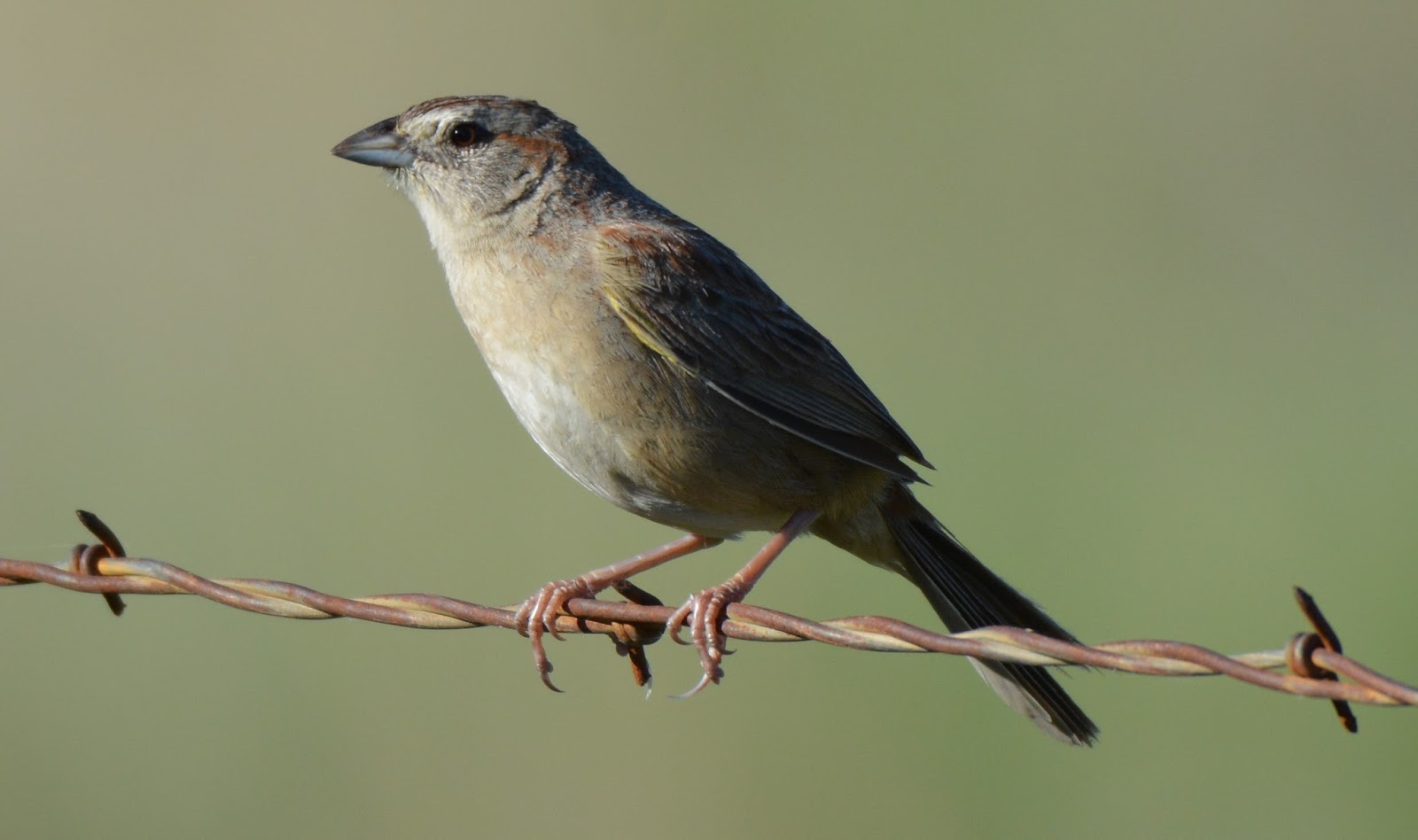
Botteri's Sparrow
Some birds, like the Rusty Blackbird, required me to go to the area 3 times before locating it. And one of those times, we had someone shooting at us! Other birds, like the Little Gulls, required patience as I scanned through hundreds of Bonaparte's Gulls. 

Cassin's Sparrow
While out on the road in southern Arizona, we had excellent views of breeding Botteri's and Cassin's Sparrows in the grasslands. In the large scheme of things, I have seen a lot of rare birds like the Arctic Tern and Purple Gallinule. The most important thing to remember about birding is that it's about YOU and the BIRDS.  I think people can get lost with the whole "competition" thing.  It's not a competition, but it certainly feels like one sometimes.  For me, it's about mastering the art of birding. This is also a potential career move after retirement. For me, it's about the travel and storytelling behind each new bird found. I'm a world birder not just an Arizona birder.  It'll be hard to let go of that ownership and attachment that I have for this state. It is, after all, where I began really studying my birds. I have to save that money for other expenses now which should include some remodeling of our bathrooms...or a tile floor:) 


Nesting Gray Hawks are studied by the UA
I ask myself these questions daily. What can I do better?  I've never seen that behavior, is that common?  Why wasn't I more patient?  Why wasn't I quick enough with my camera? Where's the darn bird?!!:) I am forever addicted to these birds.  At family events, I'm still looking at birds in the sky while everyone is drinking their beer and chatting about the every day life. I love nature.  And I love being outdoors(minus the bugs and heat). I am so curious about what's going on around me that I forget that the "boring stuff" is important stuff to other people. Don't get me wrong, I still like a good gossip session:)

Killdeer
As this summer ends, I learn that birding for lifers isn't about the quantity.  It's always about the quality of observation.  Each year varies in theme, but if one thing is certain, it's that this all is extremely challenging as it takes me out of my comfort zone.  There is so much to do. And so much to see. As my summer comes to an end, I begin another period of planning for the fall and winter months.  The checklist slowly shrinks as I target areas where there are birds I have never seen.  This year's theme, "Home" will continue. 


Tuesday, August 2, 2016

Warblers


Black-throated Green Warbler
When I say the word "warbler", I groan.  It's an intimidating word.  They are not easy birds to observe. Nor do they like to pose for the camera.  


Yellow Warbler
And it's not just me.  There are a lot of people out there who feel the same way.  They take time and patience.  A LOT of patience. 

Kirtland's Warbler
In Wisconsin, we took on the difficult task of finding nesting warblers.  We missed migration and we knew our job would not be an easy one. 

American Redstart
And to make things even trickier, we arrived at a time when most warblers are silent.  Nesting birds are often secretive as there are hungry birds and mammals out there wanting a little protein.  

Kentucky Warbler
Cowbirds eye up nests as adults collect nesting material.  They wait patiently so that they can lay their own eggs in another bird's nest.  This is the way of the brood parasite.  


Cerulean Warbler
Warblers in the birding world are considered gems.  They are beautiful but that is true about a great many other birds. And yet warblers are held to a higher standard.....


Red-faced Warbler
Over time, I've listened to other birders speak of warblers in a way that can only be described as reverence.  No other bird group gets that recognition except maybe hummingbirds, Birds of Paradise and the Resplendent Quetzal. I'm sure I'm missing a few other groups;)

Blue-winged Warbler
I think of warblers as impossible.  Always doing their own thing and not really having a care about the other birds around them. Hop under the leaf and feed....always hiding in the shadows.  

Grace's Warbler
Rarely sitting long enough for a photo. There isn't any secret way to find them.  It's all about luck and being in the right place at the right time. 

Golden-winged Warbler
The one thing that gives a warbler away is its chip note or call.  


Townsend's Warbler
There are so many similar calls that it can often be difficult to get your eyes on the right bird.  For example, I think I hear a Pine Warbler call and it's really a Chipping Sparrow!

Pine Warbler
And I think for that reason, warblers can be one of the most difficult bird groups to find. 

Mourning Warbler
So when a birder finds a warbler, it's always a celebration. 


Until next time......

Thursday, July 28, 2016

Life Is But A Dream


As the years move forward, one moment blurs into the next like a stream of consciousness forever flowing and changing the course of my life. 


Each day a gift.  Each day a promise.  


The fading sun kisses the world good-bye.  Momentary bliss. 


The soft petal of a flower.  


Daring to take a step forward into the unknown. 


All lasting impressions within my mind.  


So I live for today.  I live each moment.  And I remember.......


......all the good things that I see around me. 


Because at the end of it all, this is what I'll remember..... 


The dream of having lived my life and lived it well.


My photos today were modified by using an app called SuperPhoto.