Showing posts with label Greater Yellowlegs. Show all posts

Saturday, August 13, 2016

Dead Heat


The heat.  The hot, muggy, wet monsoonal heat. It's part of the contract we mentally signed when we agreed to live in the desert.  Anyone who says it's a dry heat, needs to visit Tucson in July through September. In fact, if you say "dry heat" to an Arizonan, they'll probably smack you:) No matter what.  It's hot here. 

The anvil builds and it's a sign that there will be a storm!
What an amazing show from Mother Nature though!  I won't lie.  During this time of year, I lock myself inside the house and watch it all from my windows.  You'd be surprised how much activity is going on out there!  But when temps are 105 degrees at 80 percent humidity, one tends to shut the curtains and imagine the possibilities of tomorrow. 


Not unlike the cold snowy winters of the north or eastern states of the US, our time of misery is now. I sit at my desk and research, crunch data, money, and plan.  Sometimes I wait for a big break in the weather to go outdoors.  And eventually, I get one!

Greater Yellowlegs
I get in my car and drive!  Migration is upon us and that means there are a lot of cool birds coming through the state.  The rain cooled air feels so good.  A cold breeze touches my skin and I discover that my goose pimples are still present.  I just stand outside, free from my chains, and breathe.  I'm birding again!  There's nothing worse than being a caged bird inside your own home!

Baird's Sandpiper
The birds seem to be happy as well.  They sit up and pose for the camera.  No sun.  No heat.  Just a wonderful moment.  That is until a Peregrine Falcon flies over and reminds everyone that they still can be eaten. 

Scaled Quail
I knew it wouldn't last forever and so I just tried to absorb the moment.  And sure enough, the next day, temperatures were on the rise as was the humidity!  The cloud cover was all but gone. 


But after the storm left, we noticed many Wilson's Warblers in our area!  During migration, storms are known for helping birds move from one area to the next!

Wilson's Warbler
While the temps are high, the birds still amaze!  Best time out here is early morning and yeah....early morning:)


Hummingbirds, peeps, warblers and so many other birds are beginning their journeys back home. May they endure the heat and long trek.  Until next time.....


Tuesday, December 8, 2015

光心臟者長壽

Coon Bluff
Finishing a year of travel and birding is always stressful and sad at the same time because come January 1st, birders begin again.

Cedar Waxwing
So why keep doing it over and over again?  Sometimes it's the challenge while with other times it's curiosity.  For me, it's always about the birds and it's always about bettering myself.  I will say that I have become much more relaxed now in the field than I used to be.  

Greater Yellowleg
It certainly makes for fun birding.  During this past weekend, I joined up with Gordon once again to find rare birds, fun birds and every other bird in between. One of our stops was at Coon Bluff along the Salt River in Arizona.  While we dipped on a rare Reddish Egret, we observed many Greater Yellowlegs and Long-billed Dowitchers in their natural settings and not at some artificial water treatment plant.  That was amazing.

Gordon searches for something rare on his birthday!
And then we headed over to Gilbert Water Ranch and enjoyed the bird show over there. 

Red-breasted Sapsucker
Eventually we moved over to Scottsdale and enjoyed the company of a Red-breasted Sapsucker.  And for fun.....

Mandarin Duck
....we went to find a random wintering Mandarin Duck.  These ducks are not native to Arizona OR the US, but there are several feral populations.  In Arizona, they aren't ABA countable, but since I don't follow that list, it doesn't matter.  ABA stands for the American Birding Association.  If you play their game, you can only count the birds that they have listed as "legit" from their list. While I understand their logic behind the birds considered "countable", I don't follow it because ABA only works for Canada and the US.  It should count for Mexico, but it doesn't.  So I don't agree with that bit.  If you're doing North America, do ALL of it.  Some birders don't waste their time on non-countable ABA birds.  For someone like me, that thinking is rather confining especially when I consider myself a world birder. Anyhow, this non-countable Mandarin Duck is one of many birds that spark a debate between birders every time:)


Mandarin Ducks are found in east Asia but their populations are in decline in countries like Russia and China.  Japan has a healthy population at about 5000 pairs.  In the US, these birds found in the wild are considered either part of isolated feral populations or birds who have "escaped".  There is a small population in Sonoma, California and it is quite possible that their range is expanding according to recent reports.  Either way, this is one beautiful duck!  It's closely related to our Wood Ducks here in the US. 

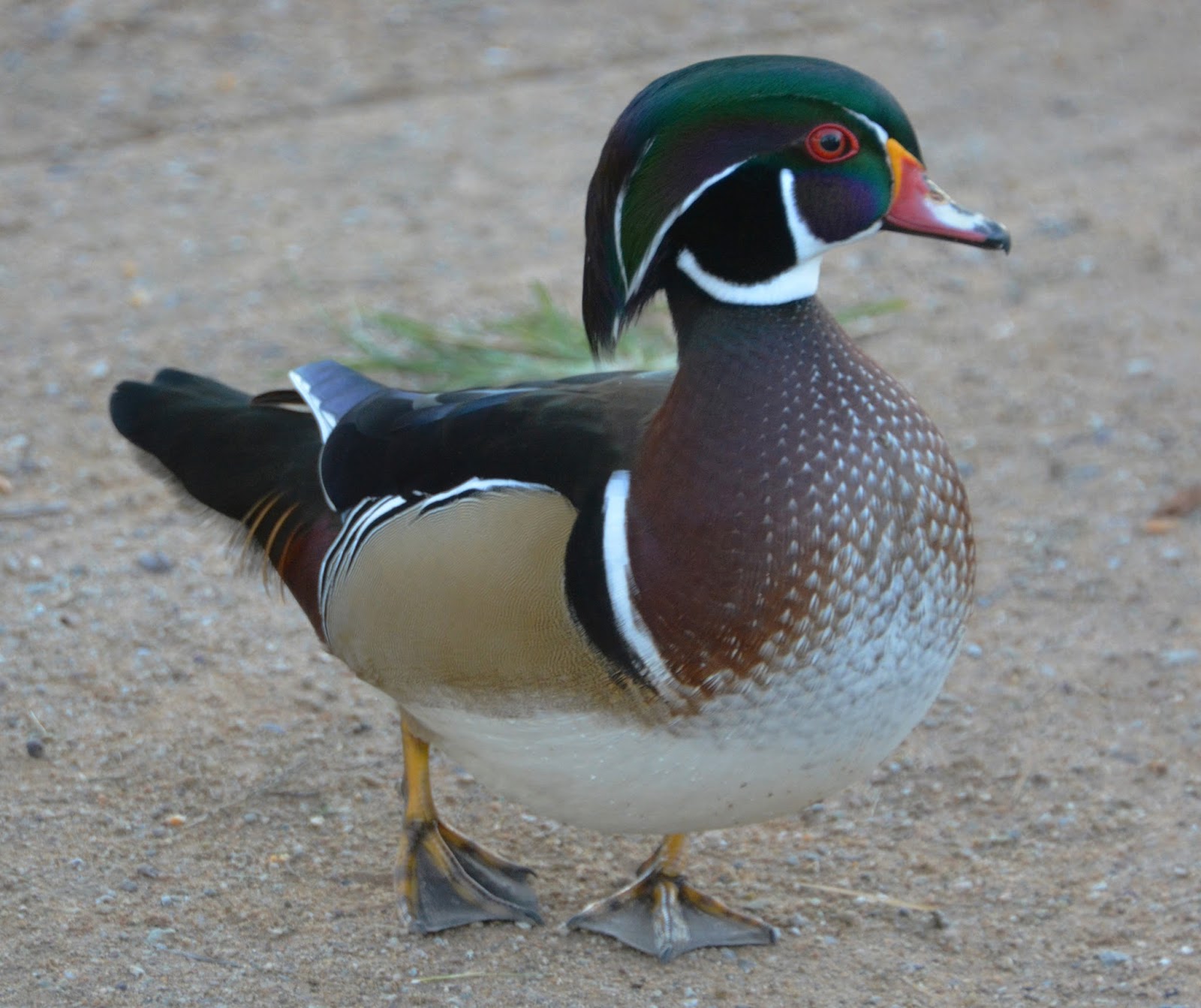
Wood Duck
 And while I've been out having fun in the world of birding, I've totally been neglectful of my garden!  When I went to go get my mail, I found this one single persimmon fruit on a lonely branch!  It was VERY exciting!  This tree hasn't produced fruit for two years!

Persimmons Fruit-variety Fuyu
So I honored the plant and ate the fruit:)  Then it was off to find a Brown Pelican in the desert. 

Brown Pelican
In December, Arizona birding is quite hot (in the good meaning of the word) and is often overshadowed by the holidays.  There are several people doing "Big Years" in Arizona and I know how stressful it can be during this month.  Last year I did that challenge for the US!  My challenge for this year has been to find as many birds as I can in North America which includes Mexico! It has been a lot of fun, but my days are numbered:) For the ladies competing for that top number one spot, good luck!  I think you're all pretty great. Best of luck to Susan, Barbara, and Janine!


And when it's dark outside, I sit back and reflect on those exciting challenges that have happened over this past year. 


I'm not finished yet, but for now, I sit back and enjoy the wonders of the wild.  And this beautiful piece of owl art from my friend Kathie Brown!!!  This is simply awesome!  Thank you!!  And below, I have taken some video of these two rare and special birds. Until next time!


 The post title means,  "A Light Heart Lives Long".  It's Mandarin for Mandarin:)

Monday, April 8, 2013

Sans Images


Wilson's Warbler
One of the things I struggle with like any birder, I suppose, is getting better shots of birds.  If I see a lifebird, but don't have great photo documentation, I get a little irritated.  The little ones are the trickiest! All of the birds featured on today's post were birds I had seen first but didn't get great shots of at the time. Take for example the Canyon Wren.  I saw the bird.  Tried to get a pic.  Ended up getting the rear end and it was gone.  Then I hear the descending call and it seals the deal.  I have to count the bird but without a decent shot.
LBJ(Little Brown Jobs) or LGJ(Little Gray Jobs) can blend in perfectly with their surroundings.  They move quick and it's important to note the field marks.  My ears are faster at "spotting" than my eyes.  The Bell's Vireo caused me a bit of confusion because it is a relatively new bird for me.  I had only seen it twice and with another birder who knew the bird.  Apparently there are 4 subspecies.  Plus Gray Flycatchers, Bushtits, Gnatcatchers, etc etc. If you don't get great observation time, these little birds become impossible to ID. So it's all about the observations!
Bell's Vireo
One of the thrills about birding is that I can't always predict who will make nice showings for the day.  I may have seen the species 100 times.  But on the 101th view, the bird might be doing something spectacular. The Lesser Yellowlegs held myself and another photographer captive for 20 minutes as it ran around with its buddy chattering away.  It made for some great laughs during their chases.
Greater Yellowlegs
Shorebirds can either be too far out, hidden behind reeds or against the sun.  When these Greater Yellowlegs made for a great show, I took the opportunity to snap off the shots.  Before this day, these birds were always out of photo reach or on the wrong side of the sun. 
A Wilson's Snipe happened to also make an appearance for me out in the open.  But the sun was setting and it made for tricky photography.  I had seen this bird last year but had poor photos to go with the sighting.  Now I am more comfortable with the shot below.
Wilson's Snipe
If I see a lifebird, I mark it down but make a mental note that I need a better shot.  A lot of energy goes into those first shots.  I would like to put a book together in several years of all the birds seen around Arizona.
Several of the birds on my list today that I don't have great shots of include the Canyon Wren, Red Crossbills(high up for the camera), Pinyon Jays(seen while on a slow moving bus loaded with wall to wall tourists at the Grand Canyon), Rough-Legged Hawks(seen while driving with 3 cars riding my tail), White-throated Swifts(oh so high!), and many of the Swallows(oh so quick!). A couple of the nocturnal birds(too dark) and of course the little birds(very spastic)......
Take for example the shot of the Warbling Vireo below.  It was too far to get a nice close up yet I was still able to get a shot of the bird.  The same goes for the Williamson's and the Yellow-Bellied Sapsuckers!
Elf Owls are small.  You all know how I love owls.  Well I stayed one night alone in a canyon in total silence.  My eyes were adjusting to the encroaching darkness.  And then I hear the call!  With my ears, I followed the faint yet continuous call.  Two other birders were in the area and had been friendly with me earlier so I led them to the sound because my eyes are terrible at night.  Having two other people look for this tiny bird would be very helpful.  It paid off.   We spotted the little tiny owl that looked like a knot in a Sycamore tree.  He was so cute.  I have a policy about filming nocturnal creatures.  No pics with flash.  And therefore, I do not have photo documentation.  I'm hoping to get shots of this bird one day.
The Lucy's Warbler.  I met this bird for the first time in mid-March.  Afterwards, the Lucy's Warbler seemed to be everywhere and allowed me some nice observations and pics.  It's the bird with the cinnamon crown and coverts. 
I also do counts at my school.  As of today, I was standing at my friend's classroom window when a Dusky Flycatcher flies right in front of me!!!  No camera.  At work.  Frustrating.  I am parallized as I am forced to watch the bird without a camera.  Inside I fight the frustration as I observe the bird alone.  No one realizes how exciting it is to see this bird.  Students snickering as I scream, "NOOOOOO!!!" as the bird flies away.  The "old man" who should have died at the age of 30 clearly had lost his mind. Oh teenagers. And yet I just saw the Dusky Flycatcher!  I just have to believe that I will eventually be in the right place at the right time with my camera to capture these birds.  The same thing happened with the Burrowing owls...and then on one perfect day, an owl sat perfectly in front of me.
Why is it important to get those shots?  My eyesight isn't great and constantly challenges me.  I need the pics to study at home.  I also heavily rely on my ears to help locate birds.  Once I have the photos, I can relax and bird.  That's why I enjoy birding at Sweetwater so much in Tucson.  I know all the birds well enough to practice my listening skills and develop my bird calls.  In a sense it's my training ground that always seems to have one or two new finds each time I visit:)
So I finish off today's write with this question.  What birds/animals/plants/bugs would you like to get better shots of?  And if you're a photographer in general(of all things not just wildlife) what would you like to get shots of?  Some fun journeys ahead.  Stay tuned for more!