Friday, September 7, 2018

The Highs and Lows

The carpeted green valley below Kitt Peak
Lately, I've been focused on the job that pays for my health insurance.  The start of the new year for every teacher is a tricky one.  If you set the tone right during the first several weeks, the rest of the year is perfection when it comes to classroom management.  On top of the main job, I've also been working on our house project that includes lots and lots of planning.  And on the weekends, I eagerly escape to go birding with friends. 

a Canyon Wren plays hide and go seek with us
Gordon came down for the weekend and we decided to do fun birding in cooler settings.  Kitt Peak was new for Gordon and it was just a nice get away from the heat.  For the first time in a LONG time, we should have brought our sweatshirts!  It was cold!  What a wonderful thing!

Yarrow's Spiny Lizard
 In fact, this is the end of summer for us.  It's the height of insects and migrating birds and bats.  September is so GREEN and buggy!  This is the best time of year for butterflies.  The trails are full of them!

a stock photo from several years ago on Kitt Peak.  This is the area we covered birding
We headed south of Tucson towards Sells on the Indian Reservation.  There's a peak that has telescopes on it.  And that's where we birded the morning finding lots of fun birds.  

Mexican Jay
We found Mexican Jays collecting acorns from an oak tree. 

juvenile Mexican Jay
 Spotted Towees appeared to be marking territories for yet another nest.  


Spotted Towhee
Meanwhile butterflies stole the show. 

Bordered Patch Butterfly
Down below in the valley, the wildflower show was incredible.  The rains have been good to Southern Arizona and the oranges, blues, purples, reds, yellows and pinks are confirmation of a happy desert. 

Arizona Poppy
One area was thick with wildflowers.  A beautiful carpet made by nature. 

Trailing Windmills
 There was no shortage of bugs. I try to escape the chiggers and mosquitoes, but they somehow find me. 


Plains Lubber Grasshopper
 The heat finally ends our Saturday of birding fun.  Sunday comes and we were looking forward to exploring Reddington Pass.  This was another new area for Gordon, but as we exited our place, we hit a wall of heat and changed the plans. 


American Snout
We wanted an easy place to bird, get water, have a nice lunch and see fun things.  The Arizona-Sonoran Desert Museum was the perfect fit.  While it's technically a "museum", it's much more than a building full of crap.  Here you can explore the wild spaces and see lots of real and wild critters that hang inside and outside of cages.  It's a great place to look for desert birds like the Cactus Wren or Gilded Flicker. 

Gordon and Micheal scour the Desert Museum property for butterflies, lizards, birds and other odd insects
Another unique species that lives on the grounds is an iguana that has survived decades on the property.  

San Esteban Island x Sonoran Spiny-tailed Iguana
Meanwhile we checked out the other critters hanging out around the riparian/desert corridor of the museum grounds.

male Bighorn Sheep struts his stuff

Eventually we made it to the aviary.  This year, I have spoken with many people about this subspecies of Northern Bobwhite below. The Masked Bobwhite is VERY rare and can only be found at the very close border of Mexico and Arizona on a few ranch lands.


the extinct-in-the-wild subspecies of Northern Bobwhite(Masked Quail)
They are breeding these birds to release in the wild, but even when we go to study them in the cages, they can be difficult to see!  So it was a real treat to find that this pair had mated....and had a chick!


I know it's a caged bird, but it's so rare in the wild that practically no one has seen these birds at all beyond a stuffed model on display for what used to live in the grasslands. To see them like this close up was spectacular. Over the years, I've seen only one in the aviary and she was always hiding.  Not on this day!
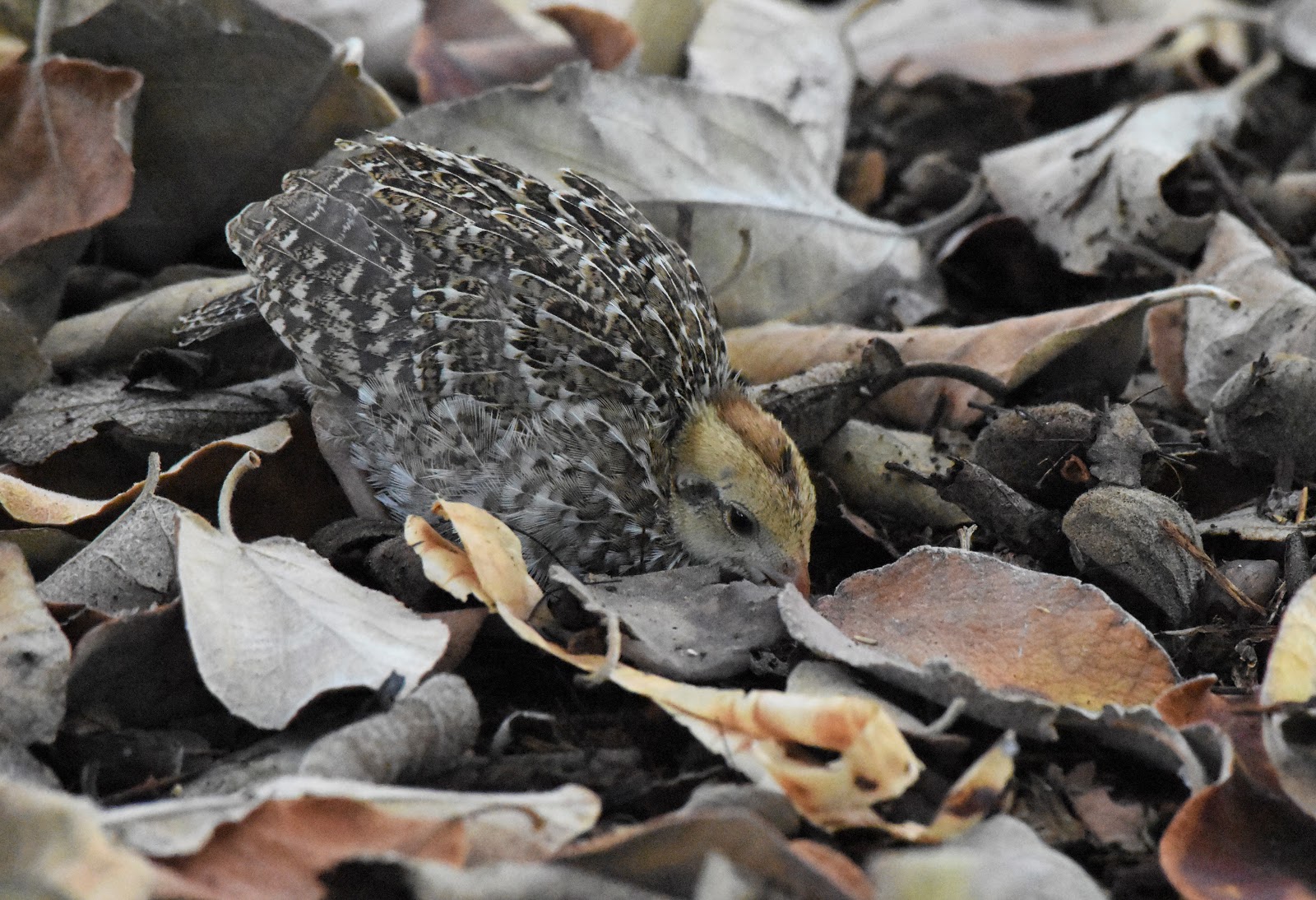

And that chick was adorable. 


After work, I'm exhausted.  The heat drains the life out of me. The mornings are lovely and it's really the only time to do any birding.  You get a 4 hour window and that's it.

Olive-sided Flycatcher
A lovely win for the week was an Olive-sided Flycatcher hanging out at my local patch that I monitor weekly.  And a very human downer happened when I misidentified a juvenile Black-crowned Night-Heron for a super rare Yellow-crowned Night-Heron.  To be fair to myself, many others thought it was a juvi Yellow-crowned Night-Heron as well.

American Avocet
I got two minutes to look at the bird from a distance, snapped my shots and then had to wait until I got home to look at them.  Magill got home before I did and looked at the pics up close and said, "Nope.  This is a juvenile Black-crowned."  Our hearts sunk.  The ID is a tricky one, but next time I'll be looking at that bill better. 


Birding in Dateland and surrounding areas for shorebirds
The juvenile Yellow-crowned Night-Heron has an all dark conical bill where the juvenile Black-crowned Night-Heron can have some yellow in the bill. Oh well.  You win most and lose a few every once and awhile.

Black-crowned Night-Heron
We randomly explore the state and search for something fun to show up. I wouldn't do it alone as it's more fun birding with friends during this nasty and beautiful time of year. We motivate each other to bird during these trying times. Migration is upon us and every day, there is something just waiting to be found.  Will you find it?  Until next time.

Friday, August 31, 2018

Seasonal Disorder

Whiskered Screech-Owl peeks out of a Willow Tree
After our Hawaii trip and during my first week back to work, I had to also prepare for Tucson Audubon's Southeastern Birding Festival the following weekend. It was a week of transition and overlapping responsibilities. So I happily put on my guide cap once again to help lead several treks around the Sierra Vista area. 

They see their first Sulphur-bellied Flycatchers
The weather this time of year can be nice, super hot and terrible or just downright dangerous.  On this weekend, the weather seemed to cooperate knowing that we were going to have a festival. 

I play the recorded Common Raven calls and compare to the calls of the Chihuahuan Ravens.  Folks are able to ID their lifer Chihuahuan Ravens recognizing the calls.  These juveniles sit and watch us at the Ft. Huachuca Cemetery
It's hard to transition sometimes from one trek into another.  From birding two weeks in Hawaii, I felt what the word extinction really meant.  And it hit me hard.  You could say I was in a funk.  Then I get back to Arizona where life and birds are fun again.  Our birds are happy here.  There's lots of birds and none are really endangered.  Organizations like Tucson Audubon have helped protect Southeastern Arizona from many human disasters.  And it continues to do so.  So the vibe here is a happy and adventurous one. One could say that birding treks can be very bipolar. Hawaii was my first sad discovery and several friends have warned me that it won't be my last last.

The Hepatic and Western Tanagers are in good numbers around the canyons
That alarm went off early Saturday morning at 4:30 AM and I reluctantly got out of bed.  I headed over to the hotel where all the participants were eagerly awaiting. Their positive energy and excitement boosted my spirits.  My teacher mode clicked on and soon we were in two vans with the fabulous Hollie driving and co-leader Ken following along to one of my most favorite places of Southeastern Arizona, the Cienegas Grasslands. 

Eastern Bluebirds(the Mexican subspecies) breed on the Huachuca base
The following day Ms. Jennie would lead our group to Ft. Huachuca for a full day trek into Huachuca and Garden canyons.  And I got to kick back and co-lead on that one.  Co-leading is great because I get to be the supporting actor and not the one to have to make the big decisions.  I don't mind group leading at all, but it's more fun to be the co-leader because you can play with the participants more. 

the ancient petroglyphs of Garden Canyon
Both days were amazing.  With 40 participants and our tours full, we all had a great weekend(and they saw birds!). My energy levels were boosted and I felt happy.  


A Gray Hawk played with me.  I told the participants one was calling from somewhere in the area.  As we were driving out, I caught the bird sitting on the branch!  Lifer! Several people very happy:)
I have to say that my eyes are terrible.  I was calling out the birds and they were spotting them.  It's funny but I have found most people don't bird by ear, but instead with their eyes. I try to bird with my eyes but the bird has to call for me to find them:) They'd say, "How do you do that?" and I'd respond, "Language is what I do."  Bird language is no different from the human kind.

Western Wood-Pewees continue to nest during this late time of year when other birds begin to migrate south
People would groan when I said "group pics!" but it's important to remember what we accomplished on those days.  When will we all ever be in the same space again? Maybe never.  It's important to remember these moments in our lives. Even if it's just a snapshot. 


Exhausted after a wonderful morning, it's now time to cool off and head home.
The more I get into birding; the more I realize how special these times are together.  Some birders who I have had the privilege to bird with are gone now. So I try to remind everyone to take a moment and share in it together. 

One of several Pronghorn seen in the grasslands around Empire Ranch
I would say that the Sierra Vista, Sonoita and Patagonia areas are my favorite places to bird in the state.  During my grassland tour, I always train people on the vocalizations of the Grasshopper, Cassin's and Botteri's Sparrows.  Then I have them ID their own sparrows once we've done a few practice ones together.  For me, it's important that they are able to leave my tour successfully ID'ing these two difficult sparrows on their own. When you find something on your own, it has more meaning.

We spy Lazuli Buntings at this cattle tank
I like to surprise participants with some fun birds that they didn't expect for their lists. After doing this tour now a couple times, I can somewhat predict some of their questions. During this time of year, transitioning Lark Buntings are found around the Empire Ranch.  For some reason, people forget about them until I hear someone shout, "What are those black birds?!!"  Then, we stop the van and look alongside the road. "Are those Lark Buntings?!!"  I award them an A+ for their astute observations.  If I feel the bird is going to vanish quickly, I will call it out, but otherwise, I think it's important for birders to find their birds on their own in a natural way.  Then they ask their questions and I help guide them to the ID of their bird.  That is how I interpret "guide".  I know where the birds are.  If I hear them, I'll lead the peeps over and then step back and watch their faces as they discover a new bird for the first time. I like that much better than pointing to the bird and saying, "There it is."  

Lark Buntings are still in their breeding plumage, but several, like the one above, is beginning to transition into winter plumage
In the pic below, the crew is looking at 2 Elegant Trogons.  During a scouting mission, we found a nice number of them in Huachuca Canyon.  I had the participants listen for their repetitive dog bark to prep them for the visit.  And they were able to locate them:) Jennie gets credit for finding those birds!  They can be tricky this time of year.

The crew spots and male and female Elegant Trogon
Life has been chaotic since work has begun.  It's like two worlds are beginning to clash.  There's the one that I love and then there's the one that I must maintain.

This appears to be a juvenile male Blue Grosbeak as there is some slight blue forming on the plumage
The heat of course is still challenging and by afternoon, we all began to slow down:)

We watch a Painted Redstart steal the show
When I am not needed, I hide in my kitchen and cook. After Hawaii, I didn't have the desire to bird as much.  Instead, I read through piles and piles of books and did a lot of internet searches on the islands. I can't let it go. 

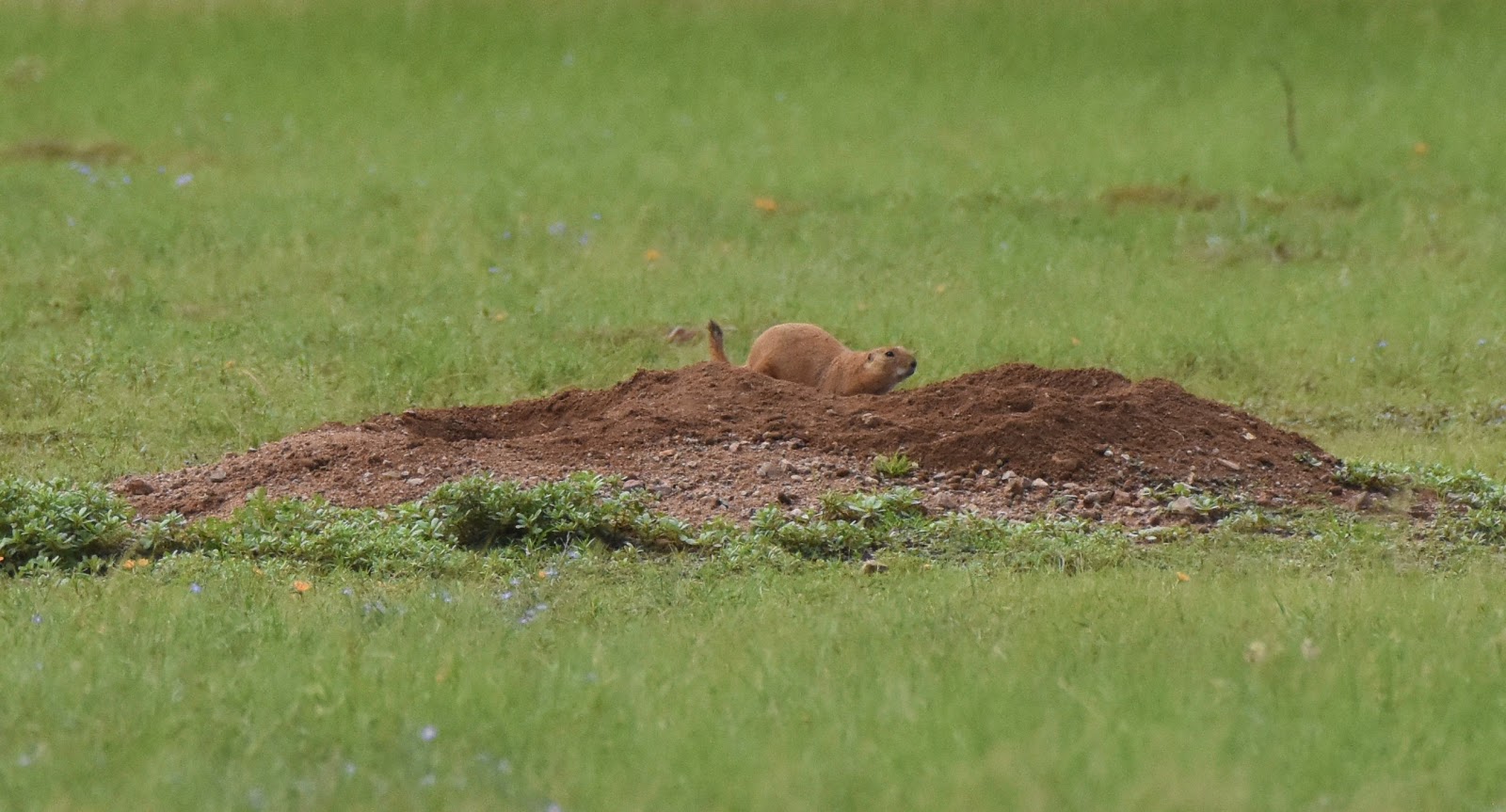
Black-tailed Prairie Dogs are doing well now in the grasslands.  They were once extirpated from the area due to ranchers poisoning them.  Today they have established themselves once again in these grasslands.  Their populations continue to increase.  Their burrows are also homes to Burrowing Owls.  Unfortunately we did not see any on this day.
It's amazing to me how each place has a different feel for birds.  I think in Arizona, it's far more accessible for people to come and bird.  We have a few quirky things to know like bring water, lock your doors, watch out for poisonous wildlife and watch for quickly changing weather conditions.  In Mexico, it was watch your camera. In Trinidad, it was watch your camera and don't go out after midnight because people get murdered.  And in Hawaii, it was relax and bird, but with a heart breaking sadness. An international birder has to learn how to go with the flow.  When we travel, we discover how locals view their wildlife.  And sometimes it sucks. 


The two biggies in Arizona that we constantly fight are wildfires and limited water.  Human morons are constantly trying to drain the last of our rivers in already bone dry conditions.  They are the life blood for much of our wildlife.  That's why I support Tucson Audubon and others.  This year, our Saguaro cactus seem to be taking a hit with development in areas like Oro Valley.  Careless developers destroyed many natural homes for our local Purple Martins, owls and flickers. This year I've lost my colony of Purple Martins at my work site.  It was heart breaking.  Lightning blew out the cactus and with it, the family of martins.  Broke my heart. There is one colony left.  Yesterday 12 of them gathered and are now preparing to migrate south. 

Jennie gets the scope ready to view a nesting Violet-crowned Hummingbird!  They add lichens to their little tea cup nest. See in ebird report below.
Life is a journey.  It is painful sometimes.  People can be the worst creatures of this planet.  And then again, they are some of the best.  These people give me hope.  I am hopeful.  I try to be hopeful. 

The crew ID's Western Kingbirds and a Botteri's Sparrow
Birding continues to grow more than ever.  This year our festival numbers doubled from last year's event.  I watched our coordinator, Luke Safford, keep his sanity over those busy days managing day treks and the overall festival conference. That's no easy feat!  He did an amazing job.  I've been in his shoes before.  So had Wrenegades member Sara Pratt.  We both laughed and were glad it wasn't us coordinating. I'm now too old to even contemplate such a monster of an event.  Luke, you did an amazing job!  Thank you for making this festival a great success!

We end our day happy with many Buff-breasted Flycatchers bouncing around us with their "whits"

For now, I'll help whenever needed.  I much like working with people and helping them find their birds.  I am working on new adventures, but have been dealing with painting our place, paying bills, and living a mortal life. October promises to be an exciting one as does November and December.  I am 23 lifebirds short of my goal.  Where will I go next?  Stay tuned for more!
For our adventures, click on the here.  
For the Las Cienegas Grasslands, click here.
And for Huachuca Canyon, click here.  

Thursday, August 23, 2018

The Silent Forest

the 'Apapane

My final post on Hawaii deals with something I have rarely felt while birding, sadness.  Immense sadness. Birding has always brought me joy, but while on Maui, I unexpectedly felt the horrid pains of sadness. Over the past 3 weeks, I've shown you the positive and beautiful moments from our treks, but this week, I must end on a very bittersweet note. While on our trek I didn't expect to experience the hard slap of extinction against my face.  The possible extinction of the California Condor during my 8th grade year was horrifying, but this bird has made a comeback. In fact, humans can reverse most trends when it comes to the decline of populations.  But in Hawaii, I felt hopelessness.  And deep deep sadness.


People have artificially made these islands beautiful with exotic things.  You can eat banana bread.  You can go to a luau and enjoy the ocean breezes.  It's all make believe like the city of Las Vegas. It's a major tourist hub. But because of this human manipulation, most of Hawaii's native bird populations will go extinct within our lifetimes.  And no one seems to care!  I had two profound experiences that I must share.  The first is the title of this post, the Silent Forest. 


After our gorgeous trek to Hana, we decided to take a major hike within the southern end of Haleakala National Forest.


I asked the park ranger if we'd have any chance of spotting the endemic honeycreepers.  Her response to me was that we would have to go higher up to find those birds.  And I responded, "Hosmer's Grove, right?"  "Yes, Hosmer's Grove."


So we hiked up this steep 2 mile trail into gorgeous forest, with most of it being exotic vegetation NOT native to Hawaii. NEVER in my entire life have I had silence hit me so hard.  We were in a forest and there wasn't any bird song! I teared up a little.  Meanwhile, people were screwing around and climbing up the trail hitting trees with bamboo poles, shouting and just not understanding what has happened here.  All they wanted to do was see the big waterfall at the end of the trail.  


Sometimes we'd see a tree perfect for honeycreepers and there was nothing
This tourist attitude made me so angry. Then after about a little more than a mile, I hit a huge patch of bamboo forest.  It's beautiful!  But it's not native to the island.  And again.  Silence. 


The silence was so deafening that no wind or waterfall could cover the absence of song. I went from tears to anger.  How could we let this happen? HOW?! 


Eventually we made it to the waterfall and it was beautiful.  But it was empty. I thought to myself, fine.  Let Hawaii destroy itself.  No one cares.  Tourists certainly don't.  I really don't feel that way now but it was my initial gut reaction.  We had been on the island for a week without finding a single honeycreeper.  I thought in my arrogance I could find one outside of Hosmer's Grove. But I was just an asshole who was overconfident in his abilities. I was so angry at everything that I had to write this post as the last one. I needed time to process what I felt. It IS as bad as people have reported.  


After our walk, I went home with a lot on my mind.  The following day, we would take the trek up to Hosmer's Grove.  I wanted to know what made it different from everything else on Maui. Why do honeycreepers exist there and very rarely anywhere else on the island?


We arrived the next day into the misty world of Hosmer's Grove.  I could already sense we were in a different habitat. The difference?  Cold and above the mosquito zone. Before the mosquitoes brought their deadly disease, these honeycreepers covered the islands at every elevation. Thankfully on Maui, there is a huge restricted stretch where the montane trees meet the shrubby alpine area away from mosquito and human populations. Here these honeycreepers make their last stand. This is where most of these birds can only live now. Luckily on Maui, much of it is off limits to people or difficult to reach on this large mountain range. On West Maui, I believe the two peaks in that area also have endemics high up but there is no road nor way to get there beyond flying on a helicopter to the locations. For birders, you really have only TWO options.  The Waikamoi Preserve or Hosmer's Grove.  The 3rd is trickier as much of it is on dirt road.  Rain can make the road to Polipoli State Park difficult and therefore many birders head to Hosmer's Grove instead. Waikamoi Preserve is only accessible to birders once a month. So if you were like me, you'd really only have ONE option.


a juvenile I'iwi
We arrived one day late in Maui and missed the monthly walk into the Waikamoi Preserve.  You must contact them at least 2 months in advance.  Why?  There are two VERY special species that can be seen on this walk.  One is the Crested Honeycreeper, or Akohekohe, and the other is the Maui Parrotbill.  I assure you that they are VERY cool birds and ONLY found on Maui.  The Maui Parrotbill is the most endangered at around 500 birds left.  The other, the Crested Honeycreeper, has around 1500-3000 birds and is listed as Critically Endangered. Of all the preserves found around the state of Hawai'i, I think this protected area is one where these Hawaiian species might have a chance.  The Crested Honeycreeper's numbers fell mainly to the mosquito spread virus and feral pigs.  Areas continue to be fenced off and this bird may be having a comeback. On the island, I found all of my birds except these two.  


Hosmer's Grove.  This is THE most common place birders go to get the big 4, the I'iwi(pronounced Ee-ee-vee; the double u is pronounced like a V), the 'Apapane, the Hawai'i 'Amakihi and the Maui 'alauahio.  It took me 2 treks to study these birds.


When we arrived our first time to Hosmer's Grove, it was misty and cold.  For the first time, we pulled out our sweatshirts and it felt good.  Instantly, I could hear a healthy forest. Finally!  It overwhelmed me and I teared up. I stood in the rainbow Eucalyptus forest and had goosebumps.  One of the most exciting things for me is standing in a new habitat listening to the new choir of songs. I close my eyes and let my ears absorb all the new and alien sounds. All the calls were foreign to me and like a good citizen scientist, I memorized each and every single one.  


the Hawai'i 'Amakihi(Maui subspecies)
The gnatcatcher "Zeet!" of the Hawai'i 'amakihi was amazing.  The slightly stretched "chip" of the Maui 'alauahio reminded me of a warbler.  The electric zingy sing song of I'iwi echoed from a small rocky canyon.  And the short descending "woot" of the Apapane gave away the bird's location.  I had goosebumps!  And not because it was so cold.  


During the rainfall, the honeycreepers were most active like this 'Apapane
Micheal had seen that I was so focused that he stepped back and let me do my survey alone.  The rain kept people away but the birds were very active.  I stood on these last sacred grounds and tried to memorize everything.  To date, every bird that I've seen  in my life is still around in good numbers.  These birds may be the only time I see them in my lifetime.  I write about having a limited amount of time often.  I felt the gravity of time here and I put hunger and the cold temps aside to take in. every. second. of. my. observations.  All I can say was that it was sacred and beautiful.  It was one of the most memorable events of the year. 


the Hawai'i 'amakihi
Days passed.  We had only a few more before we flew home to Arizona. I couldn't let go of Hosmer's Grove.  I had to go back again.  Just one more time. Just one more time. Micheal sensed I wanted to go back again because I had been affected so much the first time we were there. It was like saying good-bye to a dying friend.


The Pueo


I walked the forest once again, but this time it was sunny for a moment.  A Short-eared Owl swirled over my head as a sign.  Micheal stayed in the car.  He's not a true birder but enjoys seeing birds.  Obviously I go a little more in depth with my work and it takes time to get the documentation I need.  I recorded vocalizations of the 'Apapane and 'Amakihi.  I was able to get photos of the birds with a lot of patience. During this trek, I added the "Big 4" and the Nene to my life list.  These are the diamonds on my life list.  I won't forget them any time soon. 

Maui Creeper or Maui 'alauahio hides behind vegetation, but the chip note cues me in on the location

I failed my first time at Hosmer's Grove by confusing this juvenile Maui 'amakihi(below) for a Maui Creeper, or Maui 'alauahio(above).  During my second visit, I was able to locate this tree creeping bird by its slightly extended chip note.  And there were several in the area. The female 'alauahio looks similar to a juvenile Amakihi.  Plus their names were a nightmare to remember:) Note the straighter bill in the above pic.  Also the dark lores help distinguish these often confused species. It was easier to ID hearing their distinct calls.

I recorded a "Zeet!" with this bird making it a 'amakihi but before I could ID this call, the smaller bill, etc made me think Maui 'alauahio.  That's when I had to go back to the drawing board and do more observations.  Juveniles can be tricky for birders as their bills are not quite developed long enough.  Also it's not straight like the off season similar looking 'alauahio
These endemic birds face an uphill battle.  There are so many difficult things that they face.  Humans civilizations have done major damage to the populations of birds.  The game changer that killed off so many birds in the beginning was the introduction of the Polynesian people who clear cut forest.  Then the Europeans and Americans brought mosquitoes.  The mosquitoes brought disease and did the most damage wiping out so many species.  In fact most of these birds would be extinct today if it wasn't for the higher elevations.  These mosquitoes can't survive the higher and wetter climate.  BUT....


The 'Ohi'a Plant is a very important native bush for the endemic honeycreeper populations
Global warming is threatening these birds and the mosquitoes have been found to be moving up in elevation.  The eruption on the main island of Hawai'i has decimated a preserve of honeycreeper territory.  The plant, 'Ohi'a Lehua, is dying from a fungal disease on the big island and is now also found on O'ahu.  This plant is vital to these birds in that many of the honeycreepers use it for a food source. The introduction of exotic species like rats, goats, cats and mongoose have also had a major impact on these birds. Only at the higher levels have they made any progress.  We certainly saw a lot of mongoose, rats and cats around the urban areas. 


Haleakala National Park
The Nature Conservancies and the Hawaiian Audubon are working hard to try and save these birds.  Recently they released the now extinct-in-the-wild Hawaiian Crow, or Alala, back into the national park on the big island but they happen to be above the area where the main lava flow is burning everything downslope.  In any case, they are closely being monitored at this time.  


I made phone calls and did more reading while I was on the island.  People are working hard to save these birds from centuries of damage.  Native plants are replacing exotic ones.  A sterilization project is in the works with this particular species of mosquito that is spreading the deadly avian diseases around the island.  And areas are being fenced off from feral goat, cat and mongoose populations.  Some of the bird species like the Akiki, Maui Parrotbill, Akohekohe and Palila are confined to small areas.  Their numbers are not promising but for now, their populations are protected behind fenced walls until they can remedy the situation.  IF they can remedy the situation.  When visiting the islands, it's a good idea to visit O'ahu and then Hawai'i last so that you do not spread the 'O'hia lehua fungal disease to the other islands. OR just wear new shoes. For the latest in Hawaiian Birding, click here. 

Maui 'alauahio gleaning insects from the vegetation.
Learning experience? When I came back from Hawaii, I realized even more that I cannot change the entire world, but I can make a difference where I live. And LEARN from these sobering experiences.  This birding trek has made me want to fight with those who would undo our beautiful planet.  I live in the Sonoran desert, one of the most beautiful places on this planet and it is here that I make and will continue to make a difference.  For environmentalists, our first fight begins in November.  And then there will be more. Recently more damage has been done with this current administration and our US birds.  Click here for the latest on the Trump administration and his rollback on pesticides. 


To see the birds found at Hosmer's Grove, click here.  Next week, we take you to the Tucson Audubon's Southeastern Birding Festival.  I'll be leading two days of fun with awesome birders.  What will we find?  Stay tuned for more!  Until next week!