After our Hawaii trip and during my first week back to work, I had to also prepare for Tucson Audubon's Southeastern Birding Festival the following weekend. It was a week of transition and overlapping responsibilities. So I happily put on my guide cap once again to help lead several treks around the Sierra Vista area.
They see their first Sulphur-bellied Flycatchers
The weather this time of year can be nice, super hot and terrible or just downright dangerous. On this weekend, the weather seemed to cooperate knowing that we were going to have a festival.
I play the recorded Common Raven calls and compare to the calls of the Chihuahuan Ravens. Folks are able to ID their lifer Chihuahuan Ravens recognizing the calls. These juveniles sit and watch us at the Ft. Huachuca Cemetery
It's hard to transition sometimes from one trek into another. From birding two weeks in Hawaii, I felt what the word extinction really meant. And it hit me hard. You could say I was in a funk. Then I get back to Arizona where life and birds are fun again. Our birds are happy here. There's lots of birds and none are really endangered. Organizations like Tucson Audubon have helped protect Southeastern Arizona from many human disasters. And it continues to do so. So the vibe here is a happy and adventurous one. One could say that birding treks can be very bipolar. Hawaii was my first sad discovery and several friends have warned me that it won't be my last last.
The Hepatic and Western Tanagers are in good numbers around the canyons
That alarm went off early Saturday morning at 4:30 AM and I reluctantly got out of bed. I headed over to the hotel where all the participants were eagerly awaiting. Their positive energy and excitement boosted my spirits. My teacher mode clicked on and soon we were in two vans with the fabulous Hollie driving and co-leader Ken following along to one of my most favorite places of Southeastern Arizona, the Cienegas Grasslands.
Eastern Bluebirds(the Mexican subspecies) breed on the Huachuca base
The following day Ms. Jennie would lead our group to Ft. Huachuca for a full day trek into Huachuca and Garden canyons. And I got to kick back and co-lead on that one. Co-leading is great because I get to be the supporting actor and not the one to have to make the big decisions. I don't mind group leading at all, but it's more fun to be the co-leader because you can play with the participants more.
the ancient petroglyphs of Garden Canyon
Both days were amazing. With 40 participants and our tours full, we all had a great weekend(and they saw birds!). My energy levels were boosted and I felt happy.
A Gray Hawk played with me. I told the participants one was calling from somewhere in the area. As we were driving out, I caught the bird sitting on the branch! Lifer! Several people very happy:)
I have to say that my eyes are terrible. I was calling out the birds and they were spotting them. It's funny but I have found most people don't bird by ear, but instead with their eyes. I try to bird with my eyes but the bird has to call for me to find them:) They'd say, "How do you do that?" and I'd respond, "Language is what I do." Bird language is no different from the human kind.
Western Wood-Pewees continue to nest during this late time of year when other birds begin to migrate south
People would groan when I said "group pics!" but it's important to remember what we accomplished on those days. When will we all ever be in the same space again? Maybe never. It's important to remember these moments in our lives. Even if it's just a snapshot.
Exhausted after a wonderful morning, it's now time to cool off and head home.
The more I get into birding; the more I realize how special these times are together. Some birders who I have had the privilege to bird with are gone now. So I try to remind everyone to take a moment and share in it together.
One of several Pronghorn seen in the grasslands around Empire Ranch
I would say that the Sierra Vista, Sonoita and Patagonia areas are my favorite places to bird in the state. During my grassland tour, I always train people on the vocalizations of the Grasshopper, Cassin's and Botteri's Sparrows. Then I have them ID their own sparrows once we've done a few practice ones together. For me, it's important that they are able to leave my tour successfully ID'ing these two difficult sparrows on their own. When you find something on your own, it has more meaning.
We spy Lazuli Buntings at this cattle tank
I like to surprise participants with some fun birds that they didn't expect for their lists. After doing this tour now a couple times, I can somewhat predict some of their questions. During this time of year, transitioning Lark Buntings are found around the Empire Ranch. For some reason, people forget about them until I hear someone shout, "What are those black birds?!!" Then, we stop the van and look alongside the road. "Are those Lark Buntings?!!" I award them an A+ for their astute observations. If I feel the bird is going to vanish quickly, I will call it out, but otherwise, I think it's important for birders to find their birds on their own in a natural way. Then they ask their questions and I help guide them to the ID of their bird. That is how I interpret "guide". I know where the birds are. If I hear them, I'll lead the peeps over and then step back and watch their faces as they discover a new bird for the first time. I like that much better than pointing to the bird and saying, "There it is."
Lark Buntings are still in their breeding plumage, but several, like the one above, is beginning to transition into winter plumage
In the pic below, the crew is looking at 2 Elegant Trogons. During a scouting mission, we found a nice number of them in Huachuca Canyon. I had the participants listen for their repetitive dog bark to prep them for the visit. And they were able to locate them:) Jennie gets credit for finding those birds! They can be tricky this time of year.
The crew spots and male and female Elegant Trogon
Life has been chaotic since work has begun. It's like two worlds are beginning to clash. There's the one that I love and then there's the one that I must maintain.
This appears to be a juvenile male Blue Grosbeak as there is some slight blue forming on the plumage
The heat of course is still challenging and by afternoon, we all began to slow down:)
We watch a Painted Redstart steal the show
When I am not needed, I hide in my kitchen and cook. After Hawaii, I didn't have the desire to bird as much. Instead, I read through piles and piles of books and did a lot of internet searches on the islands. I can't let it go.
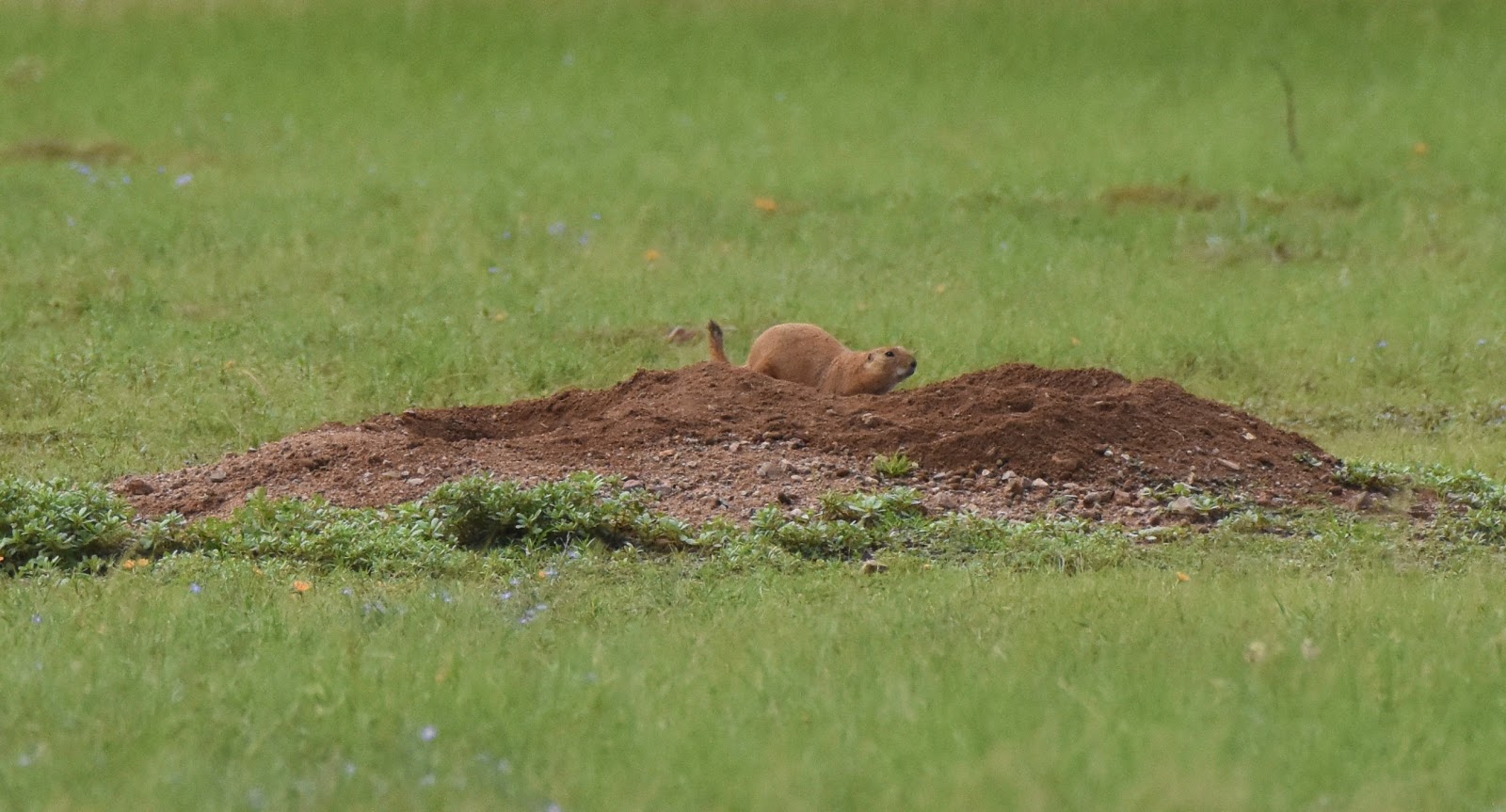
Black-tailed Prairie Dogs are doing well now in the grasslands. They were once extirpated from the area due to ranchers poisoning them. Today they have established themselves once again in these grasslands. Their populations continue to increase. Their burrows are also homes to Burrowing Owls. Unfortunately we did not see any on this day.
It's amazing to me how each place has a different feel for birds. I think in Arizona, it's far more accessible for people to come and bird. We have a few quirky things to know like bring water, lock your doors, watch out for poisonous wildlife and watch for quickly changing weather conditions. In Mexico, it was watch your camera. In Trinidad, it was watch your camera and don't go out after midnight because people get murdered. And in Hawaii, it was relax and bird, but with a heart breaking sadness. An international birder has to learn how to go with the flow. When we travel, we discover how locals view their wildlife. And sometimes it sucks.
The two biggies in Arizona that we constantly fight are wildfires and limited water. Human morons are constantly trying to drain the last of our rivers in already bone dry conditions. They are the life blood for much of our wildlife. That's why I support Tucson Audubon and others. This year, our Saguaro cactus seem to be taking a hit with development in areas like Oro Valley. Careless developers destroyed many natural homes for our local Purple Martins, owls and flickers. This year I've lost my colony of Purple Martins at my work site. It was heart breaking. Lightning blew out the cactus and with it, the family of martins. Broke my heart. There is one colony left. Yesterday 12 of them gathered and are now preparing to migrate south.
Jennie gets the scope ready to view a nesting Violet-crowned Hummingbird! They add lichens to their little tea cup nest. See in ebird report below.
Life is a journey. It is painful sometimes. People can be the worst creatures of this planet. And then again, they are some of the best. These people give me hope. I am hopeful. I try to be hopeful.
The crew ID's Western Kingbirds and a Botteri's Sparrow
Birding continues to grow more than ever. This year our festival numbers doubled from last year's event. I watched our coordinator, Luke Safford, keep his sanity over those busy days managing day treks and the overall festival conference. That's no easy feat! He did an amazing job. I've been in his shoes before. So had Wrenegades member Sara Pratt. We both laughed and were glad it wasn't us coordinating. I'm now too old to even contemplate such a monster of an event. Luke, you did an amazing job! Thank you for making this festival a great success!
We end our day happy with many Buff-breasted Flycatchers bouncing around us with their "whits"
For now, I'll help whenever needed. I much like working with people and helping them find their birds. I am working on new adventures, but have been dealing with painting our place, paying bills, and living a mortal life. October promises to be an exciting one as does November and December. I am 23 lifebirds short of my goal. Where will I go next? Stay tuned for more! For our adventures, click on the here. For the Las Cienegas Grasslands, click here. And for Huachuca Canyon, click here.
This past March, Las Aventuras celebrated 7 years of "work" on the internet machine. Slowly this blog is getting closer to a million hits which blows my mind away. The journey has been incredible!
Broad-billed Hummingbird
People ask why I blog. Sometimes they think it's kind of a joke, but I'll tell you why it's not. When I began blogging, I couldn't have answered these questions because I didn't know much at all! I just wanted to have a running diary of my garden. Today, it's crystal clear why I do what I do. If you're looking into blogging on blogger or wordpress, here's what you need to know.
Common Raven
It takes time. None of it was overnight. I began with an idea and it turned into something else. I wanted to document my garden plans around our place and it was great until I stopped gardening. Then, the title, "Las Aventuras" really hit its mark when I discovered birds. The blog truly shows the beginnings of my birding career and the adventures that have ensued since I began chasing our planet's birds.
Chihuahuan Raven
From novice to ? As a birder I am continuing to grow. But when I began this blog, I really knew nothing. Today I help guide people around southern Arizona to find birds. It's not a job but a way to connect with my readers and make new friends. And it's also a way to manage my sanity in this crazy world of ours.
Dark-lored White-crowned Sparrow
The social connection. I have met so many painters, birders, photographers and friends because of this blog. Many people joke about the world of online social media, but it isn't a laughing matter if you use it the right way. I wouldn't have met MANY of the incredibly talented and wonderful people out there if it wasn't for this blog. I have grown as a birder because of their knowledge and expertise. And vice versa. We grow together and accomplish the impossible when we put our minds together.....at ANY age.
Canyon Towhee
Writing. On a blog, you can write whatever comes into your brain. My advice? Keep it short and sweet. The writing and photography are my favorite parts about putting a post together. NEVER delete your old work. Look back at it and discover how much you've grown as a writer, photographer and blogger.
Inca Dove and Pyrrhuloxia
Photography. I LOVE THIS PART! When I began this blog, I found pics on the internet to help aide with my writing. I then purchased primitive cameras to help begin the narration of my stories. Plants don't move so it's easy to get a pic of them. Were they quality shots? That part is debatable:) But when I got into the wildlife part of the blog, it became tricky. I'll admit it. I had lens envy and today after about 5 camera upgrades and thousands of dollars, I have a nice set up. Of course that requires a financial commitment but I am now satisfied with the captured details from our amazing observations out yonder. Finding the right camera equipment is important. I thank Gordon Karre for aiding me in that department.
Cell phones take GREAT photos!
You can take courses on photography, as many do, but it's your experience with the camera out in the field that makes you stronger. Weather conditions, lighting conditions, and positioning oneself to safely capture wildlife in action are all biggies. Never endanger yourself or the subject you're observing. That's proper etiquette out in the field. PLUS, you'll really get to see some amazing behaviors by not interfering with the wildlife. And I shouldn't forget to add. It's not the size of your lens that matters. Some of my purchased work here in Tucson had me using a point-and-shoot camera. It's the photographer that makes the magic happen. So my point? Get out there and start taking pics! Photography is an exciting part of our blogs!
Western Screech Owl
And most of all, a blog is YOUR story. As much as I do it for others; I also do it for myself. Writing down my information helps me retain the data in my head while helping others interested in birding the places I've visited.
Lincoln's Sparrow
Both blogging and birding have changed my life for the better. It's not just a "hobby"; it's part of who I am. There is a quote that sticks with me to this day in regards to how learning never stops. Albert Einstein once said, "I have no special talent, I am only passionately curious." And in this case, for me, this refers to our planet, our planet's birds and the preservation of habitat for future generations. It's also about the human stories that tie into the birds.
White Wagtail at the Ajo Sewage Plant
This blog is uniquely my own and I am proud of what I have done. Ok enough of this stuff. Let's quickly talk about the Arizona Code 5 bird of the week! A White Wagtail is currently being seen in the ancient mining town of Ajo!!! Code 5 is serious business because it's rare! The only AZ record of this bird was back in 1985 at the Grand Canyon. The lure for me? Drop everything and GO! This was a lifebird, a state bird AND a county bird. When a bird meets all 3 of these criteria, it's an absolute no brainer! The White Wagtail hails from Europe and Asia and is seen yearly in the US. But to have one in AZ?!!! That is big news. Until next time friends! And thank you for reading Las Aventuras.....
New friends, the Teuke family, from Wisconsin stop and search for the White Wagtail in a very remote area of our state. EPIC!
I don't care what anyone says, but ID'ing black birds(note that I am not writing "blackbirds":) can be a bit tricky. There are still many to find, but here is a list on several that have made me glance once, twice, thrice........
Great-tailed Grackle
Grackles should be easy to ID and yet there can be doubt. In Southern Arizona, a Common Grackle would be rare, but the Great-tailed Grackle(above) is very common. So when I was in Colorado Springs, I knew I could find a Common Grackle, but the issue was that both Grackles were found there. How would I distinguish between the two? When I spotted several on a branch(below), I actually stood longer than normal to ID the call and look for the field marks to make sure I did in fact see the Common Grackle. Pale Yellow iris, dark bluish glossy head and heavy bill were several of the things I looked at first. The rain in the area made it a little difficult to pick out the bluish tones in the head and yellow eye......but I was able to see it better with my own eyes than that of the camera.
Common Grackle
But how do you tell a Brewer's Blackbird apart from a Common Grackle? It also has a yellow eye. The difference? Habitat and behavior help. But body shape, slight difference in the bill and coloring also can help with ID. The Brewer's likes to feed from the ground. But in this case, the calls are different and I was able to quickly ID the bird.
Brewer's Blackbird
But what's this blackbird??? Before heading to Guatemala, I studied the calls and behaviors of this Melodious Blackbird below. The call is very distinct and can be heard above all else in the canopy tree tops. They usually fly in pairs around water ways. Both bob their heads up and down while calling to each other. Sometimes they'll sit in opposite trees calling to one another.
But I tell you.....that call! It is so distinct that you can't miss it. I dropped what I was doing to capture this bird on camera. Birding by ear can be a powerful tool.
Melodious Blackbird
Another black bird, related to the cuckoo family, is the Groove-billed Ani. They are very common in Central America and make me smile. They remind me of muppets with their scraggly and monster looking faces. Again their call is distinct and I had it memorized from the time it came to Tucson. I have it recorded on my phone because it's one of my favorite bird calls next to the Loon. They are larger birds and appear to lazily perch on fence posts in pastures or on open branches around rivers, etc.
Groove-billed Ani
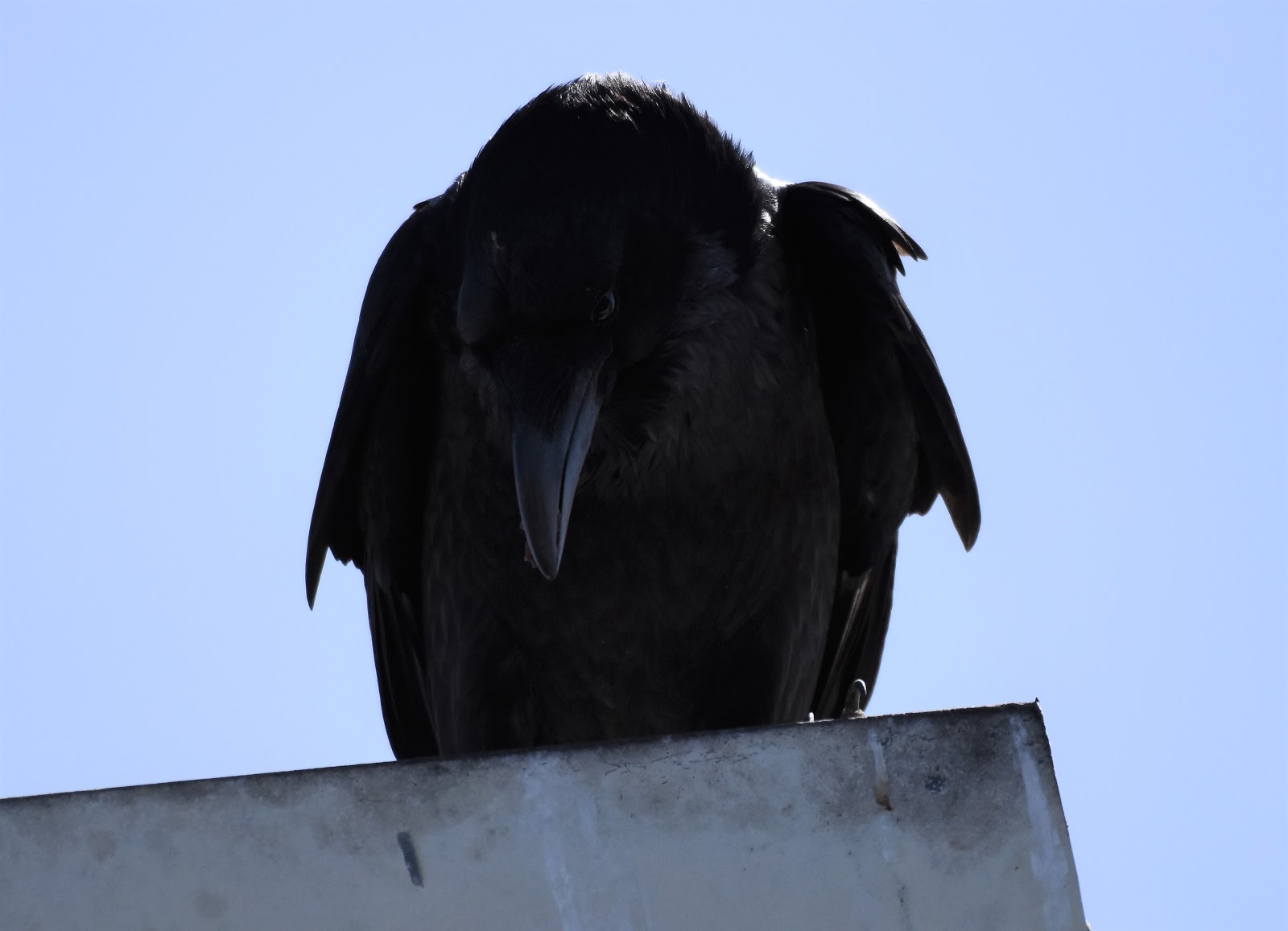
So how about those "other" black birds? Crows and Ravens??!!! In Tucson, it's possible to spot the Common and Chihuahuan Ravens. But how do you tell them apart? More common are the Common Ravens. They generally fly in pairs, but can be seen at times flying in great numbers. Even the experts can have a difficult time ID'ing these birds from afar. Chihuahuan Ravens will flock around Pecan orchards here and of course, open grasslands. They have a shorter bill with long nasal bristles. However, they fly a bit differently than the closely related Common Raven. The Common Raven "rows" its way across the airways.
American Crows
And the American Crow is a smaller bird with a large bill but much smaller than that of a Raven. The calls are the easiest to recognize. Understanding their calls, makes the ID a snap!
European Starling
European Starlings are black but very easy to ID with their body and bills. Their starry patterns remind me of outer space. But still.....from a distance, I have to really look. But if I can see those triangular wings, short square tails and that stocky body, I know right away that I'm witnessing the European Starling in action. They also tend to flock. Again their calls are distinct.
Common Raven
One black bird(or blackbird:) that is an easy ID is the Bronzed Cowbird....if you can see the red eye:)
Bronzed Cowbird
The Brown-headed Cowbird at maturity has a black body with a brown head....hence the name. Both birds have VERY cool calls. They sound like spacy, liquidy whistles! AGAIN another easy ID! Many people miss this one and I have to point it out to birders visiting from out of state. I've helped 3 birders add the Bronzed Cowbird to their life lists. Watching someone add a cowbird to their life list makes me smile. We take them for granted here as they are rather common.
Female Brewer's Blackbird
Here's a flock of Brown-headed Cowbirds below in flight. You see how they could be difficult to ID? Usually they mix with other blackbirds to add to the confusion.
Flock of Brown-headed Cowbirds
Many out of state people come to find our Yellow-headed Blackbirds. I've witnessed this bird in the tens of thousands. Twice I have been caught in the middle of the tornado energy and it made me smile. My video below captures the many Yellow-headed Blackbirds making a landing in the fields adjacent to the gas station.
I was filling up my gas once and a black cloud descended around the parking lot. Another time I was birding in Tucson and an entire flock flew around me. I was surrounded by magic!
Yellow-headed Blackbirds
These blackbirds are easy to ID. Their calls are varied and diverse but thankfully their colors stand out among the rest. Someone asked me once, "What are those blackbirds with a yellow head?" Yellow-headed Blackbirds. "Oh, that's easy." Sure is.
So is this Red-winged Blackbird below. Interestingly enough, the female looks nothing like the male. To a beginner, they look like different birds. Is it a Waterthrush? A Finch? Nope. Just the female Red-Winged Blackbird:)
Red-winged Blackbird
Finally I end with a Chihuahuan Raven. Of all these black birds I shared today, I think the Common and Chihuahuan Ravens are probably the most difficult to ID. This may sound weird, but when I see a Chihuahuan Raven, I just "know". I'll mark them down wherever I am to keep tabs on their location. On Ebird, there is a Chihuahuan Raven expert who monitors our populations and I was able to email and chat with him about his studies. I have many more black birds to find, but here are the ones I've been able to ID so far.
Chihuahuan Raven
Common Raven
Finally, I'd like to add one last thing about taking pictures of black birds or animals. It's really difficult!!! I find that having a very light background brings the detail out on these birds. Below is a pic of our cat Cassie. She sometimes blends right in with the surroundings.
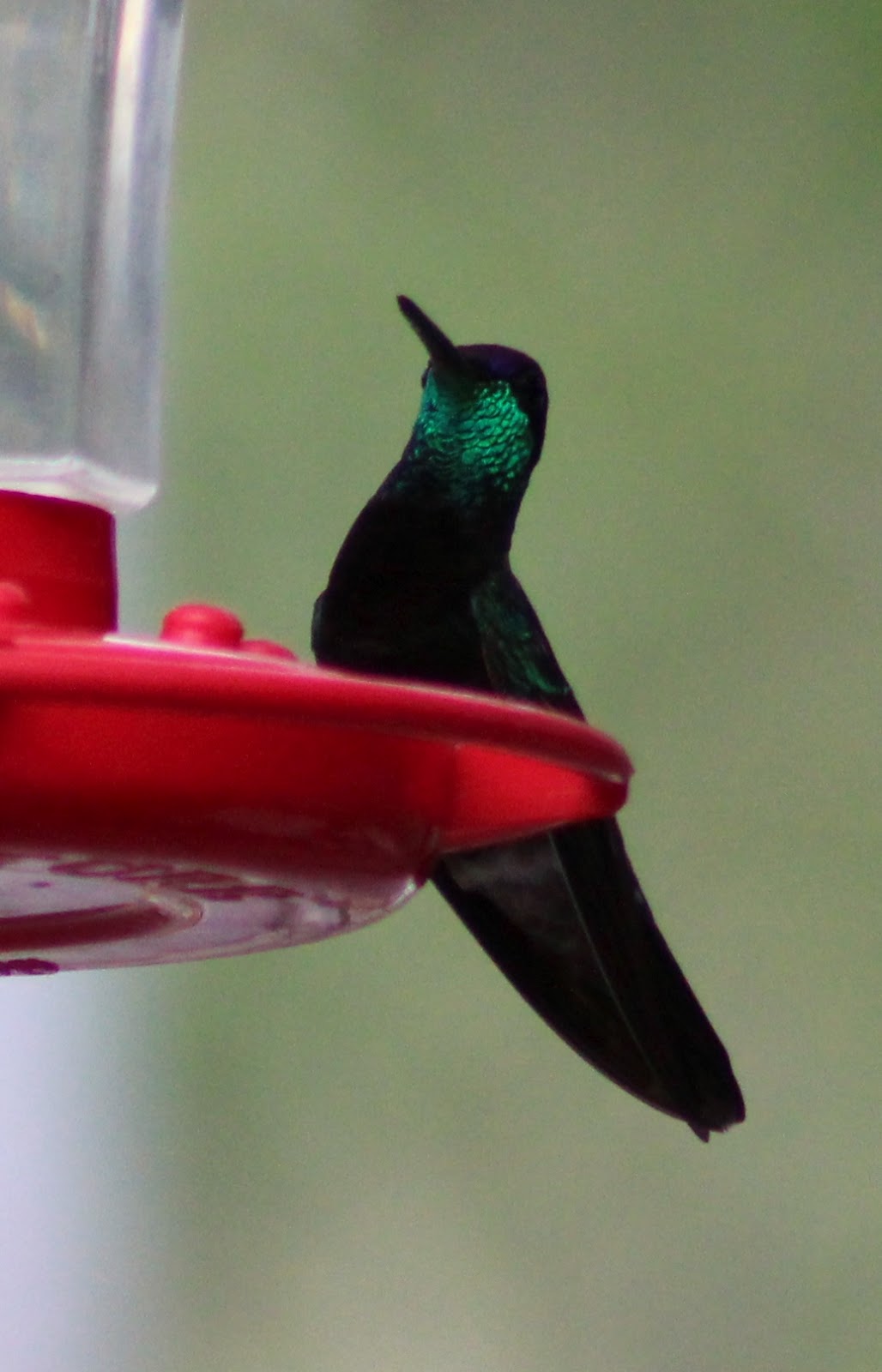
Let's start off with the Magnificent Hummer. Again, everytime I go out on my quests, people ooo and ahhh at this particular hummingbird:) Today's adventure takes us to the top of Mt. Lemmon near Ski Valley. I was searching for the Broad Tailed Hummer.
So I followed this tame raven to the Iron Door tavern after a long hike in the woods. This raven was raised by humans after the fires and is one of two that you'll find around this place. They are very healthy and happy:) One of the hummingbirds that has eluded me has been the Broad Tailed Hummingbird.
I don't know why because they are quite common. But I've been discovering that each canyon, each mountain top sports different hummingbirds and that has been a really interesting observation about these little adventures. Case in point. I started noticing a different type of female hummingbird in the woods. I do not joke when I say they hover right in front of me. I start noticing different sounds, different flight patterns and different patterns on the gorget. That's when I knew I was in the right spot. It's hard to describe the noise or flight patterns of a hummer. But if you recognize their vocalizations, you'll notice the variety of sounds that they can make.
But let's examine the female first. In the pic above, you might notice the "striping" on the gorget. There's also a little brown/yellow on the side of the wing. This tipped me off that I was dealing with a different female hummer from the rest that I have observed on my trips.
The male Broad Tailed Hummingbird looks a lot like the Ruby Throated Hummingbird back east. It's gorget will appear dark or black when it's not "flashing":) What do I mean by this? Look at the pic below of the Magnificent Hummer. Notice how the gorget(throat) shines a blue color? When it's not the pretty blue color, it's a dark black color. So I was hoping that the male Broad Tailed Hummer would "flash" for me. The results were incredible. During this shoot, I was able to go alone and focus on the photography bit without having to entertain people.
There were warning signs that something was "going down". Their territorial calls come first and then the swoop and attack. The male Broad Tailed hummer would usually chase off the Magnificent. The females would come in first and then.....
......I would wait:) And wait:) And wait......:)
My first shot was by accident. Here is the very quick male Broad Billed Hummer. He wasn't really into the feeders on this day so I had to locate where he was perching. And that is where I'd get the best pictures.
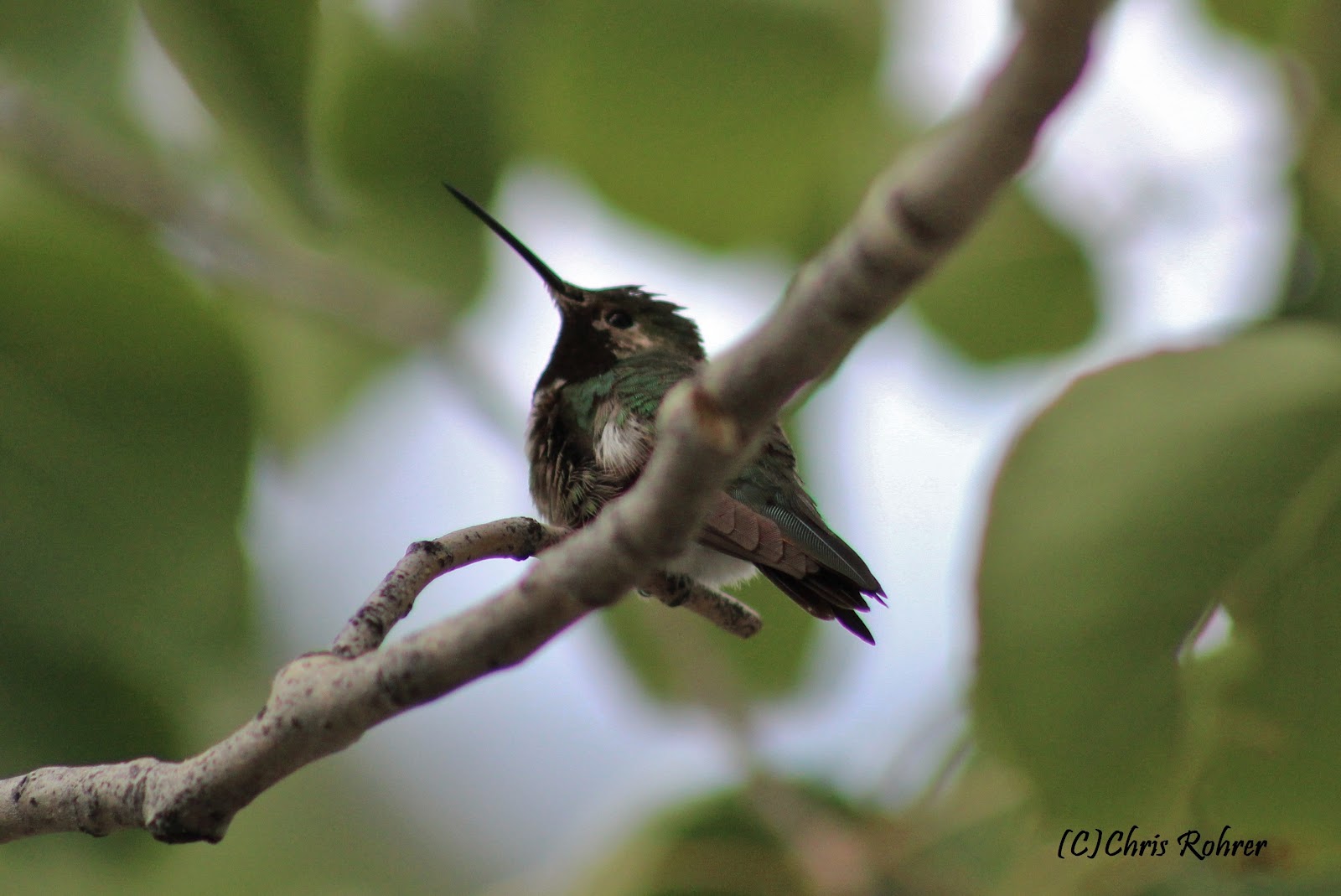
Here(below) we can see the BT flashing his gorget. Pretty little hummer.
Many of you have wondered how big some of these birds get. I needed perspective and here is a simple branch with the BT on it. You can see how small these tiny birds are. And as a photographer, I love this series of pictures.
The key is listening for their chirps and whirrrrrs. I was able to locate the male easily by tracking his flight patterns and keeping my ears open.
I was just amazed how territorial this little guy was with the male Magnificent Hummers. They're much larger. How does this little guy get away with chasing the big guys off?:)
And I saved my favorite picture for the last part of this post today. If you go out and search for hummers, remember there are 2 "Broad" titled hummingbirds. I often, in my excitement, mix their names up. There is the Broad Billed Hummer which is an incredible blue color and orange bill and then there is this guy below....the Broad Tailed Hummer. My search continues. I've had some difficulty with the monsoon rains creating terrible road conditions on the canyon roads. Many of the roads are muddy and not accessible by car. I'll be sticking to paved roads for now and hopefully I'll find some of the more elusive hummers out there. Stay tuned for more.... PS. Warren I have a stats post coming up for you with the list, etc of hummingbirds spotted including where I found them.


 Posts
Posts