Lately, I've been focused on the job that pays for my health insurance. The start of the new year for every teacher is a tricky one. If you set the tone right during the first several weeks, the rest of the year is perfection when it comes to classroom management. On top of the main job, I've also been working on our house project that includes lots and lots of planning. And on the weekends, I eagerly escape to go birding with friends.
a Canyon Wren plays hide and go seek with us
Gordon came down for the weekend and we decided to do fun birding in cooler settings. Kitt Peak was new for Gordon and it was just a nice get away from the heat. For the first time in a LONG time, we should have brought our sweatshirts! It was cold! What a wonderful thing!
Yarrow's Spiny Lizard
In fact, this is the end of summer for us. It's the height of insects and migrating birds and bats. September is so GREEN and buggy! This is the best time of year for butterflies. The trails are full of them!
a stock photo from several years ago on Kitt Peak. This is the area we covered birding
We headed south of Tucson towards Sells on the Indian Reservation. There's a peak that has telescopes on it. And that's where we birded the morning finding lots of fun birds.
Mexican Jay
We found Mexican Jays collecting acorns from an oak tree.
juvenile Mexican Jay
Spotted Towees appeared to be marking territories for yet another nest.
Spotted Towhee
Meanwhile butterflies stole the show.
Bordered Patch Butterfly
Down below in the valley, the wildflower show was incredible. The rains have been good to Southern Arizona and the oranges, blues, purples, reds, yellows and pinks are confirmation of a happy desert.
Arizona Poppy
One area was thick with wildflowers. A beautiful carpet made by nature.
Trailing Windmills
There was no shortage of bugs. I try to escape the chiggers and mosquitoes, but they somehow find me.
Plains Lubber Grasshopper
The heat finally ends our Saturday of birding fun. Sunday comes and we were looking forward to exploring Reddington Pass. This was another new area for Gordon, but as we exited our place, we hit a wall of heat and changed the plans.
American Snout
We wanted an easy place to bird, get water, have a nice lunch and see fun things. The Arizona-Sonoran Desert Museum was the perfect fit. While it's technically a "museum", it's much more than a building full of crap. Here you can explore the wild spaces and see lots of real and wild critters that hang inside and outside of cages. It's a great place to look for desert birds like the Cactus Wren or Gilded Flicker.
Gordon and Micheal scour the Desert Museum property for butterflies, lizards, birds and other odd insects
Another unique species that lives on the grounds is an iguana that has survived decades on the property.
San Esteban Island x Sonoran Spiny-tailed Iguana
Meanwhile we checked out the other critters hanging out around the riparian/desert corridor of the museum grounds.
male Bighorn Sheep struts his stuff
Eventually we made it to the aviary. This year, I have spoken with many people about this subspecies of Northern Bobwhite below. The Masked Bobwhite is VERY rare and can only be found at the very close border of Mexico and Arizona on a few ranch lands.
the extinct-in-the-wild subspecies of Northern Bobwhite(Masked Quail)
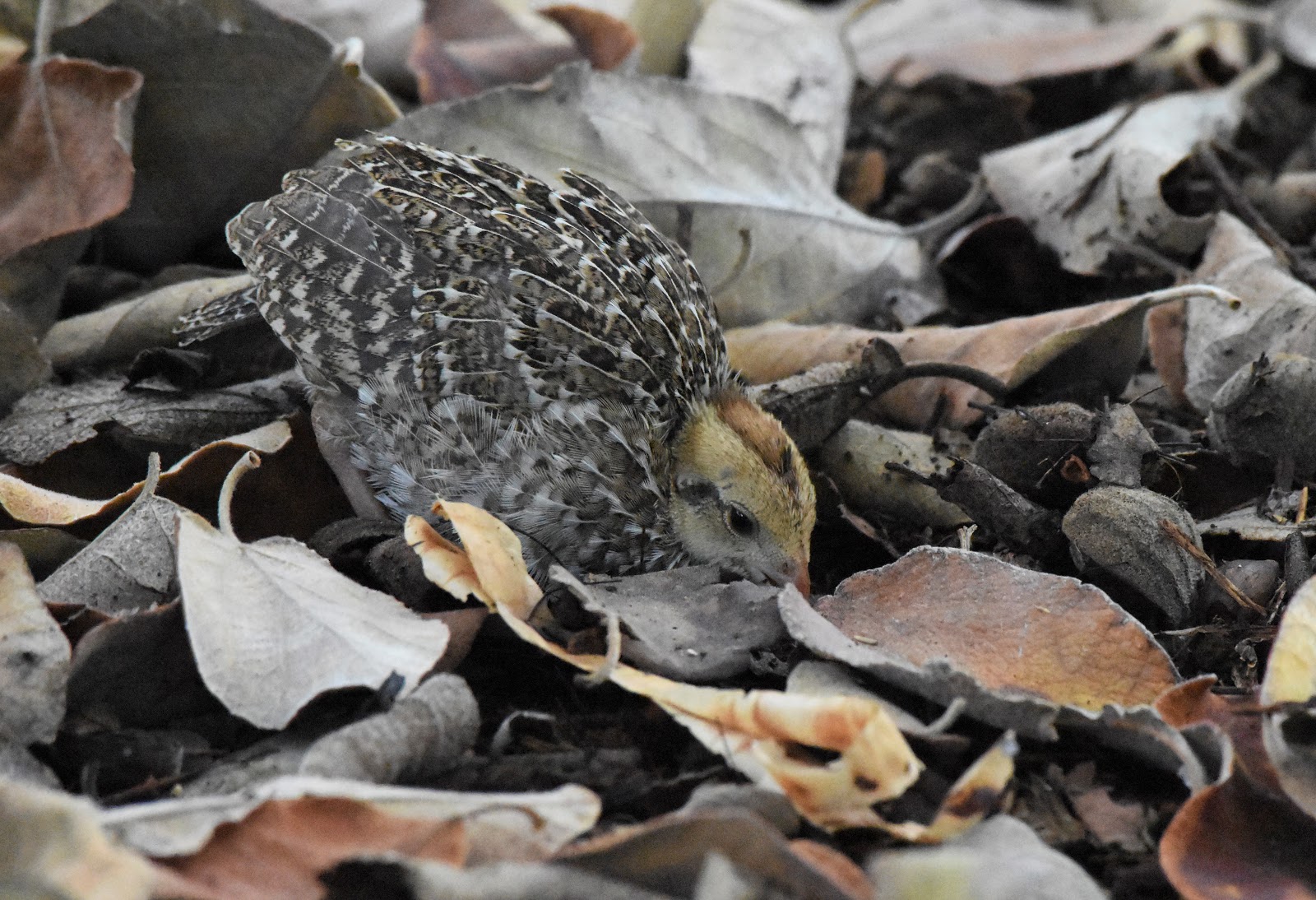
They are breeding these birds to release in the wild, but even when we go to study them in the cages, they can be difficult to see! So it was a real treat to find that this pair had mated....and had a chick!
I know it's a caged bird, but it's so rare in the wild that practically no one has seen these birds at all beyond a stuffed model on display for what used to live in the grasslands. To see them like this close up was spectacular. Over the years, I've seen only one in the aviary and she was always hiding. Not on this day!
And that chick was adorable.
After work, I'm exhausted. The heat drains the life out of me. The mornings are lovely and it's really the only time to do any birding. You get a 4 hour window and that's it.
Olive-sided Flycatcher
A lovely win for the week was an Olive-sided Flycatcher hanging out at my local patch that I monitor weekly. And a very human downer happened when I misidentified a juvenile Black-crowned Night-Heron for a super rare Yellow-crowned Night-Heron. To be fair to myself, many others thought it was a juvi Yellow-crowned Night-Heron as well.
American Avocet
I got two minutes to look at the bird from a distance, snapped my shots and then had to wait until I got home to look at them. Magill got home before I did and looked at the pics up close and said, "Nope. This is a juvenile Black-crowned." Our hearts sunk. The ID is a tricky one, but next time I'll be looking at that bill better.
Birding in Dateland and surrounding areas for shorebirds
The juvenile Yellow-crowned Night-Heron has an all dark conical bill where the juvenile Black-crowned Night-Heron can have some yellow in the bill. Oh well. You win most and lose a few every once and awhile.
Black-crowned Night-Heron
We randomly explore the state and search for something fun to show up. I wouldn't do it alone as it's more fun birding with friends during this nasty and beautiful time of year. We motivate each other to bird during these trying times. Migration is upon us and every day, there is something just waiting to be found. Will you find it? Until next time.
People always ask me when they should come and visit Arizona. Well, it's a complicated answer depending on what the individual wants to see or experience. If you are a lover of color, warmth and amazing garden tours, then I'd suggest Tucson during the month of April.
My attempt at impressionism(via a computer program) on a blooming cactus
This past weekend, I focused on nesting Cactus Wrens around Saguaro National Park and our very own Desert Museum. This museum is situated on a pristine track of Sonoran desert land which makes it a great area for nesting desert birds. The Desert Museum is a MUST SEE for all people who come to visit Tucson. You won't regret it! A museum??? Yeah I guess it's a museum of sorts, but it's not the kind of museum you'd expect. It's a living representation of our incredibly diverse Sonoran desert.
Coachline Lake in Marana from last week Thursday
I've been into gardening this month and enjoying my work around El Presidio. I've also kept up with some birding, but I've been into the artistic side of it. In fact, I'm beginning to research art courses beginning next year. I want to paint my work. I think at some point some birders enter this chapter of their lives. For me, it's a way to reconnect to the experience and also just create. One of my friends has expressed an interest as well. So it'll be fun to have a partner in crime. I have included several of my photos above using a computer program to capture the moment. A blogger who has inspired me now for several years is Gillian Olson. She does amazing work with her own photography and I love it.
Northern Cardinal
I start my Saturday morning with coffee and look out my window for inspiration. Where will I visit today? Many times, I just leave my birding up in the air with several places in mind. My first visitors are the hummingbirds and Northern Cardinals....
White-winged Dove doing a bow at my feeders:)
But on this Saturday morning, I hear the unmistakable "Who cooks for June?!" outside. PS. That's not the expression birders use to memorize their call. I just made it my own:) June is my good friend's mother and I like to think of her when I hear this call. It's actually, "Who cooks for you?!" Anyhow, enough of my gibber gabber. My point is that they were all over my feeders!!!! It's that time of year when they arrive in great numbers! And unlike other doves, they are not shy at all!
Hybrid Torch Cactus
Their arrival means one thing. Desert blooms! They will feed from our blooming Saguaro cactus soon. When the blooms are gone, many will move on to other places. Well, that's how it is here in Tucson. Some do remain.
Birds are nesting and life is happening everywhere. Little hummingbirds are hatching out of their tiny little eggs.
Female Costa's Hummingbird
As for curiosities this week. There was one. Below is an iguana I keep seeing at the Desert Museum. It is not caged nor does it belong in this part of the Sonoran Desert. Many times I will walk around the grounds and have one staring back at me closely. So I did some research. It is a spinytail iguana that isn't found in Tucson. These lizards were released on the museum grounds in the 70's where they have established a colony. Apparently they are a genetic cross between the San Esteban Island Spiny-tailed Iguana and the Sonoran Spiny-tailed Iguana. They are found in the Sonoran desert just not in this part of our desert.
Hopefully, this guy stays out of the way of this Greater Roadrunner below!
Greater Roadrunner catches a lizard for lunch
Next week, we will sweep Southern Arizona by storm as the Wrenegades once again reunite! Together we join forces to find the most birds in one day for this Tucson Audubon fundraising event! Will we outdo our list from last year? Stay tuned for more!
It was a day off from road treks. So I took my other half Pat to the Desert Museum near Tucson. The purpose of this visit was to check out the new Warden Aquarium.
Mountain Lion
I counted wild birds while working on my photography skills. And to be honest, I am getting to the point in birding where I just want to watch birds and not have to take pictures of them. My number one rule is "Get a good shot of the lifebird". Afterwards, just enjoy the observations.
Emperor Swallowtail on Hibiscus
And while I've seen all of these birds in the wild, it's not always easy to get up close and personal. So I figured, why not cheat and get some great stock photos from these birds? National Geographic does it as do many other wildlife photographers! And how do I know??? After staying at many birder bed and breakfast places, the owners tell us what some of these photography gurus do:) I still prefer the wildlife shots but it's still nice to see the details.
Western Screech Owl
And so I had a blast:)
In the wild, as most of us know, it's important to stay quiet and completely still.
Ocelot
Moving a camera up with its very audible "click" will scare away some of our elusive friends.
Today's challenge though was to capture the beauty and personality of the animal filmed. It was about NOT taking that "zoo pic" but capturing the essence and personality of the subject.
I have an affinity for owls. Owls trump most birds except maybe the Harpy Eagle. Or the Toucan. Maybe a parrot:) Well....you get the idea:)
As I'm understanding the wildlife better, my fears are also quieting down a bit. The Barn Owl flew near my ear and everyone went, "Oh my gosh guy!" One time a Bobcat came running towards me and then turned to the side. It didn't frighten me. I'm always super careful but I'm learning to read animal and bird behavior better. The Owl was just going after food. The Bobcat was only running down the path to capture a mouse.
Bobcats
Now I've heard stories. Canada and the northern parts of the United States have issues with Great-horned Owls going after "Soccer" Moms. I couldn't figure out why this was happening until it was mentioned that while running, their ponytails looked like moving mice. I laughed at first and then thought about it visually. A head injury from owl talons is not cool. So to those soccer moms out there, cover up! And hide that ponytail under a baseball cap! Public Radio is so informative:)
There is a story out there just waiting to be written and I hope to write it for you all one day. Arizona is/was home to several parrot species. I will be studying these birds over the next year here in Arizona. I hope to find some(beyond the lovebirds and monk parrots of Phoenix and Casa Grande). The Thick-billed Parrot is a rare treasure and if you ever come across one, consider yourself extremely lucky! It is endangered and while there is a successful captive program going on around the country, these birds have lost ground to habitat destruction, poaching, and high predation from hawks like the Northern Goshawk. The reintroduction to the Madrean islands looks to be highly unlikely. Currently these birds are found in the Mexican state of Chihuahua and I'm thinking a trip there would be fun.
However, Western Screech Owls are common in Tucson. Here's one below I recently took in the wild. Not the greatest of shots, but these tiny owls are still a wonderful find!
I've been thinking about adding an owl box to my garden here at El Presidio. The only issue? 3 feral cats that roam freely thanks to ghetto neighbors. I love cats. I love owls. But if I saw an owl killed by a feral cat, it would be the cats end. I'd capture it and have it taken to Pima Animal Control. And bye bye feral cat. They kill over 3 billion birds a year! We have 5 cats at our place and they are not allowed outside. But they do get an entertainment window to watch birds. It's a win win for birds and cats alike.
And so, the owl nesting box will have to wait until Greystoke, Tubby, and Bear no longer come around.
This spring I will be working on my butterfly garden again. This past summer, we saw so many of them around our property. It's all about using the right plants:)
I can now relax my camera when it comes to the Barn and Western Screech Owls.
The little guy below was very curious.
I think snakes are cool(when they are behind glass). This Mohave Rattlesnake gave me the shivers. There's nothing worse than coming across a snake in the wild while birding. I now have a first aid kit for that potential bite.
Mohave Rattlesnake
One trek I have yet to make is to the Aravapai reserve. It's home to many of our Bighorn Sheep.
Bighorn Sheep
Soon our hummingbirds will have babies.
And as for the aquarium??? It was divine! Check out the video below from my Iphone:) Until next time.....


 Posts
Posts