Showing posts with label saltwater crocodile. Show all posts

Sunday, March 17, 2013

Black Hawk Reunion

Common Black Hawk(Mangrove subspecies) on Coiba Island, Panama
Almost 2 years ago, I walked around an island with 2 friends.  I was not a birder at this point but enjoyed taking pictures.  We, including 7 other people, were all who lived on this island for several days.  I had a sub-par camera and liked snapping shots of monkeys, crocodiles and birds.  I didn't know what all the names of the birds were but I liked looking at them.  
Now flash ahead to present day. I began looking back on old photos for the above image.  Whispers of a Black Hawk Migration began to surface and I wondered, "Had I seen this bird before? And if so, do they really come up through Arizona??!!" I do not celebrate Christmas, Easter or much of any other holiday.  But I do celebrate something else.....Migration! And apparently so do hundreds of other people!
Excited birders move quickly down the road to watch the CBH migration!  Don't stand on the bridge or you'll be cited by the Tubac Police.  Many of the birders flew the coup and came to the park instead!
During this time of year, birders from all over the world migrate to Arizona as they search for something rare and beautiful like the Common Black and Zone-tailed Hawks.  Today Kathie and I would search for the Common Black Hawk....which isn't so common in these parts! They prefer to fly over riparian areas as they head north.  If you head south to Mexico or Central America, you'll find them everywhere!  But there are several different subspecies.  In my first pic, you see a Common Black Hawk from the Mangrove subspecies which cannot be told apart from the normal Black Hawk.  I found this one near the mangroves on Coiba Island while almost stepping on a croc.
It's not a log.
 That was not so cool.  The shots were cool however:) Do you see him?
 How about now?  Yeah, Tanagers, Vultures, Kingfishers and Black Hawks would have to wait as I moved out of harms way.  Crocs are pretty fast.  I'm not sure he'd find a lot of meat on me but there certainly is quite a bit of fat to chew:)
But back to Arizona.  On this day, both Kathie and I would witness, along with 60 other birders, the great Common Black Hawk migration!  I suppose it's a lot like Christmas for those who like presents with nice surprises.  For me, the best gift of the year came from the shot below.  12 Common Black Hawks took off around 9 AM to the delight of the crowds.  Birders started shouting, "Oh my god, it's a Ferruginous!!!"  "A Cooper's is displaying!"  "Look at all the Vultures!!!" "Did you hear that Larry had to go to the hospital?"  "Theres a Red-tail!!" And drum roll!!!!......"The Black Hawks!!!! The Black Hawks!!!!"  It was like being on Fantasy Island.  Only instead of Tattoo yelling; it was a smaller older lady.  And as quick as the hawks came into view; they quickly disappeared into the big blue Arizona sky.  The crowds began to dissipate.  Only the diehards stayed and got themselves a Zone-tail Hawk!  A good day indeed! But for that one moment, it was exciting to be around all those birders as they waited for the real movie stars to arrive. Those are the rare moments to celebrate!  What a show!
Common Black Hawk
Migration isn't just for the birds.  The butterflies are also showing up again!  The first sign that spring has arrived comes from the Pipevine and Mourning Cloaks!  Here's a Mourning Cloak lazily hanging on a branch like a fairy would in a good fantasy novel. 
Mourning Cloak
If you are coming to Arizona, this is definitely the time to visit.  Crazy things are happening everyday and honestly, it's a bit overwhelming.

The Common Black Hawk migration will be around for another week or so.  The best viewing happened for us at the Ron Morris Park in historic Tubac.
Turkey Vulture
This post comes from 3 different bird observations.  I went to find the Common Black Hawks at Ft. Lowell Park this past weekend in Tucson.  Around 9 AM, lift off happens for many of these birds. So we waited for the show to begin. And while on this day I didn't see any Common Black Hawks, I did find another friendly birder by the name of Molly.  Together we watched 86 Turkey Vultures rise above our heads.  A Kettle indeed.  All I can say is, "Migration. Is. Awesome!"
A Kettle of Turkey Vultures
More to come....

Monday, September 5, 2011

Giant Saltwater Crocs!

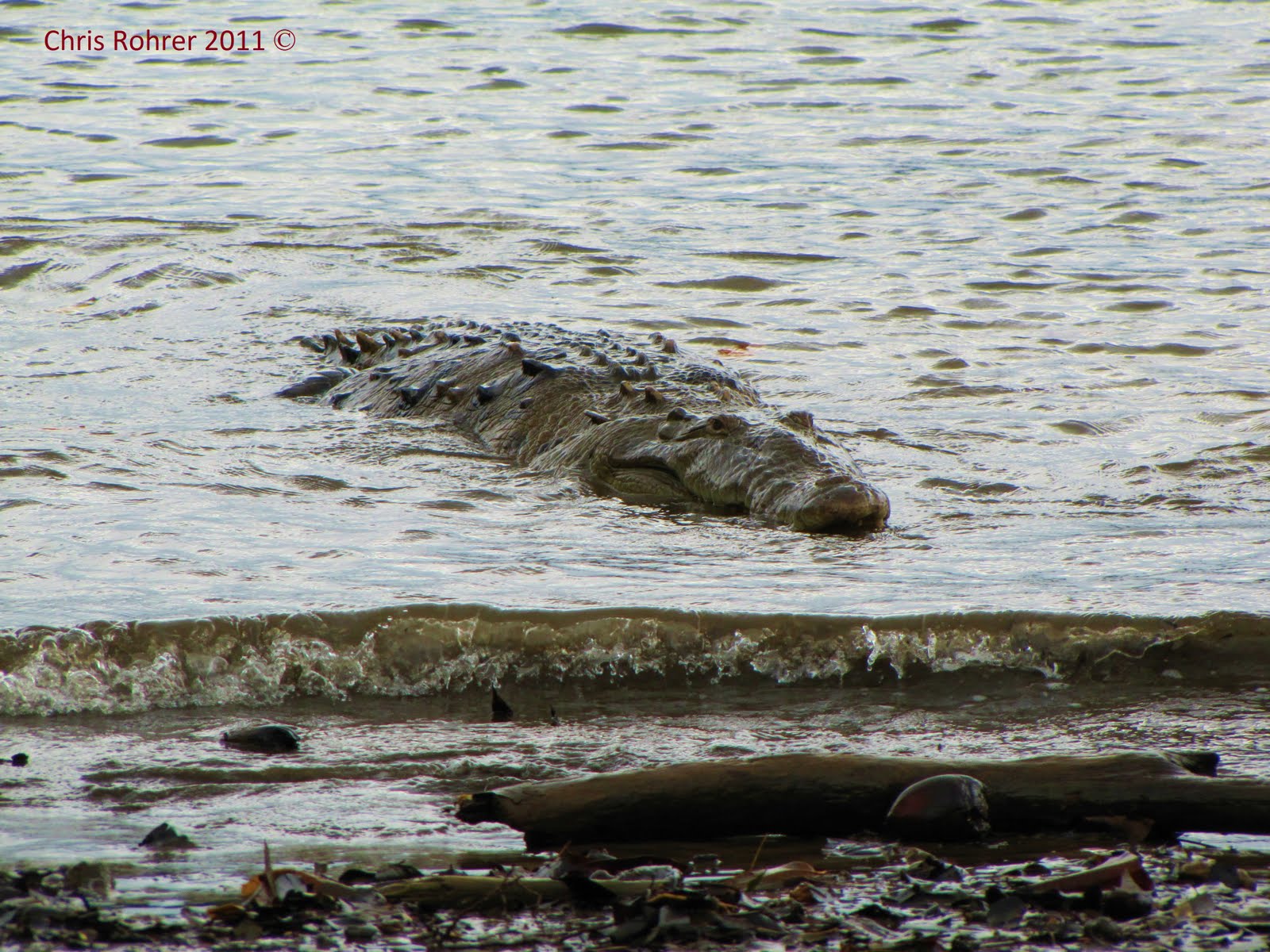
While birding along the beach, little ol' me wasn't paying attention to the ocean.  The pic above is clear.....but was it so clear below?
Someone called my attention to the water and I ran!!!  I wasn't aware that crocs could swim oceans!!  I thought that they just hung out in rivers.
Quickly I got off the beach and whipped the camera out.

Slowly Tito, the 15 year old croc(named by the Coiba Island crew), emerged from the Pacific waters.
Saltwater crocs are territorial and hang out near mangroves.  From a distance, they are really amazing creatures.  If one ever chases you, run zig zag instead of straight forward.
Obviously, they are intelligent creatures with extreme patience.  They have been known to stalk humans for days and observe their patterns.  At night, when people are sleeping, the croc will attack.  This is one of the few survivors, beyond dragonflies, that have survived the prehistoric times of the dinosaur. They are a predator to watch out for in the waters.  Protected in most countries, the Saltwater Croc is an extreme success story and is making a comeback after a near extinction back in the mid 20th century.  Most countries, like Australia, now regulate their populations as they have exploded over the past 2 decades.
During our stay on Coiba Island, we spotted 3 saltwater crocs floating like logs in the water.  These crocs can get quite large.  Just check out this giant saltwater croc caught alive off the shores of the Philippines!  This one checks out at 21 feet!!  So if you're in an area that is lucky to have these amazing reptiles, keep your eyes on the look out:) Here's a vid I shot back on Coiba island from this past summer.

Saturday, August 20, 2011

The Forgotten Garden

A small river runs into the ocean from the forest.  By night, the ocean covers this beach and invites creatures like saltwater crocs to enter the smaller island.
I sit today on the smaller island known as Coibitas off the main and larger Coiba Island.  I'm enjoying the breeze because as of late, we've been hiking nonstop into the muddy and sometimes dangerous paths of the Coiba forests. It's fun!  We've had to watch for saltwater crocs, keep our camelpacks full of water, and dry out our sweaty clothes which weren't usually dry due to a random rain event or the constant humidity that just hung in the air.  When I look from where I'm sitting, there's nothing but islands covered in emerald green rain forest which goes as far as the eye can see.  These islands harbor large areas of pristine coral reefs and are protected by the fragile mangrove forests that line the island coasts. This area is a protected corridor and of huge importance to marine life that are teeming with fish, whales, turtles, sharks, and many other sea creatures.
A guide and boat are essential to appreciate the large expanse of Coiba National Park.
I keep a lookout for a croc as we had found tracks on the beach near where I am sitting.  These huge reptiles are sneaky and blend in with their surroundings.  It's when you least expect it that they appear from out of nowhere.  Yesterday, during my mangrove shoot, my heart almost stopped when I saw one of these animals.  He was only a couple meters from me and I won't forget that experience anytime soon.  I'm glad our guide, Javier was with us on these treks.  To fully appreciate this trip, you'll need a guide and boat to get to some of these places which are difficult to reach. So today I keep my eyes open as I begin my story about the Shah and his forgotten garden.
The ladder to cross the stream into the forgotten garden. Scary!
Almost every island has an interesting history with it.  Coibitas is no exception.  Our story takes place in the 1970's.  The last of the Iranian Shahs purchased this island for his tropical getaway. Most of Coibita(then called La RancherĂ­a) was untouched except for the place where the Shah built his home and created his fruit garden.  He grew peaches, cashews, water apples, and citrus trees. Some of these trees have a difficult time standing the tropical onslaught of ocean air.  The garden was tucked away beyond the palm groves past a creek with a sketchy ladder connecting us to the garden.
Old fruit trees covered with moss and bromeliads
The Shah loved his peach trees and today several of them can be seen growing around the island in random areas.  Eventually, the Shah became sick and died.  His garden forgotten and left to the demise of Mother Nature.  His belongings were passed onto his daughter who then sold the island for one dollar to the Smithsonian Institute. Or so the story was told.  Today the island is protected by UNESCO.  The Shah's home is now a research station for scientists from all over the world to stay.  Today's guest was a researcher from Germany studying sharks around the reef area. Two men are working to keep several areas tidy. Several buildings have fallen apart and are reminders that there were others who once lived here.
The Jesus Christ lizard.  Why this name?  Because when it flees for safety, it will run across water on two legs. If you haven't seen this, you should youtube it.  It's really cool.
The fruit trees are overgrown with bromeliads and moss.  Many of them look terrible....especially the citrus trees. Mosquitos are everywhere. I stand among the trees and watch all the birds flying around the branches.  Several water apples are ready to pick, but no one is there to harvest the fruit. The owner dead.  And the image is eery giving me a moment's pause. What will our gardens look like after we're gone and no one is there to tend them?  More tomorrow......


Thursday, August 18, 2011

The Coiba Island Experience

Greetings everyone!  Here is the million dollar post from our Panama trip on Coiba island.  This was the most expensive and yet amazing experience we had in Panama.  It was worth every penny.  I wrote about our investigation on Coiba island several months ago.  We had also done some research on the Darien Gap.  Both would have cost around the same amount of money and both offered similiar experiences.  However, we were travelling during the rainy season and most of the Darien would be inaccessible due to flooding trails.  We then began to focus our attention on the biologically diverse island of Coiba.  80 percent of this large island remains untouched with pristine primary forests.  It's one of the last places in Panama to view colonies of the Scarlet Macaw.  There's even a species of howler monkey that is endemic to this island only.

It started from the tiny surfing village of Santa Catalina.  We found a guide by the name of Javier who runs a place called Casa Kenia.  He runs a great program that took us several nights to the beautiful and isolated island of Coiba.  Accommodations were okay on the island.  We did have a/c for a couple hours, but it ran on generators and eventually, the unit would shut off at 2 in the morning:)  I must make this note because it's very important to know before going.  Having ANY accommodations were better than none in this very beautiful national park.  But because it was a little rough, some birders will dislike this place because they physically can't hike the trails or have difficulty getting in and out of the boat.   So I offer this advice.  If you are thinking about going to Coiba Island, make sure you bring water shoes of some kind and spare clothes which should include some good hiking boots to walk the sometimes muddy trails.  Don't forget sunblock and your camelback for water!! It is a primary rain forest and has its challenges at times, but thanks to Javier, we had a fantastic experience on the island.  A lot of it is unexplored botanically and guess what?  The Smithsonian own the tiny island known as Coibitas to monitor this park and protected marine area.
I promised wild monkey shots...not good ones.....but here they are.  This little white faced Capuchin monkey was throwing mangos at our building in the morning.  I moved quickly with my camera in hand to snap several shots off before he moved too far into the tree tops. The bottom pic looks like the mysterious BIG FOOT picture taken awhile back.  I laughed at how this monkey walked from one section of rain forest to the other.  Some people believe it's easy to spot wildlife, but I'd like to say that it's one of the most challenging things to do as an amateur photographer.  The wildlife is all around you, but you have to really look and listen to see all the wonderful critters.

My case in point.  Where is the monkey in the trees of this picture? 
Pic taken by my friend Jen Inboden
So why did Panama leave this island in such a pristine shape?  Quite simple.  They placed a penal colony here which accounts for a small portion of the islands deforestation.  The vegetation is growing back as the colony is shut down.  No more prisoners live here anymore.  You may think of this place as the "Alcatraz" of Panama.  Many people were afraid to come here because several prisoners had murdered locals who accidentally wandered onto the wrong island.  I'll tell that story in a few days.  But because Coiba Island had this reputation on the mainland of Panama, it was protected unintentionally by killers and murderers......with a positive outcome for Mother Nature and for human kind! A potential algae that grows around the waters has been recently discovered to fight cancer.
The island is large with flowing rivers full of animals.  It's difficult to get inside the interior and we had only scratched the surface.  One side was completely off limits as the tides and currents of the ocean made for a dangerous ride.  Instead, we were able to visit the calmer side of things within one of Panama's most beautiful and sacred coral reefs. Coiba Marine Park is considered one of the top ten reefs of our world.   Several smaller islands surround this larger one.  It's possible to have whale and dolphin sightings here.  While on this trip, I saw many large sea turtles swim around the reefs. And birding.....well, there's a lot of them to see here as well.   The beach above was an entrance to a secret trail full of old and twisty vegetation.  Monkeys had recently walked on the beach leaving their fresh tracks behind in the sand.

Not all rain forest is the same.  People want to know what primary or secondary forest means in person.  Well after walking around in primary pure virgen rain forest, I will never forget how incredibly cool it was.  Twisty gnarly vines connected mammoth trees together.  And there was a soothing presence about it all.
Iguanas galore on Coiba island. 
It's difficult picking out the massive amounts of green pics and determining which shot will be posted on the blog.  For me this post was the most difficult because I had to choose which pics best represented what I saw in the forests.  Here is an example of the viny ancient look of Coiba.  In fact, Coiba is known as one of the viniest rain forests on this Earth.  It has a unique look. 

It wasn't uncommon for vines to connect or take over entire trees.  Vines would come from the ground....the air.....water.......basically anywhere they could cross; they would. I loved the bark of this tree on the pic below.  Moss and lichens covered many of the trees in Panama which added a lovely green tone to the brown bark.
This is a saltwater crocodile below.  A special post will be released in November on this guy, but for now, here's a pic. What? You want more now?  How about a clip on him on the last day of the month?  I have a fantastic video showing this guy in all his glory on August 31st.  We had to be careful swimming in certain areas around the island.  These guys are pretty territorial so you won't find many concentrated in one area, but there are usually a couple lurking around the waters.  When we went swimming, we always kept our eyes open for floating logs because that's what they looked like in the ocean waters. 
Saltwater crocodile
This reptile fascinated me.  He also scared me a bit as I had never been close to one before.  I've seen alligators and caiman but nothing prepared me for the size of this creature....15 feet long!!
As I walked the beach, I noticed something in water.  I hadn't paid attention to the signs, but it stated that crocodiles live in these waters and that visitors should keep their eyes and ears open.  Traveller note. Always keep your eyes and ears open in wild national parks:)  Luckily I had followed that tip and spotted this guy in the water.  I had been snapping shots of birds in the mangroves nearby.  Crocodiles are fast. Traveller tip two.  If you should ever be chased by one on land, make sure you run zig zag. 
It wouldn't be right to post all these pics without including a shot of the agouti. Apparently, Coiba island has their own variety of this rodent, but I couldn't tell the difference. 
I'll have more shots and views for you from this amazing journey to Coiba Island and surrounding areas.  I think I have broken down the topics into some interesting areas that you'll find fascinating.  Some are on plants.  Some are on gardens.  And some are on reflection.  Either way, I hope you enjoy this mini series.  If you have the 500 to 600 dollars and time for this week stay, I  highly recommend it.  It isn't a trip for the faint of heart, but if you have energy and endurance, this place will capture you imagination.  Like Gamboa, it was difficult saying good-bye to an area not travelled by many people.  In fact, most Panamanians were excited that we were going to the island and stated that they wish they could visit.  Most travellers wanted to go but didn't have the money to do it....especially the backpackers.  Speaking of backpackers, we met two of them on this trip.  They went to Coiba on their own which was much cheaper, but they didn't have a guide or a way back.  It was difficult for them to get a view of the entire island and were limited to just a couple of trails from the ANAM station.  It was by luck that we came along and were able to bring them back to Santa Catalina.   I recommend a guide so that you get the full experience of the islands because it's a definite must see for your bucket list! PS.  Javier is a birder:) Until tomorrow....
http://www.casakenia.com/