One of the roughest rides of our Guatemalan trip came from a day visit to Semuc Champey. It's an unusual land feature with lagoons created by a river that plunges into the Earth. It's a bit of real life fantasy. One could imagine being in the movie Avatar on the planet Pandora. But getting there would prove to be a real challenge.
I didn't remember it being so difficult to visit. In fact, I wasn't alone. Several other people had been to Semuc Champey 6 years previous as I had been. We had a smooth ride on a paved road, but on this trip, it was a crowded and rocky ride. To make matters worse, we had the ugliest kind of tourists.....the obnoxious ones! So on this trip, I went to a happy space in my head and blocked the annoying chatter out. Once we arrived at our destination, we again left the tour group and hiked alone into the park.
 |
| Chestnut-headed Oropendula |
It was great. We were alone and the critters were out in full force. For some reason, I was super thirsty on this day and drank all of my water from my pack! We were half way up a very muddy trail that was rather dangerous and slippery when I ran out! Anxiety attack! But to get the first shot for this post, we had to climb nearly a mile up! There was no going back. The railings were sketchy as was our footing. In these situations, walking sticks will not work very well. You need both hands to maneuver the poorly maintained areas. It was hot, muggy and overcast. And birding was a real challenge on this day!

It's tricky doing photography while birding and walking. Perhaps it was the reason why I wasn't paying attention to my water consumption. As soon as the water went in; it was sweat out! But on the Mirador(Look Out) trail, we observed 50 Oropendulas fly up into the canopy of a tree. Their brilliant yellows were incredible as they fluidly glided from one tree to the next. It looked like there were acrobats all around us.
Along the way, brilliantly colored creatures crossed our paths.
 |
| Royal Flycatcher |
And new birds! Several yellowish birds caught my attention as they gathered twigs for nesting. What in the world were they? One female. The other male.
 |
| Yellow-throated Euphonia(female) |
It took me forever to get several decent shots of these Euphonias. I had crossed a rickety bridge that had holes through the wooden boards. Below, the raging green river roared as I hobbled across the firmer beams. On the shore of the Cahabon River, the Euphonias flitted in such a fast manner that I almost missed them. Almost. Something caught the corner of my eye as a tiny bird flew into a tiny nest that looked like it was part of the tree. I stood still and waited for them to come out and I'm glad I did.
 |
| Yellow-throated Euphonia(male) |
It is overwhelming to see so many new birds. I studied them. I really did, but there were too many to remember. So I made mental notes and just observed them until I could ID them later on. I would write my observations in my notebook. When we arrived back to our place at night, I would sit and ID these birds before I slept.
 |
| Swallow-tailed Kite |
I walked near the edge of this river as it plummeted into the Earth below. It was extremely dangerous. I wondered if anyone had slipped and met their fates in this dark powerful black hole. While the river was swallowed into nothingness, hundreds of swifts flew in and out of the caverns below. I had to ID these birds as they were not ones I had seen before. I slowly neared the edge and morbidly thought about what death would be like in the great massive abyss below. There are miles of undiscovered wet caves that still hold ancient Mayan secrets. Once I had my ID shot, I quickly left the area.
One foot in front of the other. Always slowly and never quickly.....that's when mistakes happen.
I couldn't believe how many swifts we had seen. Here is the shot that allowed me to ID them. I magnified it and was able to determine that we were witnessing White-collared Swifts in the hundreds!
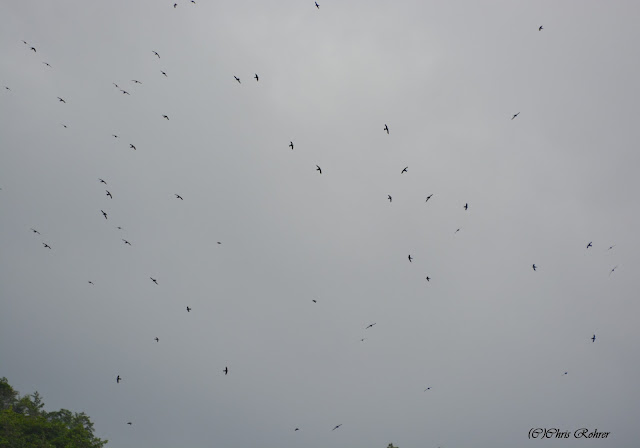 |
| White-collared Swift |
The worst part about exploration is the thought of returning back home after an exhausting hike. People say we should find the little joys amid the chaos. We did.
After our extreme hike, we relaxed in the lagoons. Thankfully I wore my water shoes to maneuver around the slippery rocks. I submerged myself into the water and washed the dirt and sweat off of my body as did my friend. A Black Phoebe reminded me to keep an eye out for the children of the forest. They wait until the tourists are in the waters and then run and steal their items on shore. So Lynda kept watch while I swam. And vice versa.
We were alone in this paradise. My friend was shocked by the tiny brown fish that nibbled around her feet. They swarm the legs and for free, clean all the dead skin off of your body whether you want it or not:) It oddly feels good:)
Our ride back would prove to be a nightmare. The driver, greedy for money, took another group back to town. We were stuck for two hours in the rain as we waited for this guy to come back. The ugly tourists got uglier and more annoying. On the ride from hell, we would have to stand back to back or front to back like sardines in a truck. Thankfully, my camera was in a water proof bag. At one point, our truck didn't make it up the hill and we all had to get out so that the truck could speed up to the top of the hill. Guatemala is not Costa Rica:)

Guatemala is certainly a challenge for many people. It's always work to get to and from the destinations. But the views were incredible. And what was that thing I wrote about previously? Oh yeah....finding the joy amid the chaos. As I stood in the back of the truck with my whole body aching, I was reminded why we were there. Several Common Pauraques flew around us. And I ended my evening with another lifebird. However, it made think. How much else will I have to endure to find those rare lifebirds? So many people think that birding is sitting by feeders with your binoculars eating sandwiches. For me, that is birding on a break. But the real action happens out in the field and much of it is not easy. Nothing is ever easy, but the payoffs are awesome. Over 100 different kinds of birds can be found in this biologically diverse area.
 |
| Jesus Christ lizard |
While our day wasn't full of many birds, many were lifebirds. And that was a day well spent:) Plus it was a good workout;) More to come.....
Muscovy Duck 2-lifebird
Black Vulture 2
Swallow-tailed Kite 1-lifebird
Common Black-Hawk (Common) 1
Common Pauraque 3-lifebird
White-collared Swift 300 -lifebird
Royal Flycatcher 1-lifebird
Black Phoebe 1
Clay-colored Thrush 3
Yellow-winged Tanager 1
Melodious Blackbird 8
Great-tailed Grackle 5
Chestnut-headed Oropendola 2-lifebird
Montezuma Oropendola 50
Yellow-throated Euphonia 2-lifebird


 Posts
Posts


