Showing posts with label Magnificent Frigatebird. Show all posts

Sunday, November 4, 2018

The Caravan


Our trek to Organ Pipe was interesting, but it was the work in Mexico that had me more interested.  A lot of birders signed up for a gull workshop with AZFO's Lauren Harter and David Vander Pluym.  And on the last day of the conference, a large caravan of birders crossed the border into Mexico.

Magnificent Frigatebird
We planned on staying the night in Rocky Point or Puerto Peñasco.  Many of the birders wanted to go with the caravan together.  No matter how many times I write this, there are still birders who are afraid to cross the border even though it's completely safe to travel to Rocky Point.  Like everything else, people need to use common sense. 

30+ birders scour the ocean with their scopes
We spent our morning with scopes and gulls.  But we also had our own agenda.  I wanted to do a count around Morúa or the Pinto Estuaries so we broke away from the group after lunch to do our own counts. I've been doing work around those areas for several years now and had never birded the area in October.  We rented a place on the Morúa estuary and really had a nice hike full of excellent birds there.


AZ Fish and Wildlife's Troy Corman and Wrenegade team member Tim H scope the horizon for possible rare birds

It's hard to navigate areas with large groups of people.  Many were there to spot the Yellow-footed Gull which is a bird of interest for many people.  These gulls live around the Sea of Cortez in good numbers.

Yellow-footed Gull
We said our good-byes and then were off to our sector of Rocky Point to get some work done.

At Morúa Estuary, we do a major bird count
The first bunch of birds we crossed paths with were plovers.  Snowy Plovers were everywhere.  They are the cutest of the bunch.   

Snowy Plover
Another common plover along the Pacific waters is the Black-bellied Plover.  Most of the shorebirds are in their winter plumage right now so they all look rather gray together.  Some can be downright tricky!


Black-bellied Plover
Another special bird that people come to see in Rocky Point is the Wilson's Plover.  They have a big bill and are the sassiest of the bunch.  In the pic below, the bird is throwing a little "tude" at an oncoming Snowy Plover. 

Wilson's Plover is the sassiest of the bunch
Even though it is cooler and pleasant, the sun can be quite strong as it bleaches the landscape.  In the pic below, we arrived at the mouth of the estuary where the bird life was at its highest.  I discovered my first Black Skimmers for Mexico here.

The bright light of the dunes and the ocean create a bleaching of color affect
Another great bird to see was the Elegant Tern.  They were the most common tern in this area next to the Forster's Tern. This species is listed as Near Threatened.

Elegant Tern
There were schools of fish everywhere.  And where there were large numbers of fish, there were hundreds of birds diving into the waters. Heermann's Gulls closely followed Brown Pelicans and tried to steal the food from their bills. 


A near threatened Herrmann's Gull sits on the back of this Brown Pelican
On Sunday morning, Gordon wanted to do his survey at Cholla Bay.  So he showed a couple birders how he likes to do his count.  As always, we had a great time and finished our counts with a nice list of bird species there.  The key is to go at low tide if you're a photographer.  At high tide, Cholla Bay is great with a scope.  


Short-billed Dowitchers
Short-billed Dowitchers had to be carefully ID'd by listening to their flight call.  As they flew, we were quickly able to ID them as Short-billed and not Long-billed.

Birding Cholla Bay at low tide is great for photographers wanting to get up close to the birds
As the bay drains of water, shorebirds, like the Red Knot below, go crazy on the crabs. 

A dull winter plumaged Red Knot forages for food
I've seen Red Knots in a lot of places but they are often too far to get clear views. One of my goals for this visit was to observe this species better. And it was great! 


Western Willet
Our special find, and definitely off my radar, was this gorgeous Fox Sparrow, the Sooty-colored subspecies. At the Morúa and Pinto Estuaries, there are specific green spaces or migrant traps that have green lawns and mesquite bosques.  I looked over at the trash bin and saw a bird scratching on the ground.  At first I thought it was a towhee until we put our bins on it!  HOLY COW!  We ended up with a Fox Sparrow on our Mexican life list. I also added a Dark-eyed Junco which was yet another bird I had not expected for Mexico.  Anyhow, the migrant traps around the hotels are great near the estuaries!!  I've had so many surprise warblers and sparrows show up in these green spaces. 

A rare Fox Sparrow
Our adventures continue......

Saturday, June 2, 2018

Estero El Soldado


Originally I scheduled a trek out to San Pedro Island, but the water was too choppy and the trek was cancelled.  These things are to be expected during hurricane season. So I followed up on Plan B, the mangrove estuary of El Soldado between San Carlos and Guaymas. 


If a birder is looking to get away and enjoy the beach life for a bit, s/he should check out San Pedro Island, the El Soldado Tidelands(or Estero El Soldado), and along the rocky beaches of San Carlos. 


When the island trek was cancelled, I started going over this area with my friend Tami because there were several requirements for our group on this day.  A little bit of swimming, drinking, eating and hiking along the water's edge.  The Estero provided all of those things easily.  


There was a resort nearby that also had gardens.  And birds.  Lots and lots of birds.  There were ocean ones, and coastal ones and garden ones.  And MANGROVE ones!

Genus Callinectes
 It's not often I get to bird a mangrove living in the desert.  And it often shocks me to know that even in the harshest of climates, the miracle of a small mangrove can happen in the craziest of climates. For a moment, I was transported to the tropics.  In fact, San Carlos and Guaymas are truly the beginning ranges of neotropical birding.  It is here we find such wonderful birds like the "mangrove" Yellow Warbler, Mangrove Swallows and Great Kiskadees.  It is exciting. 


Ocean birds won't disappoint either!  While none of these birds were lifers, they were a thrill to see again.  

Royal Tern
One of my favorite groups of the birds, the gulls, were in good numbers.  Terns, Royal and Elegant, were also seen in good numbers along the coast. 


As I laid under these palms while the group went out for a swim, I watched the world pass by me.  I closed my eyes to the cool shade breeze and smiled.  We all agreed that this was a great way to kick start the summer.


Laying on my back, I aimed my camera up into the air and shot pics of birds flying just several feet above me. 


I loved this place so much that next time, we're staying down here in the resort along the estuary.  


A Magnificent Frigatebird hung right over my head in hover mode, defiant against the strong winds. I love these birds.  You could see fleets of these air pirates off in the distance over the rocky coastal crags.


And while this was an excellent birding spot, our group was humbled by an observation between the estuary and ocean.  An adult Brown Pelican defended a recently deceased fledgling/juvenile and tried protecting the body from intruders like beach walkers and vultures. Nature can be very cruel, even from within the artificial boundaries of "paradise".  We like to humanize things when we see such terrible moments in the animal world.  But to watch this adult defend this lifeless body made us a bit somber. 


The thing I love about birding now is that when I see something like this, I have a deeper understanding of the bird world.  Our human side says, "See! These creatures do have emotions!" My scientific side says its instinctual.  Maybe they're both right. There are so many "experts" out there and they all have their professional opinions.  For me, the important part was to gather notes on this observation and learn. 


I heard someone say that they were going to chase that Turkey Vulture away.  Then it was time to explain to that person that nature has to play out.  It's not the Turkey Vulture's fault that the fledgling died.  It has to eat as well.  They are Mother Nature's natural garbage disposals. They play a role as well.  Most of you know this but for those of you who don't, here goes. Why don't Vultures have feathers around their heads?  Well if they eat dead and rotting things, then having feathers would be a bad thing.  They'd pick up diseases and bugs, etc from the carcass.  So no feathers.  Nature is cool!


This summer is going to be an absolute thrill.  Two months of exotic trails on different islands will hopefully yield lots of new and interesting birds. My first trek begins in a few weeks to Trinidad and Tobago.  I need this vacation after this stressful Spring. Much like my Monterey, CA trek a few years ago, I'll be in a private cabin at the Asa Wright Nature Center for a week.  Then I've rented a wonderful apartment in Arima for other area visits.  I can't wait to get out of this heat!


For the Estero El Soldado checklist, click here.  Summer is just beginning and it's time to cross the 1000 bird mark. Can we achieve it this summer?  Stay tuned for more!

Thursday, October 19, 2017

More Than You Know


Perhaps a little too close to the arches in Cabo San Lucas
Fall break each year is a spiritual commitment to myself as I exit from this routine life to reflect.....on life.  


Last year, I took you to Monterey, CA with Debi Love Shearwater.  This year, we are heading to sunny San Jose del Cabo in Baja California, Mexico. 


This whole trip was based on a crazy happy hour we had a couple months back. So I blame it all on the tequila:)  I was with friends Lori and Tami talking about taking a trek to the baja Mexican pennisula. And so it happened.  

Ruddy Ground-Doves are the common doves in San José next to the White-winged Doves
So we began to plan.  We got a beautiful Airbnb in the sleepy town of San José del Cabo. 


As a birder, it's important to get a place close to where you are intensively birding.  Our place was located along the Riparian area making it SUPER easy to wake up and bird.  
To make things sweeter, this historic building was situated along the beautiful riparian area known as Estero San José, a birder's paradise. From the blue dot down to the beach, it's excellent habitat for many birds which include a few endemics. 

a nice example of a Ruddy Ground-Dove
I had been studying this area for three particular birds, the endangered Belding's Yellowthroat, a subspecies of Northern Cardinal(Santa María) and the Gray Thrasher.  We kept our eyes out for a random Xantus's Hummingbird but as I pieced my research together, I figured this hummer would be hard to spot in this location right now.  Knowing the habits of our hummingbirds here, I suspected the Xantus to be in the foothills of the mountains or along farm/ranch areas.  We did check out golf resorts and hotels with flower gardens but we didn't spot a SINGLE hummingbird species while there.  I suspect the behavior is a cross between a Costa's and a Broad-billed Hummingbird. 

a cooperative Sora
In the picture below, you'll see a mountain range behind the town.  This is where the recently split Baird's Junco, a relative of the Yellow-eyed Junco, and the Xantus's Hummingbird hang out. Other specialties include several subspecies that will most likely be split down the road like the American Robin and the Northern Pygmy-Owl. While doing the research, I found that all the Baja endemics can be done easily by birders in one full week but I didn't have that much time. Plus we were there to have fun.  And we did:)

a small kettle of Turkey Vultures hang out in a section of the Estero of San José del Cabo
So my only focus for this trip was the riparian area in San José del Cabo. Our first bird was the Gray Thrasher.  It looks like a cross between the Curve-billed and Sage Thrashers.   

the endemic Gray Thrasher
To find this bird is to understand the word "thrasher".  Thrashers are active in the early morning and right before sunset. The weather in Baja California is so hot and muggy right now.  So at sunset, before our beer fest, we walked along the cooler mesquite lined path of the estero and found these birds in great numbers feeding along the path with Cactus Wrens. They prefer desert scrub and sure enough, that's where we found them.  For my birder friends, this thrasher isn't as skittish as a Crissal or LeConte's. BUT having birded the estero throughout the weekend in both the AM and PM hours, I found that they were most visible during the evening hours (at least for this time of year). And I can understand why!  It was HOT and disgustingly muggy!

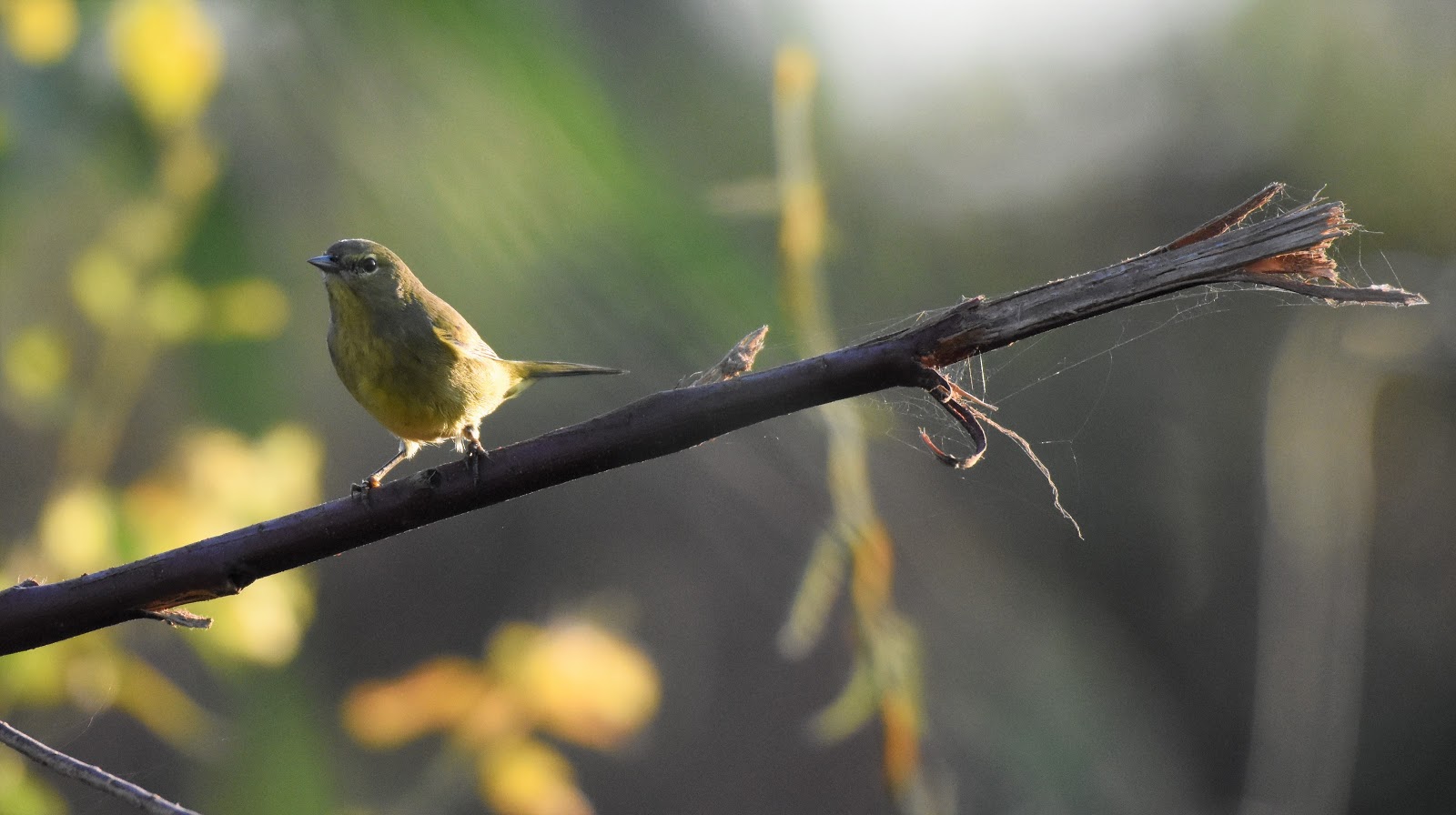
One of many Orange-crowned Warblers seen in the estero
That was a fun lifebird and even though my friends are not birders, they had fun playing detective:)  Last month, San José del Cabo was hit with a hurricane and the riparian area was torn up pretty well.  In fact, a chunk of the bridge and main highway were destroyed. So we carefully birded around the exposed metal joints and dangerous steep cliffs.  We discovered a warbler sanctuary!  It was SO birdy! The warbler show was incredible.  I also believe the whole world's population of the Scott's and Hooded Orioles winter in Baja.  They were EVERYWHERE.  Instead of flocks of robins, there were flocks of Orioles.  Impressive! They are permanent residents of Baja and summer residents of AZ. 


As we got closer to where the ocean meets the mouth of the river, I noticed more birds.  The trails were in better shape and we were able to navigate into really nice birdy areas. 


Common Gallinule
Common Gallinules were present and far outnumbered the American Coots. Rails were everywhere and getting photos of them were near impossible. 


The hurricane cut away a huge swath of land.  Clumps of dead vegetation which included concrete chunks and fallen trees littered the riparian area. 


I forgot that the Ridgway's Rail and Least Bitterns can be found down there. I really tried for photos of a Least Bittern but it snaked its way into the reeds quickly before my camera could focus.  The Ridgway's Rail could only be seen with binoculars at the far edge of the river.  We couldn't get closer because of the hurricane damage on the path.  In fact, we had to be careful with the loose ground near the edges of the river.  If the ground had given out, I probably wouldn't be drinking my coffee and writing to you all now because my arm or leg would be in a cast:) 


a Turkey Vulture perches on some fallen trees from last month's hurricane in San José
Between the beers and laughs, we walked and did quite a bit of exercise. There was ONE bird that I wanted more than anything else on this trip. I studied the endangered Belding's Yellowthroat a lot.  It looks similar to the Common Yellowthroat that is found throughout much of North America. I searched inside of reeds and lumps of wet vegetation for these birds.  Having memorized their calls, I located two pairs. And then we went to work.....

female Belding's Yellowthroat
And I shouldn't just say "I".  I went over the calls with my friends and we spread out creating a network for this tricky to photograph bird.  The Belding's Yellowthroat is endangered because it is a true endemic of the Baja pennisula(this area is mostly desert and the bird requires wetland/riparian habitat).  Why is it endangered?  Housing development. Similar to Florida and the Florida Scrub-Jay, this bird faces an uphill battle as the real estate market booms in the Baja.  As humans manipulate the limited water resources for their own needs, this bird's habitat is disappearing.  Thankfully, the Estero San José is a protected sanctuary for this bird and many others. 


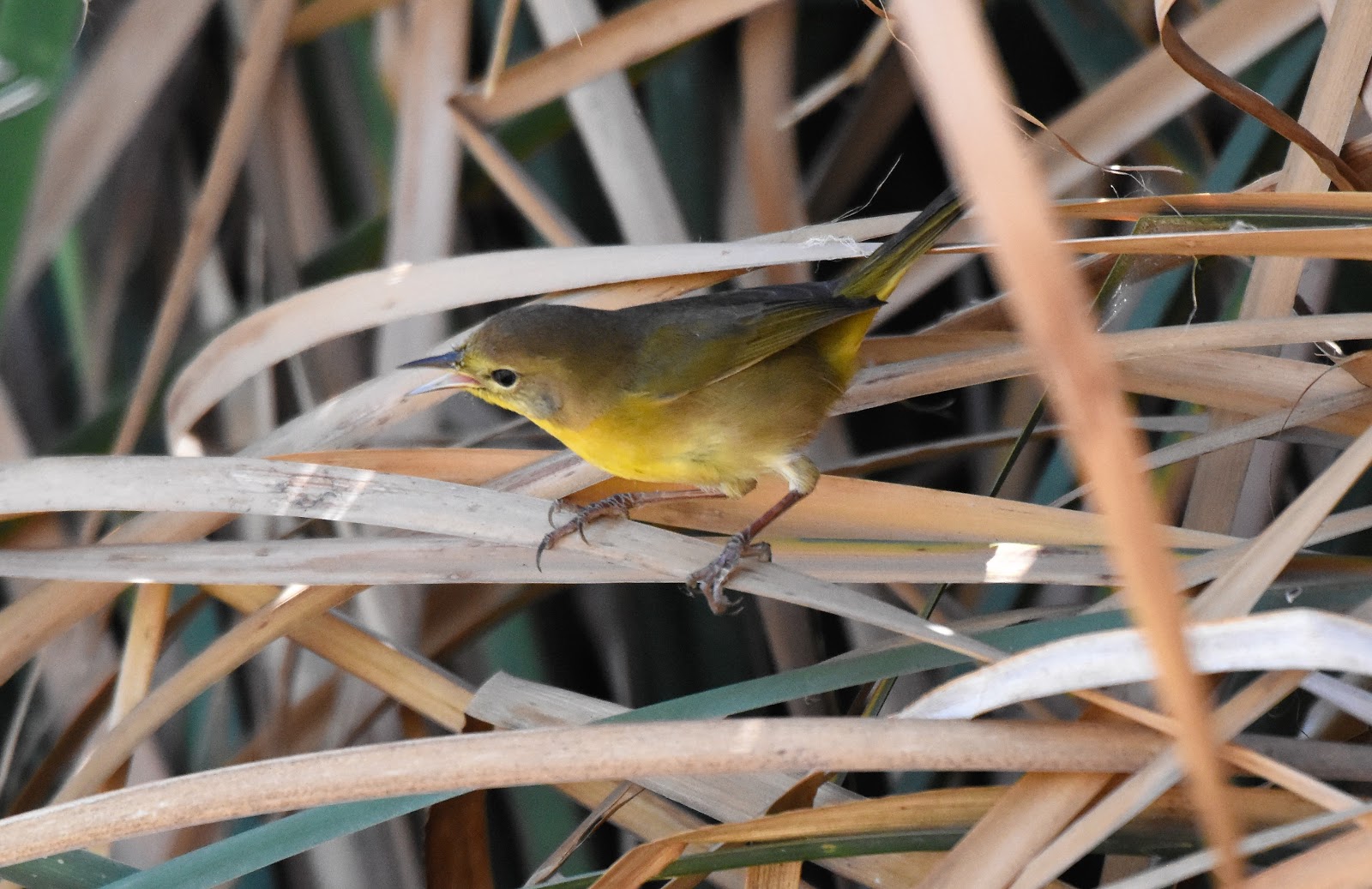
So to understand the word "Yellowthroat", birders KNOW that any warbler that carries the name, Common or Belding's Yellowthroat, will be difficult to photograph. I thought I'd have difficulty with the ID on these similar looking birds but here's what I learned. 1. We had both Yellowthroats at this location.  However, there were more Belding's present. 2. These warblers are very vocal and it helped us zone into the area where they were feeding. Their call is different and sorta reminded me of a wrenish rattle. I was able to successfully record the male calling. We were able to watch these secretive warblers with our binoculars.  3. They are overall very YELLOW.  The male has a black mask similar to its relative the Common Yellowthroat.  But it was their call and deep yellow coloring that caught our attention.  We observed one pair in a nesting territory for about a half hour.  After that, we went to an all you can drink event on the beach to celebrate our success and um....enjoy our vacation. 

Don't do it guy!  The current is TOO STRONG!
Our next day was a mini pelagic on the ocean. I overdressed once again because I needed pockets for my equipment.  At one point, I nearly passed out. It was 95 degrees with a high humidity rate. 

Some fun cliff diving in Cabo San Lucas at Pelican Rock
While my friends enjoyed the pelagic, I counted birds along the fascinating rock formations.  My particular study was focused on Blue-footed Boobies and Magnificent Frigatebirds.  BUT it turned out that my observations would mostly be on the Frigatebirds and Ospreys.  We found the Boobies but only for a second. 

This Osprey watches over all of us during our pelagic
Then something very "spring breaky" happened to me.  I don't know how to explain it because it was a moment.  One of those PURE moments.  The kind that makes a person feel complete joy and sadness all at once. Otherwise known as bittersweet:)

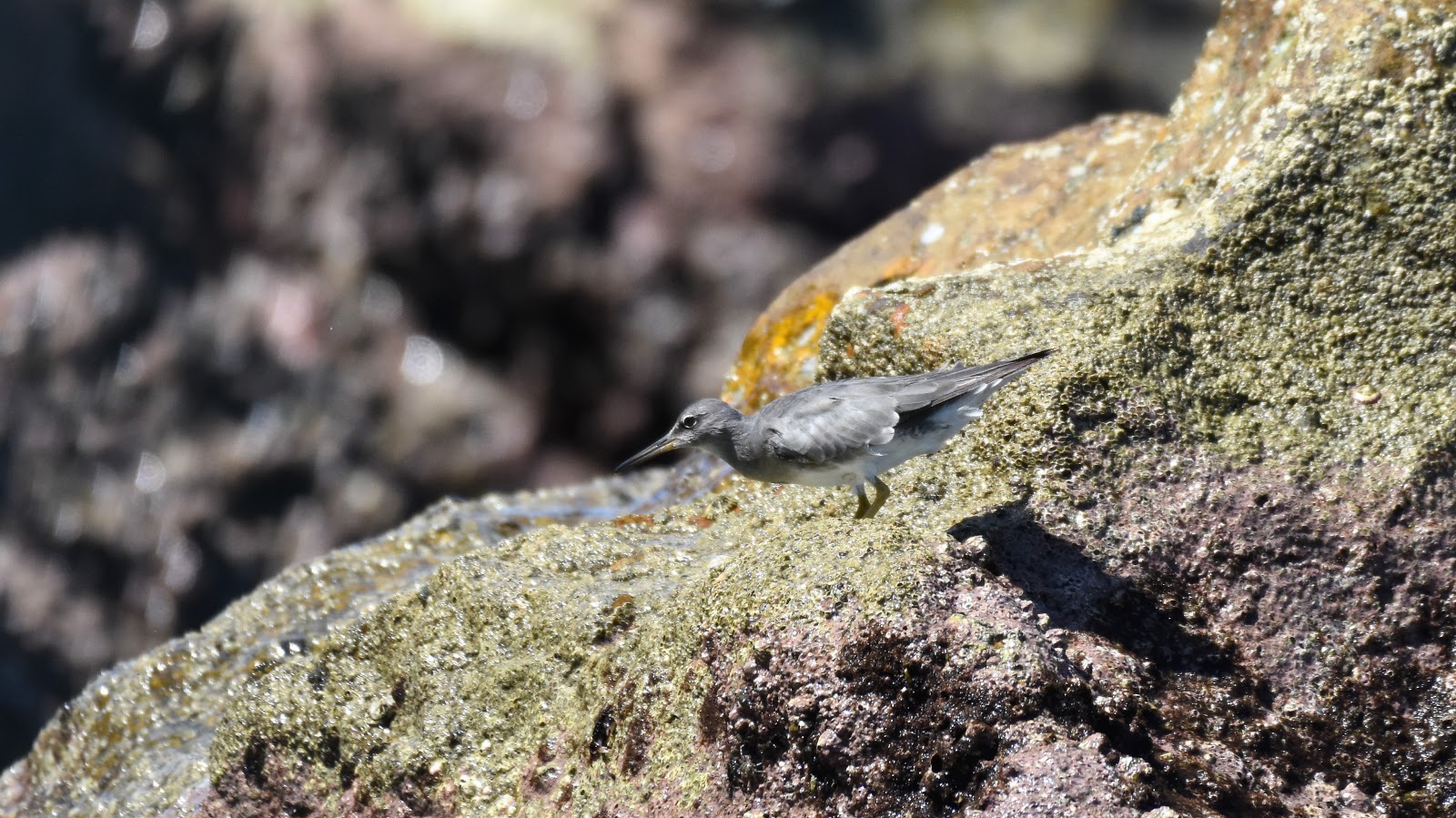
A Wandering Tattler flies into view for a few seconds
As we were coming back into port, I heard one of my favorite club tunes from this year, More Than You Know, carried across the waves.  I searched for the source of the music and discovered two young men overlooking the ocean as if they were kings of the world. And for a brief moment, I felt like I was in my 20's again with that same bliss/naiveté.  Twenty years later, I was saying hello to my old self.  And then our boat docked and it was over. 

Striped Shore Crab
For the rest of our trip, the song played over and over in my head.  I tried to process why this moment had affected me so much.  Thanks to my friends, we were able to talk it out.  Life experiences shape us and make us who we are.  But there is something very beautiful about innocence. So thank you Tami and Lori for helping me connect the dots. 

This sea lion attempts to sleep but the crabs taunt him
So yeah it was a weird experience.  How the hell does one go from dance party aficionado to birder?!!!  I like me now but sometimes I wish I could be footloose and fancy free for just a moment. But that would require late night parties and staying awake:) That's too much work!

an ancient looking Brown Pelican 

Anyhow, I love Anthony Burdain from the various food networks and his constant search for secret local culinary delights. One night on our way back from Cabo San Lucas, I smelled something really good. I saw many locals all gathered at this hole-in-the-wall restaurant in a random neighborhood outside of the historic San José del Cabo district. The kitchen was run by a smiling Celia Cruz type and I had a feeling that this place was something special. The next night, we went back to investigate and I asked our waiter what was it that everyone came to their restaurant craving.  He laughed at first and then realized I was serious.  The next thing I knew, he brought me the most delicious PAPA RELLENA.....a stuffed potato.  And. It. Was. Good!


My heart lit up again.  I felt the fire rekindle inside of me.  I missed my Mexico.  I've missed it so much.  I missed being around fun and wonderfully polite people who just chat! Where it's okay to say "hi" to a complete stranger and not have the other person think you're insane.  I had forgotten how incredibly rude some Americans can be.......no.  That's wrong.  I haven't forgotten how rude Americans are.  I had become immune to it!  I hate where this country is right now. It's embarrassing. I hate the hatred and division this so called clown has created between Republicans and Democrats. And here's a little personal observation.  While on my flights, everyone I sat next to began talking about this idiot.  I swear to the gods that I never brought up the topic.  I didn't want to...but I've got this strange presence that allows people to open up to me.  They needed someone to listen.  And I listened.  The US is not in a good space right now. 


And in Mexico? Well, they would start talking about this cheeto puff as well!  As an unofficial ambassador, I reminded them that he doesn't speak for most of the country.  Then I switched the conversation to birds:)  

Magnificent Frigatebird
We watched the pirates of the air, the Magnificent Frigatebirds, glide and dive trying to steal food from each other.  One day, I will see one of these birds in Tucson.  And when I do, I will be ready with my camera. 

Spotted Boxfish
Normally I'm not into fish but the fish around the waters of the Baja Pennisula are stunning!!!!  While I was sitting on our boat, I looked down and observed several colorful species coming up to the surface of the water. 


Color is everything. Mexico IS color.  There is color in the food.  With her people. With her culture.  In the language.  In her wildlife.  It inspires me and many many others.  Mexico recharges my battery and reminds me why our neighbor to the south is pretty awesome. 


We had a blast.  This crew in the pic above is awesome.  They are genuine, down-to-earth, and know how to vacation properly.  Work out/bird in the morning.  And then, explore! And have a good time.  I needed this trip more than I knew. 


Here are my checklists in case you are interested in exploring the San José del Cabo area which includes the birder's paradise Estero San José. From the airport, San José is about 20 minutes away.  Don't pay the 50 bucks they quote you inside the airport! It's cheaper taking the busses or a taxi outside the terminal! Have courage and you will have saved yourself money! People will pester you.  Just get out alive with your luggage! As for Cabo San Lucas. It's about 45 minutes away by bus or taxi. For 2 bucks, catch the Ruta del Desierto bus from San José.  But bring plenty of water to stay hydrated. Alcohol doesn't count:) Cabo San Lucas isn't for everyone.  If you want quiet, stay in San José or at the resorts that lead up to Cabo San Lucas.  In a year or so, I'll plan my next trip back to the town of Todos Santos and schedule a visit to the Sierra de la Laguna area of the mountains for the rest of the endemics. 


For the reports on California/Pacific Coast birds, Baja Endemics, and waterbirds for the month of October from Estero San José, click here(Day 1) and here(Day 2).
For the pelagic birds from Cabo San Lucas, click here.  Life doesn't wait.  In the next couple weeks, we're going to get our cold on.  Stay tuned for more......