Showing posts with label Ferruginous Hawk. Show all posts

Sunday, January 5, 2020

The Christmas Bird Counts


The team spies Mexican Jays across the lake
The CBC, or Christmas Bird Count, has been around for 119 years.  It has been a long lasting tradition for many birders around the United States during the months of December and January. And it continues to grow in popularity. And before I get started, I hope everyone had a wonderful start to their New Year! 


Orange-crowned Warbler along a remote lake
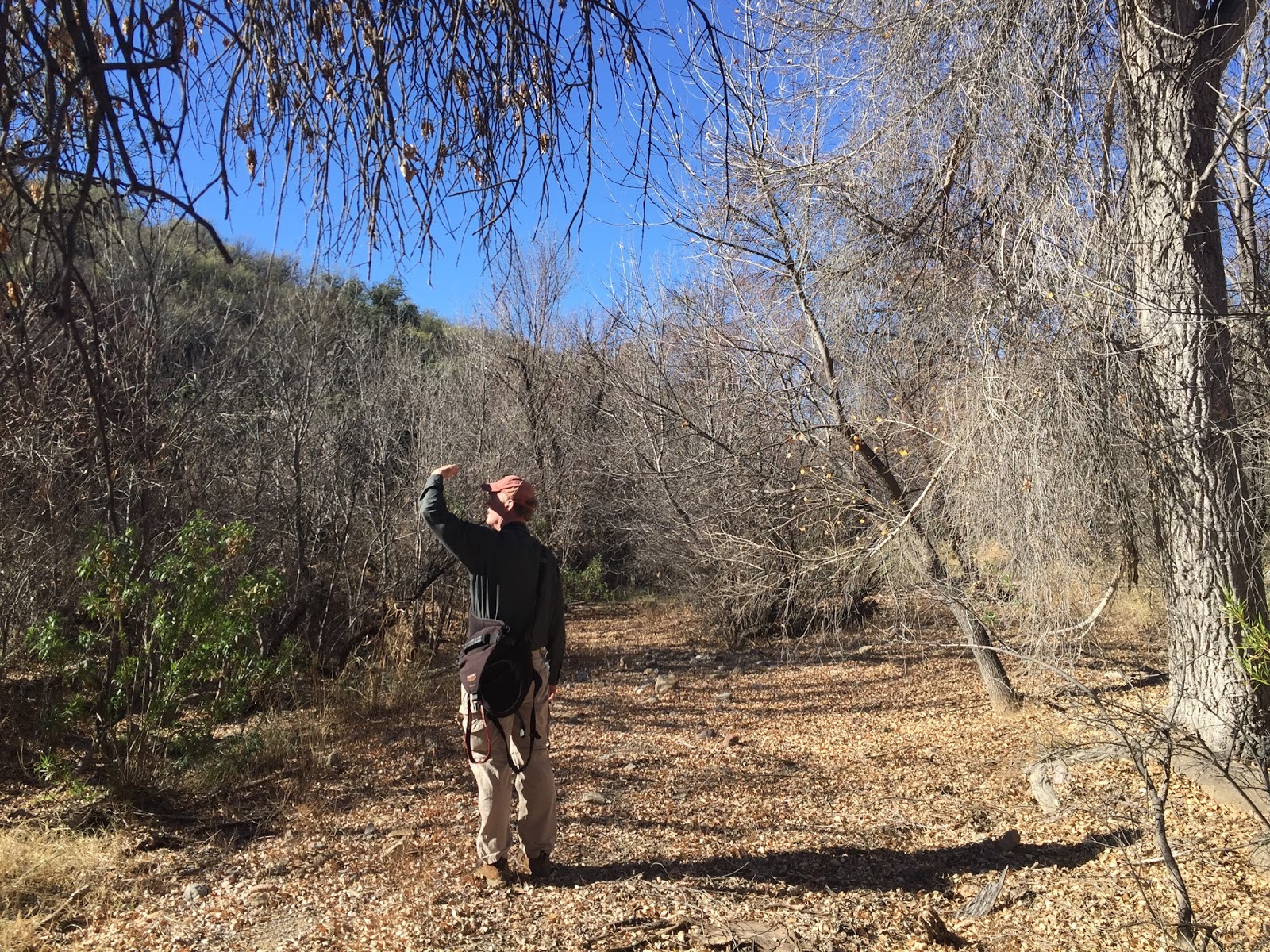
Each year I try to do at least 2 CBC's.  Anything more than two is too much:)  The CBC is a great way to meet birders from all over.  It's also a chance to explore areas that are generally off limits to the public or too difficult to enter.  There are several Arizona "circles" where the birding is rather difficult due to the remote unmarked and rough dirt road conditions. Often the leaders are given permission to get onto private land. This "circle" requires a lot of powerful vehicle driving and 4 wheel driving is a must. There's a bit of danger involved which is why it's exciting.  One of my favorite places to bird is in the Atascosa Highland area as it has some of the wildest spaces in Southeastern Arizona. But getting there is no easy task. Getting lost is a given and a road map is needed!


a secret lake in the middle of nowhere in the Atascosa Highlands
This area is also excellent for a secretive species of quail known as the Montezuma Quail. If you are going to see them well, you have to be quiet.  We were not. 


And that's why a covey flushed off into the dry wash.  Not only did we find these birds, but we also had sightings of Townsend's Solitaires and many other bird species.


This CBC count is special because it's right along the border.  You'll find water depots and buckets with food for people looking to call the US home. Every year, I have fun doing this count because I get to explore new areas that I normally don't visit.  This year we explored Apache and Jalisco Canyons.  At one point, a road became a small running creek.  There was no cell service so we packed our things well.  

Sharon spies a Hermit Thrush on a hill across the lake
The CBC is a great way to meet new people in the birding community and true to form, I met 2 new birders on this count.  

A Bewick's Wren greets us
Unfortunately, I couldn't stay for the dinner party at Wisdom Cafe because I had several doctor's appointments to attend the following day.  However, it was a lot of fun.  

The gray ghost, a male Northern Harrier
Then for the second CBC, because I only do two, I helped my friend Gordon with his area.  We went into the Buckeye area full of agricultural lands and canals.  On that day it was wonderfully cold and rainy.  I learned several new things about Maricopa birding.  I don't often bird around the Phoenix area and while Buckeye is outside of the Phoenix area, it's still in Maricopa County.  

One of the 14 Common Ground Doves we discovered along a Palm nursery
I never knew this but two rather difficult-to-find doves in Arizona are somehow breeding in this area.  We went into a palm tree nursery and found a lot of Common Ground Doves.  I can see why they'd breed in this area as it has the scrubby palm orchard necessary for cover. 


The gray skies made photography almost impossible, but on rainy days, at least for Arizona, the birds can be quite active.  However heavy wind and rain can make birding a challenge.  Our big challenge for the day was not to get stuck in the mud which there was plenty!


Long-billed Curlew
 Phoenix birders get to see certain birds more frequently than we do around the Tucson area.  Tucson gets colder than Phoenix in winter and we don't have the amount of water that Phoenix does. So finding birds like White-faced Ibis, Long-billed Curlews and Black-necked Stilts made me happy. 

Black-necked Stilt
While we were on the road, Gordon ran into some friends looking for the second rare ground dove of the day, the Ruddy Ground Doves.  Apparently these birds are at this property year round!  What the heck?  I never knew that.  All I knew was that Ruddy Ground Doves once bred in the Phoenix area, but housing projects destroyed their habitat and watering holes. I know this first hand because I researched old ebird reports where ancient birders reported hundreds of them. The old hotspots are now replaced with cookie cutter homes.


We were thrilled to spy 5 Ruddy Ground Doves on this day. So many people come to see these birds and they often dip.  Thankfully Gordon's friends were spared that feeling of a dipping disappointment. 


Ruddy Ground Dove
CBC's are wrapping up across the United States.  It will be interesting to see what their results will find.  If you are interested in the data collected, click here

Botta's Pocket Gopher
There's more to birding than just counting birds or finding new species.  During our time out in the field, we saw a small tornado forming.  To our knowledge, it never touched down but it was fun to watch. 


The rain kept the dust down around our count areas and made for some optimal birding.  Ferruginous Hawks are one of my favorite buteos. During our counts, we found several around the area. 

Ferruginous Hawk
Have you thought about doing a CBC?  If you've done one or more, where did you do it?  And what was the craziest bird you found? Below, I took a video of thousands of blackbirds getting ready to eat out in the ag fields. Until next time.....


Wednesday, February 27, 2019

Snowy Arizona


This storm has been in the making for some time.  We've been hit with storm after storm here.  Visitors escaping the frigid cold temps of the North aren't so happy, but we, the locals who live here, have loved it. The night before the storm arrived, our local weather forecasters told us to get ready for the arctic blast. 


Schools were closed and an official "snow day" was declared. The night before we planned a trek to Saguaro National Park to take pictures. In the morning, there was just rain and then I heard Micheal yell from the dining room, "There's snow!"  Snow in midtown is RARE.  In fact, I don't ever recall seeing snow here.  The closest thing to white this neighborhood ever sees is cocaine or maybe a leucistic Rock Pigeon:)


As always with these two crazy friends, one was focused on using her new camera in the snow while the other was throwing snow balls.  We were amazed by the amount of water here. 


I counted birds and did my surveys at my local patch, Reid Park, taking lots of documentation photos.  For those of you who know Tucson, you know how hot it gets here.  So today was for Tucsonans.  There were so many happy faces everywhere. 


It was an unofficial holiday. For one moment, there wasn't any Christmas madness in the air.  The news focused ONLY on the weather.  And for the first time in a long time, I didn't hear that orange baboon's name ONCE.  We were just people in Tucson, in Arizona, having fun in the snow.


The weirdest thing that I witnessed was this cat below playing in the snow with his human companion.  They were doing a photo shoot together and this cat acted like a dog.  Never in my life have I seen a cat do something like this before.  The guy snapped his finger and the cat chased him on the lawn.  If I did that with our cats, we'd have a revolt!


Then there was the day after. WOW!  The views were incredible.


I continued counting birds and enjoyed the cool temps. 

Ferruginous Hawk
The birds were hungry after the storm. During the storm, they huddled under the bushes to stay warm. Every species acts differently in extreme weather. 


the Southwestern Song Sparrow
 Some people were stupid. In the pic below, we saw this submerged truck in Willcox around Lake Cochise.  It's either a stolen truck dumped in the grasslands OR a bunch of idiots who thought it would be fun to go "mudding" in the snow.  Either way, it looked like a perfectly good truck.


It was a strange weekend full of fun and rare snow birding. 

Curve-billed Thrasher
The wildflower show should be amazing this spring. In a way, it was sad saying good-bye to the storm because the summer temps will be arriving soon enough.

Marsh Wren
 For now, I'll try to take in every moment I can outdoors.  There's no rush:)


Until next time.....

Wednesday, January 24, 2018

The Devil Is In The Details


Birding friend, Scott Olmstead, had the weekend off. We planned a specific study on sparrows that most birders try to avoid.  Enter the Sage Sparrow.


Ferruginous Hawk-one of my favorite hawks
I would say that this is one of THE most difficult groups of sparrows in the state to ID.

A Sage Sparrow is difficult to ID in bad lighting or where the field marks cannot be seen

Scott wanted a good study session.  The Bell's Sparrow would be a lifer for him.  And I love sparrows. So the challenge was on!


So we got in the car and headed to the best place in the state for Bell's Sparrows, Robbin's Butte. And there we did our detailed study.  Scott is analytical and very good about observation.  We scoured the property and found two nice loose flocks of "Sage Sparrows".  It was SUPER enjoyable.  This is not a birding trek for a lot of people, but sparrows are my favorites.....even more so than owls!  GASP!  It was fun being with someone who also found them fascinating. 

A Bell's Sparrow-a dark malar and fairly non-streaky mantle is good for Bell's
The differences are so minute with this group of Sage Sparrows that it requires extreme patience and observation.  Several years ago, they were split and a birder's nightmare began. You can compare both species above and below.  Can you see the differences?:)  If you can't, don't stress.  Most birders have to work for this tick.  The Bell's Sparrow above has a darker malar than its head. While the more common Sagebrush Sparrow is uniformly gray in malar and head.  But there's more!

Sagebrush Sparrow-uniformly gray in malar and head-streaky back mantle
The two birds have different "mantles" (the triangular patch behind the head that connects the neck and back:)  Lighting can be an issue here in AZ so it's important to confirm the 2nd field mark, the mantle.  The Sagebrush Sparrow has heavy streaking on the mantle, but the Bell's Sparrow has very light to no streaking on the back.  Anyhow, I'm proud of the "work" we did here.  It was absolutely thrilling. Here is our list from that day. Scott added a lifer, and we were on to our next locations.  These were all new for him and it was exciting to show him around the Buckeye/Glendale area......which is not really my territory.  So kudos to my friends Gordon and Magill who have shown me their preferred routes to this great birding destination. 

Maybe a Cackling Goose but the neck was really long!  I'm still stuck on the ID of this bird.
We weren't done though.  We had more difficult birds to ID.  Scott just didn't know it yet:)  We stopped in Avondale, at a location known for its wintering Cackling Geese.  It was fun watching Scott sort through these much smaller Canada looking geese. To be honest, it was hard for me. In Arizona, we don't just get one subspecies of Cackling Goose, we can get two or three! In AZ, it's tricky business.


The Cackling Goose is a smaller bird with a thicker neck.  On one subspecies, the bill is small and triangular.  But not all subspecies are the same.  This Cackler looks to be of the Richardson's subspecies. Birders have to be very careful separating Cackling Geese from the smaller subspecies of Canada Geese.
Not all birds are tricky to identify though.  Most were a welcome reprieve from our difficult ID challenges. But how does a birder ID these tricky birds successfully?  Lots of study from bird guides, online sources, conferences and observations in the field with experts can help greatly. It's a combination from all of them that ultimately make you a better birder in general.

American White Pelican
Currently, Tucson and Phoenix are home to many wintering Snow Geese.  But we always have to carefully look and make sure we don't have a Ross's Goose in the bunch.

Snow Goose at Lakeside Park
Greater Scaups are rare to Arizona.  More common are the Lesser Scaups.  But it isn't uncommon to find a rare Greater Scaup in our local watering areas during the winter months. Does that make sense?:) It just takes a little patience and recognition of the field marks. 

A mystery scaup at Kennedy Lake
A Redhead eyes me warily as if to say, What are you up to Mister?

Redhead at Reid Park
In my searches, I find more Snow Geese.

The Blue Molt Snow Goose of Columbus Park
A Pied-billed Grebe surfaces for a second before disappearing into the water in search of food.

Pied-billed Grebe
Then I spot a juvenile Snow Goose!  This winter, they seem to be everywhere in Tucson.


It has been a good month so far in that it has been full of amazing finds for the state. We both finally saw the Black-throated Green Warbler in Phoenix.  Later, we chased a rare Lapland Longspur.  And then with friend Magill, we conquered the Short-eared Owl.

My first state record of the Black-throated Green Warbler in AZ
 I currently am working on the details for more journeys into the unknown.  Some of it is scary as I retrace my past and discover (or rediscover) new birds. 

Black-throated Gray Warbler
The journey ahead will be interesting.  That much is certain.  Until next time.....

Monday, January 18, 2016

The Borderlands


The borderlands of the US are some of the wildest and most remote areas of the American Southwest.  It's often best to go with water, friends and a good vehicle for these treks. 

Ferruginous Hawk
After I returned from Wisconsin, I had wanted to go to Yuma and find a rare Streak-backed Oriole.  It's a three hour drive and I didn't want to make it alone. The trek to Yuma can be...somewhat dry:) When my friends Gordon and Muriel said they were chasing the bird, I asked if I could join them. They still thought I was in Wisconsin.  And I actually was at the time of my text:)

Streak-backed Oriole
They were very kind and let me hitch a ride on this very early morning trek. Since it was the first day of the year, we felt that it was important to start the year off with a "proper" bird:) That's the birder rule.  The other birder rule is to record every bird you see on that first day.  On this day, we would find the beautiful Streak-backed Oriole from Mexico:)

Burrowing Owls
We also made lots of other discoveries on our way back home.  There were plenty of Burrowing Owls around the farming fields. But as we were counting birds, my body decided it couldn't take the stress anymore and I crashed.  I had just returned from Wisconsin and slept for 3 hours before getting back on the road again in Arizona!  I think at one point I did some snoring.  

Can you see where the border is?  Hint:  the left side is Mexico and the right is the US.  The dry creek bed is basically the dividing line. 
I also had signed up previously to help out with the Atascosa CBC count around the California Gulch and Warsaw Canyon areas along the Mexican border the following day.  So as I said good-bye to Muriel and Gordon on Saturday, I was off with Dave and Ron on Sunday doing more area counts of birds. Yes I was still exhausted. But it was for a good cause and a way to help out Tucson Audubon. 

We print a map and find a new riparian area to bird along the Warsaw Canyon area.  I write in my notes that water in winter is very important for the Five-striped Sparrow.  There was a springs/creek along a rocky outcrop. And it was here that we found one of these sparrows.  On the other counts for the day, several other FSSP were discovered around similar spots. 
As we walked along the springs of Warsaw Canyon, we found wonderful birds like the Elegant Trogon, Five-striped Sparrow and Black-capped Gnatcatcher.  The roads along the border were rocky and steep, but somehow we managed to get to our very isolated locations. 

Common Hog-nosed Skunk
This area was full of fantastic wildlife.  Throughout the day, we had excellent views(!) of the very secretive Montezuma Quail!  Their numbers were quite impressive, but that didn't stop them from disappearing quickly into the vegetation. 

Female Montezuma Quail pretending to be a rock. It took me 5 minutes to locate her!  That's how "invisible" they can be!
The border can be hot and dangerous.  My tip to birders/historians/hikers/off road junkies/herpers/wildlife trackers, and everyone else who wants to visit these areas?  Bring food and water with you.  Use a sturdy vehicle that can handle off road conditions.  If you can, try and bring a friend or two with you. And always keep your eyes open. Cell phone service is spotty and doesn't work much of the time. Most of the time, the border crossing folk won't do any harm. I've been into other areas when I first began birding that had opened my eyes up to what is "THE BORDER".  It's the reason why I now carry a cell phone that has a tracker on it. I went 12 years without a cell phone! Now I'm addicted and straying away from my story so....With all that said, I have NEVER had issues in this area(Ruby Road/Peña Blanca Lake), but I have heard stories. Water and flat tires should be your main concern. And keep it all locked up. 


As we chased a Northern Beardless Tyrannulet, we found a water depot for people crossing this very isolated stretch of desert. A church organization from Tucson supplies water and food in this hidden location. These "watering holes" have been controversial as this church has been in the news several times for its humanitarian work along the border. I have no opinion on the matter, but I do hate the trash left behind in the nearby wash!


As Dave drove his all terrain vehicle up the sharp and rocky "roads", I laughed. I think it's something I do when I'm nervous.  But it was kinda fun:) We were going up some steep inclines! Luckily none of us had to use the bathroom! 

Northern Beardless Tyrannulet

As the day came to close, I thought about how crazy my start to the New Year had been. From snow to desert and then back to snow again.  I feel like I've finally hit my stride as a legit birder and that everything I've done has lead me to this moment in my life. And yet I still have so much to learn! My focus this year is on finding new state birds for Arizona. Over the next couple weeks, we'll explore the beautiful Ramsey Canyon, Lake Havasu and the Willcox area.  If you haven't done a CBC(or Christmas Bird Count) with your local Audubon, I highly encourage trying it out. And throughout the year, your local Audubon will have many other events planned! Check it out! It's good for the birds and it's a great way to meet new birders and make friends. And of course, learn about our feathered friends. Until next time.......