Showing posts with label CBC. Show all posts

Sunday, January 5, 2020

The Christmas Bird Counts


The team spies Mexican Jays across the lake
The CBC, or Christmas Bird Count, has been around for 119 years.  It has been a long lasting tradition for many birders around the United States during the months of December and January. And it continues to grow in popularity. And before I get started, I hope everyone had a wonderful start to their New Year! 


Orange-crowned Warbler along a remote lake
Each year I try to do at least 2 CBC's.  Anything more than two is too much:)  The CBC is a great way to meet birders from all over.  It's also a chance to explore areas that are generally off limits to the public or too difficult to enter.  There are several Arizona "circles" where the birding is rather difficult due to the remote unmarked and rough dirt road conditions. Often the leaders are given permission to get onto private land. This "circle" requires a lot of powerful vehicle driving and 4 wheel driving is a must. There's a bit of danger involved which is why it's exciting.  One of my favorite places to bird is in the Atascosa Highland area as it has some of the wildest spaces in Southeastern Arizona. But getting there is no easy task. Getting lost is a given and a road map is needed!


a secret lake in the middle of nowhere in the Atascosa Highlands
This area is also excellent for a secretive species of quail known as the Montezuma Quail. If you are going to see them well, you have to be quiet.  We were not. 


And that's why a covey flushed off into the dry wash.  Not only did we find these birds, but we also had sightings of Townsend's Solitaires and many other bird species.


This CBC count is special because it's right along the border.  You'll find water depots and buckets with food for people looking to call the US home. Every year, I have fun doing this count because I get to explore new areas that I normally don't visit.  This year we explored Apache and Jalisco Canyons.  At one point, a road became a small running creek.  There was no cell service so we packed our things well.  

Sharon spies a Hermit Thrush on a hill across the lake
The CBC is a great way to meet new people in the birding community and true to form, I met 2 new birders on this count.  

A Bewick's Wren greets us
Unfortunately, I couldn't stay for the dinner party at Wisdom Cafe because I had several doctor's appointments to attend the following day.  However, it was a lot of fun.  

The gray ghost, a male Northern Harrier
Then for the second CBC, because I only do two, I helped my friend Gordon with his area.  We went into the Buckeye area full of agricultural lands and canals.  On that day it was wonderfully cold and rainy.  I learned several new things about Maricopa birding.  I don't often bird around the Phoenix area and while Buckeye is outside of the Phoenix area, it's still in Maricopa County.  

One of the 14 Common Ground Doves we discovered along a Palm nursery
I never knew this but two rather difficult-to-find doves in Arizona are somehow breeding in this area.  We went into a palm tree nursery and found a lot of Common Ground Doves.  I can see why they'd breed in this area as it has the scrubby palm orchard necessary for cover. 


The gray skies made photography almost impossible, but on rainy days, at least for Arizona, the birds can be quite active.  However heavy wind and rain can make birding a challenge.  Our big challenge for the day was not to get stuck in the mud which there was plenty!


Long-billed Curlew
 Phoenix birders get to see certain birds more frequently than we do around the Tucson area.  Tucson gets colder than Phoenix in winter and we don't have the amount of water that Phoenix does. So finding birds like White-faced Ibis, Long-billed Curlews and Black-necked Stilts made me happy. 

Black-necked Stilt
While we were on the road, Gordon ran into some friends looking for the second rare ground dove of the day, the Ruddy Ground Doves.  Apparently these birds are at this property year round!  What the heck?  I never knew that.  All I knew was that Ruddy Ground Doves once bred in the Phoenix area, but housing projects destroyed their habitat and watering holes. I know this first hand because I researched old ebird reports where ancient birders reported hundreds of them. The old hotspots are now replaced with cookie cutter homes.


We were thrilled to spy 5 Ruddy Ground Doves on this day. So many people come to see these birds and they often dip.  Thankfully Gordon's friends were spared that feeling of a dipping disappointment. 


Ruddy Ground Dove
CBC's are wrapping up across the United States.  It will be interesting to see what their results will find.  If you are interested in the data collected, click here

Botta's Pocket Gopher
There's more to birding than just counting birds or finding new species.  During our time out in the field, we saw a small tornado forming.  To our knowledge, it never touched down but it was fun to watch. 


The rain kept the dust down around our count areas and made for some optimal birding.  Ferruginous Hawks are one of my favorite buteos. During our counts, we found several around the area. 

Ferruginous Hawk
Have you thought about doing a CBC?  If you've done one or more, where did you do it?  And what was the craziest bird you found? Below, I took a video of thousands of blackbirds getting ready to eat out in the ag fields. Until next time.....


Monday, December 24, 2018

Her Maiden Voyage

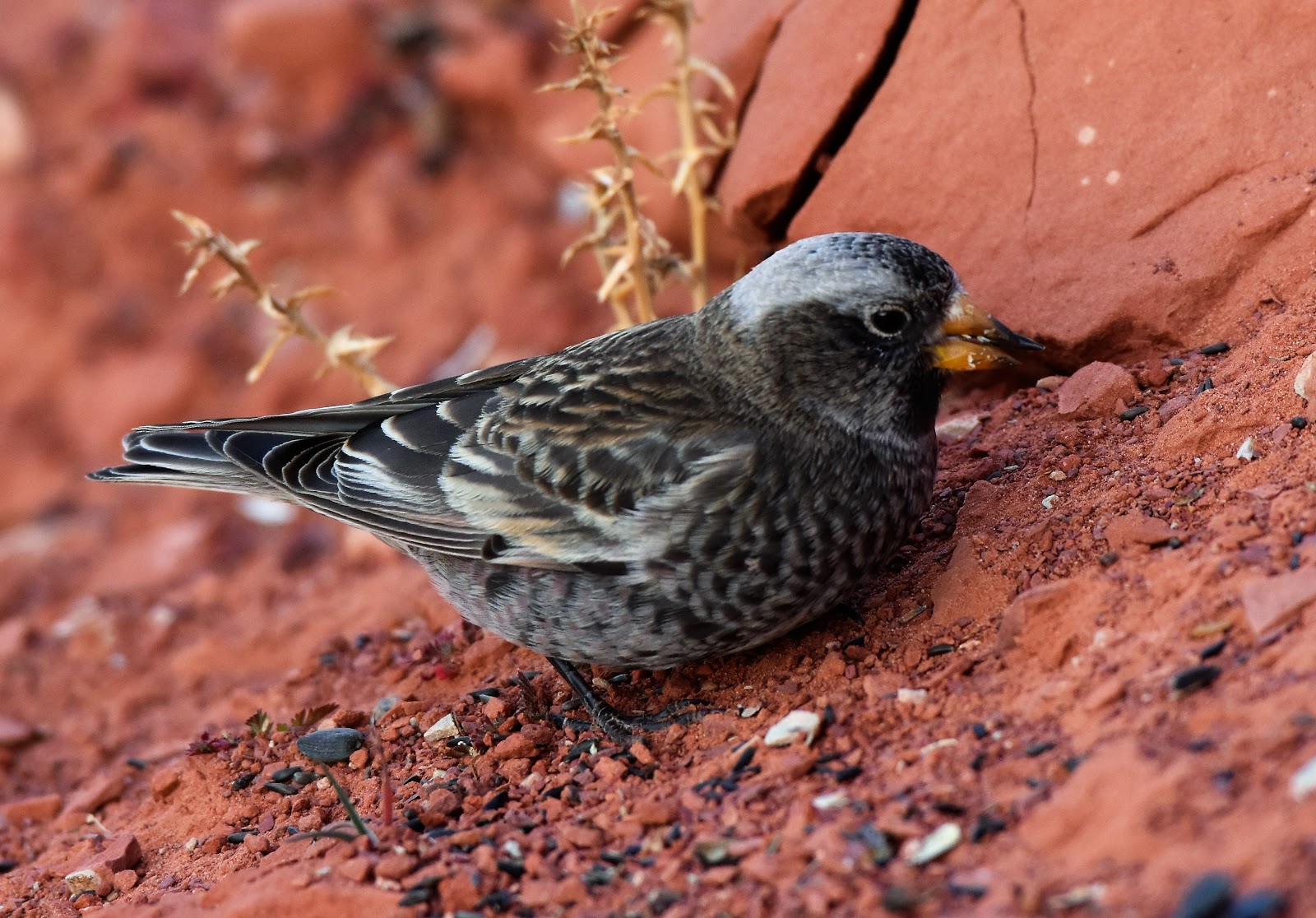
Black Rosy-Finch
With one semester completely and successfully finished, it was time to get back on the road again.  During our holiday luncheon, all I could think about was the break.  And the birds. 


Good people working together to help enrich the lives of young people. It's never easy keeping a smile but break gives us that much needed downtime to recharge our batteries. 
Now that the holidays are here, CBC(Christmas Bird Count) counts are happening all over the country. I mentioned to you all last weekend that I was supposed to do a count up on Mt. Lemmon for our local CBC.  Unfortunately, my car of 10 years had other ideas and her power steering went out early in the morning.  I promptly cancelled my participation and spent the day buying a new vehicle.  Ah the joys of new car payments!  She's a white SUV that goes by the name of Betty White.  Her code name is Manakin.  


a wintering Greater Pewee in Reid Park continues
Feeling bad about my failed CBC count on Mt. Lemmon, I helped with the Tucson count at my local patch.  Then it was off for some amazing Arizona birds!


The USS Betty White made her maiden voyage up to the northern boundaries of the state just outside of the North Rim of the Grand Canyon to search for 2 new Arizona birds, the Black and Gray-crowned Rosy-Finches.  It was a 2-for-one journey with friends Gordon Karre and Barb Meding.  

Just part of one of the flocks that zipped up and down.  They reminded us of our wintering lonspurs in the grasslands
For several years, I've always gone with Gordon in his vehicle because my car wasn't big enough to carry all of our equipment.  I should note that I purchased that car before I was a birder.  And I'm not one to sell it off because it didn't fit my needs right away.  She was a good car.  The Bea Arthur was a reliable vehicle that gave me many years of joy. 


A birder has to be careful observing birds.  With this location, I had a little vertigo.  The hillside was quite steep!
I was sad to let her go. Why name the vehicle?  I don't know.  It's what I've always done.  Plus I love/d what Bea Arthur and Betty White stand/stood for in their lives.  Not only are/were they great actresses, but Bea served in the military as a young person. And Betty White continues to be a champion for animals.  Barb thought she had passed and I thought I was going to have a heart attack.  Betty is a national treasure! She is immortal!


The very tricky Gray-crowned Rosy-Finch was a skulker for us and did not like to pose on the ground for the camera so I had to catch it in flight.   Fish or bird?  You tell me. 
Anyhow, it was so much fun.  And I was a proud driver taking my friends up to the top of the Echo Cliffs searching for these beautiful birds.  I felt like an adult!  I laughed when Gordon spilled black coffee over my place mat.  Having been an owner before of a new vehicle, I laugh at those first "oh no's!"  The first ding, the first spill, the first scratch etc.  At what point, do we let that OCD nature go?  With Bea, it was after a pork green chile incident that leaked out into my seat(and stained it forever!) because my friend didn't cap her tupperware container properly.  And then it happened again when a friend was backing out and rubbed against my car giving it a "cute" little dent.  So now, I'm a little more relaxed with everything.  Just no dents, dings or scratches on Betty for awhile please:)

A nice side-by-side comparison of the two species. They are similar and were tricky to pick apart. 
It was an incredible morning out.  Not only was the landscape gorgeous, but so were the birds!  Rosy-Finches in Arizona are a treat!  The challenging part was picking out the one Gray-crowned in the bunch.  They can look similar together. 


There were 2 large flocks that would rotate in and out of the area we were standing.  I think we got to observe both flocks twice with a 5 minute interval between their visits. I'd move once they flew to a new spot to get different angles of the birds.  


They feed from the Russian Thistle on the hillsides.  But to keep these beautiful birds there for birders to observe, people are continually throwing oilseed sunflower seeds to keep them around a little longer.  These birds love cliffs and as you can imagine, they can make it difficult for birders to get a good view.  So we employ our own tactics that keep them around a little longer.  


What a thrill to see these birds up close!  My first time was also with Gordon during our Sandia Crest journey to New Mexico.  In fact, that's where most people go to see all three species.  While we are in the southern most range for Black Rosy-Finches, they are not commonly seen like this for birders.  There's usually a once-a-year sighting by a couple birders.  However, a Gray-crowned Rosy-Finch is RARE!  Their range is the largest of all the Rosy-Finches but it doesn't dip quite down into AZ. However, they are suspected to enter the state in areas that are difficult to reach for birders. With that said, there are a few historical records including one from 2013 in a remote area of the state. The area we visited was much more accessible!


After we had that amazing observation, we went for the California Condors of Marble Canyon on the Navajo Bridge. I wanted to see the rare wild born California Condor in the area!  There was a Condor volunteer there monitoring the four birds in the canyon.  With his scope, he pointed it in the direction of the wild born bird and I was super excited!  It made me so happy.  I love condors.  Their location is also quite beautiful. And seeing a wild born one on the cliffs and not from a zoo gives me hope. As long as hunters use lead bullets, these birds will have to be monitored for lead poisoning.  Hunting for food is fine, but it's gross to think of lead in your own food.  Why not use copper bullets if you like to kill things for pleasure?  The Condors eat the lead filled carcasses left behind by the hunters.  There are 3 major threats to Condors.  1. Lead poisoning  2. Golden Eagles/Coyotes 3. Telephone Wires


Then, in a random twist for our trek back home, we took a ride to Winslow, Arizona where we had to take it easy.  


The USS Betty White promises many more treks.  Our next trek will take us into California but until then, I wish everyone a wonderful holiday season.  Until next time!