Showing posts with label Cackling Goose. Show all posts

Sunday, January 12, 2020

Road Trip

This Woodhouse's Scrub-Jay isn't stupid.  The bird is waiting for a handout in the tourist heavy Garden of the Gods

I love the idea of road trips, but as I'm getting older, I don't have the patience to sit for 11 hours in a vehicle like I used to. That is the amount of time it takes to get from Tucson to Colorado Springs IF you don't make long stops. And how can a birder pass up such fantastic birding hotspots like Bosque Del Apache?!  I like to meander to my final destination spot. 


Orion is a human beaver hybrid
I agreed to do the trek because I wanted to see our family and because I didn't want Micheal driving alone during the holidays.  It's a dangerous drive between the border of New Mexico and Colorado.  We've had so many issues going through the Raton Pass.  Between a serious tire blow out to the pass becoming slippery due to an icy storm passing through the area, we've had our share of mishaps.  This trip would be no different.  A rock fell off a cliff and hit a car knocking the car off the highway.  The other car driving behind that car ran over the huge rock and blew their tires out.  The rock pieces?  Well those flew onto my windshield cracking my front window! We dodged a bullet and I called my insurance to have the crack fixed.  Thankfully no one was hurt, but unfortunately both cars were in bad shape. 


During a stroll in a nearby cemetery, I enjoy watching Fox Squirrels chase each other around the grounds. 

I like to take things slow and I needed to take a break.  My body has been healing and I didn't want to overdo it.  So there were two requirements.  If I took my car Betty to Colorado, we needed to stay an evening in Socorro, close to Bosque El Apache.  I needed that moment when the sun began to set and the birds began to fly over our heads to put myself together. No matter how many times I see it, it never gets old. The video below is just one moment from a long one I had while watching the miracle of Sandhill Cranes and other waterfowl fly over my head. 


The following morning we left Socorro for Colorado Springs, but we stopped in Pecos, New Mexico for breakfast.  And at this cozy restaurant, we saw the most beautiful holiday tree.  I sat sipping my coffee next to the fire trying to memorize all the details of that gorgeous tree. Those are the moments from a road trip that I enjoy.  


Sometimes I'd love to shrink myself and get lost in the majesty of a holiday tree like Chip and Dale did in that Christmas special so many decades ago.
As we headed north towards the Colorado border, we began to see Black-billed Magpies, a sign that we were getting closer. 

Black-billed Magpie
We arrived at a nice time in the Colorado Springs area.  It was still light out.  Never drive into or out of this city at night.  There are many elk and deer along the way.  And had we been driving through the Raton area at night, I would have never seen that rock fall onto the pass. I have never experienced near death experiences like the one we had during our wedding when our tire blew out at night while trying to get home.  A man with a hook for a hand came and towed Micheal's car to his place to pick "some things up".  He proceeded to get into a fight with his girlfriend and then left his trailer.  Once inside his tow truck during that LOOOOONG drive to Trinidad, he began telling us about how Trinidad was the transgender capital of the world. Where was he going with that story? In fact, where am I going with this story? Once we got to Trinidad, a tire shop tried to sell us huge tires because Micheal's car was foreign and they didn't have his tires. Our only spare was not going to get us home as it was 8 hours away. I walked all over that small town the following morning finding the only two foreign tires that would fit his car for that long drive home. 26 bucks!  That's all it cost. Had we gone with the bigger tires, we would have paid around 400 dollars and had vehicle damage!  As you can imagine, it probably explains why I am not a big fan of the Raton Pass and I'm traumatized for life. 


Poor Bee Bee.  She's not a lap dog at all. 
Once we arrived into the Colorado Springs area, we had a nice visit with the family. And while there wasn't anything new in the birding category for me to find, I finally got to observe not one or two Cackling Geese but thousands! In Arizona, they are rare. But in the Springs area, they were everywhere!  Many years ago, I created several Ebird Hotspots in that city so I felt like it was my duty to do a count around those three local parks. And that is where I discovered my Cackling Geese.  

A Cackling Goose comes in for a landing
Just when I thought there was nothing new to discover, I was reminded again about how wrong I can be.  I assumed all the geese were Canada Geese, but while out in the field, I was getting a Cackling Goose vibe. Surely, Cackling Geese were rare for Colorado.  When I went back to the in laws, I got on my computer and looked up the data and discovered that Cackling Geese(Richardson's subspecies) wintered in the Colorado Springs area!  So cool!

An easy ID for this Cackling Goose, a white line at the base of the short neck, dark back, short bill, square head makes it perfect for the Richardson's subspecies. 
I went back the next day at the same time and studied the various subspecies really well.  It was the first time that I was able to really get close and observe field marks. It's not always obvious.  How does one tell the difference between the Taverner's subspecies from a "Lesser" Canada Goose!?!  It's not easy.  But the bill is usually the first field mark we have to look at.  And that's not always a great one to use.  A Taverner's bill isn't as small and triangular like the other subspecies of Cackling Geese.  But it's not quite as long as the Lesser Canada Goose either. 

Cackling Geese are easy to pick out when next to their larger relatives, the Canada Goose.  This Richardson's subspecies is about a third of the size of the related Canada Goose
I spent so much time studying them that I forgot about the time. I went in the morning and the next thing I knew, it was lunch time!  I had told Gordon before our road trip that Colorado birding this time of year is pretty uneventful.  And I was wrong in a good way. It's not Arizona birding but it's fun.  Plus I got to add American Tree Sparrow to my 2020 year list!

The Richardson's Cackling Goose is the main subspecies to winter in Colorado.  It is possible to find Taverner's mixed in with this group.  Source: Utah Birds
We took nature walks during the early afternoon.  It would be cool to cold depending on wind gusts. And daylight was a premium.  It was a constant battle to get any birding done because the sunrise was late and due to the shadow of the mountain, the sun set early. 


There's a great place to bird near Colorado Springs in the town of Fountain.  It's a lovely preserve that goes along a river.  During our walk we discovered that beavers had been busy.  We also had a Great Horned Owl fly out from the trees over our heads.  


My nephew Orion finds an old wasp's nest. I spy my first-of-the-year(FOY) American Robin. 


American Robin
There are places that we always seem to go visit when we're in Colorado Springs like the Fountain Creek Regional Park, Pike's Peak, and of course, the amazing Garden of the Gods


Now I've taken you all there once or twice before, but it's impossible not to enjoy these spaces over and over again. 
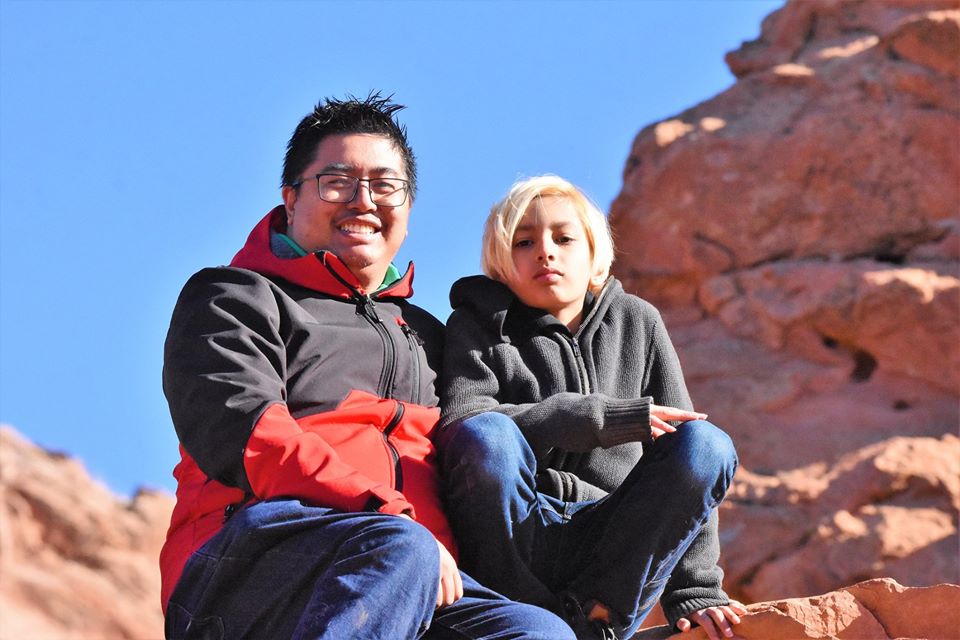

I personally like the gift shop there.  They have affordable art to hang on your walls and a fun restaurant where you can enjoy the beautiful outside.  And it was there, I added my first 2020 Townsend's Solitaire!


We had a lovely time.  It seems to speed up when we are there.  I also noticed my pain was gone for most of our visit.  Strange but it was a nice break from my side aches. 


Honestly, I don't know what this year will bring.  I've left much of it open.  I have visitors coming to go birding with me and I am really looking forward to spending some great time outdoors showing them my beautiful part of the world. If and I mean IF, this body gets back on track, I am organizing treks to Florida, the Darien Gap in Panama, and on the big island of Hawaii (or O'ahu). For now, I look forward to peaceful weekends with my cats in the catio, a nice stroll close to home, and doing some work in my garden. Until next time....

Wednesday, January 24, 2018

The Devil Is In The Details


Birding friend, Scott Olmstead, had the weekend off. We planned a specific study on sparrows that most birders try to avoid.  Enter the Sage Sparrow.


Ferruginous Hawk-one of my favorite hawks
I would say that this is one of THE most difficult groups of sparrows in the state to ID.

A Sage Sparrow is difficult to ID in bad lighting or where the field marks cannot be seen

Scott wanted a good study session.  The Bell's Sparrow would be a lifer for him.  And I love sparrows. So the challenge was on!


So we got in the car and headed to the best place in the state for Bell's Sparrows, Robbin's Butte. And there we did our detailed study.  Scott is analytical and very good about observation.  We scoured the property and found two nice loose flocks of "Sage Sparrows".  It was SUPER enjoyable.  This is not a birding trek for a lot of people, but sparrows are my favorites.....even more so than owls!  GASP!  It was fun being with someone who also found them fascinating. 

A Bell's Sparrow-a dark malar and fairly non-streaky mantle is good for Bell's
The differences are so minute with this group of Sage Sparrows that it requires extreme patience and observation.  Several years ago, they were split and a birder's nightmare began. You can compare both species above and below.  Can you see the differences?:)  If you can't, don't stress.  Most birders have to work for this tick.  The Bell's Sparrow above has a darker malar than its head. While the more common Sagebrush Sparrow is uniformly gray in malar and head.  But there's more!

Sagebrush Sparrow-uniformly gray in malar and head-streaky back mantle
The two birds have different "mantles" (the triangular patch behind the head that connects the neck and back:)  Lighting can be an issue here in AZ so it's important to confirm the 2nd field mark, the mantle.  The Sagebrush Sparrow has heavy streaking on the mantle, but the Bell's Sparrow has very light to no streaking on the back.  Anyhow, I'm proud of the "work" we did here.  It was absolutely thrilling. Here is our list from that day. Scott added a lifer, and we were on to our next locations.  These were all new for him and it was exciting to show him around the Buckeye/Glendale area......which is not really my territory.  So kudos to my friends Gordon and Magill who have shown me their preferred routes to this great birding destination. 

Maybe a Cackling Goose but the neck was really long!  I'm still stuck on the ID of this bird.
We weren't done though.  We had more difficult birds to ID.  Scott just didn't know it yet:)  We stopped in Avondale, at a location known for its wintering Cackling Geese.  It was fun watching Scott sort through these much smaller Canada looking geese. To be honest, it was hard for me. In Arizona, we don't just get one subspecies of Cackling Goose, we can get two or three! In AZ, it's tricky business.


The Cackling Goose is a smaller bird with a thicker neck.  On one subspecies, the bill is small and triangular.  But not all subspecies are the same.  This Cackler looks to be of the Richardson's subspecies. Birders have to be very careful separating Cackling Geese from the smaller subspecies of Canada Geese.
Not all birds are tricky to identify though.  Most were a welcome reprieve from our difficult ID challenges. But how does a birder ID these tricky birds successfully?  Lots of study from bird guides, online sources, conferences and observations in the field with experts can help greatly. It's a combination from all of them that ultimately make you a better birder in general.

American White Pelican
Currently, Tucson and Phoenix are home to many wintering Snow Geese.  But we always have to carefully look and make sure we don't have a Ross's Goose in the bunch.

Snow Goose at Lakeside Park
Greater Scaups are rare to Arizona.  More common are the Lesser Scaups.  But it isn't uncommon to find a rare Greater Scaup in our local watering areas during the winter months. Does that make sense?:) It just takes a little patience and recognition of the field marks. 

A mystery scaup at Kennedy Lake
A Redhead eyes me warily as if to say, What are you up to Mister?

Redhead at Reid Park
In my searches, I find more Snow Geese.

The Blue Molt Snow Goose of Columbus Park
A Pied-billed Grebe surfaces for a second before disappearing into the water in search of food.

Pied-billed Grebe
Then I spot a juvenile Snow Goose!  This winter, they seem to be everywhere in Tucson.


It has been a good month so far in that it has been full of amazing finds for the state. We both finally saw the Black-throated Green Warbler in Phoenix.  Later, we chased a rare Lapland Longspur.  And then with friend Magill, we conquered the Short-eared Owl.

My first state record of the Black-throated Green Warbler in AZ
 I currently am working on the details for more journeys into the unknown.  Some of it is scary as I retrace my past and discover (or rediscover) new birds. 

Black-throated Gray Warbler
The journey ahead will be interesting.  That much is certain.  Until next time.....

Saturday, September 23, 2017

Las Aventuras: Arizona Geese and Swans


A gaggle of geese

Today we'll examine part 2 of this blog series on Arizona birds, the Geese and Swans.  We'll discuss the rare and common birds and also who's countable (and not).  This is a fun group of birds because they are large and easy to see. To find them just head over to the many parks, farm fields, lakes and golf courses found around Arizona. And maybe, you'll discover something rare! So let's go on this goose chase and discover another group of birds found in Arizona.  


The Canada Goose.  Love them or hate them, they are quite common from the city of Phoenix on up to the northern part of the state.  They are often found around golf courses and parks in the Phoenix area all year round.  NOW.  If you live in Tucson like I do, they are VERY rare and not common at all.  Many Phoenix birders think it's funny when Tucson birders get excited about Canada Geese:) 


The Cackling Goose is to the very left.  Tricky tricky.....
The Cacklers.  Cackling Geese can be a major headache to ID because they are so similar to some of the smaller Canada Geese subspecies.  And within the Cackling Geese populations, there are ALSO subspecies.  To make things even more difficult, these miniature looking Canada Geese are often found mixed in with their brethren:)  Often ebird reviewers and birders alike need time to carefully look at the field marks before they "okay" their sighting.  These geese are always present every year during our winter months but in very small numbers.  Look for a shorter bill and a smaller bird.  It's even better if you have the Aleutian subspecies that has the white line at the base of the neck!   


Snow Goose
Okay.  Since I'm talking about similar geese species, let's look at both the Ross's and Snow Goose, both which can be found in Arizona during our winter months. 


The Snow Goose is much more common here during the winter.  To differentiate them, look at the "grin" on the bill of the Snow Goose. The Snow Goose is also larger with a bigger bill. Note the size of the bill on the Ross's Goose below. 


A Ross's Goose emerges from the cold mists of sewage water. 
Another fun wintering goose is the Greater White-fronted Goose.  I wouldn't say it's common but it's usually not too hard to find wintering in Arizona during the winter months.  


The Greater White-fronted Goose
If you play the ABA game, birds like the Egyptian Goose, Graylag and Swan Goose don't count. 


Seen in California not ABA countable
 However, from field experience, I can say that the Egyptian Goose is a species to watch and I think it's important to note the occurrence of this bird in the state for our records. If you are a true birder, you mark EVERY detail down on your counts, wild exotics included. In California, there has been evidence that these birds are breeding in the wild. Their populations are also increasing around the state.  This goose is not native to the US but has established several populations around the US. In Arizona, a few are seen each year in various places. 


Brants are usually found wintering along the coast of Southern California and very rarely get blown into Arizona by a big storm
But the sea goose that is rarest and most precious of them all is the Brant.  It will show up every great while at a pond or lake somewhere.  Sometimes, it's just for a day.  


Now for the swans.  There are 3 swans that can be seen in Arizona.  We have Tundra, Trumpeter and Mute Swans.  But here's what you need to know about these three species......


The Tundra Swan can be ID'd by the yellow lore on the bill
Tundra Swans are the most "common" of the three swans.  And by common, I don't mean often:)  But they have been known to winter in various watering holes around the state for the winter.  Some years are better than others.  But if you see a swan in the wild, the default is Tundra(or Mute Swan who has escaped the confines of a golf course). 


Trumpeter Swans at Sweetwater Wetlands in Tucson
Or even rarer, you might have the Trumpeter Swans.  Again, these birds are considered gems to the Arizonan birding community.  They can be tricky to ID and often throw birders off guard.  These somewhat similar looking swans to the Tundra can be one day wonders or stay for a week or more in the right habitat.  Proper ID is important here.  Tundra Swans have yellow lores and their bills are somewhat different from the Trumpeter Swans.  If you find this rare swan, consider yourself blessed by the bird gods:)


the invasive yet loved by golfers, Mute Swan
And finally, the Mute Swan.  It is not countable in the ABA world.  ABA listers get "ticked" when other birders count this "crap bird" on their Arizona list.  There is no right or wrong here but I will tell you that these birds are often captive and more than likely escapees from golf courses. If you ebird and are solely an ABA lister, you can enter 0 in your count.  Yes, you saw a Mute Swan but it won't count on your overall life or state list.  If you want this invasive swan to count, you'll have to go east and find one:)  And there are plenty.  


This is the complete list of "expected" geese and swans, but if you've lived in Arizona long enough, you know that crazy rarities have shown up.  Who knows?  Maybe an Emperor Goose will appear during a crazy weather event. With the right storm, anything is possible. I am bias, but if you are a birder, Arizona is THE place to live for all things avian.  Granted, I think birding is epic anywhere you go, but there's nothing like settling down after a trip somewhere and saying, "It's good to be back home with my birds."  Each Arizona day can shock and dazzle with a crazy surprise.  My Arizona series will continue on one of my favorite groups of birds......the grouse!  Stay tuned for more!  


Our resident Blue morph Snow Goose in Tucson.  A year long resident and popular with the local birding community.  He is loved. 


Monday, January 23, 2017

Winter Birding in Maricopa County


Sometimes, while waiting for the next challenge, we occupy our time with important surveys.


Over the weekend, I grabbed a golf cart and joined friends Gordon and Joe for the Greater Phoenix waterbird count.  Gordon lead our team for this annual Arizona Game and Fish event.  

Gordon and Joe count waterbirds on the golf course
We drove golf carts and counted all the wintering waterbirds at all the watering holes......and that was A LOT! I could not believe how many golf courses are found in the Phoenix area!  


Hooded Merganser
Phoenix is an amazing place to bird in the winter.  There are thousands of ducks that find safety within the urban limits of this huge city. 


I'm not a big fan of birding here in the summer though.  It's really hot with a lot of roads and sidewalks absorbing the 110+ temps.  At night those same roads and sidewalks keep the night temps very warm by releasing the heat.  So casually walking around Phoenix in the winter is a real treat.   


Our count took the full day and along the way, we saw some great birds.  It was overcast, windy and COLD!  


I like to help out when I can.  Gordon's trek was fun and had us outdoors exploring new locations.  


It also gives us something to do while we wait for our next great trek to the North.  

Green-tailed Towhee
 So if you are coming to Arizona for the winter, you will find lots of wintering ducks hanging out in our urban parks.  During the summer in Wisconsin, I was shocked by how frightened the birds were of us.  They tend to hide better and keep their distance far far away from people. I think it has a lot to do with hunting in the Northern States.  Ducks aren't dummies.  Luckily for them, they've found safety within our urban water areas.  And they definitely aren't shy of the people here. 


The day after our count, we went to another watering hole and found a rare Cackling Goose(Richardson's subspecies) hanging out with some Canada Geese.  Look carefully at the photo.  While they all look the same, one of the geese is smaller and has a short bill. 

Cackling Goose to the lower left of this picture
I love those kinds of ID challenges in the field. 


drake Green-winged Teal
Most ducks aren't shy in our area, but the Green-winged Teal can be tricky at times.  This drake, however, decided to swim up to me.  It doesn't happen often:)

Northern Shoveler
It's also interesting to note the differences between the drake(male) and hen(female) of the duck and merganser species.  Here is a male Common Merganser below. 

male Common Merganser
And here is the female(below). Very different looking!


A thank you to Gordon for setting up our count, leading our team and driving and to Joe for helping out. Our adventures will continue next week.......