Tuesday, July 19, 2011

Year of the Solar System


This past May, I attended a NASA presentation in Phoenix by Dr. David Williams of ASU. I was extrememly fascinated by what he had to say at this conference about space exploration.   While the space shuttle mission may be on hold for now(no more shuttle missions), there are plenty of satellite missions currently happening or being planned in our solar system.....and beyond.  The direction of the space program seems to be focused on mapping all the planetary bodies and many of their moons in the solar system before planning any human missions. Currently all planets, except Neptune and Uranus, have either rovers or satellites mapping their surfaces OR WILL have satellites/rovers mapping their moons and surfaces(ie. Pluto).  Dr. Williams shared with the audience that Pluto is still considered a planet until further data is received and examined from the New Horizons Mission.  Everyone clapped enthusiastically by that statement.  I love when people get excited about space.:)  The following information is about the detailed projects going on with NASA.  Pictures for this post are not my own.  NASA is calling the time period from 10/10-8/12, "The Year of the Solar System."  Here's a breakdown of the various projects.......
Mercury
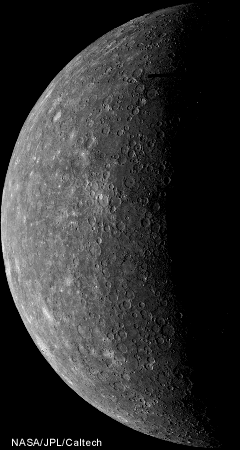
Mercury and the ESA Mission.  "What’s special? Most of ESA's previous interplanetary missions have been to relatively cold parts of the Solar System. BepiColombo will be the Agency's first experience of sending a planetary probe close to the Sun. BepiColombo’s mission is especially challenging because Mercury's orbit is so close to our star. The planet is hard to observe from a distance, because the Sun is so bright. Furthermore, it is difficult to reach because a spacecraft must lose a lot of energy to ‘fall’ towards the planet from the Earth. The Sun’s enormous gravity presents a challenge in placing a spacecraft into a stable orbit around Mercury. Only NASA's Mariner 10 and MESSENGER have visited Mercury so far. Mariner 10 provided the first-ever close-up images of the planet when it flew past three times in 1974-1975. En route to its final destination in orbit around Mercury in 18 March 2011, MESSENGER flew past the planet 3 times (14 January 2008, 6 October 2008, and 29 September 2009), providing new data and images. Once BepiColombo arrives in 2020, it will help reveal information on the composition and history of Mercury. It should discover more about the formation and the history of the inner planets in general, including Earth." Source: http://www.esa.int/esaSC/120391_index_0_m.html

"Venus has often been described as Earth’s sister planet since the two are very similar in size and bulk composition, although they evolved to very different ends. Venus is not currently targeted by any NASA missions although future mission concepts include the Venus In Situ Explorer (VISE) and Venus Mobile Explorer (VME) that would investigate the surface of Venus and help understand the climate change processes that led to the extreme conditions of Venus today. A Venus Surface Sample Return (VSSR) mission is also being considered. These missions remain long-range goals for Venus exploration." Source: http://science.nasa.gov/planetary-science/focus-areas/exploring-the-inner-solar-system/   There have been many missions to Venus which included the infamous Magellan spacecraft. The Magellan was launched into space by NASA in 1989 to map the surface of Venus and test the beginnings of interplanetary exploration which included testing aerobraking(a spaceflight maneuver that reduces the high point of an elliptical orbit by flying the vehicle through the atmosphere at the low point of the orbit). While NASA doesn't have a probe flying to this planet, Japan does. "Akatsuki ("Dawn"), originally designated Planet-C, also known as the Venus Climate Orbiter, is a Japanese Space Agency (JAXA) mission designed to study the dynamics of the atmosphere of Venus from orbit, particularly the upper atmosphere super-rotation and the three-dimensional motion in the lower part of the atmosphere, using multi-wavelength imaging. It will also measure atmospheric temperatures and look for evidence of volcanic activity and lightning." Source: http://nssdc.gsfc.nasa.gov/nmc/spacecraftDisplay.do?id=2010-020D

The Moon. "The Gravity Recovery and Interior Laboratory, or GRAIL, mission is a part of NASA's Discovery Program. It is scheduled to launch in 2011(lecture notes stated September). GRAIL will fly twin spacecraft in tandem orbits around the moon for several months to measure its gravity field in unprecedented detail. The mission also will answer longstanding questions about Earth's moon and provide scientists a better understanding of how Earth and other rocky planets in the solar system formed.

Scientists will use the gravity field information from the two satellites to X-ray the moon from crust to core to reveal the moon's subsurface structures and, indirectly, its thermal history.

The measurement technique that GRAIL will use was pioneered by the joint U.S.-German Earth observing Gravity Recovery and Climate Experiment, or GRACE, mission launched in 2002. The GRACE satellites measure gravity changes related to the movement of mass within Earth, such as the melting of ice at the poles and changes in ocean circulation. As with GRACE, both GRAIL spacecraft will be launched on a single launch vehicle." Source: http://moon.mit.edu/ I learned something else interesting about the moon and will be writing a specific post on this later on this week.

Another amazing thing I learned from this lecture was that we were also exploring the asteroid belt!  Here is some information on the Dawn Mission. "Dawn, as a mission belonging to NASA’s Discovery Program, delves into the unknown, drives new technology innovations, and achieves what's never been attempted before. In Dawn’s case, it is orbiting one member of the main asteroid belt, Vesta, before heading to gather yet more data at a second, Ceres. Dawn's goal is to characterize the conditions and processes of the solar system's earliest epoch by investigating in detail two of the largest protoplanets remaining intact since their formations. Ceres and Vesta reside in the extensive zone between Mars and Jupiter together with many other smaller bodies, called the asteroid belt. Each has followed a very different evolutionary path constrained by the diversity of processes that operated during the first few million years of solar system evolution." Source: http://dawn.jpl.nasa.gov/mission/

Mars.  There is a lot of work being done on this planet....in fact, too much to write about in this already extensive post.  I will have a specific and fascinating post on this planet in several days. Right now, the current launch of the rover Curiosity is scheduled for November of this year. I found the landing of this vehicle quite fascinating. Two things of interest.....methane gas and water. That's all I'm going to say:) PS. The landing of this vehicle is really cool! It has lasers:)


Saturn. Currently the Cassini mission is working its way around Saturn and her moons. This mission is scheduled until the year 2017.  This spacecraft is studying several moons around Saturn which include the infamous Titan where water vapor and methane were found.
"Cassini completed its initial four-year mission to explore the Saturn System in June 2008 and the first extended mission, called the Cassini Equinox Mission, in September 2010. Now, the healthy spacecraft is seeking to make exciting new discoveries in a second extended mission called the Cassini Solstice Mission. The mission’s extension, which goes through September 2017, is named for the Saturnian summer solstice occurring in May 2017. The northern summer solstice marks the beginning of summer in the northern hemisphere and winter in the southern hemisphere. Since Cassini arrived at Saturn just after the planet's northern winter solstice, the extension will allow for the first study of a complete seasonal period.Cassini launched in October 1997 with the European Space Agency's Huygens probe. The probe was equipped with six instruments to study Titan, Saturn's largest moon. It landed on Titan's surface on Jan. 14, 2005, and returned spectacular results. Meanwhile, Cassini's 12 instruments have returned a daily stream of data from Saturn's system since arriving at Saturn in 2004. Among the most important targets of the mission are the moons Titan and Enceladus, as well as some of Saturn’s other icy moons. Towards the end of the mission, Cassini will make closer studies of the planet and its rings.

Enceladus
Small, icy Enceladus is of great scientific interest because it is surprisingly active. Cassini discovered an icy plume shooting from this moon, and subsequent observations have revealed the spray contains complex organic chemicals. Tidal heating is keeping Enceladus warm, and hotspots associated with the fountains have been pinpointed. With heat, organic chemicals and, potentially liquid water, Enceladus could be a place where primitive life forms might evolve. Questions surrounding Enceladus’s “astrobiological potential” are at the heart of many investigations being conducted in the Solstice Mission.

Titan
Cassini catapulted our knowledge of giant, haze-enshrouded Titan into a whole new realm. During the primary and extended missions Cassini investigated the structure and complex organic chemistry of Titan's thick, smog-filled atmosphere. On the frigid, alien surface, the spacecraft and its Huygens probe revealed vast methane lakes and widespread stretches of wind-sculpted hydrocarbon sand dunes. Cassini researchers also deduced the presence of an internal, liquid water-ammonia ocean.
Titan remains a top priority as scientists hope to catch the moon’s surface features in the act of changing. The spacecraft will look for signs of seasonal climate change such as storms, flooding, or changes in lake levels, as well as evidence of volcanic activity.

Saturn
The spacecraft eventually will make repeated dives between Saturn and its rings to obtain in depth knowledge of the gas giant. During these close encounters, the spacecraft will study the internal structure of Saturn, its magnetic fluctuations, and the mass of the rings.
Rings
From a distance the rings look ordered and tidy. But up close, Cassini finds Saturn’s rings to be a complex place where small moons and ring particles jostle and collide, where waves and jets constantly form and dissipate.
Icy Moons
Cassini is revisiting many of Saturn’s icy moons in the Solstice Mission. Over multiple flybys, Cassini will study the intriguing bright and dark surfaces of Dione and Rhea to compare their geological and cratering histories with those of other icy moons. Scientists will also study further the unique thermal features recently discovered on Mimas.
Magnetic Environment
Cassini’s continued journey carries it throughout the huge sphere of magnetic activity that surrounds Saturn. One major discovery was that water ice jets from Enceladus play a major role in Saturn’s magnetosphere. Water from the jets loads up the magnetosphere, influencing radio and auroral activity, and even causes changes in the rotation of the magnetic field itself. The Solstice mission will study these phenomena in unexplored areas of the magnetosphere and probe for links to Enceladus in addition to connections with other moons." Source: http://saturn.jpl.nasa.gov/mission/introduction/
Jupiter. "The Juno mission is the next scientific investigation in the NASA New Frontiers Program. The mission's primary science goal is to significantly improve our understanding of the formation and structure of Jupiter. By advancing our knowledge of the giant planet, we will also dramatically advance our understanding of the origins and early evolution of our own solar system at the most fundamental level. The Juno spacecraft will investigate Jupiter's origins, its interior structure, its deep atmosphere and its magnetosphere from an innovative, highly elliptical orbit with a suite of seven science instruments. In addition, a camera called JunoCam will be used by student participants in the Juno Education and Public Outreach program to take the first images of Jupiter's polar regions.
Juno Mission Trajectory


Juno will achieve the mission science goals by sending a spinning, solar-powered spacecraft into a unique Jupiter polar orbit with close perijove. The mission design provides a maximum delivered payload to Jupiter and a unique polar orbit which satisfies the science measurement requirements while minimizing the radiation exposure of the science instruments. Juno is currently planned to be launched in August 2011 and will travel towards Jupiter after an Earth fly-by in October 2013 to provide a gravity assist.  After a five year journey the spacecraft arrives at Jupiter in 2016. A Jupiter Orbit Insertion (JOI) and JOI clean up over the next two perijoves (closest point to Jupiter) assures an ~11 day orbit. Perijove at 1.06 Jupiter Radii and apojove at ~39 Jupiter Radii combined with the 90 degree polar orbit, provides the resolution and global viewing geometry required to achieve the mission science goals. The polar orbit with close perijove also allows the spacecraft to avoid the bulk of the Jovian radiation field. During the one year, 32 orbit nominal mission, the line of apsides or the orbit precesses due to Jupiter's oblateness. The 32 orbit one year mission at Jupiter fits nicely between solar conjunctions, further simplifying mission operations." Source: http://juno.wisc.edu/mission.html


Finally...and the most exciting.  The New Horizons mission to Pluto.  It was launched in 2006 and will fly by Pluto in the year 2015.  This is a historic mission as this spacecraft runs differently than others.  It will pass Pluto and fly into the Koiper Belt.  This will also get its own post.
"In 2006, NASA dispatched an ambassador to the planetary frontier. The New Horizons spacecraft is now halfway between Earth and Pluto, on approach for a dramatic flight past the icy planet and its moons in July 2015. After 10 years and more than 3 billion miles, on a historic voyage that has already taken it over the storms and around the moons of Jupiter, New Horizons will shed light on new kinds of worlds we've only just discovered on the outskirts of the solar system. Pluto gets closer by the day, and New Horizons continues into rare territory, as just the fifth probe to traverse interplanetary space so far from the Sun. And the first to travel so far, to reach a new planet for exploration." Source: http://www.nasa.gov/mission_pages/newhorizons/main/index.html

So why all of this?  My heart belongs in the stars as it does in the garden. These posts will explore the bigger mysteries uncovered by previous spacecraft and also the heart of imagination. I'm sorry for this long post.....and it will be the longest of this series, but I hope you find these writes interesting. Until tomorrow....we'll take a break from the science and explore the fiction:)


Monday, July 18, 2011

Phoenix Comicon 2011

Trying to tie the gardening part of my blog in with the convention.  This is Poison Ivy from the Batman series who loves plants above all living things including humans.  She's one of my favorite villains.  As we all  know, touching Poison Ivy can have some very itchy consequences:)
With one Comicon done and another to go.....the San Diego Comicon begins this weekend!!  We'll be there snapping pics.  I'm going to celebrate by sharing my love of all things space.  From my heart and from NASA, we will explore the universe and celebrate the adventures that lie ahead of us.....welcome to my blog.  Watch for updates this weekend from the San Diego Comicon and my daily posts from May's Phoenix Comicon.  So get your geek on as we explore space! This following write is from May 2011.


Greetings all,
As I sit here tonight thinking about how I am going to break down all this information over the course of several blogs, I am also needing to explain what you will be reading and why I feel it’s important to share.  Las Aventuras is a blog about gardening and travel.  It is going to look “spacy” and “science fiction” like over the next several days as I report on some really fascinating stuff.  In my mind, space is one of the great adventures that lies ahead and of course  that is what this blog is all about….adventure of the garden, travel, and imagination.  Dr. Williams, from ASU, gave an amazing lecture at the Comicon in Phoenix in May and I can’t wait to share that information with you all.  You are going to find articles in 3 primary categories…..the Adventures of Space, the Adventures of my Childhood(that which inspires me), and of course the Adventures of Gardening with a Sci-Fi twist.  I hope you enjoy this series of writes as I have from a fun filled weekend in May of fact, fiction, and discovery.    Let’s begin…..
Lightsabers from Star Wars
If you’ve  never been to a sci fi convention, it can be a bit of an eye opener.  As you look at the pics in this blog, you’ll see A LOT of people dressing up in all kinds of outfits.  I remember a time once during my high school years when I went to my first convention with my Dad.  We both had a good laugh as people with pointed ears and blue attenaes walked around us.  I met some of my childhood heroes growing up….Uhura(Nichelle Nichols) and Chekov(Walter Koenig) from Star Trek.  It was one of the most fun experiences I remember from my childhood.  And the best part was that my Dad was a good sport and came along for the fun.  This time, me and the better half, went together and had a blast.  You’ll see a lot of familiar faces on several of the blogs coming up.  We got to meet A LOT of cool actors and have a couple laughs with them.  Actors make up one part of the convention scene.  You’ll find a lot of legit scientists doing presentations from NASA  that will include many advisors from our national programs.
R2D2 from Star Wars
Bring plenty of money for this weekend event as it can get pricey with all the food, hotel, and “other” expenses that pop up.  The Phoenix Comicon comes once a year(generally around Memorial Day weekend), but there are other events that pop up from time to time….so keep your pointed ears openJ It's located at the Phoenix Convention Center with several hotels nearby. If you’re a fan of fantasy, comic books, anime, science, or science fiction,  you won’t want to miss this event.  Tickets can be purchased online as well as other special event items. I recommend you do this ahead of time so that you can avoid the lines and hassle of waiting. We also discovered that we need backbacks full of food and water to keep from passing out!  Stay tuned for more out of this world fun.  Las Aventuras is taking you up into space and beyond.  After that, we’re coming back to Earth and investigating the beautiful country of Panama!  Until next time, Live Long and Prosper!
Han Solo Frozen

Created from some vid I took.  Enjoy:)

Sunday, July 17, 2011

Mexican Fencepost Cactus


This is one of my favorite pics that I've taken so far this year up in Phoenix.  I absolutely love the look of this cactus.  There is only ONE growing on the El Presidio property, but I will remedy that situation down the road.  This particular cactus can be expensive, but it is worth the investment.  It survived the winter and LOVES sun and heat.  It definitely makes a statement around people's yards.  As the title of this cactus suggests, it is used by many as a "natural" fence...especially in the Phoenix area.  While it does well here in Tucson, it does even better in Phoenix. Like most cacti, don't overwater in winter, but during the summer, a weekly watering doesn't hurt.  Of the cacti, this one can take a little more water than the others.  It is one of my favorites along with the Night Blooming Cereus and I highly recommend trying it out for your Tucson garden.

As you can see in this pic taken up in Phoenix, they can be grown close together to create that "fence" look. It can grow up to 20 feet tall and doesn't have that thorny dangerous part about it like other cacti so it is safe to plant in areas full of pedestrians.  While it usually does well in our winter, I like to put stryofoam cups on the tip of the cactus below 25 degrees.  Fantastic cactus and one for the Tucson garden!  Until next time.....

Saturday, July 16, 2011

Radiance


Here are some pics I snapped that reflect the natural lighting of the desert sun.....


These were taken in the Phoenix area and reflect the beauty of the sun.

Wildflowers....


Spiny cacti.....

Or a vase of Daffodils at sunset......light is beautiful.

Friday, July 15, 2011

The Phoenix Desert Botanical Gardens


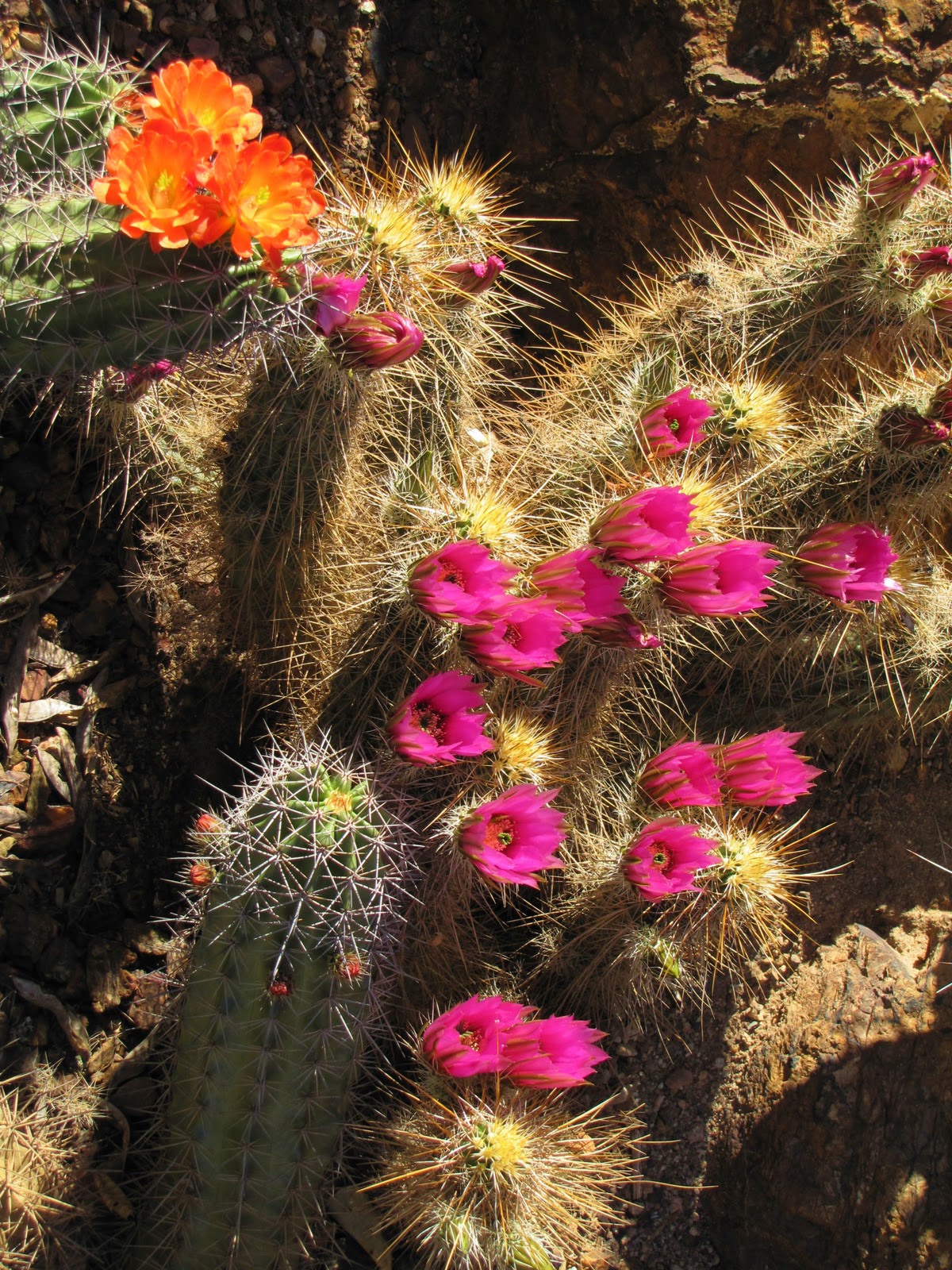
The Mexican Fence Post Cactus.  This was my favorite pic from  that day's work of photo shoots.

We've finally come to the end of our journey this week to the Phoenix Desert Botanical Gardens.  We had a fantastic time exploring the scenic grounds near Papago Park.  Bring plenty of sunscreen and a hat to protect your head. There is a lot of see.  The one nice thing about this place is the convenient access to drinking fountains around the property.


Since 1939, the Desert Botanical Garden has been home to one of the finest and most diverse collections of succulent plants, including rare, threatened and endangered species from around the Southwest.  It is the only botanical garden in the world whose mission, from its early inception, was to focus solely on desert plants.  A small group of Valley citizens created a botanical garden to encourage an understanding, appreciation and promotion of the uniqueness of the world's deserts, especially the Sonoran Desert.  They foresaw the Valley's potential and unique identity, envisioning the need to conserve a piece of the desert environment.

The Desert Botanical Garden sits on 145 acres and has more than 50,000 plants in its collection.  The Garden has 5 thematic trails that exhibit cactus and succulent species from around the world.  Interpretive exhibits along the trails highlight desert wildflowers, conservation, desert plant adaption and ethnobotany.   The Garden is a museum of living plants.  Docent-led tours are offered daily October through April.    Self guided audio tours are also available.

The Garden's commitment to the community is to advance excellence in education, research, exhibition, and conservation of  desert plants of the world with emphasis on the Southwestern United States. 
The address:
1201 N. Galvin Parkway
Phoenix, AZ 85008
dbg.org
Telephone 480-941-1225

They offer group tours, rental space for weddings, a patio cafe and garden shop.


If you are interested in desert gardening ideas, this is the place to check out.  We had a wonderful day exploring the premises.


The best times to go are in Spring or late Fall when the temps cool off a bit.   They are open 7 days a week from 9 AM to 5 PM


Stay tuned for more from the garden.......

Thursday, July 14, 2011

Serenity


"If you build it, they will come."  Creating a garden also means creating an inviting place for our local fauna to stop and ponder your work.  Some of us have large yards while others have smaller areas.....but no matter what the size, you can still create an oasis for wildlife to stop and visit.


For the best results, plant native Sonoran species that will attract our desert friends to rest or eat.  I know that bunnies or javelina aren't everyone's favorites at times, but they do make a nice addition to a beautiful desert garden.


Until tomorrow.....

Wednesday, July 13, 2011

The Art of Desert


One of the things that I think people overlook in their landscape around town is the use of hardscape and art to create a magical or serene feel to their yards.  What I like about the Desert Botanical Gardens of Phoenix is the use of art around their landscape design.  Design is key to everything.  Notice how this rock above utilizes the very structural agave with a red contemporary art piece in the background?

Or how a hidden water feature tucked under a mesquite tree can add tranquility to your surroundings?

Look closer at the above pic and you'll see fish swimming about......

The structural Organ Pipes make a statement as you enter under the steel domes....


Note how color can play into design........look at the two larger cactus framing the "doorway".  Every angle provides a delicious meal for the eye.....

Water covers rocks and adds a green shade to the brown background......

Glass art captures the sun and makes a bold statement as you enter the Phoenix Botanical Gardens....so when planning your gardens, don't forget these important elements.  Until tomorow......

Tuesday, July 12, 2011

Cacti and Succulent Competition

While at the Gardens, there was a competition for the best cactus or succulent set up.  We were given a bean at the entrance of the building and asked to drop the bean in a cup next to our favorite arrangement.

Lots of tables were set up with many beautiful arrangements.


It was also a nice break from the hot weather outside!

Eventually I had to make my choice and my favorite is below......

Cyphostemma Cirrhosum

Monday, July 11, 2011

The Luna Moth


One of the exciting finds at the Desert Botanical Gardens in Phoenix was the Luna Moth.  They had several flying around their butterfly pavilion and it was really neat to see.  I've seen these in nature before but I didn't remember from where....the Spanish word for this type of moth is "alevilla".

"Luna Moths are members of the Saturniidae family, also known as the "Giant Silkworm Moths." Luna Moths are huge moths, with a wingspan of four and a half inches. They have a white body, pinkish legs, and huge pale green wings. The hindwings have eyespots and long tails. They fly, only at night, in Spring and early Summer. The female Luna Moth lays eggs on the bottom of Black Walnut leaves. She lays about 200 eggs in small groups. You can tell a male from a female, because males have larger, bushier antennae.  When the adult Luna Moth leaves its coccoon, it is not ready to fly. Its wings are short and stumpy and the insect needs to rest. It usually hatches in mid-morning and climbs a tree trunk to hang its wings, so they can fill with blood. Once the wings are inflated, the adult moth will wait until nightfall to fly off to find a mate. Adult Luna Moths don't eat; in fact, they don't even have a mouth. They only live for about a week, and their only purpose is to mate.  Female Luna Moths release a chemical at night which attracts males. Adults die shortly after mating or laying eggs. Usually, two generations are born each year (that means that moths that spent the winter in a coccoon will hatch, mate, and lay eggs; then their children will hatch, mate, and lay eggs which will hatch and make cocoons for the Winter). Luna Moths were once very common, but are now considered an endangered species in some areas."


Sunday, July 10, 2011

Maxine & Jonathan Marshall Butterfly Pavillion

My friend Marla

While I'm in Panama and collecting lots of cool info, I thought I'd take you to a place we visited in early April at the Maxine and Jonathan Marshall Butterfly Pavilion.  This next series takes us to the Phoenix Desert Botanical Gardens near the Papagayo park and Phoenix Zoo.  If you go right now, wear a hat and go early in the morning, but personally I think it's too hot to even enjoy the experience and would wait until October or November to visit. As some of you may or may not know, I am a docent for the Tucson Botanical Gardens and volunteer when I can in the Butterfly Pavilion there.  Most butterfly pavilions are closed now and quite frankly that's a good thing......it's just too hot to function is this weather.  However, we don't need pavilions here in the desert southwest during this time of year as we have lots and lots of our own native butterflies to enjoy here.  I have a series on butterfly plants written back in March so it's not too late to put a couple of those plants in for your own enjoyment:) 


The main differences between the two butterfly pavilions are that the Tucson display is enclosed and smaller while the Phoenix display is airy, open, and surrounded by a net.  The types of butterflies and moths are also different.   Our shipments come from Costa Rica, Africa, etc. and the Phoenix butterflies come from Florida.  All of them are very cool and that's what I loved about this particular butterfly pavilion.  There were lots of oranges and yellows flying all around us.  


These Julia(Dryas julia) are taking a break from their warm day and catching up on some fresh citrus.

I secretly shot my friend looking at something.  She had a stowaway butterfly on her shirt as she was trying to exit.  Many of the butterflies found in this pavilion can also be seen in the Sonoran desert.  There were Sulfurs, Buckeyes, Queens, Malachites, Longwings, and Swallowtails.  The mister would come on every several minutes to keep the moisture levels up for the butterflies.

A Swallowtail which can be commonly seen in our desert takes a break from the afternoon sun.

The Queen butterfly is a popular and welcome guest during our warm summer months in Tucson.


Stay tuned for more.........

The Zebra Longwing