Sunday, November 3, 2019

Pumpkin Spice and Everything Nice

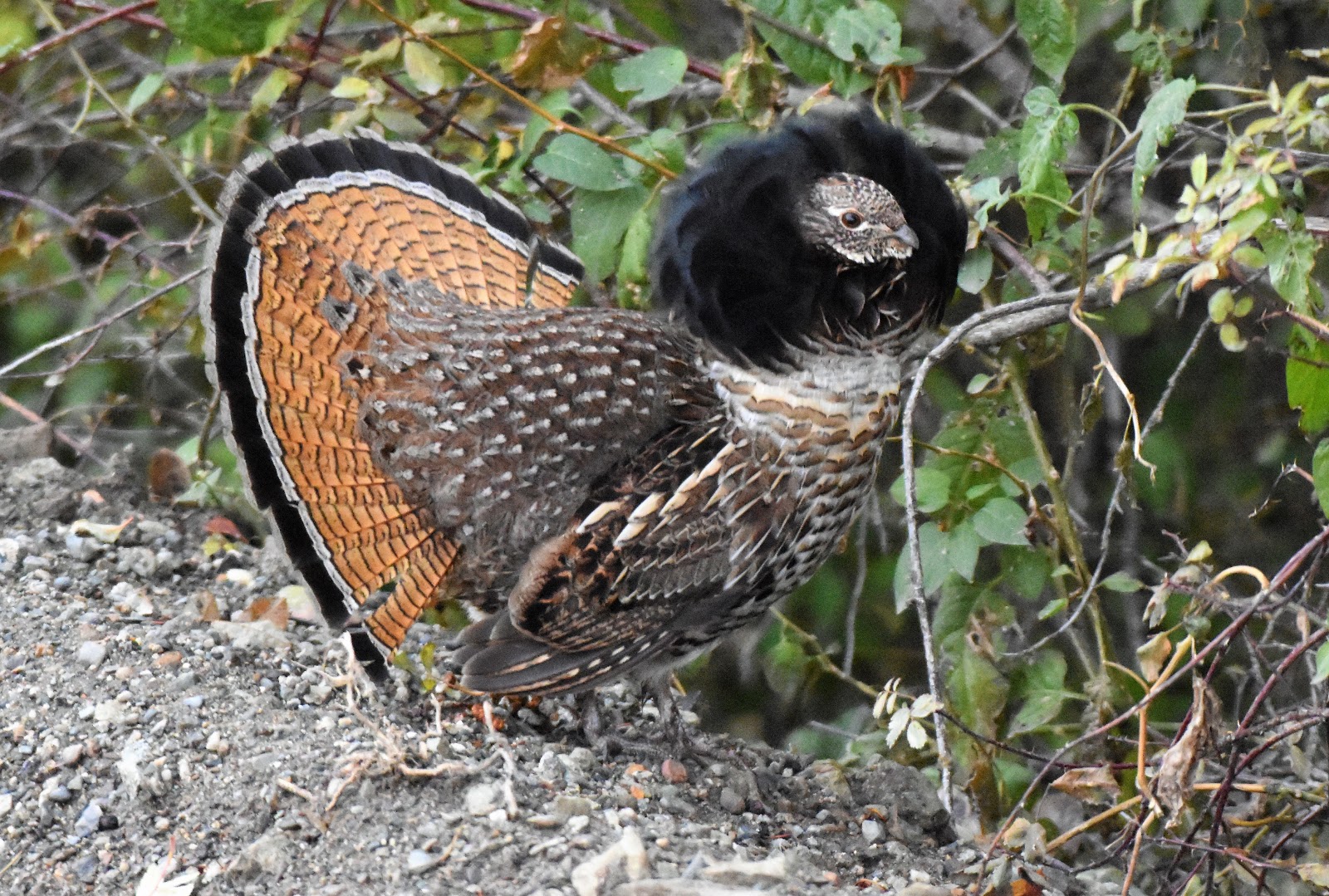
A male Ruffed Grouse puts on a show for his lady friend
This week we take you to the beautiful Pacific Northwest where I joined friend and bird guide Khanh Tran for a scouting mission.  


Our mission?  To scout several new areas for owls and grouse, specifically the Boreal Owl.  And while I was there, I wanted to understand the Blue Grouse habitat better.  Several years ago, they were split.  The Dusky Grouse. And the Sooty Grouse. 

Pine Grosbeak
It was a fun trip.  There were no expectations other than to go birding with Khanh and have fun. Khanh needed to do some scouting for his clients and we definitely checked out some amazing places together. 


Pine Grosbeaks were definitely in good numbers for this time of year.  We had them at virtually every location.  Khanh mentioned that this might be a good sign for winter birding in Washington state. 


We maneuvered around hunters during this week on mostly secure roads. During one outing, we had three species of chickadees.  My ears could pick out ONE Boreal Chickadee and we both briefly saw the bird.  A huge flock of Mountain Chickadees passed through the area, but one lingered a little longer.  Bingo!  But it didn't stick around for a pic. This chickadee prefers the higher elevations, above 5,500 feet, in Engelmann spruce.  The tighter the growth of these spruce; the better chances of us finding this species of chickadee. 

A Mule Deer evades the hunters
It was fun watching Khanh bird.  He is unique from other birders in that he studies habitat well.  He knows his elevations.  In fact, his jeep has a sensor detecting elevation hikes. And what separates him from other birders is that he doesn't use ebird.  He's aware of it, but he does his own thing.  I admire that about him.  It frustrates some local birders because he doesn't report his findings on ebird. In fact, during our time together, I hid several reports to protect the owls.  It takes a lot of time and money, along with the habitat knowledge, to find these birds.  This kind of birding is very different from much of my Arizona work.  However, I will say today that Ebird has blocked out several sensitive and specific owl species sightings from their program.  And I'm appreciative of that.  It's all to protect the bird.  You want an owl?  Teach yourself by attending conferences, reading and personal exploration.  There are no short cuts. 


The roads and hillsides burst forth with bright fall color.  I don't think Khanh even knew how wonderful it would be.  Every year, I plan an autumn trek somewhere where I can just bird and look at the pretty landscape.  During this time of year, the birds take a backseat to all the trees and bushes changing color. 


Chestnut-backed Chickadee
Often during our trek to find the Boreal Owl, there would be flurries as we hiked in elevation.  Then the snow would happen and it was time for the holiday music.  Everyone always apologizes for the weather, but I informed Khanh that I bring the rain and snow with me everywhere I go.  I hate the heat so much and I love wrapping myself up in my fuzzy lined jacket.  It makes me happy to feel that cold.  He told me it wasn't optimal weather, and I understood that very well.  I didn't care.  We were just birding and doing what I would normally do in Arizona. Chasing birds gets old.  Exploring new habitat however NEVER gets old. 


I frosted my hair for this trek so that I would match my surroundings:)  Snow. The older I get, the more and more I hate the heat.  I'm not sure I could live along the Pacific Northwest because of the constant overcast skies.  But eastern Washington or Oregon wouldn't be such a bad option. The minute you leave the rain forest strip, the skies open and the sun shines. 


One of the most stressful things about the birding here are the roads. On this trek, there was only one road that was questionable. I mean, if that rock below my feet let go, there's no way of surviving that fall. The pic below shows me on that sketchy part of the road.  The rock juts out and underneath the rock there is nothing for a couple thousand feet!


For those of you following my Dusky Grouse search in Arizona, you will know that I have not had any luck with this bird over the years.  I have searched the right kinds of habitat for this bird and looked in the right locations. Well, I'm excited to say that I spotted my first 3 Dusky Grouse! After studying them for 20 minutes, I attempted a pic.  Understanding their behaviors and where they prefer to feed has helped me understand our only AZ grouse better.  They are found in the White Mountains around Greer, the North Rim of the Grand Canyon and around Snowbowl north of Flagstaff on Mt. Humphrey.  Next year, I know how I'll approach finding my last "new" breeding AZ bird. 

An elusive Dusky Grouse
Now onto our Boreal Owl story.  Our first night was too windy.  The snow storm was strong and the night dark.  No luck. 


It was on our second night, again during the most beautiful snow storm, that we'd find our Boreal Owl in a new location.  There was no wind.  It was quiet. Dark. And snow flakes gently fell to the ground.  The packy kind of snow. As we stood under the snow umbrella of a dense conifer tree, we heard the unmistakable "skee-oo" of the Boreal Owl.  Most people just get to hear that call, but I was rewarded with a great look as the bird flew into my light.  It's short body and longer wings flew silently under that quiet umbrella into the branches above our head.  I didn't know which was cooler, the atmosphere surrounding the bird or the bird itself.  It wasn't long, but it was enough to ID and memorize.  I closed my eyes and tried to mentally capture this moment for those really difficult days at my job. There are no souvenir pictures other than the one my mind mentally took.  I was proud of myself for letting the camera at my side so I could just enjoy watching this bird. "Skee-oo!" and it moved further away.  And then another quieter, further "Skee-oo!" The Boreal Owl was gone. 


It was hard to top that sighting of the owl, but the following day, we saw a male Ruffed Grouse on display!  Never in our lives have we seen this bird display.  Khanh sees this bird all the time, but never like this.  I have only ever dreamed about seeing this bird in his mating stance ever since the day I began studying them in Wisconsin.  I thought I'd never see this bird do it's strut.  But years later, both Khanh and myself get the observation of a lifetime!


The larches of the North Cascades were a brilliant yellow as the sun hit them with a gentle ray of light. 


We hiked northern Washington along the Canadian border in lots of snow. 


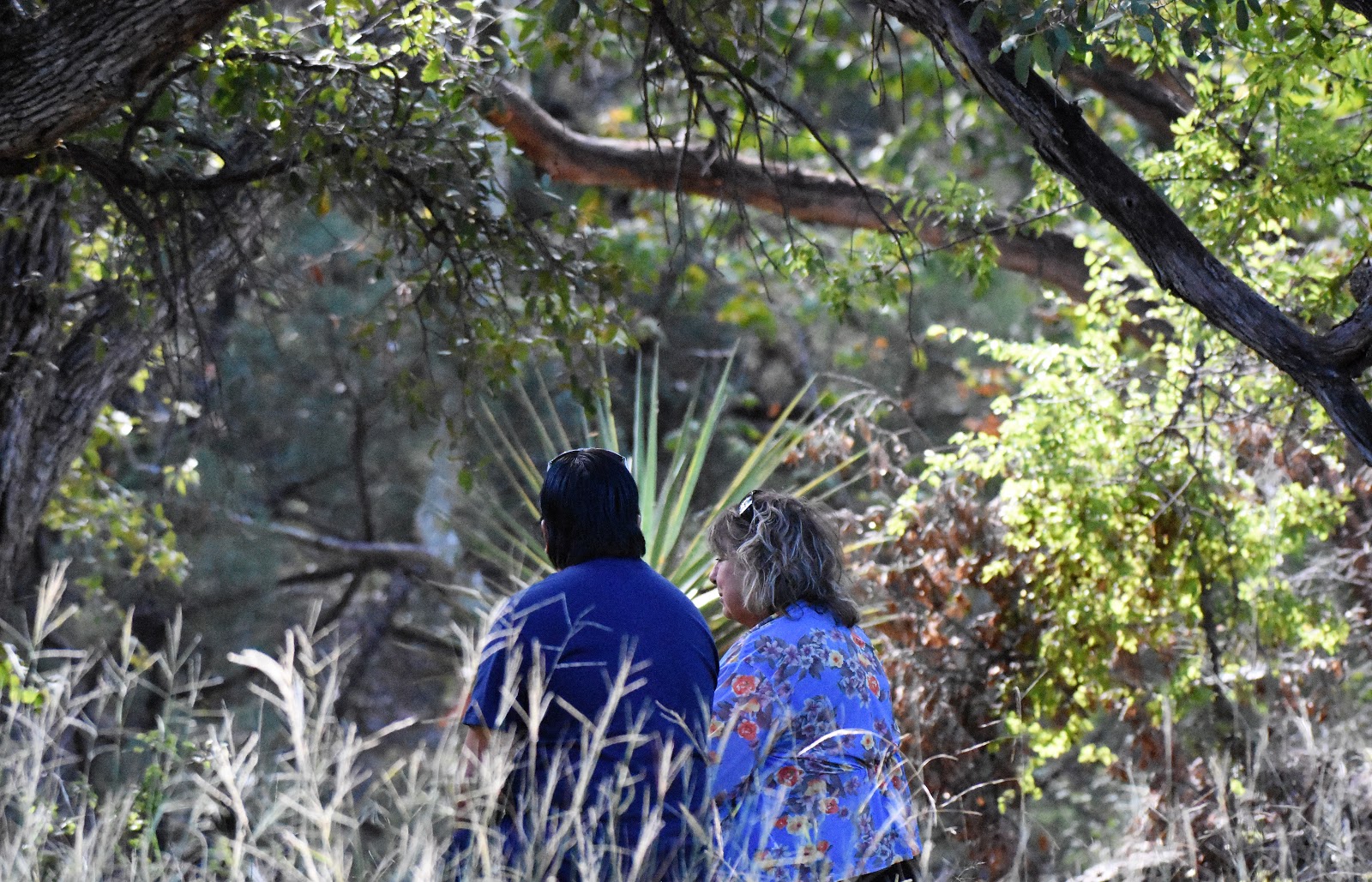
Don't mind my crazy hair.  Khanh looks great.  I need a haircut. Until next time friends!


Saturday, October 26, 2019

Welcome Surprises

A Sonoran Bumblebee stops for a look
Summer has officially left the desert and the end of the 2019 year is coming.  As we get closer to the start of the holidays, I've been enjoying some peaceful outings with friends and family. 


Our friend Bonnie from Wales came to visit. And it was a blast getting to hang out with Sherry too! We took a nice hike in Madera Canyon to find that elusive Elegant Trogon.  


After our hike, we sat at the Santa Rita Lodge feeders and watched a Black-throated Gray Warbler take a sip from the fountain. 

Swainson's Hawk
As we took my Santa Rita bird route, we had a lingering Swainson's Hawk fly over our heads.  This bird was most likely heading south for the winter. 


With the extreme temps gone now, it's SO nice to sit under a rock and absorb the natural world around us.  


A male Vermilion Flycatcher fluoresces in the autumn light. 


This year has been all about reflection. About friends.  About sharing the experience with others. I remember those days when I did all of my birding alone, but now, I can't imagine my world without these friends. 

Bronzed Cowbird
One night after a rough day at work, I went to a local park to count black birds.  Not everyone gets into the black birds, but I like this group a lot.  I sat on a lawn at a local park and watched them feed from the grasses. When I say black birds, I literally mean any bird that is black including cowbirds and blackbirds:)

Yellow-headed Blackbirds
To my surprise I discovered many of our wintering birds are coming back!  


juvenile Gray Hawk
While some of our summering ones still linger. 


I welcome the wintering birds.  I welcome those friendships both new and old.  And I welcome back these wonderful temperatures.  Winter has come.  Next week we celebrate autumn in the Pacific Northwest.  I hope you join me for our adventures with friend and bird guide Khanh Tran.  Until next time friends.....

Monday, October 14, 2019

What's in a number?


My last 10 new birds for the state of Arizona
Overall, it has been a slow year for me in Arizona for bird rarities.  And the rarities that I've seen so far this year have been eastern birds which means many of them are not lifers. Still, it's fun to challenge oneself and search for new state birds. These last ten "new" bird species moved me into the 460 bird species category of Arizona birding.  It took about a year to get here starting back in October of 2018. 


In years past, it wasn't unusual to add 15 or 20 birds a year.  I was doubtful that I would hit this milestone marker so soon but here they are, numbers 450 to 460.  This is the true challenge of state birding. 


The Ringed Kingfisher is an elusive first record and required a lot of skill and luck to find. 
We start out with a first time record of the Ringed Kingfisher in Arizona. Speculation had been swirling in a remote southern part of the state near the mining town of Safford that a large kingfisher had been seen visiting watering holes around a neighborhood.  A naturalist saw this bird but didn't report it right away until he mentioned it to another birder.  She snapped photos and shared it to social media.  What followed afterwards was mayhem. First time record birds are serious business.  All birders from ancient times and present came together to look for this elusive bird in a rather red neckish area of the state. It eluded many birders.  Apparently, some were threatened by the savage locals. We never saw any of that stuff. In fact, the Saffordlings were very kind to us. Maybe it was because we didn't trespass onto private property. Today this bird may still be around but no one is saying a peep.  The chase was exciting for me because I got to play detective with a friend.  And it worked. 


I speak with Scott as we search for the Iceland Gull
At 451, friend Melanie Herring spotted a rare gull for Arizona birders.  A few records for the Iceland Gull have been recorded for this state.  But not many.  So it was a lovely chase to a desert lake surrounded by an RV campground. This was another fun state chase near the Phoenix area. 

We search for rarities in Ajo, which also includes the Ferruginous Pygmy-Owl

Then it was time for 452.  Birders attended an AZFO conference back in 2018.  An excellent lecture was given on Ferruginous Pygmy-Owl in Ajo.  These saguaro cactus loving owls are considered endangered here in Arizona and found in specific habitat.  We've speculated often about where we'd find these owls besides Organ Pipe National Monument.  I just didn't want to chase and disturb this owl.  There are literally hundreds of miles of excellent habitat for this bird but their locations are very remote and difficult to access without the right vehicle. But we did our hike.  I heard and saw the bird and left.  This sensitive species is hidden from ebird and only those with excellent knowledge of their habitat will be able to find them. This is one I didn't want to chase and will not chase again.  Their populations seem to be doing fine but a civil war broke out among birders about advertising the various owl's locations. These particular owls are not fond of human settlements and like to live away from the urban areas. 


In a remote area near the North Rim of the Grand Canyon, we search for the Rosy-Finches
The next two state birds were observed on the same day.  It was a perfect day out and one of the most fun treks to the North Rim.  This would be the day we'd get to observe Black Rosy-Finches up close along with a Gray-crowned Rosy-Finch!  Not only are these beautiful birds, but they are often difficult to observe up close. Every year a birder sees one or two Black Rosy-Finches, but they don't stick around long enough for other birders to observe.  A Gray-crowned Rosy-Finch was the icing on a cake with only a handful of records!  


Weather makes birding a lot of fun
By the end of the year, a Black-legged Kittiwake flew into the Phoenix area.  I didn't have great photos of this species from other places so I went to search for this bird.  So did many other birders.  It stuck around for a few days and made for a nice experience. 


People search high and low for the White-throated Thrush, yet another first AZ record
The White-throated Thrush was probably the MOST exciting bird for the 2019 birding season. I actually took a day off to see this first time Arizona record. 


We discover a rare Red-eyed Vireo on a beautiful spring day
Then it would get slow.  Between January and May, there were no new birds for my Arizona list.  Again on theory, I went with my friend Celeste to Boyce Thompson Arboretum to check out the spring migration for warblers, etc. We lucked out and had a great observation of a Red-eyed Vireo.  I've seen this bird often in other places but never in Arizona.  There are several records of this bird every year passing through the state.  It's just about being in the right place at the right time. And we were. 


During hawk migration, we keep an eye on the skies. 
At 458, I had had it with this stupid nemesis bird, the Short-tailed Hawk.  I have hiked and driven to all the spots where these birds had been reported.  Each year a few nest on our mountain tops in Southern Arizona. However, they take some skill in finding.  Most people accidentally find them.  Luckily for us, we got to see one on top of Mt. Lemmon. And now my last AZ breeding nemesis bird and lifer is the Dusky Grouse. 


Searching for my nemesis, the Dusky Grouse in the White Mountains, we discover by accident an Eastern Kingbird
The last two birds were not very exciting for me at all. Bird number 459 was the Eastern Kingbird and 460 was the Yellow-throated Vireo. We spotted a migrating Eastern Kingbird flying across the highway near Eager.  It wasn't chaseable as they never are due to their migration pattern.  It's a bird that does not stick around the area. However, the Yellow-throated Vireo near Sedona has stuck around for several years now.  It's a rare bird for the state, but I never went to chase it because I wasn't into searching for that bird. However during a trek up to Flagstaff, we stopped to look for the bird.  It was found in the beautiful Oak Creek Canyon.  


Yellow-throated Vireo territory is quite beautiful in Oak Creek Canyon, Sedona, AZ
If anything state birding can be a lot of fun.  Birds can take you to some very random locations.  Driving is a must and it requires patience and gas money. I will admit that with a job and friends, the state birding takes a third place unless the bird is a lifer. The Yellow-throated Vireo is a good example of this all.  It took me two or three years to look for it.  It's a pretty rare bird for the state but I've seen them often enough.  The Red-eyed Vireo or Eastern Kingbird are other species that I normally wouldn't chase. 


Looking for longspurs
Now if we're talking warblers or ocean birds, then I get excited.  I still wait for a surprise Magnificent Frigatebird to descend from the heavens during a hurricane event.

Perfect conditions for a rare Magnificent Frigatebird during monsoon season, when hurricanes move north into our area
Stay tuned for more!

Monday, October 7, 2019

The Rains of Migration

A gorgeous view to the entrance of the Chiricahuan Mountains
Birders often gamble while traveling to new places when searching for new species. Sometimes the weather cooperates.  And sometimes it doesn't.

Jeff tries to get that perfect shot of a Blue-throated Mountain-gem
This past weekend I had the fortune of showing Floridian birding friend Jeff the wonders of the magical Chiricahua mountains. He was in search of several really cool Arizona rarities AND a couple resident birds. 

Wilson's Warbler

(Un)fortunately on our planned outing, it rained all day long with the temps in the lower 50's.  These were the coolest temps we've had in a long time!  I was not appropriately dressed and froze my butt off!  BUT, I love the cold.  It makes me happy.  And so did the rain.  However, Jeff wasn't having it. This was his ONE shot for several lifers. 


Jeff searches high and low for the White-eared Hummingbird, a species that like to hang out near riparian streams and oak trees
I know how he felt, but truly it was a magical day out even with the rain. I told him not to lose faith.  We'd find birds even in the rain.  They might not be in best photography light, but they'll be around the mountain. Jeff drove with the windows down so I could hear the bird conversations happening around our vehicle. 

A rare Berryline Hummingbird comes to the feeders

Our first stop was for the Berryline Hummingbird at the Southwestern Research Station. It didn't show first thing in the morning.  And it began to rain.  So I suggested we hunt for the Mexican Chickadees first.  Later on in the morning, we returned to a hungry Berryline Hummer feeding at one of the stations. Hummingbirds get super active during rain events so I knew the bird would be around the feeders. 


The Berryline Hummingbird is a rarity for Arizona but does often show up several times a year during the summer.  However, they don't always stick around like this female did. While at the Southwestern Research Station, I noticed this vehicle and laughed. It made me think about all the birders who don't have an SUV or bigger car to drive on our rugged Arizona roads.  There are some birders who really chance it out there and gamble their lives with their older vehicles. I'll sometimes arrive at a location and wonder how in the world they safely made it with the car they were driving.  I was once that birder not so long ago:)


While on the road, we had amazing views of a Band-tailed Pigeon. These pigeons are secretive and often skittish in Arizona.  This bird analyzed its situation before quickly flying off. 

My favorite sighting of the day was this Band-tailed Pigeon
High on the Chiricahuan mountains, we drove through the clouds.  These massive gray blobs of moisture began to descend all around us.  The conditions began to turn for the worse. 


At one point, I felt like I was in Oregon or Washington state.  Everything was so green and lush. And while we were driving up to Rustler Park, I began hearing Mexican Chickadees.  And lots of them!

Mexican Chickadee

My only photo is the one I took(above) years ago in the same general vicinity.  These chickadees are super difficult to snap photos of!  We tried several times attempting to capture that one awesome shot.  Jeff saw plenty of these chickadees but they didn't want to pose for a pic.  I couldn't believe the numbers this year.  This species has done very well!


Blue-throated Mountain-gem
And of course, another resident, the Blue-throated Mountain-gem was in great numbers.  Jeff was excited to see this gorgeous hummer as well. 


The mountains were full of our regular resident birds as well.  At one point as one of the clouds descended upon our position, it pushed down a huge number of migrating birds into the trees.  We were literally surrounded by dozens of Western Tanagers!


A Purple Gallinule is an expected rarity for Tucson in the newly flowing Santa Cruz River.  Clearly this restoration project is doing its job. 

What had seemed as a lackluster monsoon season in southeastern Arizona this year has turned into an exciting bang to the end of the season.  We have been getting storm after storm now when it should all be winding down.  With these storms, comes lots of vagrants!


It was a special treat to be able to bird with Jeff during that magical rain event.  Setting aside the photography, as I do often now, the act of birding is a thrill. Much of my photography is just for documentation and this blog now. In the true sense of birding, you just have to experience a new bird with your eyes and ears. And we did. I think for every 10 new birds I discover; I may get 7 lifer shots of which 5 are only great.  We spoke about that in the car. On that day, Jeff added 4 lifers to that lifelist and we dipped on one of our targets, the White-eared Hummingbird.  But I wasn't hopeful for that one as they had just left the nesting site. When it began to rain in that particular spot, we didn't see any birds at all except a Hammond's Flycatcher. And that's all part of the game. 


And speaking of games and difficult birds!  Next week we celebrate fall up in Flagstaff as we search for my nemesis, the Dusky Grouse!  Until next time....