Friday, August 17, 2018

The Road To Hana


One of the many gorgeous views along the road to Hana
There is a popular stretch of road on Maui that will take you to Hana.  It's a harrowing drive along beautiful forests and cliffs as drivers face one lane road conditions.  For birders and tourists alike, it's a VERY memorable day.  


I don't know how we did it, but we made spaces work as parking lots while we explored the vast network of waterfalls.


Along the way, we stopped at gardens and food trucks.  Bring cash as most of the vendors don't have credit card machines NOR do they have connection to the internet.  For as popular as Hana is; it's pretty remote. 

Micheal feeds the birds at a garden stop
While strolling through a garden, we found this Chinese Hwamei(below) singing away.  This is an exotic.  While this species was fascinating to observe, I was hoping to spy REAL native sea birds along the ocean. On this beautiful day, the bird gods would grant me my wish. 

Chinese Hwamei
A Maui must, if you've never done it before, is to take the beautiful road to Hana. There is TOO much to see and do on this day.  In fact, many try to squeeze it all into a few hours. We stopped at state parks to hike, food trucks to eat, tried the banana breads offered along the "highway", and had a fruit drink while observing the infamous Green sea turtles.  Basically, we ran out of time during our trek to Hana. It's a fun day out.  

Great Frigatebird
Eventually along the ocean, I began to see Great Frigatebirds.  It made me so happy. I love frigatebirds in general.  We would see these birds often along the shores of Maui. 


Great Frigatebird
Then something magical happened.  I always wondered what it would be like to see my first noddy.  We made a fun stop at Wai'Anapanapa State Park to look at the black beach.  Then I noticed something else that was black, a noddy.  And not just one!


This sighting was an absolute thrill for me as we watched Black Noddy after Black Noddy fly to and from various rock islands.  Then we noticed an idiot tourist who disturbed the birds on one of the rocks.  See video below and tell me what you think the Noddies are trying to tell him.


Aside from that incident, I was stoked.  A Black Noddy is a cool bird.  It was the only time I saw them on our trek to Maui.  Personally, when I see a natural bird to the islands, it feels good.  It's hard to explain the experience, but for birders, it's a solid birding observation. The bird was never introduced by an outside source because it was naturally there since the beginning of time.

Black Noddy
And just like in the books, they posed well for the camera.


We stopped for Banana Bread that later served as our lembas bread(Lord of the Rings reference) because I put it in the glove box and forgot about it.  One day, we were in the middle of nowhere on the dry side of the island and got hungry.  I remembered the glove box and that mini loaf became lunch:)


When something is native to an island, like the Green sea turtles or the burrowing Wedge-tailed Shearwaters, it's a beautiful thing.  THIS is also Hawaii.  This was the part I had been longing to see, not the made up stuff.


We came close to these exhausted turtles taking a break from the rough surf of the ocean.

Green sea turtle
There is a reason why they are so tired.


I sat with Micheal for several hours watching the shearwaters blast out of their burrows and enjoyed viewing happy sea turtles surf for food along the rough waters near the rocky shore.

Don't throw your LEI into the ocean!!!!  Take the flowers off instead and throw them in!
Then we saw this woman throw her lei into the water and I went, "WHAT?!!"  Twelve sea turtles were swimming along the shore! 

This line can get tangled around the turtle's neck or fins!
 It's traditional for people to throw their leis into the ocean when saying good-bye to the islands, but what this woman did was a bit ignorant. I looked at her and then she realized what she had done, but it was too late.  These leis were the perfect size to get around a turtle's head.  She should have properly dispatched the flowers into the water and NOT the unnatural string.

Happy sea turtle comes up for air
After she left, Micheal went after the leis and took them out of the ocean so that the turtles wouldn't strangle themselves.  As you can see, there are lots of tourists who don't use their heads. Our wildlife suffers because of our ignorance. We can prevent many things from happening if we just used common sense and cared more.

Red-billed Leiothrix
Throughout the forests, I would hear many exotic birds not native to the island.  No honeycreepers at all.  A Red-billed Leiothrix popped out in the open for just a second to say hi.

a white speck dots the sheer cliff
The most magical moment happened when my lifer, the White-tailed Tropicbird, flew past my head as we hiked up a steep cliff.  These birds nest along the cliffs and it was here that we had amazing views.  

White-tailed Tropicbird beams an angelic white against the dark forested cliff
A scenic lifebird?  Oh yes.  4 of these amazing angels gracefully danced around a huge waterfall along a forest at the edge of a cliff.  It was a bit scary, but the observation was well worth the effort.


It was an amazing hike where fresh air moved the sitting humid moisture away from our bodies.


celebrating our White-tailed Tropicbird sightings
Afterwards, we stopped at a food truck along the ocean to watch for the Hawaiian Petrel while having a local favorite chicken dish, the Huli-huli.  Oh man was that good!


Micheal got the chicken tamale. It was a memorable night as the waves crashed against the shore and the petrels flew out to the rock island.  Sometimes, you put your camera and binos down and say to yourself, "Enough is enough. Just enjoy the moment."  I can say now that I hate carrying a camera with me. But without documentation, I cannot tell the stories.  You'll just have to believe me when I say to you that it was a great night. 


The wind whipped through our hair.  The ocean mist sprayed against our faces.  My search for the native sea birds was a success. The road to Hana was worth the adventure and risk.


But now it was time to deal with the white elephant in the room, extinction.  The following day, we hiked through a silent forest and that is where I'll leave you for this week.  Next week, we'll explore something that I have never felt before while birding.  We'll conclude our Maui birding adventure with a bang. 

You'd be surprised how many idiots went past this sign. When people die from tourist accidents, it's due to their lack of intelligence. Darwin works in mysterious ways.
Until next time....

Sunday, August 12, 2018

From One Pond to the Next

the endemic Hawaiian Stilt, still considered a Black-necked Stilt but I feel it will be split down the road

During our first days on Maui, we'd explore golf courses and ponds for several important birds. These birds are considered endemics to the island/island chain.  And there's nothing quite like finding endemic birds in Hawaii.  The honeycreepers of Hawaii are the true endemics, but anything introduced by the Polynesians are also considered endemics.  Let's travel together from pond to pond on Maui and discover some great birds.....


There are TWO truly outstanding ponds on Maui that birders need to visit for several important birds. They are the Kealia and Kanaha State Pond Wildlife Sanctuaries. Both are great places to pick up some important birds. 

the vast Kealia Pond
The Kealia Pond is a large area with a really nice visitor's center.  Here you can spot two endemics, the Hawaiian Black-necked Stilt and Hawaiian Coot. There is a wonderful boardwalk here that stretches for about a mile along the ocean and ponds.  We had no problem at all viewing the Hawaiian Coots here.  Also present were MANY Black-crowned Night Herons. 


These "ponds" are extremely important conservation areas due to Hawaii's limited amount of coastal salt water marshes.  These birds are all threatened but have a stable population on 3 of the main islands, Maui, Kaua'i and O'ahu, with Maui being the best place to view them all.  I enjoyed Kealia Pond for the informaton and walk.  I suspect it's a great place for wintering ducks. 

After we shopped at Costco, we stopped at Kanaha State Pond to observe some great birds and look at the cloud cover of West Maui.  It's very breezy here and was an enjoyable place to relax and bird. 
But it was the strange Kanaha Pond where we had excellent views of the stilts and other cool shorebirds. There is a small parking area and then ONE short walking path out to a building where you can scope out shorebirds.  Here we saw MORE species of birds like the Pacific golden plover and Ruddy Turnstones.  There were also Mallard x Hawaiian Duck hybrids here.  


the Pacific golden plover was a treat to see off in the distance.
And I'll be honest here, while coots are interesting birds, viewing a Hawaiian Coot wasn't as thrilling as finding other birds on the island.  But as a birder, I have to understand what made a Hawaiian Coot a Hawaiian Coot.  The longer yellow shield stood out against our Red-shielded varieties here on the mainland.  All of these birds are listed as Vulnerable.  Up until the 50's and 60's, these birds were declining.  Today their population is increasing again.  However without these maintained and protected ponds, these birds most likely would be extinct today. 

the Hawaiian Coot, unlike the stilts, maintains its unique species status
While I enjoyed the plover and stilts, I REALLY wanted to see the Hawaiian Goose, or Nene. At one time, this goose had almost gone extinct but today their numbers are increasing once again.  They are listed as Vulnerable.  The real trick was finding them on Maui where they can be difficult to observe. 


During our time there, we only saw them once and it was because we made the effort.  Had we not gone off course, we would have never seen these birds.  They are also reported up at Haleakala National Park around the visitor's center.  According to park officials, their populations have been forced up to the higher elevations thanks in part to introduced predators like the rat and mongoose. Their populations stand today at around 2500 birds.  However, when Captain Cook arrived to the islands back in 1778, it was estimated that there were as many as 25000 birds on the islands.  So I knew our quest on Maui was going to be a challenge.  


Java Sparrows, or really Java Finches, rock!
I had heard people on Maui say that they didn't see Nene on the island anymore.  Others said that their populations were actually doing well but many of the birds were up at Haleakala National Park.  From my own studies, I made an educational guess.  It is said that this species is also found around golf courses.  So we went to look.....


One of the exotics that I was really hoping to observe was the Java Sparrow.  It is also listed as vulnerable in its native lands of Java, Bali and a part of Indonesia.  But they are doing VERY well on Maui as an introduced species:)  While making breakfast one morning, I had one come to my window and it made me smile. PS. This is not a true sparrow but rather a finch species. But back to the Nene......


I found this golf course from an aerial view of a map near our apartment.  It was our first attempt and I thought, why not? We searched for a body of water and fate would have us view the world's most endangered goose!  There were two of them and it was exciting.  This was a bird I really wanted to observe and we were given great views. During the rest of our stay, I searched all the golf ponds that followed afterwards to see if we could spot more of these birds, and unfortunately, we never saw this species again. Not even up at Haleakala National Park where they are commonly seen!

the Nene or Hawaiian Goose
Another introduced species from South America that I had hoped to observe was the Red-crested Cardinal.  There were plenty:)


This year, I have seen THREE birds with the word Cardinal in their name, the Northern Cardinal, the Masked Cardinal(Trinidad) and now, the Red-crested Cardinal. All of these exotic birds were found feeding around the grassy golf course areas. 


Other introduced birds, like the Chestnut and Scaly-breasted Munias, were also very common.  The pic below captures for me how exotics view their island.  It's theirs and they are not going anywhere now.  Look at the way this munia is staring back at us!  Attitude!


I'd spot more exotics and get frustrated.  Several of these exotics have been classified as invasive in that they are chasing the smaller endemic honeycreepers out of their territories!  But then I'd see this adorable pair of Japanese white-eyes and think, ok, this is really cute. But the birder inside of me knows that this shouldn't be cute and that it's scary to see everything on the island, at every habitat location, FULL of these birds. 


Years ago, I wrote about the rare exotic Spotted Doves of southern California.  They have all but disappeared from that region except for Catalina Island.  But since the ABA(the American Birding Association) has opened Hawaii up to the "birder's game", an ABA lister should have NO problem finding these birds next to their Zebra Dove friends. 


Last but not least, I need to write about these ducks you see on all of the islands around the golf course ponds.  It should be assumed that all of the ducks are a Mallard x Hawaiian Duck hybrid.  Why?  Well apparently people thought introducing Mallards to the golf courses was a great idea. Once again, humanity mucks it up.  Today, the endemic Hawaiian Duck faces extinction due to Mallard hybridization.  This story is similar to the American Black Duck one.  And the simple fact is that Mallards hybridize with pretty much everything.  Mottled Ducks, Mexican Ducks, Hawaiian Ducks, and American Black Ducks all have similar appearances.  On Maui, it is assumed that all ducks are hybrids now.  


The Hawaiian duck has a bold to faint ring around the eye.  It's overall brown and dark.  The last true places to find these birds are on the island of Kaua'i and a few places on O'ahu.  On our way out of Hawaii, I was able to spy a female Hawaiian Duck fly into the Japanese Tea Garden of the airport. There it took a bath while I ate my lunch. 

a female Hawaiian Duck
 Below is a pic of these "pure" birds from Hawaii.gov. Today, the fight continues to save these birds.  On the link there is an important message, DON'T release ducks in the wild.  And don't feed the ducks! The island of Kaua'i is the last stand for these great birds.  Knowing what they know, I don't know why they'd release wild "pure" birds to hybridized populations on the other islands, but they did.  It seems like one would want to contain the Hawaiian Duck population and sterilize the hybridized mallards out there. 


In Arizona, beginning some time this month, if you find a pure Mexican Mallard in southern Arizona, you'll be able to count it on Ebird!  But you have to be careful because it's much like the Hawaiian Duck or Olympus Gull up in the Northwest of the US where ranges overlap and hybridization occurs.  Mallards are iconic to ponds and watering holes but they are also invasive!


My Hawaiian Duck find
Next week we explore a favorite topic of mine, sea birds!  This was an exciting group to study as many birds breed on the islands in strange places.  See you next week!
For the Kanaha Pond Wildlife Sanctuary, click here. 
For the Kahili Golf Course, click here. 
For Kealia Pond, click here. 

Sunday, August 5, 2018

Birding Maui


Aloha from Hawaii! This US state is an international destination for so many people. While this wasn't a birding trek per say, we did a lot of birding while at our destinations.  So I studied my birds like crazy before our trip. 

Common Waxbills on Oahu
It was my first time to the islands and I didn't know what to expect.  I had read that the "exotics" had taken over this US state because their endemic birds had gone/are/or will be extinct in just a decade or two. I have heard some ABA birders call this place "a bunch of bull$#%^ birding". I roll my eyes at their responses. I understand what they are saying, but I don't like it. I will write about this in next week's post. For now, I was just happy to be free with my camera and explore.  Trinidad has an incredible abundance of flora and fauna, mostly ALL native to the island, BUT I had to be aware of my surroundings there. It's amazing how the birding has a different feel for each place I visit. Here in Hawaii, it was some of the most relaxing birding I've done in a long while. 


Red-vented Bulbul
Once we arrived at the Honolulu airport on Oahu, our "work" began!  As the unofficial birder tradition requires, we, the birders of the world, must rush to the windows and see if we can spot our first "new" bird for the country or state.  So, while waiting for our transfer flight to Maui, I walked out into the open mall of the airport and discovered TWO parks where we could sit down outside!!!!  The hour we waited to fly to Maui was spent observing 5 new bird species right outside our terminal!

Zebra Dove
Everything was perfect.  Micheal did a great job planning our vacation.  I worked around his scheduled events and together, we had a really nice time.  For those of you heading there, let me give you some tips.  We arrived at the Maui airport and picked up our rental quickly.  Then, we went to the Costco, which is also right there, and did some grocery shopping for our two week stay on the island to save money going out to eat everyday.  AND it should be noted that gas IS the cheapest at Costco.  For example, most gas stations charged around 4.50 to 5.00 dollars per gallon.  At Costco, it was 3.25. So be prepared to get in line with everyone else on Maui and wait for that "cheap" gas.  You'll save $$$!

My office
The island is covered with Japanese White-eyes and Common Mynas.  Be prepared to see a lot of chickens and possibly a "pure" Red Junglefowl!

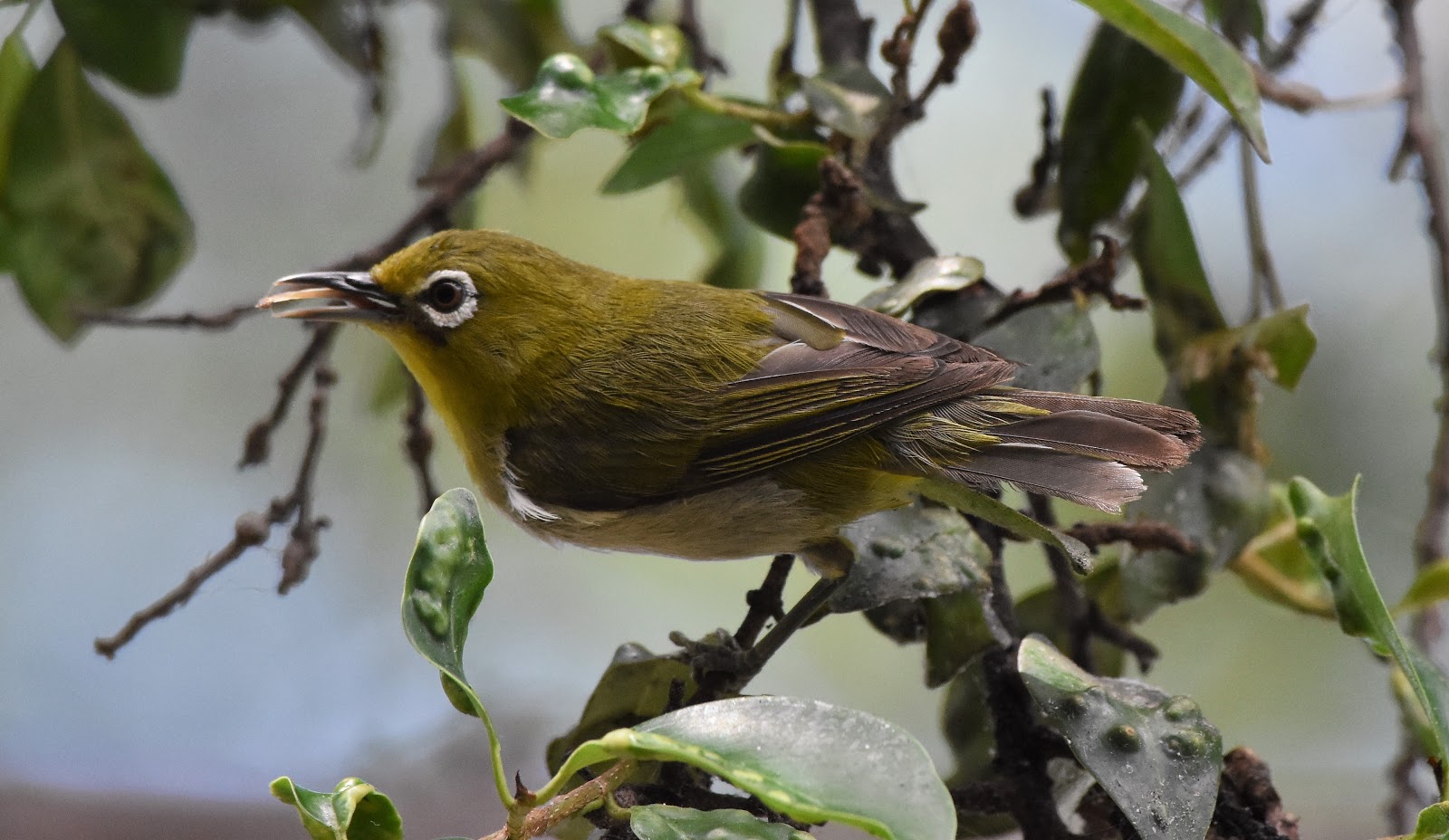
Japanese White-eye
A vacation wouldn't be complete without a traditional Hawaiian luau.  Micheal surprised me with a front row ticket to the stage.  It was a beautiful night along the ocean as we ate tradional food, like poi, and watched some amazing performances.  


In between everything, there were more exotic birds. The two of us would ask each other which part of the island we liked more.  There are SO many different habitats that it was hard to pick just one.  But overall, I liked the highland country where it was cool and misty.  On our way to Haleakala National Park, I fell in love with the grasslands.  Then again, I also loved West Maui along the beach. Or wait!  Maybe I liked the road to Hana more!  Yes, the names of the birds and places will have you puzzled as you try to twist your tongue around these foreign sounding words. 


We'd walk random paths and see random things.  I liked it.  Everything was VERY relaxed on this island.  The traffic wasn't an issue and the people were very kind.  

The mighty Isis rises from the ocean waves
If you ever felt that Cattle Egrets were hard to observe up close, don't worry......they are EVERYWHERE on this island and usually, just a few feet away from where you are standing. 


Cattle Egret
We went to the Nakalele blowhole on West Maui.  Be careful as people have died in this location.  We observed lots of tourists making poor decisions during our treks around the island.  


I laugh now wondering if I'd ever get to see a Common Myna in Hawaii.  I don't laugh anymore because this is an invasive bird.  But I couldn't hate the bird for being there.  They were introduced by people who were not educated and not aware of the fragile ecosystem of the islands.  This bird is only surviving like the human rats that cover this world.  It is as common as a Rock Pigeon, House Sparrow, Grackle, or American Crow. They are VERY smart birds.  I watched them maneuver around the unaware tourists who left their food unattended.  I got the sense that they are as smart or smarter than a jay, raven or gull.  I saw intelligence in their eyes like when I observe a raven or parrot looking at me. 

the very Common Myna
Hawaii is perfection in so many people's eyes.  And from the tourist point of view, it was.  I loved it.  I feel guilty for liking it so much.  This island was taken over by Polynesians, then Europeans and then the US.  It is a mix of EVERYONE.  Today, the atmosphere is inviting to all. When I put on my birder cap, you will see how my views change over the course of my three week write . I talked to people and did interviews with the nature conservancy and Hawaii Audubon Society about the endemic bird situation on the islands.  There are two fronts I'll tackle.  One is the sea bird population.  And the other will focus on the endemic honeycreepers that are found on the various islands.  I'll give you some tips about planning your birding treks there. 


On a personal note, it has been a year since my Grandma passed.  On this night at the luau, I thought about her and how much she would have loved this event.  This very iconic show is as cheesy as it is cool.  It reminded me of the movie Dirty Dancing where all the rich people got together and did rich people things. NOTE: I am not rich. I budget and don't have kids:) That last part of that sentence is the important one to note:) It reminded me of the stories my parents and grandparents used to tell me.  It's what people THINK Hawaii should be. And so it is for them.


 Micheal joked and said this was the Hawaiian version of William Shatner.  This guy was as cheesy as you can imagine, but somehow it was all fun.  I felt like I traced the footsteps of my Grandparents and partook in something that happened back in the 1950's.  They served us drinks the whole night and it was the most relaxing thing ever. I let the birder go for that evening and enjoyed the meal, the dances, the ocean breezes and spending important time with Micheal.  I think it's a great way to cap off your final evening in Hawaii.

Fire dancers!
And we can't forget those dancers!  Wow!  It was hot!  Literally, being up front next to the stage of these fire dancers was.....hot!


In the background, the Common Mynas were watching and waiting for an opportunity to sneak some of the food. Some succeeded.  


Here's my birder take on my first trip to the islands.  Like a surfer, it takes practice to understand how the birding world flows.  In Trinidad, I conquered the birds.  On Maui, I "failed" my first time and within reason.  I picked up all of the birds except TWO very rare ones.  It's not really a failure but I don't like dipping on endemics in isolated areas.  It means I'll have to go back to Maui for only one day to pick up these very endangered birds which pains me. There's not enough time in this life to retrace footsteps. The next time I go, they may be extinct. They are well protected as they should be.  It was out of my control so I did the best I could.

Grey Francolin, one of the more challenging birds to approach
Most of the time, I find my birds alone or with friends.  But with Hawaiian birding, you can't do this alone, you need to work with several agencies to accomplish your goals.  And like the surfer below, I stumbled. 


But I will not stumble again on my next trip back.  I will be better prepared. Over the next 3 weeks, I'll break down what I saw in great detail.  Hawaii may be paradise for humans, but for its endemic birds, the story is a dark and complicated one. 


"Mahalo" for following Las Aventuras.  Until next week my friends!