Friday, March 23, 2018

The Maze


Birds are everywhere, you just have to be open to seeing them. 
There are sacred moments in this life.  There are moments I share with friends and family.  And there are moments when all I want to do is just throw myself into a completely new experience alone.  And that is what I did.  


Over the past several years, I had been working on this project to go back to Mexico and do some of my own work. But I hit a snag.  I realized that I couldn't do it alone because it was too dangerous.  Having lived in Mexico City, I realized that there was no way I could carry around my camera without the threat of it getting stolen.  I was particularly interested in one endemic sparrow. So what to do?


Black-polled Yellowthroat
There were several issues I had to consider.  One.  The endangered Sierra Madre Sparrow is located in a very difficult area that is known for crime. It was not a place I wanted to go alone with my equipment. Plus, it's not even in a tourist area for me to easily visit. I swore to myself that I would never drive in Mexico City ever! This is where I needed a person who knew the area well for safe observations. I have taken people around Mexico City to visit the sites, but never to remote birding spots! Two. I had never hired a personal guide before. What was it like? I pride myself on finding my own birds by myself or with friends.  And three. What I wanted to do required a lot of travel between places.  There was NO WAY I could get to them all in one day or over several days! Enter Rafa Calderon. 


At the Mexico City airport from my hotel Camino Real
This post is titled, "The Maze" for a reason.  To do what we did in a day would have been otherwise impossible.  To safely go from one ebird hotspot to another in the big city required the help of an amazing guide by the name of Rafa Calderon and driver(and birder), Gerardo Aguilar Anzures.  The moment I met both of them, I knew we were going to have a great day.  And here's the thing.  I didn't want the day to end. As quickly as it started, it was over.  It was a great experience. I guide all the time, but I just didn't realize how important our work was until I became a participant myself.  Now I completely get it.  I just thought having a guide was like cheating, but it's not.  You still do the work, but you can do it comfortably with the person who knows their birds best.  Plus, I gained a whole lot of information about the area that I otherwise would not have known.  It wasn't just about the birds. And now I know that my guiding is seen in the same light and that it has value. All I can say is that I'll do this again.  It was such a positive experience.  I get it now. I really do. 


Beautiful sunrise at the Lerma Sanctuary for the Black-polled Yellowthroat
This trek was about visiting my Mexican family and setting up connections in the Mexican state of Tlaxcala. Plus I needed to brush up on my Spanish.  The funny part was that we'd speak in Spanish and then while I was birding, I'd flip into English analyzing data and sounds. On a side note, Rafa speaks English very well. I listened to both Rafa and Gerardo discuss the birds using their scientific names instead of the more common names we have in English.  The reason for that?  Every Spanish speaking country uses different names for the same bird and it can be confusing. It was all latin to me:) How they keep it all straight is beyond me?!  It's hard enough remembering the English names. Anyhow, I collected a lot of sound recordings from our new bird finds.  Now let's get started....


There were two extremely important birds that I needed to find around the Mexico City area.  They are endangered birds and restricted to a very tight habitat range.  The first of our searches would begin in the protected sanctuary of the Lerma marshes near the town of Toluca.  Rafa picked me up at my hotel near the airport and we were off! I really don't know how I would have found this place on my own.  There were a lot of twists and turns on the highways.  It isn't a place an outsider can get to easily, but once we were there, wow!


Starting this past October, I began studying Mexico's yellowthroat species.  They are fascinating.  So our agenda had both yellowthroats included on our list of "priority" birds.  Our first yellowthroat was the beautiful Black-polled Yellowthroat. 


It wasn't hard to locate, but like most Yellowthroats, it was difficult to get photos. This bird is a Mexican endemic and is listed as endangered due to habitat loss. 


March is a good time of year to see these birds as they are vocalizing during their breeding season and feeding up around the cattails. 


This is one of the easiest yellowthroats to ID thanks to that nice black cap on the head.  


While we there, we had nice ongoing looks at this bird.  There were many pairs vocalizing and singing throughout the marshes. 


As with everything, my agenda dictated our next stop and it was time to go for our next bird, the Hooded Yellowthroat.  


Just a part of the UNAM campus
 Back into the maze we went, this time with more traffic.  Gerardo zipped in and out of lines of cars like a pro.  Our next stop was UNAM in Mexico City.  

Hooded Yellowthroat
The campus was gorgeous and maintains a historic patch of vegetation that covers a large area.  The birding was amazing here.  We found our Hooded Yellowthroats with a little bit more effort. These guys look like Common Yellowthroats except that they have a gray hood on top of their head.  There were other birds that I had seen before but wanted to observe better like the Cinnamon-bellied Flowerpiercer and Berylline Hummingbirds. We had great views and then to save time we took off again into the Maze. 


Now the traffic was in full force, but we made it to the area that we would bird for a good part of the afternoon.  We arrived to the scrubby and grassy area known for the endangered Sierra Madre Sparrows.  There are two great spots for observing this sparrow, but one spot was better for safety reasons.  Rafa explained to me that they are working with the locals to preserve this area, but some of the locals believe that they can get more money out of birders coming into the area hoping to find the bird.  There is a parking lot where birders can leave their vehicles, but if you're not close to the vehicle, it can get broken into by thieves. So if you're a little more adventurous to do this on your own, don't lose sight of your rental!

El Parque Las Maravillas.  Rafa listens for the Sierra Madre Sparrow
 The safer alternative is to park inside the Las Maravillas Park where there are people attending to the entrance. I paid our small fee and then we entered the gates. We left our vehicle and began to explore. Rafa explained to me that this is an area that birders should always visit in pairs or small groups. He doesn't come to this spot alone, even if it is the safer alternative. It looked safe, but appearances can be deceiving.  All I know is that I felt safe because we were together and it made the birding comfortable.  Then, I heard sparrows!!!!  We had our first glimpse at one as it flew in front of us.  It's tail was slightly down like that of a Cassin's Sparrow in flight.  My heart started to beat.  Yes!  YES!  This bird was the main reason for this day to happen. 


As we walked around the area, we were careful not to step on any rattlesnakes, nesting grassland birds or dog poop. Gerardo called out to me in a hushed whisper, "¡Chris, ven para acá!

Sierra Madre Sparrow
One was sitting only a few feet from us!!!!!!! Like the feelings I had with the LeConte's Sparrow that came to visit us in Tucson last year, I had goosebumps up and down my arms. I was so happy! Observing an endangered bird is a special thing.  And I won't lie, sometimes I get a little emotional. I read about all these birds in texts and think to myself, how long will it be before they disappear?  How can we stop their extinction from happening?  Hopefully, it's not too late. To see something so rare and beautiful before our very eyes was incredible. Sometimes, you get a second.  Sometimes you have a little longer before the bird disappears. Thankfully, I had longer views as I was able to clearly ID all the field marks, recognize vocal call and flight patterns.  Yes. Birding is a drug and the adrenaline is real. 


Reluctantly, we had to move on.  Tick tock.  We hiked further along the road into a wooded area and found even MORE birds!!!


Lifer after lifer happened in this short period of time.  So many amazing birds every where.  Even ones I had seen before.  

Green-striped Brushfinch
I had researched well and knew what I could expect but when you're in the field, you forget the birds.  Thankfully, that's where Rafa helped out again.  He kept me on track with my list of birds that I needed for my life list.  The guy was amazing.  He pulled out his notebook and went over my notes.  I told him in the beginning of our day that I was guilty of lingering too long on birds and that I had a habit of not paying attention to the time.  He kept me on track and taught me a thing or two about his style of guiding.  I liked it very much and will incorporate some of his work into my own.  

Russet Nightingale-Thrush
Thankfully I already knew many of the birds in Central Mexico as they can also be found in Arizona.  However, I will say that there were many new ones sprinkled into the bunch that made it exciting.  Yet another lifer, the Striped Sparrow stole my heart.  This is a common bird and it was seen in good numbers throughout our day.  

Striped Sparrow
Our day ended with a bang. We stopped at a great local restaurant for lunch and had excellent tacos known as asesinas. There we spotted an Acorn Woodpecker while eating outside in the woods. Another exciting stretch of birding happened along a nasty gravel road. I don't know how we did it but we made a solitary forested rocky path into a two lane road at times. Old rusty trucks would come through the area and I'd swear that we'd all get stuck. But Gerardo was great. At one point, he had something dragging under his car after hitting a speed bump(tope) at full speed. The border between Morelos and Mexico state can be dangerous, but with the route we took, I felt fine. These two guys were great. We spoke about how a birder navegates through Mexico. Talk about an adventure! Again, I wouldn't go walking around this remote forest alone.  It was here that I had my best looks ever at Golden-browed Warblers.  This is the 4th observation I've had of this species, but most of the time, they are HIIIIIIIGH up in the dark canopy of a rain forest.  Here in Mexico, they came out just enough for us to get stunning views. 


Golden-browed Warbler
 But there is a rule in this unspoken birder's realm.  For one excellent observation, it must be replaced with a new crappy photo observation of a new lifebird. Photos are always a bonus but not required when spotting a new or previously seen bird. I was so excited about getting great photos of the Golden-browed Warblers. Then I remembered the rule and started laughing when I tried unsuccessfully to get pics of the blasted Colima Warbler.  That's the rule.  So I have come to accept that I saw a cool Colima Warbler and it's okay.  You win some and you lose some in the photography department.  


And so it would be.  The bird gods would grant me one great look at a Colima Warbler without good photos.  It would be my final lifer for the day.  Thanks to Rafa, I was able to add 10 new lifers to the list which included Aztec Rail, Black-polled and Hooded Yellowthroats, Striped and Sierra Madre Sparrows, Russet Nightingale-Thrush, Rufous-capped and Green-striped Brushfinches, and Colima and Red Warblers. If you need a guide for Mexico City, I highly recommend Rafa Calderon. He's in the same boat as I am. Works during the week and does a day of birding on the weekend with other people. I also want to thank Scott Olmstead for recommending him.  You can do a half day or a full day with Rafa.  There are several guides that will do two days and one night in his birding crew for the owls, etc. As a person who has lived in Mexico City, I can tell you that it's an amazing place to visit(or live), but you have to be careful. Crime is no joke there. This trek was worth every peso!

A clever Colima Warbler
In this 3 part blog series, we'll visit some very dear friends who I consider to be my second family. I'll show you how you can bird and make a difference wherever you travel.  We'll also explore a restricted area in one of Mexico's most beautiful forests between the states of Tlaxcala and Puebla. I'll share with you some tips on how you can safely bird in a country like Mexico or Guatemala where the birding infrastructure is different from that of places like Costa Rica, Panama, Peru or Ecuador.  For now, here are the lists from our fantastic journey around Mexico City. Until next time.....

For the rare Black-polled Yellowthroat, click here.
For the visit to the safe UNAM campus, click here.  
For the report of the Sierra Madre Sparrow, click here. 
For the Golden-browed and Colima Warblers, click here. 

Thursday, March 15, 2018

¡Qué Locura!

A Raccoon is exposed!
These past few weeks have been a crazy time for me.  I've been out with family, friends and clients while trying to maintain my sanity at work.  And I found myself too tired to write. 

Twilight at Columbus Park in Tucson
My only personal birding happened after work for several days along the Santa Cruz river corridor in Tucson with the hope that I would spot at least one Common Black Hawk for my Pima County list. They are coming through the area right now in good numbers. Best time to see them is in the morning and late afternoon when they take off/land. No luck yet but I still hold hope. 

Sora

Meanwhile they did their yearly burn at the Sweetwater Wetlands. After the burn, it's an excellent time to spot birds like the Virginia Rail or Sora. And maybe a racoon. Or two. Or three....:)


And honestly.  I have been more into the hiking around our mountains.  It isn't uncommon to do a 5 or 10 mile hike on the weekend.  The views are stunning!

Viewing the beautiful riparian area of Madera Canyon from the trails above
So while out on some of those trails, I did some guiding for people looking for some rare birds.  I've seen the birds many times below, but my guests have not so it was all about them getting the nice shots.  And that's how it has been for me.  It's more about the search lately and not about getting the best pic.


Rare birds are everywhere.  You just need to know where to look.  Left to Right, Cassin's Finch, Painted Redstart, Elegant Trogon, Rufous Hummingbird, Steller's Jay, Rufous-backed Robin, Sinaloa Wren, Lincoln's Sparrow, juvenile Bald Eagle
I enjoy seeing the smiles as they discover their first lifers.

A vocal Canyon Wren

At another level, I'm planning for a very tricky adventure in a few days.  Normally chasing birds isn't too difficult on your own, but there are a few locations around the world that require me to be careful and hire help. 

Pied-billed Grebe
I look forward to the challenges ahead.  It has turned out to be a year of unexpected surprises.  While it has been "slow" for the state list, it has been, so far, a solid regular year for visitors to find some of Arizona's specialty birds.


Snow Goose
I monitor parks, hawk migration, etc and I keep finding cool birds that are rare for those locations which has been exciting.


Red-tailed Hawk
My life has been changing.  My transition from education into the birding world has been flawless and maybe a little ahead of schedule.  I am ready to be a full time guide but I can't. Not yet. The early days of birding were so much fun.  While birding is still fun, it has turned into theory and detective work which ultimately has changed the free spirited nature of the activity. To stay on top of my game and help others, I have to research out in the field.  And some birds I know better than others.


Broad-billed Hummingbird
I find that I am exhausted much of the time by living two completely different lives. Mondays are my worst days because I don't recharge on Sunday like I should.  I feel the most alive when I am on the trails.  Then when I'm in the real world, I feel like a robot living a life of routine.  Maybe that's what has kept me grounded.

Mexican Jay
Either way, it's not a complaint. Today, so many options have unexpectedly opened up for me and I can say that I am now ready to "be the change I wish to see in this world." It has, however, taken me several years to get to this point in my life.

Wild Turkey
I continue monitoring and researching critically endangered birds around the world.  Some are making a comeback.  Others are not.  This weekend, I found out that the White-backed Vulture below used in a raptor education program at the Arizona Renaissance Faire is needed for an important breeding program in the US. Their numbers in the wild have plummeted this year to alarming numbers.  Seeing a wild bird is an incredible thing.  To see it at a show in an educational setting is cool, but it's not the same thing.  And to know that a rescued bird in this educational setting was recalled back for an emergency repopulation attempt makes me sad. The good news is that this vulture has successfully nested with his mate this year.

White-backed Vulture taken back in 2013
Finally, this week, I had a smile.  Apparently I have been sharing a lot of my anger towards vaping and drugs on campus.  Several students put this poster together and gave me a smile.  Maybe they are listening.  I hope they are listening. I may be hard on them, but I want what's best for them because I care.


What is Juuling?  It's another way of vaping nicotine or marijuana.
I'll be on the road this Friday and will hopefully have some exciting news for you all when I get back from my trip.  There is a certain sparrow I am looking for....and it's endangered. Until next time.....

Thursday, March 1, 2018

The Transitional Slide

Northern Cardinals sing their hearts out this time of year to attract a mate
As winter fades into spring, the wintering birds begin their migration.

White-crowned Sparrow
February in Arizona is relatively a quiet time in the birding world.  Some rarities show up, but overall, it's a great month to catch up on yearly ticks in a relaxing manner.

The San Francisco Peaks
This year, so far, has been great for early hummers.

Anna's Hummingbird
During our trek out to the Desert Museum, we find several Costa's Hummingbirds actively feeding around the gardens.

Costa's Hummingbird
Their brilliant purple dazzles the naked eye.


But even rarer?  A male Allen's Hummingbird is hanging out with the Costa's in the area.

A rare male Allen's Hummingbird
February, March and April are busy times for bird guides.  While I am not an official bird guide, I find myself with many birders needing our Arizona specialties.  It's fun.  I meet new people and I get to watch their reactions to their "new" birds. One day, I'll be able to guide full time, but for now, it's stick to the program:)


During a tour to the Heard Museum, I found this Native American painting.  It accurately depicts a Great Horned Owl's preference for skunk. I imagine the meat is quite aromatic.

Verdin
With my parents at Boyce Thompson Arboretum, we notice Verdins and feeding Anna's Hummingbirds.


At the Desert Museum outside of Tucson, my parents admire the unique looking cacti and succulents.


While we visit all these amazing places, I stop and count birds whenever I can.


At one location, I discover a rare White-throated Sparrow.

rare White-throated Sparrow
At Saguaro National Park, we admire the moon in the background of a beautiful Saguaro.


This is the time of year when I begin to question why I'm sitting on my butt instead of chasing life birds.  Well, soon.  Very soon I'll be taking you all to a special place in search of several special birds while visiting with friends.  For now, I sit at a holding pattern. Until next time....

Tuesday, February 13, 2018

For The Journeys Ahead

Northern Harrier
Sometimes we wait in a holding pattern.  But it's the anticipation of the next big adventure that excites the imagination. 

The Knob Hill Fire burns in the Dragoon Mountains
In the meantime, I scout areas and collect data for several birders who will be coming to Southern Arizona for their own adventures.  They too are excited about finding new birds to add to their life lists. It's a job I take seriously.  

Sandhill Crane comes in for a landing. 
The winter months are the only times we are able to observe certain birds.  Every year, I head down to Willcox and Cochise Lake to be among the Sandhill Cranes.  Everyone says to go to the Whitewater Draw.  I love it there too, but it's not the same as Willcox.  If you are a photographer, you head to Willcox.  The birds fly right over your head and land just a few feet away.  It's pretty spiritual. 


Our wildfire season is early this year.  Fire started this weekend on private property and spread over 2 thousand acres on the Dragoon Mountains. While observing the cranes, we watched the fire spread over a section of the mountain.  


Another fun challenge was finding ONE Eurasian Wigeon in the near thousand population of American Wigeons. 

American Wigeons
Can you find the bird?:)

A Eurasian Wigeon
I have written this before and I'll write it again.  I wish I could bird in this weather all the time. It was comfortable.  


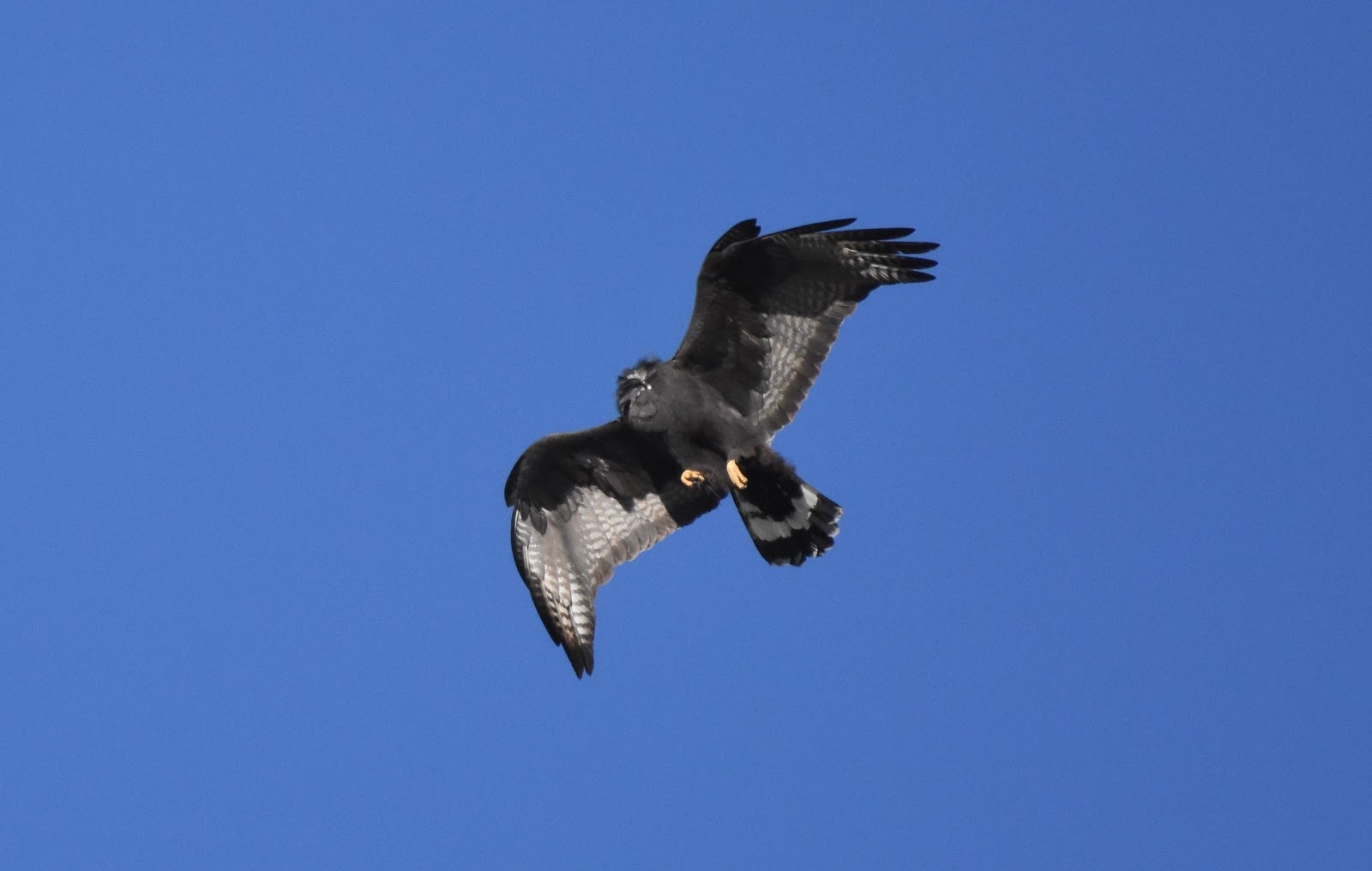
On my weekly observation at Reid Park in Tucson, I watched our beautiful wintering Zone-tailed Hawk take flight and stay in the air for nearly 2 hours!  Often it flew right over my head looking for prey. Other times it looked like it just wanted to fly for enjoyment. 

Zone-tailed Hawk
During one moment, I thought the bird had lost its head. 


However, the hawk was just preening.  This is the second observation that I've seen of this species preening in flight. This bird is an acrobat!


On another outing during the week day, I just wanted to bird in a different location.  So I went to Agua Caliente Park for an evening count. 

Agua Caliente Park
I hadn't researched this location.  I just wanted to bird.  Birding keeps my skills sharp for the people who rely on me to find their birds.  Maybe you've noticed this about yourself with certain species of birds?  I tend to glance over some species while with others, I look at more closely.  Such is the case with sparrows. My gaze lingers a little longer with these bubbly happy-go-lucky birds. 

a beautiful Swamp Sparrow
I enjoy sparrows.  I don't know why. Most people don't get into these birds but I could spend hours watching them hop around bushes.  During that evening, there were a couple Lincoln's Sparrows in the area and I was enjoying their fine plumage design when I noticed this Swamp Sparrow(above and below) next to them!  Wow!  It's a rare bird for Pima County in the winter, but it was a most welcome sight!


We went on other adventures, mostly for the walk.  I just needed to bird pretty spaces after those past couple weekends of gross agricultural habitat.  It was really really nice. 

We take a lovely stroll in Ramsey Canyon of the Huachuca Mountains
While up on Mt. Lemmon, I met two people who signed up for our trip with Tucson Audubon to the Huachucas in August.  I had a blast getting to know them and we had a great time finding birds. It was fun hearing their excitement as I got them on great birds. My reports are below. 

Northern Flicker
This year's theme is all about family and friends in other places.  I am working on one trip now and looking forward to the challenges ahead.  While I wait, I will continue to count birds around the state.  I try to balance it all out. People in my life will sometimes say, "I wish I could travel like you do."  A lot of them could, but often it seems like it's outside of their personal comfort zones. I've just made it a personal mandate.  I've earned it.  There's no looking back.  Only forward.  You only get one life.  Own it and find happiness.  Until next time.....

For Agua Caliente Park, click here. 
For Willcox Lake, click here. 
For Mt. Lemmon, click here. 
For Reid Park, click here.