Showing posts with label Northern Flicker. Show all posts

Tuesday, February 13, 2018

For The Journeys Ahead

Northern Harrier
Sometimes we wait in a holding pattern.  But it's the anticipation of the next big adventure that excites the imagination. 

The Knob Hill Fire burns in the Dragoon Mountains
In the meantime, I scout areas and collect data for several birders who will be coming to Southern Arizona for their own adventures.  They too are excited about finding new birds to add to their life lists. It's a job I take seriously.  

Sandhill Crane comes in for a landing. 
The winter months are the only times we are able to observe certain birds.  Every year, I head down to Willcox and Cochise Lake to be among the Sandhill Cranes.  Everyone says to go to the Whitewater Draw.  I love it there too, but it's not the same as Willcox.  If you are a photographer, you head to Willcox.  The birds fly right over your head and land just a few feet away.  It's pretty spiritual. 


Our wildfire season is early this year.  Fire started this weekend on private property and spread over 2 thousand acres on the Dragoon Mountains. While observing the cranes, we watched the fire spread over a section of the mountain.  


Another fun challenge was finding ONE Eurasian Wigeon in the near thousand population of American Wigeons. 

American Wigeons
Can you find the bird?:)

A Eurasian Wigeon
I have written this before and I'll write it again.  I wish I could bird in this weather all the time. It was comfortable.  


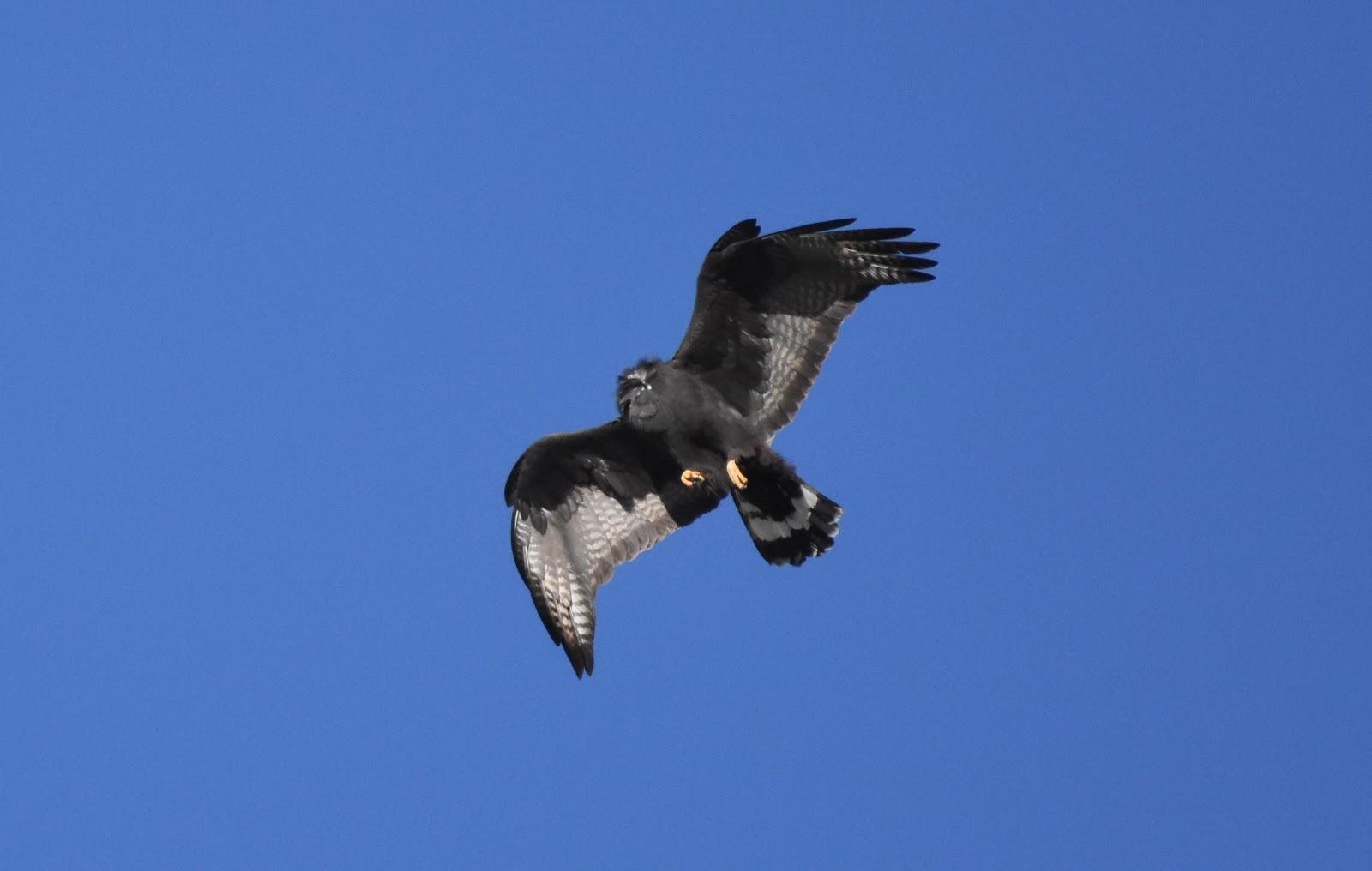
On my weekly observation at Reid Park in Tucson, I watched our beautiful wintering Zone-tailed Hawk take flight and stay in the air for nearly 2 hours!  Often it flew right over my head looking for prey. Other times it looked like it just wanted to fly for enjoyment. 

Zone-tailed Hawk
During one moment, I thought the bird had lost its head. 


However, the hawk was just preening.  This is the second observation that I've seen of this species preening in flight. This bird is an acrobat!


On another outing during the week day, I just wanted to bird in a different location.  So I went to Agua Caliente Park for an evening count. 

Agua Caliente Park
I hadn't researched this location.  I just wanted to bird.  Birding keeps my skills sharp for the people who rely on me to find their birds.  Maybe you've noticed this about yourself with certain species of birds?  I tend to glance over some species while with others, I look at more closely.  Such is the case with sparrows. My gaze lingers a little longer with these bubbly happy-go-lucky birds. 

a beautiful Swamp Sparrow
I enjoy sparrows.  I don't know why. Most people don't get into these birds but I could spend hours watching them hop around bushes.  During that evening, there were a couple Lincoln's Sparrows in the area and I was enjoying their fine plumage design when I noticed this Swamp Sparrow(above and below) next to them!  Wow!  It's a rare bird for Pima County in the winter, but it was a most welcome sight!


We went on other adventures, mostly for the walk.  I just needed to bird pretty spaces after those past couple weekends of gross agricultural habitat.  It was really really nice. 

We take a lovely stroll in Ramsey Canyon of the Huachuca Mountains
While up on Mt. Lemmon, I met two people who signed up for our trip with Tucson Audubon to the Huachucas in August.  I had a blast getting to know them and we had a great time finding birds. It was fun hearing their excitement as I got them on great birds. My reports are below. 

Northern Flicker
This year's theme is all about family and friends in other places.  I am working on one trip now and looking forward to the challenges ahead.  While I wait, I will continue to count birds around the state.  I try to balance it all out. People in my life will sometimes say, "I wish I could travel like you do."  A lot of them could, but often it seems like it's outside of their personal comfort zones. I've just made it a personal mandate.  I've earned it.  There's no looking back.  Only forward.  You only get one life.  Own it and find happiness.  Until next time.....

For Agua Caliente Park, click here. 
For Willcox Lake, click here. 
For Mt. Lemmon, click here. 
For Reid Park, click here. 

Monday, November 20, 2017

Each And Every Day

A Northern Flicker feeds from a Hackberry Tree
With my professional lens back in hand, it was back on the trails trying to recapture pics of birds I had seen last weekend. 

It's hunting season and Micheal is letting this Mule Deer to hide better
 However, we mixed it up a bit and stopped over at the Empire Gulch to see just how badly this past summer's fire damage had been. 

Loggerhead Shrike
 As with any fast spreading fire, it twirls and whirls around vegetation.  Some spaces are left unscathed while others are torched to the ground. It looks like the wintering birds don't mind.

A patch of towering Arizona Cottonwoods still stands, defiant of the fire
  Let me show you an example.  Here is a photo of the Empire Gulch before the fire a couple years ago during our yearly fundraising event(below).

It was a shaded forest.  After the fire, the sunlight has infiltrated the canopy of the riparian area
 The Empire Gulch is/was a migrant trap for many birds.  This is the "after photo" of the same magical space that is now changed. 

This ancient and magical Arizona Cottonwood is gone.  Even certain trees hold our hearts from over the years.  It was sad to see this beautiful tree gone.
This fire, caused by a border patrol agent target practicing during the driest part of the season, caused a massive grassland fire that destroyed homes and the very important Empire Gulch.  While wildfire is important to reinvigorate an area like the grasslands, it can also be devastating to riparian areas.  Unfortunately, this area will take years to return to its former glory.  And not all of the riparian area was affected (which is a good thing).  However, several of the HUGE and unique Arizona Cottonwoods are gone.  So while the grasslands truly benefited from the fire, the riparian area will take years to recover. Each of these habitats attract different birds. This gulch is important to our breeding summer birds like the Gray and Zone-tailed Hawks.

The mega rare Couch's Kingbird still hangs out at one of Tucson's local parks

 Back in town, I had to go back and get better photo documentation of the visiting Couch's Kingbird. 

Wilson's Snipe
 And also photos of one of my favorite species of bird, the Wilson's Snipe. They are beautiful shorebirds that often stay hidden in the grasses and mud clumps, but for some reason, these two birds didn't seem to mind being out in the open. 

Love is in the air between the two behind Micheal. They were the sweetest couple. 

We also explored a new place to catch a bite which is truly a wonderful piece of Americana. Micheal didn't want to go because it's a truck stop.  For years, people have been telling me about this place so finally, we made a stop at the Triple T Truck Stop at Omar's Hi-Way Chef Restaurant.  It. Was. Awesome.  If you're into people watching, this is the place. The food was great and cheap. And the service was fantastic.  

juvenile male Northern Pintail
I'm staying close to home so that I can spend more time with our Cassie.  And well, each day presents a new challenge.


I wish everyone celebrating Thanksgiving in and out of the US a wonderful start to the holiday season.
Until next time.....

Friday, September 15, 2017

The Catalina Highway


Sometimes you just have to get away.

Western Bluebird
I took a drive to the top of Mt. Lemmon on that Catalina Highway.

Turkey Vulture
For several early hours, I just took in the cooler temps and enjoyed feeling cold.


And while I stood alone in the forest.....


......I watched the birds actively feed all around me.

White-breasted Nuthatch
There were many young ones following their parents from branch to branch and from tree to tree.


Yellow-eyed Junco
The end of summer is near.  Soon the young ones will be leaving with their parents.

Western Wood-Pewee
Characters, like this Northern Flicker, may choose to winter on Mt. Lemmon over the winter OR head on down to the warmer temps of Tucson.

Northern Flicker
Others, like this Pygmy Nuthatch below, will remain here.

Pygmy Nuthatch
Hawks are moving through the area now. Many are heading south passing through the Catalinas.

Red-tailed Hawk
After this crazy summer, things are starting to get back to normal again. With temps cooling down below 100 degrees, I'm feeling my energy come back.  It's not easy getting trapped inside your home for more than a week over the course of 2 or 3 months. More adventures coming soon.....


Monday, July 25, 2016

Juvenile Boot Camp

Northern Flicker(Red-shafted)
Right now, up in the mountains, around the grasslands, hopping around the cacti and playing in the canyons, many Arizona fledglings are learning how to be birds. AND SURVIVE! Each species is unique when it comes time for raising their young ones. 


Yellow-eyed Junco just developing the yellow eye:)
Yellow-eyed Juncos work together as a team.  The young ones stick together and hunt along the ground for food.  

Olive Warbler
Olive Warblers learn how to fly for the first time as the parents lead them from branch to branch. Sometimes if they stray too far, they remind the little ones to return to their location. 

Red-faced Warbler
Young Red-faced Warblers are curious just like most juveniles of our planet's species (which includes our own).  Parent's keep a close eye on their young ones when a Cooper's Hawk or Steller's Jay gets too close. An alarm call goes out and parents will actively chase the predators away. 

Bushtit
The smaller birds, like this young Bushtit, try to figure out how to eat this ant.  It takes the bug and smacks it many times against the branch.  And then again and again until the bug is dead.  Many of his siblings are doing the same.  The parents know that with time and practice, they'll be pros. 


Some birds, like the Cordilleran Flycatcher, just sit on a branch and wait for Mom or Dad to come feed them. Then the parent's call their young one to fly to their new position where they'll feed them again. Clever flight training technique! 

Cordilleran Flycatcher
A young Bridled Titmouse tries to take down a very large moth that is much bigger than the bird.  It grabs the wing of the moth and the moth pulls the bird with it!  Once again, Mom and Dad save the day and help out!  

An older photo not taken from this photo shoot but one to help tell the story of the Bridled Titmouse
Young birds MUST learn quickly how to survive.  It's a do or die world out there in the land of Nature.  They face so many obstacles and as we observe these young birds, we hope they make it. Sometimes, it's heart breaking to observe a Steller's Jay take down a young Dark-eyed Junco while the parents helplessly scream and attack the Jay. But we understand that the Jay is also part of the world and needs to survive. 


Other times I am mortified by what I see. Here are some stock photos from a couple years ago.  I see babies jumping out of nests and parents and older siblings flocking around the predator to make sure the young ones survive.  Again, I do nothing in this case.  It's part of Nature.  

Pyrrhuloxia on high alert
 But when I see the young ones on the road where they can get run over by a car, I do assist because most headphone wielding joggers or drivers aren't paying attention to their surroundings. I block traffic and allow these young ones passage to the other side of the road where they will be safe.  


Mom is waiting with food once the young are off the road.  Dad and Uncle P are screaming at the snake while the fledglings bounce out of their nest onto the road. 
Anytime, humans are involved, I will break the Prime Directive of Birding and assist when needed.  They already have enough to worry about and don't need the human threat added. Fortunately, the Pyrrhuloxia story ended well.  As for the Coachwip(Red Racer) snake?  Well once the birds were off the road, I backed away carefully.  It's a beautiful snake but I've seen it get nasty with Herpers when they try to hold them.  That's why I don't hold snakes or lizards:)


We had a great time helping Jeff from Madison, WI find his lifers on Mt. Lemmon.  And while he found his lifers, we observed some amazing parent/fledgling activity. Every time I go out into the field, there is ALWAYS something new and different happening. 


Life is good.  Until next time.......