Thursday, August 13, 2015

Sumidero Canyon


We woke up the next day.  No tour bus.  No guide.  Just us. And it felt good.  We could go and explore on our own and at our own pace. The 5 days of tours were brutally intense.  Now it was time to slow down. Or at least that's what my body was telling me. 


We kept it local and returned back to Sumidero Canyon.  Once again, we strapped on our water packs and began the hike into the clouds and canyon. 


Lesser Roadrunner
 One of the target birds that we missed from our treks was the Lesser Roadrunner.  Here in Arizona, we have the Greater Roadrunner.  We couldn't leave Chiapas without spotting one of the "Lessers".  As we walked further up the road, the mist let up some.  It was enough to allow us a brief glance at a "hazy-what-looked-like-a-roadrunner on the road" creature.  Gordon became excited and said, "That's a roadrunner!  I know it is!"  


I'm like, "Yeah right Gordon. And monkeys fly out of my butt.":)  Note to self.  I need a shave badly!"
And me?  I was skeptical.  I had heard that this bird was real but I didn't believe it.  When I saw the bird, I thought, "It can't be. Therefore, it isn't:)" We hurriedly moved forward.  The heavy mist took over and the bird disappeared. WHAT IS IT WITH THIS WEATHER AND NEW BIRDS!!!???? There are no such things as Unicorns.  And there are no such things as Lesser Roadrunners. Then the cloud lifted and all was revealed.  


In true Mexican fashion, it was like witnessing the Virgin of Guadalupe opening her cape with hundreds of roses falling about her.  But in our case, this was real! I do believe in Roadrunners!  I do believe in Roadrunners!  Beep beep!

juvenile Rusty Sparrow
 Then we had a visit from a Rusty Sparrow!  This made us scratch our heads because it wasn't like the ones we had observed on our trips.  Come to find out.  This was a juvenile.  Awesome!

Gray-crowned Yellowthroat
 And the clouds got thicker and thicker making the birding a real challenge!


This Ent almost pulled Gordon under:)  But in reality, it's a beautiful Amate Fig tree with a nice looking root system
I never miss home while I'm traveling, but I guess if I did miss something it would have to be the lighting conditions.  Everyday is practically a nice day in Arizona.  And the birds seem much more cooperative than these neotropical ones. 

Streak-backed Oriole
Take for example this Streak-backed Oriole.  Why in the world does it only pop out for pics in cloudy conditions?  Don't they know we are only there for a short amount of time?  Apparently they didn't get the memo:) 


This pic above is really great.*cough*cough* Some of my best work.  Ever.  We finally have the Oriole sitting on a branch in full cloud "lighting" and I know the pictures will not turn out very well.  In my mind just like my father does during those trying moments, I begin humming that tune by Colbie Caillat, "All you have to do is try try try....."  


As we continued our walk, Plain Chachalacas flew or hopped from branch to branch.  The jays were active.  And so was the Ferruginous Pygmy-Owl calling. 

White-throated Magpie Jay
As we ended our trek, I noticed something positive happening near the roadside of Sumidero Canyon. 


Along the way, we noticed how many homes were built close to the road of this "protected" area. It was definitely a poor neighborhood. And it got me thinking a random thought.  In the US, most people with money want their places along the edges of parks etc.  But here in Mexico, it's usually the opposite. Why?  Poverty.  Cut wood for fuel.  Poach animals for food. Raise crops on the areas you just cut down, etc etc.  Most of the hill was bare thanks to obvious clear cutting. 


It is unclear to me whether this happened before the park was put into a protective status or after, but we did witness something positive.  I will end here on this note.  As a teacher, I am happy to report that there was a program teaching kids about planting trees. Good for them! And great for the park! Hopefully in 10 years, the hillside will have a new forest instead of grass. If we don't teach our young about protecting our planet now, we will be in very bad shape down the road. 


So while I was writing this post, I thought about what people might be asking as they read it.  And I think I have it figured out.  The question that came to me was....."What is the difference between a Greater and Lesser Roadrunner?"  Here's a pic comparing the two species. 


Top: Greater Roadrunner Bottom: Lesser Roadrunner
And finally.  This month you can find my work in the latest August edition of Watching Backyard Birds. This is from the publishers of Bird Watcher's Digest.  It was a fun experience putting everything together.  So a big THANK YOU to Dawn Hewitt and team.  If you are paperless, you will find that they have a free online preview of this edition to check out. 


Until next time friends.....

Wednesday, August 12, 2015

GIANT Expectations

White-nose Coati at Zoomat
After a long stressful week of intense birding, we ended it all with the Wonder Team, Matt Hale and Francesca Albini.  They worked so well together that I had thought they were married! Their amazing teamwork made the last day very special.  


Matt sets up the scope to begin the search for buntings
Out of the 10 participants scheduled, 4 of us remained.  It was by far the easiest and best day for birding and photography.  I had been looking forward to this day since we arrived.  Why?  Well, I have never birded the Pacific Lowlands before.  And even though there were birds I had already observed, I wanted to see them again!  It was a magical day out for our group.  The heat was oppressive but the birding and crew were some of the finest!


We spot our first White-nosed Coati in the wild.  There are several in the background. 
We headed into the protected Sepultura Reserve which is southwest of Tuxtla Gutierrez.  And then, the show began. White-nosed Coati walked out on the limbs of trees.


White-throated Magpie Jay
At sunrise, we stopped at a great overlook area with a beautiful view of protected rain forest that went as far as the eyes could see.  A gentle breeze blew through the canyon. I also saw dinosaurs, but I'm keeping their gps location secret.  However, I will report some very special bird sightings.....:)


La Sepultura at dawn
Even in the darkness, I could make out something blue and pink flitting around the leafy canopy. Francesca silently moved towards the bird and pointed.  Matt directed the scope towards her aim.  And then.....


The majestic male Rose-bellied Bunting(formerly named Rosita's bunting) made an appearance!  People just dropped their jaws and uttered things like "WHOA!", "That is one beautiful bird.", "#%^!", or "My milkshake brings all the boys to the yard, and they're like..." Just kidding on that last part. It was a real make out session with this bunting. 

Rose-bellied Bunting(formerly called the Rosita's Bunting)
I wished this moment would last forever.  Gorgeous weather.  Beautiful views.  Fascinating wildlife. And wonderful people. Yeah, I'd like to write, "Perfect moment."  There.  I just did it:)


But it wasn't just enough to find one group of gorgeous buntings.  We had to find ANOTHER!  Both were in the same area.  As a birder, I can tell you that I've never had a "Bunting Day" like this one.  We went down the slope further and there, from within the forest, a gorgeous Orange-breasted Bunting appeared. 

Orange-breasted Bunting
As a child growing up, these bunting's colors were my personal favorites.  And if I had to choose between the two, I think I like the color scheme better on this one.  But it's a hard call.  Both were very beautiful birds. 

Great Egret
I knew water was near when the group had an unexpected flyover by a Great Egret. It just came out of nowhere.  But it was hanging out somewhere, I imagine, near a hidden stream. 

Bare-throated tiger heron
As we moved further down into the lowlands, I could feel the steamy oppressive heat that made many locals shed their clothes.  My skin had a beautiful shine to it from all the sweat.  I engaged my "water pack". As an Arizonan, I am familiar with this nasty type of heat.  Me and the Gordon filled up our packs with ice in the morning and were refreshed the entire trip.  I'm glad we brought our camel packs with us on this trek.  It felt good observing awesome birds without feeling heat exhaustion. Ice and a water pack. They are the answer to all of your hot travel woes my friends. 


We stopped at a local pond and had the most amazing show of birds and reptiles. 

Ruddy-breasted Seedeater

There were so many awesome birds in one spot that it made it difficult to focus. It was a bird bonanza and we stayed here for a long time soaking up all the incredible that was this pond.  Rose-throated Becards, Ruddy-breasted seedeaters, Groove-billed Ani's, Crested Caracaras, and Northern Jaçanas.  Finally, I got my answer to how one pronounces this last bird's name.  I always pronounced the word in Spanish as Ha-Ka-Na.  But Mr. Matt said it was a Portuguese word and that would mean it was pronounced Ja-Sa-Nah. 


Of course, life would not be complete without a gnatcatcher sighting.  They are another favorite of mine. 

White-lored Gnatcatcher
No such thing as Mallards down there.  I put one into ebird just for fun to see if the bird was rare.  And indeed it was!  So who was the duck-of-the-day?  Well, the Black-bellied whistling duck took their place:) Not a bad duck to see over and over again:)


Black-bellied whistling ducks with Bare-throated tiger heron
We had a couple of friendly local people warn us not to get into the water because there was a family of caiman swimming around the pond.  I would never enter any water near mangrove areas because I learned the hard way in Panama, thanks to Tito, a Saltwater Croc, who decided to interrupt my birding session on the beach.  That's when I learned that there were bigger reptiles out there who wouldn't mind the taste of "gringo". 

Gordon could've taken this caiman on:) 
In time, I knew I would eventually see the Ferruginous Pygmy-Owl.  They barely make it into Southern Arizona and the ones that do are kept secret.  This owl is considered rare in our state and is protected by law.  I know a couple sites but they are located in several sketchy areas that are several hours away from Tucson.  For now, our sightings of this bird in Chiapas will suffice. 

Ferruginous Pygmy-Owl
Finally today, I'd like to introduce the bird that brought us here on this trek, the Giant Wren.  It is a large and spectacular wren that is endemic(there's that word again) to this region. 

Giant Wrens
Eventually it was time to turn around and go back home.  I didn't want to return.  I wanted to stay in Puerto Arista and see the estuary that had Roseate Spoonbills, Magnificent Frigatebirds, Tricolored Herons, Wood Storks, etc flying over the waterways.  It. Was. Incredible. 


Wood Stork
While not the greatest collage I've put together, here's a Magnificent Frigatebird going after a Great Egret for dinner.  The bird is trying to get the Egret to spit out or vomit whatever it has in its' gullet. They are known as the pirates of the sea. Sorry about writing the word "vomit".  It sounds vile, but the Magnificent Frigatebird loves it:)


Unfortunately, this day had to come to a close, but there were still many adventures ahead for us that we would take on our own.  As the group tours ended, we took to the trails ourselves and came up with some great birds on our last two days.  Stay tuned for more. 

Monday, August 10, 2015

Vanishing Lands

Will this road into a protected reserve be a blessing or a curse?
The whole purpose of my trip to Chiapas was centered around our El Ocote trek.  There were several birds endemic only to a small region of Mexico and two of them were on this day trip.  During our time out in the field, I'd hear many people use the word endemic(specific to one area/location).  There was "endemic" as in the "regions between Guatemala and Mexico".  And then there was "ENDEMIC" meaning only found in a narrow band within a small part of Mexico.  Two birds, the Nava's Wren and Long-tailed Sabrewing, were the main reasons I returned back to Mexico.  I needed help finding the Nava's Wren.


I have several strategies I utilize when birding new areas.  1. Research my area for endemic birds like the Florida Scrub-Jay in.....Florida:) And 2. Find them first.  Everything else will fall into place. The endemic species on our planet really face an uphill battle.  And like the Florida Scrub-Jay, these birds could face extinction within the near future due to habitat loss and fragmentation of their habitat. This fragmentation can lead to the birds being "trapped" and confined within one area where they won't be able to breed with other populations. The good news is that there are people listening and work is being done to protect some of these areas like the Ocote region.   But just how well protected are these "biospheres"?

White-winged Tanager
And this got me thinking at a very deep level.  Why are we, as people, allowing greed and capitalism to destroy these incredibly beautiful areas?  It would be easy to blame Mexico for their semi protected wildlife nature reserves.  We found bananas growing in the middle of the forest.  There's a road cut through this mountain range that they are planning to make into a highway.  This highway cuts into the very endangered Nava's Wren territory.  They breed and nest within limestone caves(some along the road) and like many birds, they prefer to remain secretive in the dark forests within this very specific habitat. My experiences abroad have shown me that highways allow people access into these areas so that they can slash and burn the intact forest.  And along with the wood material/farming/cattle land that comes from this act, they will also poach the creatures that live in these protected areas. I could shake my finger at Mexico for being reckless. 

Stripe-throated Hermit
But it isn't just Mexico is it?  It's here in the US, Great Britain, Australia, Nicaragua and pretty much happening all over this planet. Who am I to judge Mexico when we have a mining operation attempting to infiltrate our sacred Santa Rita mountains here in Southern Arizona?  Or the suburb with an Italian flare that will take MORE water from what's left of our precious San Pedro river near Sierra Vista! And while in Mexico, I heard talk of a canal going into Nicaragua that was secretly passed by their President.  Apparently China is paying for the construction and it has already begun.  This would cut into Lake Nicaragua and across large tracts of pristine forest while dislocating thousands of indigenous people.  Ecosystems are in jeopardy. The lake is freshwater and obviously the ocean is not. And with China basically running the canal, I see lots of terrible things happening. Nicaragua doesn't have the money or resources to clean up natural disasters and yet, they are agreeing to put this canal into THEIR country.


When we visit these very special places, I try to memorize every little detail because I know it will change.  The deeper into the life bird realm you go, the more you discover about the world around you.  I am an observer. When I chose this life several years ago, I realized that I could one day face the inevitable  possibility of a bird going extinct from my life list. There is profound sadness in that realization.  Today's trek was a mixed bag of the good and bad. 

Long-tailed Sabrewing
The weather conditions were again not so great on this morning so my pictures are not as crisp as I'd like them to be.  Our first special bird of the day was the Long-tailed Sabrewing.  I was glad to have Martin with us on this trek.  He was a book of knowledge and experience.  Again I learned lots from this wonderful man. 


Slate-colored Solitaire
The Long-tailed Sabrewing is an endangered bird found naturally around the Isthmus of Tehuantepecin of southeastern Mexico around the states of Veracruz, Oaxaca and west Chiapas(where we were). This bird's population numbers have been declining due to habitat destruction.  

Blue-black Grosbeak
We spent a good amount of time observing this bird feed from the Birds of Paradise in the area. Martin pulled out his scope and we all had great looks at this large sabrewing.  

Crimson-collared Tanager
As we continued on, the group noticed Bananaquits in the area.  I scratched my head for a moment before spotting a stretch of banana plants along the road.  Then it all made sense. This road is just the beginning of exploitation. 


On a positive note, the area was deemed as a protected space for our next bird, the Nava's Wren.  I enjoy hummingbirds like the next person, but wrens and sparrows and terns and cryptic birds get my blood flowing.  Our wrens in the Americas(yes, the US is included:) are spectacular.  So we continued onwards.  My heart started beating rapidly for this one. 

Black-faced Grosbeak
We had a wonderful guide by the name of Michael Retter(works with the ABA) who did a great job locating one of the wrens.  This was definitely a bird where I needed a guide!  Patience is a virtue.  And in the darkness, one bird followed us.  We saw glimpses here and there.  One of Martin's eyes squinted from concentration.  The man of much travel had another lifebird on this trip that he desperately needed to observe. Our fingers twitched above the capture button of our cameras.  But we would not rely on the automatic to focus.  It was manual here on out. 

Olivaceous Woodcreeper
Distractions were constant. We patiently stood.  And stood some more.  The wren was calling.  But birds like the Red-billed Pigeon(below) flew over our heads. Focus Chris.  You are given only this time and nothing more. My finger trembled over the trigger.  My ears tuned into the call and located the bird hiding in the foliage.  But my eyes!  These damn eyes!  It is my one true limitation as a birder.  Being blind in one eye and poor sight in the other really messes up my chances for spotting birds in dark conditions.  But I sure can hear them.  


Red-billed Pigeon
Then a miracle happened.  The shadow moved into an open dark space and delighted the group of birders. 


Nava's Wren
Even I could see the bird!  I focused the best I could on the wren while he skulked from within his dark layer.  It was now or never! And during our excitement, I tried to keep my hands steady on my binos. Within a few moments, the bird disappeared into the darkness again. 


It felt good.  Everything else after this trek was gravy.  But I was left sad after the observation. Does this bird have a chance? The Nava's Wren has a restricted range in easternmost Veracruz, one site in Western Chiapas(that would be us) and two in eastern Oaxaca. This bird is listed as Vulnerable due to its' limited range. Sometimes it's not that the bird is hunted or poached; it's just that it naturally has a small population that is vulnerable to human encroachment. While land has been set aside for these birds here in Chiapas, we also observed that farming has infiltrated this particular spot. Just what exactly defines a "protected" area?  Hopefully some lines will be drawn to help keep this region TRULY protected. So for now I throw this question out to the international community?  Are there natural areas in your part of the world that people are trying to develop but shouldn't?

Saturday, August 8, 2015

That Sinking Feeling

Northern Bobwhite hanging out in some of my favorite kinds of plants...Agaves and Mother-In-Laws Tongue(or at least a variety of it)
During the week, I had been looking forward to the day trip to El Ocote. There were some very special birds in this area that I had wanted to observe better.  Apparently, there was a huge sinkhole full of nesting Green Parakeets and a pair of Bat Falcons hanging out in this huge crater sized locale. 


The minute we arrived into this area, my heart began to beat quickly.  Was that a Northern Bobwhite I heard?!!!  I scrambled out of the van and was astounded by several of these ground birds casually singing out in the open.  This was a bird I thought I would never see and yet here, this "black headed" subspecies hung out singing its' "BOBWHITE!" song. Things were already looking pretty good.  So many birds were calling from different areas that I didn't know where to begin.  

Boat-tailed Flycatcher
Meanwhile back in the van, our birding group began to drop like flies.  Sometime during dinner the night before, the participants ate or drank something deadly. It literally created a massive $*^t storm. We got up for the trek early in the morning and my beloved Helen, in her most British and polite way, told us that she would not be joining us.  It got Helen!  Meanwhile on the other day trips, the plague began to hit and take out many of the birders in their vans. One man couldn't control himself and ran into the bushes.  Another man crumpled to the ground because he lost his strength.  And yet another, fell madly ill and passed out in the back for the entire trek.  What was going on?! Everything after Wednesday night changed the energy of our tours for the rest of the week.  

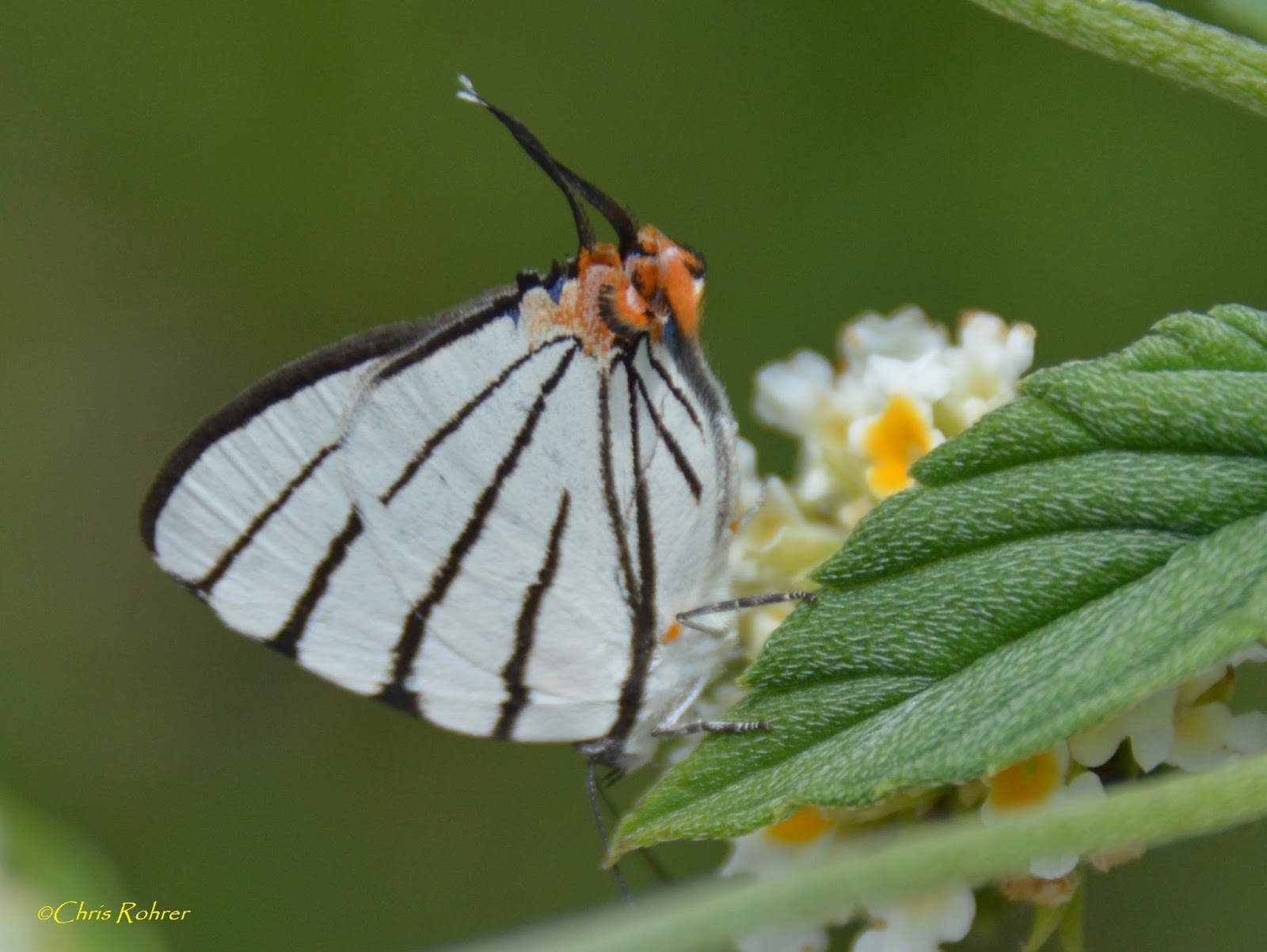
Fine-lined Hairstreak, Arawacus sito. Thank you Doug Taron for the ID This butterfly is CRAZY. The "tentacles" at the end of this butterfly kept moving and I thought there was something wrong with the butterfly, but it's a distraction mechanism!!!!!  The head is actually opposite and "moving tentacles" are a distraction for predators.  EPIC BUTTERFLY!

Martin was with us again on the trip and we set out to explore this AMAZING place! I really liked hanging out with this guy. Both of us had the same ideas about where we should focus our attentions.  My life bird at 600 was the Green Parakeet and I still didn't have any decent photo documentation.  But here in the sinkhole, I had an opportunity to see several thousand of them!  Their voices echoed from within the rock walls. 

Couch's Kingbird
I did not have enough time in this location so I had to really pick and choose the birds I wanted to see. If I had the time?  I would have rented a room in one of their stone cabins and spent a week there.  I would have eaten at the restaurant and studied the ancient markings on the inside of the sinkhole's walls. But I only had a couple hours. So time was ticking again. Black-headed Saltator or view the mass of parakeets around the sinkhole?  The sinkhole won.  Thousands of these birds live there and at dawn they create quite the spectacle as they spiral out of the hole. 

The Elf, Microtia elva

I ran up the stairs and stood at the edge looking down.  It was something special. 

"Sinkhole of Parrots" 
While waiting for a flock of Green Parakeets to rise from the pit, I watched an Altamira Oriole hang out in the subtropical vegetation. 

Streak-backed Oriole
Then it began.  The rise. A choir of squawking parakeets circled from below the pit slowly rising in a swirl until they were eye level with our birding scopes and cameras. 

Green Parakeets
Their brilliant green made a dramatic statement against the muted rock face.  

A little abstract bird art.  I was feeling a bit creative in this magical location
Eventually the birds would land and we would get to see them better. 


I felt guilty so I returned back to the van and checked up on our fallen.  Two were feeling better, but the other was out stone cold. Please let him be sleeping. 

Holcosus chaitzami, Taxa Teiidae, Sauria or common name Chaitzam's Ameiva/Not much is known about this lizard
When we arrived back to our hotel that day, we were greeted by lots of unpleasant stories.  One person was escorted to his room because he could not walk.  I heard some people calling it a case of the "turista" while others declared it to be "Montezuma's Revenge."  Either way, I felt terrible for the group.  I also discovered that Helen had returned back home to Britain:(  I never got to say good-bye to her.  Dinner that night was reduced to half and would continue to diminish by Friday night.  For many, their last supper would be spent elsewhere. 


I could not afford to get sick.  These last two days were my biggest days yet.  I had never birded the Pacific lowland habitat and it was the single biggest highlight for me besides this trek to El Ocote.  So I'm already organizing a future trek to these areas again with a trip to Palenque and Belize in mind.  As for the sick? Well I'm happy to report that everyone is feeling better again.  Stay tuned for more....