Saturday, October 9, 2010

Butterfly Event!!!


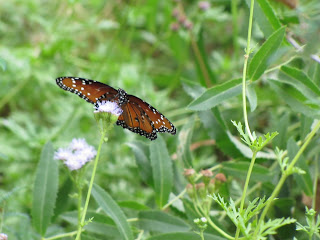
If you're in the Tucson area, the Tucson Botanical Gardens is having their first big butterfly event tomorrow.  Tickets are on sale. We've watched these little guys grow and they are quite the sight right now flying around. Here is the information....
http://www.tucsonbotanical.org/2010/10/butterfly-affaire-2010-a-wicked-evening/


Tickets for this event are a bit pricey....especially if you are on a teacher's salary:) This is essentially the kick off to the butterfly event.  The cost is much cheaper after Sunday.  They have a dinner and some fun planned and hence, I believe, the 150 dollar ticket price.  You may also find another beautiful butterfly garden at the Desert Museum while there is also an informal butterfly garden  at the Tohono Chul Park.  Either way, it's butterfly season here in Tucson!!:)  The difference at the Botanical Gardens is that they will have several varieties from South and Central America....like the morphos butterfly:)

 I can't stop taking pictures of these guys:)

Friday, October 8, 2010

A Date to Remember

Tucson is great for palms....not all palms...just some.  Here is some info regarding a palm that does well here.

The date palm must have full sun. It cannot live in the shade. It will grow in all warm climates where the temperature rarely falls to 20°F (-6.67°C). When the palm is dormant, it can stand temperatures that low, but when in flower or fruit the mean temperature must be above 64°F (17.78°C). Commercial fruit production is possible only where there is a long, hot growing season with daily maximum temperatures of 90°F (32.22°C) and virtually no rain—less than 1/2 in (1.25 cm) in the ripening season. The date can tolerate long periods of drought though, for heavy bearing, it has a high water requirement. This is best supplied by periodic flooding from the rivers in North Africa and by subsurface water rather than by rain.

The date palm. Hanging from the tree are the infamous dates.

The date thrives in sand, sandy loam, clay and other heavy soils. It needs good drainage and aeration. It is remarkably tolerant of alkali. A moderate degree of salinity is not harmful but excessive salt will stunt growth and lower the quality of the fruit.

Date palms grow readily from seeds if the seeds and seedlings are kept constantly wet. But seedlings are variable and take 6 to 10 years to fruit. Furthermore, 50% of the seedlings may turn out to be males. The best and common means of propagation is by transplanting the suckers, or offshoots when they are 3 to 5 years old and weigh 40 to 75 lbs (18-34 kg). They are usually separated from the parent palm as needed, but in southern Algeria suckers are often put on sale standing in tubs of water. Some offshoots are maintained in nurseries until roots are formed, though most are set directly in the field after a seasoning period of 10 to 15 days just lying on the ground, in order to lose 12 to 15% of their moisture. In parts of Egypt subject to annual flooding, very large offshoots—up to 500lbs (226 kg) are planted to avoid water damage. In general, it is said that at least 2 offshoots can be taken from each palm annually for a period of 10 to 15 years. The potential of tissue culture for multiplication of date palms is being explored in Iraq, Saudi Arabia and in California.


The date palm is believed to have originated in the lands around the Persian Gulf and in ancient times was especially abundant between the Nile and Euphrates rivers. Alphonse de Candolle claimed that it ranged in prehistoric times from Senegal to the basin of the Indus River in northern India, especially between latitudes 15 and 30. There is archeological evidence of cultivation in eastern Arabia in 4,000 B.C. It was much revered and regarded as a symbol of fertility, and depicted in bas relief and on coins. Literature devoted to its history and romance is voluminous. Nomads planted the date at oases in the deserts and Arabs introduced it into Spain. It has long been grown on the French Riviera, in southern Italy, Sicily and Greece, though the fruit does not reach perfection in these areas. Possibly it fares better in the Cape Verde Islands, for a program of date improvement was launched there in the late 1950's. Iraq has always led the world in date production. Presently, there are 22 million date palms in that country producing nearly 600,000 tons of dates annually. The Basra area is renowned for its cultivars of outstanding quality. The date has been traditionally a staple food in Algeria, Morocco, Tunisia, Egypt, the Sudan, Arabia and Iran. Blatter quotes the writer, Vogel, as stating: "When Abdel-Gelil besieged Suckna in 1824, he cut down no fewer than 43,000 trees, to compel the town to surrender; nevertheless, there are still at least 70,000 left."

Grown here in Tucson at the Botanical Gardens

Spanish explorers introduced the date into Mexico, around Sonora and Sinaloa, and Baja California. The palms were only seedlings. Still, the fruits had great appeal and were being exported from Baja California in 1837. The first date palms in California were seedlings planted by Franciscan and Jesuit missionaries in 1769. Potted offshoots from Egypt reached California in 1890 and numerous other introductions have been made into that state and into the drier parts of southern Arizona around Tempe and Phoenix. In 1912, Paul and Wilson Popenoe purchased a total of 16,000 offshoots of selected cultivars in Algeria, eastern Arabia and Iraq and transported them to California for distribution by their father, F.O. Popenoe who was a leader in encouraging date culture in California. It became a profitable crop, especially in the Coachella Valley. There are now about a quarter of a million bearing trees in California and Arizona.


Thursday, October 7, 2010

Harrisia Adscendens

This plant originates from Brazil.

A few of the twenty-some species in the genus Harrisia are found in cultivation and often grown as landscape plants in warmer climates where they can clamor and sprawl freely. Stems of this species are typically thin and few-ribbed; areoles with several needle-like spines are spaced enough to make the stems easily visible. All species have large nocturnal, white flowers which are fragrant. Floral tubes have bristles or wool and the fruits are round yellow or red fleshy spheres. The fruits are a useful identification key.
Sprawling in the Tucson Botanical Gardens

Wild populations of this genus can be found from Florida to California in the United States, through the Caribbean islands and down into South America along the east half of the continent as far south as Argentina. As mentioned above, most species are not well-known in cultivation, presumably because of their unwieldy growth habit. One species H. jusbertii is found in collections and is believed to be an inter-generic hybrid of H. pomanensis and Echinopsis eyriesii. In Florida, this genus is seldom seen in the wild as they inhabit islands and remote places where vegetation is extremely dense and inaccessible.  Some will actually crawl and act like vines.  I have several pictures from two previous posts showing their blooms on the El Presidio Grounds.
I don't know why I like this plant so much, but it's got a cool feel to it and one of the few cactis to have a vine-like quality.


"Cactiscapes"


Here are some attractive groupings of cacti......


Wednesday, October 6, 2010

Euphorbia or Cactus?


One of the things that I have been learning a lot about lately are the differences between Euphorbias and the Cacti Family.  I have been calling a lot of the Euphorbs "cacti" over the years and I am putting a stop to it this year.:)  So your question is....what's the difference?  Here's a response I found that clarifies....


Posted By: David Hershey, Faculty, Botany, NA


Area of science: Botany "Both the cactus family and euphorbia or spurge family are large diverse
families. Some main differences are that cacti usually have clear, watery sap
and many euphorbs have milky, sticky sap that is often toxic. Cactus spines
occur in clusters of more than two on an aerole, an extremely short shoot.
Euphorb spines are modified stipules and occur in pairs, and have no aeroles.
Flower structure also varies between the two families. The characteristic
euphorb inflorescence is termed a cyathium, which appears as one flower but is
several. Flowers lack petals. The female flower is elevated on a stalk and
surrounded by tiny male flowers each consisting of just an anther. The flowers
are then surrounded by cup-like leaves. In contrast to small flowers and
inflorescence of euphorbs, cactus flowers are usually large single flowers with
petals and many stamens.

Cacti are native almost exlusively to dry areas of America while Euphorbia are
native throughout the world in both wet and dry areas. Cactus-like euphorbs are
found in Africa. The majority of cacti are succulents with fleshy stems adapted
for water storage and photosynthesis and leaves reduced to spines or needles.
Some euphorbs are succulents but many have broad leaves and are not succulent,
such as poinsettia (Euphorbia pulcherrima), castor bean (Ricinis communis), snow-on-the-mountain (Euphorbia marginata), rubber tree (Hevea brasiliensis)
and the houseplants croton (Codiaeum variegatum) and chenille plant (Acalypha
hispida). "


From my personal experience, I have also found that these guys like a little more water than their cacti siblings. Generally speaking, the Euphorbs a bit less spiky and have ridges with needles compared to the very spiny cactus.....look at our native Teddy Bear Cactus to compare.......


Do you see the differences?  Happy Gardening!!!!

Tuesday, October 5, 2010

Bird Droppings? Look closer.....

So something is eating your citrus bushes and you don't know what it is....you think it's a bird because there are a lot of droppings on the leaves.....

But at closer inspection you discover it's one of the ugliest catepillars alive.


Thanks to the macro feature on my camera I can get close ups like this!! Seriously they are ugly.  Here are recommendations from people about these catepillars.  Caution...don't be quick to pick them off...as you'll see what the end result is in a few moments....
1.  If they are on older larger citrus bushes, don't do anything. 
2.  If they are on younger bushes, they will eat all your leaves....but generally the leaves always grow back. However, some gardeners recommend picking them off.


The little "tongue's" that stick out emit an odor to keep predators away....so this guy didn't like me so much.  The official scientific word is the "osmeterium"....
So the final result?  This pic below was not taken by me but here is what the end result is....but I will get some shots down the road:)


The Swallowtail!!

It is catepillar month in Tucson and butterflies are all over the place.  Keep your eyes on the look out for these guys!  Happy gardening!

Monday, October 4, 2010

Crested

What does "crested" mean when it's used with cacti?

Crested cacti are unique formations that happen every now and then in nature. Above is a picture taken of a Crested Saguaro Cactus at the Tucson Botanical Gardens.  Of course you can find other kinds of crested cacti which are really striking to have in your collection.

When you see a cactus that is a little unusual looking, in that it is not straight or round,  or that it has swirls and twists....you are probably looking at a crested plant.  A crested cactus will make another crested cactus....just carefully break a  segmented section off and follow cacti transplanting rules.  However....
This cannot be done with a Saguaro Cactus as it grows differently from other cacti. You can't propagate it the same way.  That is why a crested Saguaro is really a thing of beauty and a unique feature in the desert landscape.  And I should also mention that it is protected.....so you can't touch these guys:)

Yes....Saguaros get that tall!!:)  Happy Gardening!!

Look closely......


Tucson is a strange place.  If you plant it, they will come.  I live right in mid-town and even with all the traffic, you can create an oasis for your desert friends.  You just have to look carefully as with everything in life....and you'll find it. 


I'm definitely a plant guy, but I love all the wildlife that comes with a plant. I've heard Portland is similiar to Tucson in that there is wildlife and parks spread throughout the city.   Sometimes I wonder how the wildlife gets here.  Once when we were coming home at night, I heard some strange scratching and behind our shed, I found a skunk!!  It was very random and of course, the skunk disappeared after a few days.  It scratched my Eucalyptus, but other than that it moved on to other places.  We have hawks, hummingbirds, 3 types of butterflies that live on the property(so far), many lizards and geckos, bats, dragonflies, several species of birds.....and the more I plant, the more they come...and that's a side benefit of creating a garden oasis:)


I am loving this camera.  It has allowed me to do some incredible photo work....I cannot wait for those big moments while I'm travelling this year.  Until my next post.....happy gardening!

Sunday, October 3, 2010

Day Dreams.......


 Yesterday a rain storm hit us....It was a nice surprise here in Tucson.  Here's a shot of my cat looking out onto the side garden.


Luna and Aurora

Saturday, October 2, 2010

Sabino Canyon


Some images to get you excited for the fall season.  In Tucson, you can drive up to the different mountain ranges or simply go to Sabino Canyon....one of Tucson's local gems. Above is the cottonwood tree that grows along our rivers and streams.....


See you in the garden soon!!:)