Showing posts with label agave in Tucson. Show all posts

Saturday, March 19, 2011

Wicked Fun!

This post is a very special one for me.  I have just come off the high from meeting Amy Stewart, author of Wicked , a book about poisonous plants and human interactions with these plants. It was a great day because not only did I get to have lunch with Amy, but I also got to chat with Scott Calhoun who is a locally famous landscaper/writer in the Tucson area.  I'm not sure what the word is to describe the feeling from being around these expert plant people, but I think "overwhelmed" is a term that comes to mind.  There was some really great plant discussion going on and I just listened to it all not wanting it to stop. It was almost surreal.  I had my tablet and pen and took notes. It was really enjoyable to be around such wonderful energy and passion in what these people do in their own lives.  I have to be honest.....I have done the field studies, the historical studies, and the crazy adventures.......but in a different area with language, education, and indigenous peoples.  We are all connected, but I am at a crossroads in my life finding out that I wish I had gone further with my studies in botany like my friend Dr. Heidi did back in our tree hugging society days. Public school education isn't what it used to be and unfortuneatly a lot of good people are leaving the profession in search of a better job that treats people with respect.  Many of you would be shocked by how parents treat our teachers today.   I do enjoy teaching my high school and university students along with my love for the Spanish language (and all the field work I get to do during my summer "vacations")......but there is no denying that the fire that burns within me lies elsewhere these days and in a different direction. Today's meeting and lecture are indications that changes may be coming down the road. There was a quote someone once told me....."Education is a life long process."  I totally agree with that saying today but when I was younger, I didn't want to believe it.  Every 6 years teachers have to recertify in their content area, but the issue I have with this is......what if you want to study something else because we all change after time?  The answer is "No.  It has to be in your content area." Then I ask, "What about those month long trips I take to Spanish speaking countries?"  "No.  Vacations don't count".  People who travel with me KNOW that I don't take a vacation and some of them refuse to go with me(like my other half Pat:) If you're going to spend all that money on a plane ticket, why would you sit at a beach the entire time? My parents recently remarked to my sister who came out to visit that I would keep them busy busy busy.  I do research on language variations, indigenous attitudes vs. the national culture, plant studies, and historical/cuisine(my favorite) visits.  Spanish fluency comes from travel and study.  Knowledge comes from the source. To be authentic in your field, you MUST work and get experiences from these invaluable sources. No district or university can offer that experience to me.  So while I am studying plants on my own time, it's on my own time. :)

Amy Stewart, author of  Wicked and Dr. Ergot Ratbane of the Wicked Plant Display at the Tucson Botanical Gardens.  This picture sums it all up for me and just shows what happens when great ideas come together. Ms. Stewart found a great angle on plants that interested people worldwide and the Botanical Gardens found a way to bring that excitement into the gardens here. PS. Dr. Ergot Ratbane is hilarious both in person and in character and makes me laugh.  There were a lot of kids today coming through his office and it can be overwhelming....but he was ready with crayons and paper:)

I first "met" Amy Stewart through Austin's PBS program, Central Texas Gardening which can be found on YouTube.  She's a very kind and knowledgeable person who, like all of us, has to find time in their day to balance busy schedules.  From our chat, I understood that there were several major things that an author must go through....1)Research for your book 2) Travel time for the research on your book 3)Writing your book 4) Trying out the things that you are writing about(like Amy's poisonous plants) in your own garden  5)Editing and Publishing your book and 6)The book tours that follow while still trying to write your next book....and somewhere in there..... family. Amy was really friendly and great to get to know. 

So let me list what was so "wicked" about  Ms Stewart's lecture....
1.  Alnwick Castle has a Poison Garden on deadly plants and is also where Harry Potter was filmed.
                                             2. Around 68,000 people are poisoned every year
3.  Hemlock killed Socrates
4. There is a poisonous research plant in Logan, Utah
5. White Snakeroot killed Lincoln's Mother from Milk Sickness.  The cows had eaten the snakeroot weed and the people drank their milk which was also poisoned and hence, Lincoln's mother was a victim from this poisoness plant.
6. Pallagra is a vitamin defiency of B3 or niacin giving people in the early days the appearance of being a vampire.  This happened because corn was utilized by early American settlers as their primary source of food.
7. The most painful plant may be the Giant Stinging Tree or Dendrocnide Moroides.  If "stung" by this tree, the pain can last up to a year or reignite on the skin from heat or sunlight.
8. There is an animal poison control center for beloved pets....ASPCA
PS.  Lilies are toxic for cats and will give a cat kidney failure....think about this plant before buying a bouquet for your table....especially if you have a nibbling kitty. 
9.  Teenagers are finding other ways to smoke things besides weed. If you hear them using latin, be aware.  Diviner's sage is hard to get; but can be ordered on Ebay type sites. It can also kill.
10. Finally, what do you think is the most dangerous plant in the world?  It's the one that has killed the most people worldwide at around 90 million people.....what do you think it is?  Answer on the very bottom.

On a personal note, I had an amazing day at the Tucson Botanical Gardens and I'd like to thank them for inviting Ms. Stewart.  Her website is:


There are two people I'd love to sit down with here in Tucson and meet during another time....Scott Calhoun of ZonaGardens Landscape Design and David Yetman from the PBS KUAT series “The Deserts Speaks”
Scott Calhoun's website is http://www.zonagardens.com/

The answer to the question above is tobacco

Stay tuned for more.......


Friday, February 4, 2011

The Day After


I understand it happens, but I don't like it.  This weather pattern hasn't happened for awhile and I suppose we were spoiled with warmer winters over these past several years.  Plants did very well.  While midtown Tucson has higher temps than other parts of the city, it still suffered a nasty freeze last night that got into the teens.  The cacti damage is phenomenal.  Colonies of nopal (or a variety of prickly pear) just collapsed onto the sidewalk.  A neighbor walked over to my door last night and asked, "Did you see the cactus all over the sidewalk?"  I sure did.  In addition to that situation, the tropicals in two large pots died.  Several birds of paradise bit the dust.  While I have covered all the citrus, I haven't lifted the sheets to see the extent of the damage....and I'm sure there's some there. The scariest part of the freeze for me is my love affair with the mighty Jacaranda. It is the one thing that I hope springs back to life in March. It's normal for the ferns to dry up and fall off this time of year, but this 3 year old beauty has never seen a freeze like this.  Of all things, I cross my fingers for this tree.  It is a similiar reaction I had with a Chinese Elm a couple years back that collapsed due to Texas Cotton Rot.

I suppose in a way, this freeze teaches us as gardeners to plant native species in our yards.  But even the native species had a hard time keeping up in the landscape.  Is this about failure? No.  It's about the constant redefinition of our garden spaces.  As people, we like to form routines and get into those routines.  I planned to work on Spring Projects.....not fear for already established plants that cost money and redo an area!  If it's one thing I try to remember, it's this.  While the top of the plant is fried, it doesn't mean the root system was.  When March comes....March 15th to be exact, it will be the start of Spring and most things can be trimmed at that time.  Trim trim trim and watch how everything grows grows grows.  So hope is not lost......it's just our guts reacting to this terrible winter event in the US.  And you people who love it.....enjoy it while it lasts:)

Except those who've had pipe damage in Tucson.  This freeze event has shut down schools today because plumbing is all jammed up with ice. In fact, a lot of places are closed down today.  It's weird because in Wisconsin, this freeze wouldn't even be an issue.....partly because my hobbit friends and family are built from a sturdier build.  Living in the desert after awhile makes you develop a "thinner skin":)  Going back home in winter can be a cultural shock at times:)  Anyhow, last night we opened all the pipe valves for water to leave.  However, a resident must have seen the water and shut one of them off!!!  So it is frozen solid.    All other pipes were in good shape this morning when I went outside to look them over.

As for failures.  A bunch of bloggers have been talking about keeping a journal of what desert and non native desert plants collapse at certain temperatures. With the temperature sustained at 18 degrees last night for several hours, it is surprising to see that the oleanders have held up.  The live oaks seem unaffected.  The palm tree looks fine.  The Heavenly Bamboo(Nandina) is holding up.  A Cereus and Silver Hair Cactus survived.  Roses....what?  There was a freeze?:)  Texas Ebony looks wonderful.  One colony of bamboo collapsed; the rest look healthy. 

That which suffers.  The prickly pear.  Bouganvillea.  Birds of Paradise.  Any tropical such as the Scheflerra or Spider Plant.....all collapsed. Castor plant gone.  But the seeds....collected:)

That which is unknown.  Citrus. Loquat. Guava. Ficus. Jacaranda. These are the "line plants" that can grow here because Tucson is listed as subtropical.  But the "line plants" can die from the frost.  I'm not sure what the official word is for this because my brain is frozen.....but there is a word. Citrus is hardier than the rest of these trees listed. Again it's about placement.

That which benefits.  All fruit trees....they certainly have gotten their chill hours this winter:) And.....you. A freeze allows us to re-examine a garden space and put something different in its' spot.  It also allows us to clean up the plants in Spring where before the plant looked super healthy and you didn't want to touch it.  Bushes need pruning.  While the bouganvillea, looks atrocious; don't touch it.  Wait until March 15th or until freeze warnings have been lifted before trimming your plants.  The "dead" branches and leaves protect the core part of the plant from total collapse. 

Finally, failure doesn't define the end but rather an opportunity to explore other venues. While it's heart breaking, it's also a learning opportunity for gardeners to reconstruct their gardens in Spring.  The reason why we hurt when this happens is because we've personally nurtured and worked with these plants...in some cases for years! And all it took was 1 night or several nights to undo all the love and devotion you gave your babies. (This last line sounds like a bad love affair.:)  I know that this sounds strange, but everyone feels this.  There is an attachment or bond that we form with not only our plants, but our children, pets, etc.     Well, if you are a Vulcan type person reading this blog that doesn't have emotions, it's then about the investment of time lost. But because you're logical, you'll be able to move on faster after a devastating event like this:) Your scientific knowledge will allow you to explore more logical native species in your landscape.  Until next time, live long and prosper.....in the garden:)
PS.  The word, thanks to Antigonum Cajan, was endemic.:)

Friday, January 21, 2011

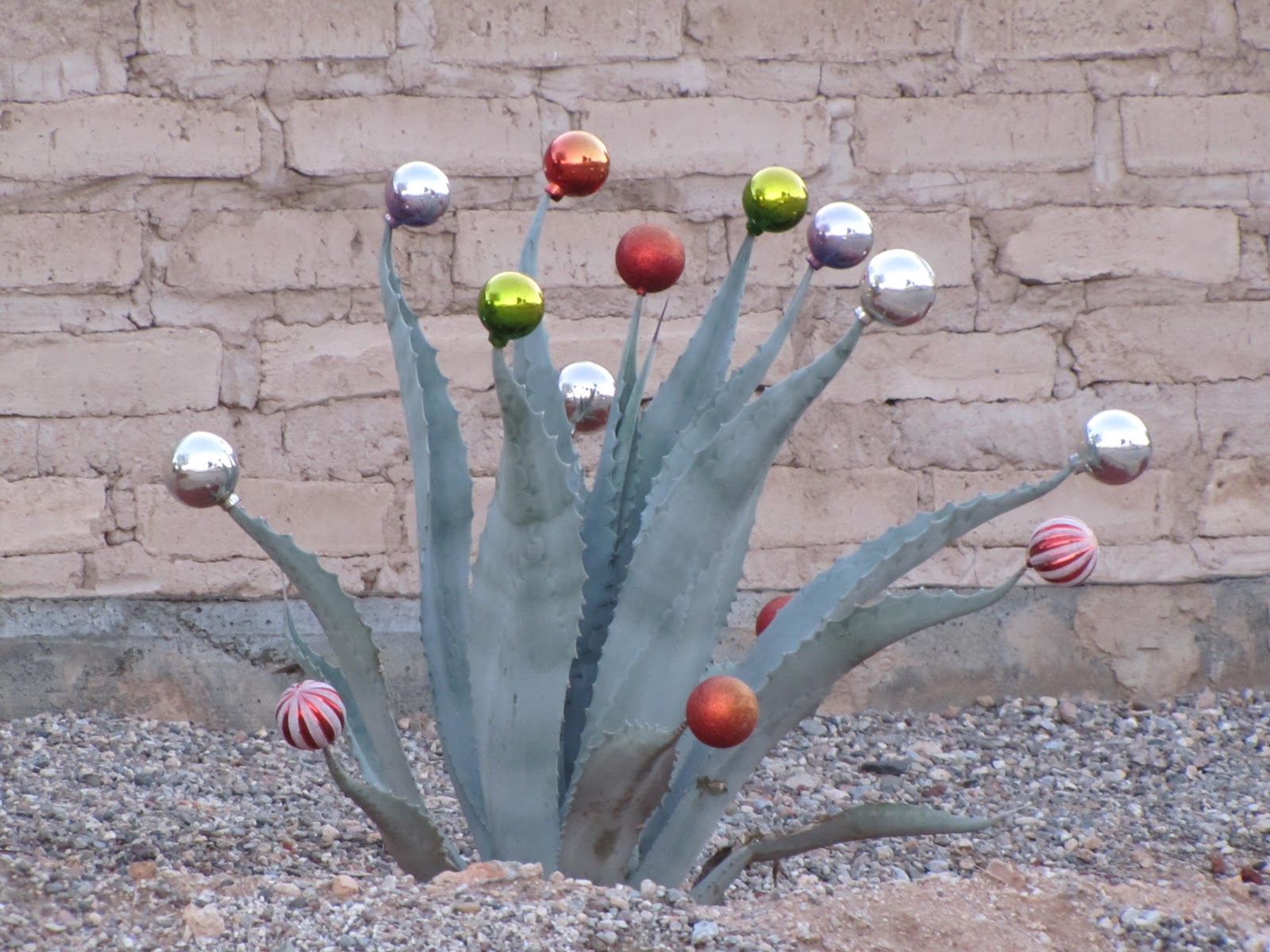
Agave Fun!

Taken in the AM
Okay, let's take a break from all the project talk for the moment. Here is an idea for you agave lovers during the holiday season.  Obviously, the home owners are still feeling the Christmas spirit.  I actually like this idea a lot.  This top one was taken this morning on the way to work and the bottom one sparkles with afternoon sun on the way home.  Agaves add sculpture and form to a garden.  The only thing I don't like about them is that they can make you bleed if you are not careful so always wear gloves when dealing with these dagger like plants.
Taken in the PM