Wednesday, August 19, 2015

Close Inspections

I found a magical fairy village in the middle of the woods!
August is a whole month of crazy.  Monsoon is in full swing and so is migration.  It's the one time of year when everything all comes together.  But the temps are brutal in the desert and surrounding areas. 


Enjoying the cool breeze of a monsoon storm in Sierra Vista along the San Pedro River

And it is during this time of year that I collect my data for migrating warblers, shorebirds and birds listed as endangered or in decline.  Did they nest?  Are there juveniles? Are there more or less of these birds coming through the area right now?  After chasing life birds in Chiapas, I just felt I needed to connect more with "my birds" and do quality study. 


The monsoon clouds build over Cochise Lake in Wilcox
While I love the grasslands, I'm not a huge fan of the chiggers and bugs.  Right around the first couple weeks of August, we hit the peak season of monsoon.  It's during this time of year we begin to see some early migrants passing through our area while also observing difficult birds, like the Cassin's Sparrow, out in the open doing their "larking display".  There isn't a certain date for this peak.  It's just something I feel out each year.  Each weekend during the month of August, I carefully pick the spots to do my studies.  In this post, we stopped at the Wilcox Lake for migrating shorebirds, Mt. Lemmon for warblers, St. David for nesting Yellow-billed Cuckoos, and my work site in Oro Valley(weekly patch study) for the nesting Purple Martins specific to our Sonoran Desert.  It has been a quality month of research and birding.  None of it is boring.  The hikes are incredible and the treks are some of the most scenic on this planet. 

Black-necked Stilts
We headed down to Wilcox and explored "Cochise Lake" first.  We picked up two Stilt Sandpipers, one Semipalmated Plover and Sandpiper.  While these birds were wonderful to spot, our best observation happened with a cranky Northern Mockingbird and Swainson's Hawk. 

A Northern Mockingbird chases a Swainson's Hawk off the post.  That takes some huevos. 
After awhile, we headed out because it looked like it was going to rain in the area.  

Black-tailed Jackalope Jackrabbit:)
I wanted to check up on our now fledged Mississippi Kites, Yellow-billed Cuckoos and Yellow-breasted Chats.  Along the way, we observed lots of great birds around the countryside. 

White-winged Dove perches on an Ocotillo
We'd stop and look and then move onto the next area. 

A male Northern Cardinal sits on top of a Saguaro.  Talk about a strange sight!
After a summer of chasing crazy new birds in Mexico, I was happy to just stand in MY world with MY birds and let them fly around me.  I know this world best.  Every habitat.  And almost every bird.  It's great.  They are my secrets.  My escape. It is very comforting to know that many made it back in one piece.

Gila Woodpeckers are LOVING the sugar water right now.  Sorry hummingbirds!
The Gila Woodpeckers fought the hummingbirds for nectar. 


Spiders hid on leaves.  And chats.....did a lot of chatting:)

Yellow-breasted Chat
I went to St. David and followed up on the Cuckoos and Kites.

A Yellow-billed Cuckoo flies over my head.  I have a special connection with this bird as it followed me around last year in the trees:)  And it was back again in the same area where we hung out for awhile watching each other.  
Thankfully, they were all there safe and sound.


Here's my friend who is still around
Currently the western variety of the Yellow-billed Cuckoo is in danger. It is listed as threatened and near the threshold of endangered. Tucson Audubon currently has surveys going on around their nesting areas in Southern Arizona.  They are collecting data about this declining species so that they can designate areas for their protection. "The loss and degradation of native riparian habitat throughout the western Yellow-billed Cuckoo's range has played a major role in the bird's decline"(source)


Back at my work site, I do a weekly survey of the birds found around the campus.  The Purple Martins were concerning for me because they are clear cutting major areas of desert next to the school and wash.  Normally, I see these birds before school is out but I hadn't seen them before summer break.  However, I was SO happy when I discovered this desert subspecies flying around the Saguaro cactus at the start of our new school year.


I don't know how they did it with all the chaos around them but they raised another wonderful family.  They had 3 young at the time but have now begun their migration.  I hope they return next year.  It's crazy how connected I have become with my local birds.
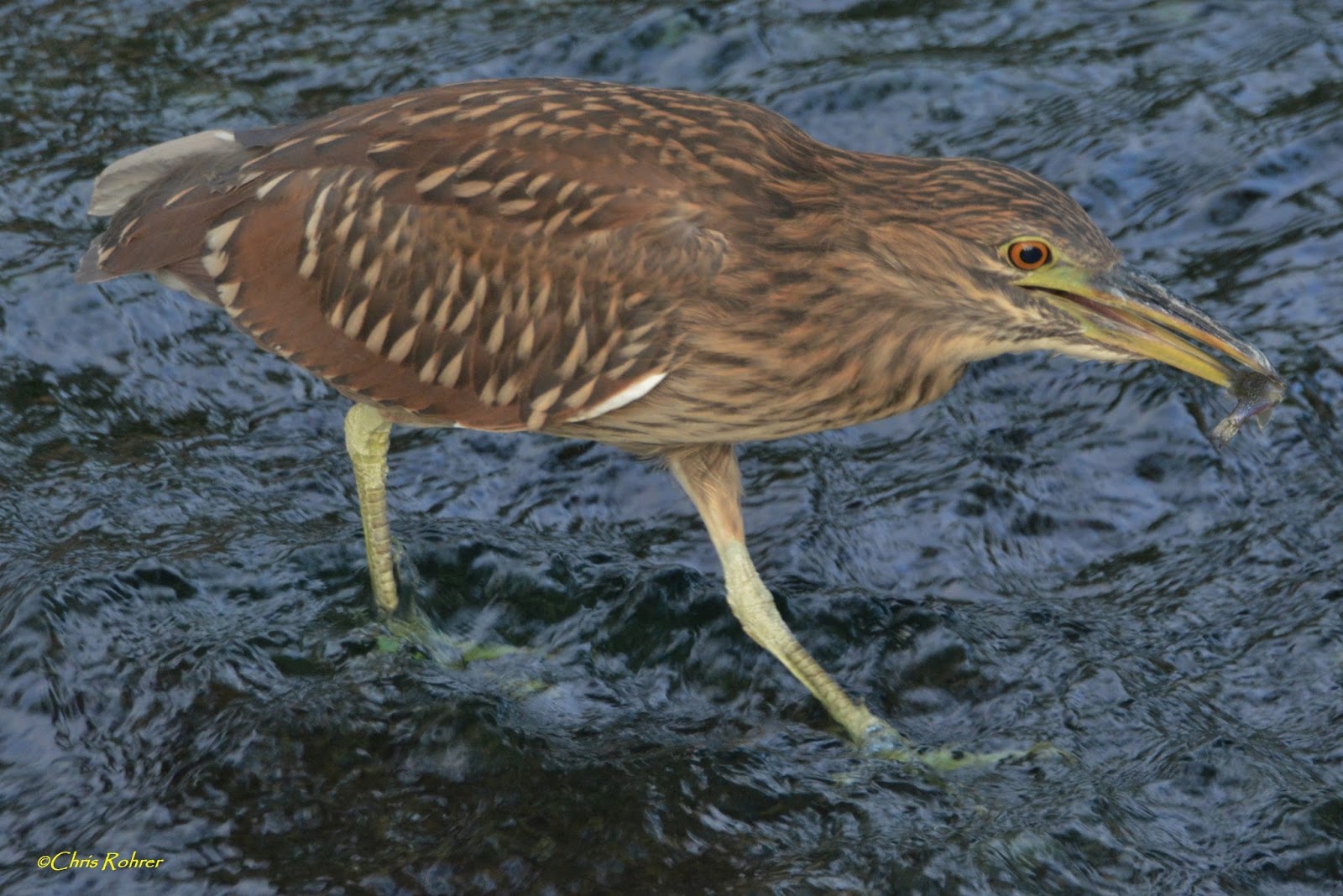

Black-crowned Night Heron
On a particularly hot day, I wanted to bird but not far from home.  So I went to my other regular patch at a nearby park to count the juvenile Black-crowned Night Herons.  The Herons have had a good year!  4 juveniles were seen on this 100+ degree evening.


The heat can be intense!  Thankfully warbler migration begins on top of Mt. Lemmon in August and this is where I'll finish my reporting.

Townsend's Warbler
It was hot in Tucson at around 113 degrees.  Mt. Lemmon was sunny with a slight breeze in the 80's.  This was a no brainer.


On this beautiful day, we had 11 of the 13 warbler species on the mountain.  The Wilson's, Townsend'ss and Hermit warblers were AMAZING!  It was a successful outing indeed!

Wilson's Warbler
Warblers are pretty cool birds.  Yes, they are difficult to see, but they are little gems that dance underneath the shadows of leaves. 

Hermit Warbler in flight
Overall, it has been a great month out and the data collected was a success.  I realize not all years will have such positive reports but this one was one of the best thanks to lots of wonderful rain.


Birding can be quite meaningful. With this collection of data, I become stronger and better at being not just a birder but a true citizen scientist.  


Over the next two weeks, we'll meet new friends on the trails.  Las Aventuras is about to begin Chapter 3 of "Americano".  Stay tuned for more friends:)

Monday, August 17, 2015

Hotspots


White-fronted Parrot
Eventually all good things must come to an end. With one day left and physical exhaustion finally catching up with me, we decided to dedicate our lives to creating a new hotspot for Tuxtla Gutierrez.  And find those blasted parrots flying around our hotel!

Tropical Kingbird
For days, we observed possibly hundreds of these birds flying from our hotel to the park across the street. There were at least two species that kept squawking over our heads as we slipped our hotel card into the door.   It drove us nuts! By the time we'd get back, the sun would be setting or we'd be exhausted from our daily treks out into the field. We'd see their shadows fly above our heads and try to find the field marks with our binos. So after our tour, the hunt began.  And we walked our neighborhood and scoured every building and tree out there. Here's what we discovered. 


Caña Hueca Park
There was indeed a park next to our hotel.  It was safe for us to carry our cameras, at least during the day. This park was a place for people to mainly exercise.  But from within it, there were a great number of bird species flying around!  To make it even more enticing, a canal flowed through a part of the area attracting several water birds like Snowy Egrets and Neotropical Cormorants. When I looked on ebird, I realized that this park was not an ebird hotspot.  It's within a green area of the city and a perfect spot for local and visiting/migrating birds.  The park is known as Caña Hueca. 


juvenile Social Flycatchers
Around the park area, we visited several shopping centers to observe which birds intermingled among the humans.  It was a bit strange for shoppers to watch us snap photos of birds in the parking garage area:)  Beyond caring anymore:)  

Grey-breasted Martin
Anyhow, back to the parking garage.  I saw a bunch of these swallows flying into the shade and I thought they were Northern Rough-winged Swallows. Thanks to Michael Retter, he said, "HEY!  Those are Grey-breasted Martins!"  Mother of pearls, he is right.  I have only seen this species once in Antigua, Guatemala.  Instinctively, I knew I had to take a picture of this bird.  But I had Northern Rough-winged Swallow in my brain.....not a Martin:)  Thank you Michael for catching the ID!   


The park itself is lovely for people who love to run.  They had this soft padding throughout the area and I have to admit that I didn't mind walking on it:)


Along the way, we found our parrots in large numbers around the park feeding on the various fruit trees.  


There were several times when a large seed or fruit almost knocked me out!  White-fronted Parrots hid everywhere in the foliage.  Sometimes they could be seen out in the open.  AND they were ALWAYS heard:)

Groove-billed Ani
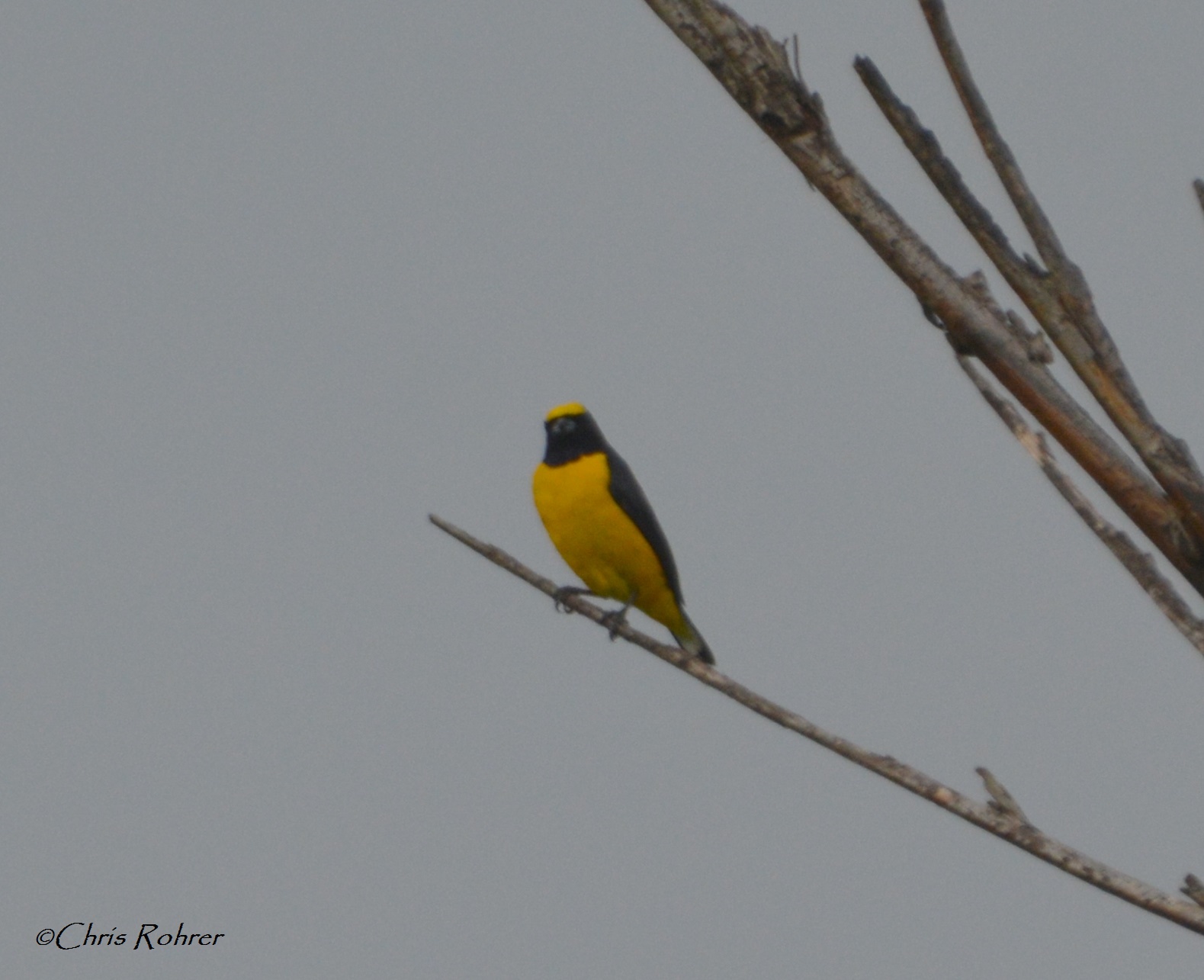
We had several Groove-billed Ani hanging out in the trees!  And then there were Scrub Euphonias darting around the branches. Some even hung out at our hotel!

Scrub Euphonia
The place was amazing! We had 27 species in this park alone!  It just proves that you don't have to go far sometimes to find amazing birds. 

Looks just like the leaves
Parrots and Parakeets have always been a fascination for me.  To be honest, I hate their chatter.  Their squawking hurts my ears too much BUT I love everything else about them.  They are social.  They are highly entertaining in the wild once you spot them. And they have a VERY set routine.  They get up early in the morning and make a lot of noise to wake up the hotel birders.  No need for an alarm.  Then they head over to the park or Marriott hotel and feed off the trees around the property.  By 5:00 PM, it's time to head back to their "sleep" area and snuggle in together on top of the Marriott hotel roof or other man made structures. By observing their daily routine, we were able to track them to their food sources and get great pics. 

Green Parakeets
It is my hope that this park will become a hotspot for future birders visiting Tuxtla Gutierrez.  There aren't many hotspots at all within the city and yet I know the city is full of surprises. If people ebirded like they did in Tucson, I can only imagine what would be found!  I wouldn't mind living there for a year and exploring the various watering holes, etc around town. 

Green Salsa Chilaquiles
 Every chapter in our life must close.  And for me, this trip to Mexico was healing.  I still had a torrid love affair with chilaquiles.  Perhaps the best breakfast or hangover cure out there. But I was so sad. I wasn't ready to go home.  I sat looking at my food not wanting to eat.  Because it meant that once I ate it, I would not have a decent plate of chilaquiles for a LONG time after.  So I took a picture.  It's refried black beans, green or red salsa over fried tortilla strips with shredded chicken and topped with delicious Mexican cheese that just screams, "OH YEAH!"  And so on my last bite, my affair ended.  Oh love can be so cruel!


But then something perked me up.  A cow. The cow is a symbol of my Wisconsin roots.  It reminded me of where I grew up. The coffee was Mexican and I remembered why I pursued Spanish as my passion.  When I mixed the two together, I remembered why I chose Tucson as my home.  I will be back Mexico.  I have missed you. 


On our flight into Mexico City, we flew over the volcano known as Popocateptl near the beautiful colonial city of Puebla.  I suffered from a bit of nostalgia. I hiked those mountains. I lived there.  I became "me" there.  While I saw many birds on this wonderful trip, I couldn't help but think of all of my human experiences in this country.  While the guided tours were awesome (as were the people), I won't do them again. Part of the reason I love to bird abroad so much is that I get to know the local people in the area. And that comes from my Spanish training. It enriches the whole experience.  Plus when I find a bird, I earn it.  No one found it but ME. And that's a life bird earned in my book. I know there will be times when I need to call on someone for help.  The Nava's Wren is a perfect example of THE bird I could not find on my own. This trip was amazing and it better defined who I am as a birder. For that I am grateful.  And to people like Laurie Foss and Michael Retter(and everyone else!) who put this trip together, THANK YOU!  It was flawless.  You guys did a great job!  


A Giant Swallowtail greets me on my return home to Tucson.  This butterfly was laying eggs on my citrus plants in our garden. We all live in an amazing world!
As Las Aventuras leaves the neotropical world behind, we return back to Madera Canyon and begin the third chapter of "Americano". Until next time friends.........

Thursday, August 13, 2015

Sumidero Canyon


We woke up the next day.  No tour bus.  No guide.  Just us. And it felt good.  We could go and explore on our own and at our own pace. The 5 days of tours were brutally intense.  Now it was time to slow down. Or at least that's what my body was telling me. 


We kept it local and returned back to Sumidero Canyon.  Once again, we strapped on our water packs and began the hike into the clouds and canyon. 


Lesser Roadrunner
 One of the target birds that we missed from our treks was the Lesser Roadrunner.  Here in Arizona, we have the Greater Roadrunner.  We couldn't leave Chiapas without spotting one of the "Lessers".  As we walked further up the road, the mist let up some.  It was enough to allow us a brief glance at a "hazy-what-looked-like-a-roadrunner on the road" creature.  Gordon became excited and said, "That's a roadrunner!  I know it is!"  


I'm like, "Yeah right Gordon. And monkeys fly out of my butt.":)  Note to self.  I need a shave badly!"
And me?  I was skeptical.  I had heard that this bird was real but I didn't believe it.  When I saw the bird, I thought, "It can't be. Therefore, it isn't:)" We hurriedly moved forward.  The heavy mist took over and the bird disappeared. WHAT IS IT WITH THIS WEATHER AND NEW BIRDS!!!???? There are no such things as Unicorns.  And there are no such things as Lesser Roadrunners. Then the cloud lifted and all was revealed.  


In true Mexican fashion, it was like witnessing the Virgin of Guadalupe opening her cape with hundreds of roses falling about her.  But in our case, this was real! I do believe in Roadrunners!  I do believe in Roadrunners!  Beep beep!

juvenile Rusty Sparrow
 Then we had a visit from a Rusty Sparrow!  This made us scratch our heads because it wasn't like the ones we had observed on our trips.  Come to find out.  This was a juvenile.  Awesome!

Gray-crowned Yellowthroat
 And the clouds got thicker and thicker making the birding a real challenge!


This Ent almost pulled Gordon under:)  But in reality, it's a beautiful Amate Fig tree with a nice looking root system
I never miss home while I'm traveling, but I guess if I did miss something it would have to be the lighting conditions.  Everyday is practically a nice day in Arizona.  And the birds seem much more cooperative than these neotropical ones. 

Streak-backed Oriole
Take for example this Streak-backed Oriole.  Why in the world does it only pop out for pics in cloudy conditions?  Don't they know we are only there for a short amount of time?  Apparently they didn't get the memo:) 


This pic above is really great.*cough*cough* Some of my best work.  Ever.  We finally have the Oriole sitting on a branch in full cloud "lighting" and I know the pictures will not turn out very well.  In my mind just like my father does during those trying moments, I begin humming that tune by Colbie Caillat, "All you have to do is try try try....."  


As we continued our walk, Plain Chachalacas flew or hopped from branch to branch.  The jays were active.  And so was the Ferruginous Pygmy-Owl calling. 

White-throated Magpie Jay
As we ended our trek, I noticed something positive happening near the roadside of Sumidero Canyon. 


Along the way, we noticed how many homes were built close to the road of this "protected" area. It was definitely a poor neighborhood. And it got me thinking a random thought.  In the US, most people with money want their places along the edges of parks etc.  But here in Mexico, it's usually the opposite. Why?  Poverty.  Cut wood for fuel.  Poach animals for food. Raise crops on the areas you just cut down, etc etc.  Most of the hill was bare thanks to obvious clear cutting. 


It is unclear to me whether this happened before the park was put into a protective status or after, but we did witness something positive.  I will end here on this note.  As a teacher, I am happy to report that there was a program teaching kids about planting trees. Good for them! And great for the park! Hopefully in 10 years, the hillside will have a new forest instead of grass. If we don't teach our young about protecting our planet now, we will be in very bad shape down the road. 


So while I was writing this post, I thought about what people might be asking as they read it.  And I think I have it figured out.  The question that came to me was....."What is the difference between a Greater and Lesser Roadrunner?"  Here's a pic comparing the two species. 


Top: Greater Roadrunner Bottom: Lesser Roadrunner
And finally.  This month you can find my work in the latest August edition of Watching Backyard Birds. This is from the publishers of Bird Watcher's Digest.  It was a fun experience putting everything together.  So a big THANK YOU to Dawn Hewitt and team.  If you are paperless, you will find that they have a free online preview of this edition to check out. 


Until next time friends.....