Saturday, November 6, 2010

The Bamboo Ranch

Part 1 of a 2 Part Series on Bamboo

What would your garden look like if you just planted bamboo? Ever wonder the space it would create?  I asked myself this question last year as I began planting bamboo around the gardens.  I did a lot of research on bamboo and made the decision to plant Buddha's Belly Bamboo. It was a beautiful variety and today it grows and makes a bold statement in the garden.  I had heard of a home that fell in love with bamboo and were so passionate about this plant that they started growing it. People saw their garden and began asking where they could buy bamboo. And so began Tucson's very own Bamboo Ranch....  This place did not disappoint in the least. Their home is surrounded by a shroud of bamboo forest.  It had so many varieties of bamboo growing all over the property that it was hard to distinguish one from the other. However, the owners have everything you need to know about bamboo and will walk with you around their property to point things out.                         

Bring a list of questions before you go as the owners will go over a lot of information with you.  We were given a pad and paper to write down varieties of bamboo that we may be interested in purchasing.  Bamboo, by the way, is bigger than you can imagine.  There are smaller varieties, but even then, they are still pretty big.  In the picture above, you will see the difference between the running and clumping varieties. The left, the running bamboo, is more hollow while the right, or clumping variety, has a thicker culm.  The runners are great for areas that you don't care about or an area you want filled fast.  It can be invasive and most people think ALL bamboo is like this.  However, it is not.  I believe the majority of people in Tucson prefer the clumping varieties over the runners.  It was explained that because of our clay soil; it's not really all that invasive....but be warned:)

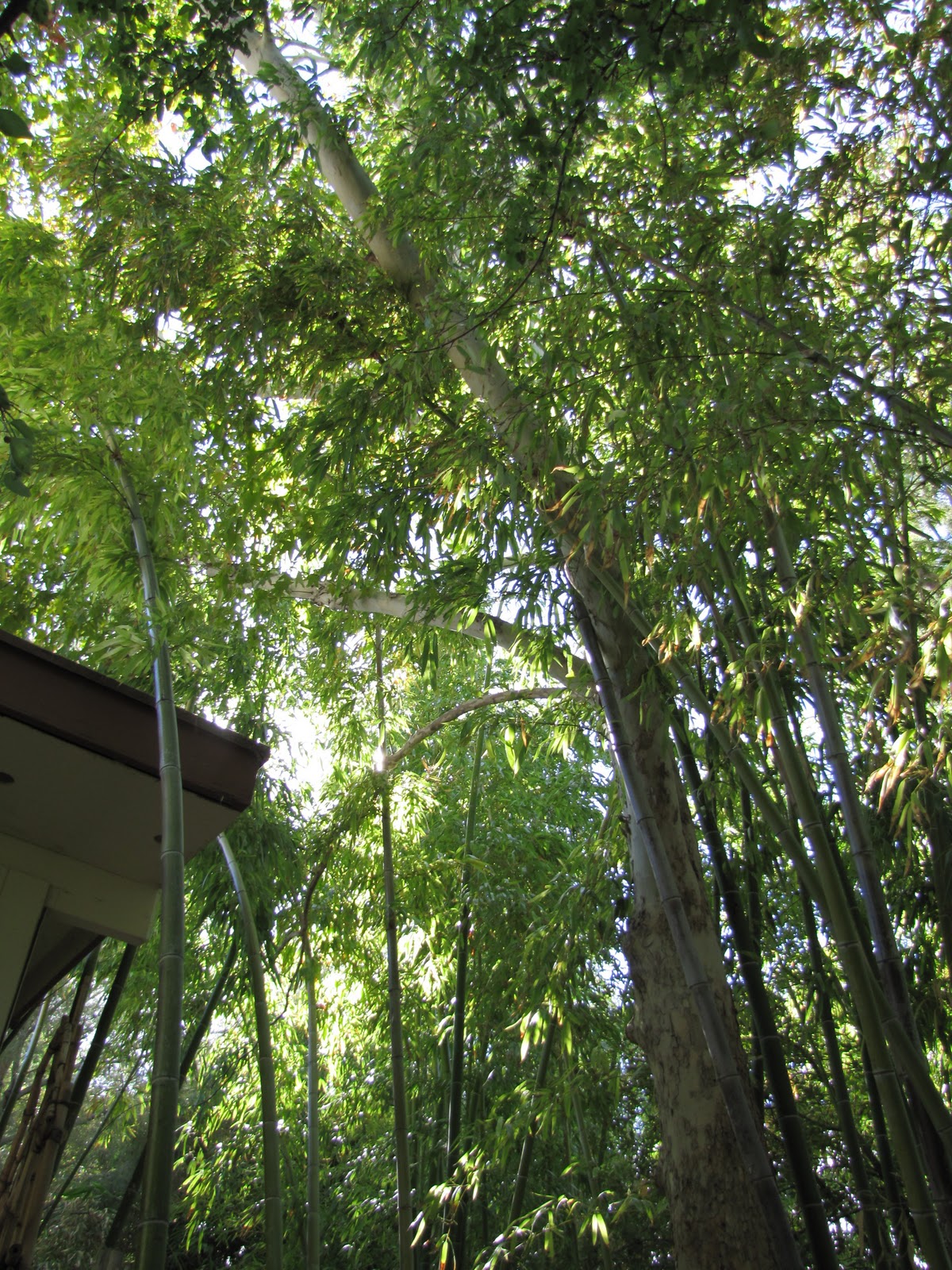
 Ever wonder what it would look like if you planted your garden with only bamboo?  Look here as the sun is blocked by this forest of green sticks.  I will say that bamboo encourages mosquitos to hang out longer in the fall.  If you plant bamboo, make sure you have the space.  It makes a great screen from the neighbors and during the summer it does require a little extra water.  However, if you have grey water, direct it to your patch of bamboo and see what a difference it will make:)

Tucson Botanical Gardens

Bamboo will rise to the occassion above your trees. It loves sun and I find it does better on the west side of our home. In shade, it will grow slowly.  The first year, your bamboo won't do much, but in your second year, you'll see it double in size. By the 3rd to 5th years, you will notice thicker culms.  It is considered a grass and should be fed twice a year with nitrogen.


A bridge over a wash creates a magical space. Your garden space can be transformed into a tropical wonderland.  People say that bamboo is not native to Tucson and they wouldn't be completely wrong except that there is a bamboo native to the Sonoran desert known as the Mexican Weeping Bamboo.


Bamboo galore!!  Generally a 5 gallon runs 40 bucks at Home Depot or Lowes. However, at the Bamboo Ranch, you'll find a large variety of bamboos that vary in prices according to the variety you buy.  Generally, for a healthy batch of bamboo in the 5 gallon, it'll run you anywhere between 50-65 dollars while the 15 gallon pots will run you around 120 dollars.  Now that I know this place is here, I'll be returning for more in spring:)


Check out the culms on these stalks!!  Notice how some bamboo are more erect while others bow.....something to consider.

You can have your own forest within 5 years:)  Just beware....once it's in the ground and established, it can be difficult to get rid of......


Notice the size against human comparisons.....


Netting is only needed on the very hot side of the home when they are getting established their first year.  Once established they can take the FULL sun. 


For more information on purchasing bamboo, contact 520-743-9879 or email at bambooranch@juno.com
If you are interested in visiting the Bamboo Ranch, you will need to set an appointment up with the owners.  It truly is an amazing place with over 100 varieties of bamboo. As they say in their advertisement, it's your southwest source for bamboo!! You can see that they love what they do....it truly was a great afternoon at "The Ranch"  Below are two websites.  One is for the bamboo ranch and the other was a link that shows you how tall bamboo can get.  Happy Gardening!!


Thursday, November 4, 2010

Wildflowers

My friend Kristen near Kitt's Peak

I have to admit that this post does not excite me like it should.  I don't know why, but I guess I'll explain as I go.  I should first admit that I LOVE California poppies and Globe Mallow and I LOVE the desert blooming in the springtime.  I've been here long enough to have witnessed two amazing blooms in our Sonoran desert. Wildflowers are a wonderful attraction in any garden, but my issue is that they are high maintenance once you get them going....oh yeah, and they like to pop up all over the place whether you like it or not.

I yelled at her to get on the ground but she wouldn't at first because she thought a rattlesnake may have been hiding.  Ahhh Kristen:)

So you may ask, "Why are you writing this blog about wildflowers then?"  I just had a class on them this past weekend and I have to admit that I wasn't looking forward to the discussion.  Our speaker was a wonderful person who loves these varied plants and was definitely passionate about her topic.  But like my neighbor said to me at the table, "These plants look like weeds and what I pull out of my garden!"  I started laughing because I have killed many a wildflower.....and I know that I'm doing it.  They are pesky and weedy and get into everything.  The flower is pretty, but afterwards, it makes the garden look unkept.  I know I know.....who do you think you are mister?  Wildflowers are the bomb, phat, tight, cool, or fill in the blank with the latest word for "awesome"___________!  Okay okay...don't shoot me down....I love all plants great and small, but I like them in their natural setting.  "But they are in their natural setting!"  Yes yes....I know this....just not in my garden please:)
Taken in '97 near Kitt's Peak. In masses, wildflowers are sexy.

Here are some tips if you are into wildflowers....and they are pretty when in bloom.  The seeds are generally smaller so put them in a ziploc bag with some sand and mix them up.  Rake up an area loosely and sprinkle the seeds into the ground.  Cover with a light amount of dirt and water gently. Note. Some gardeners leave extra seed out for their feathered friends as they like to check out your work once you're done.  In the desert, it is important to plant your seeds in September or October so that they will germinate. Most need full sun. Not to be a party pooper, I purchased some desert zinnias and am planting them on the south side of the home.  We'll see what sprouts. Here's the 411 of wildflower perfection in the Spring....
-You need moisture to germinate seeds.  Some recommend a deep soaking of the seeds to wash off the "inhibitor".
-Plant between September and early December for germination to get that fabulous wildflower show that makes the Sonoran desert dance
-1 inch of moisture is required along with heat and fall rains.  If fall rains are sparse, as they have been this "La NiƱa" year, water area.

If you are heading to Rocky Point, as I am seen here, you will pass some key areas of the Sonoran desert that are famous for their wildflower shows of mallow, lupine, datura....well, the list goes on and on. It is not uncommon for people to stop along the roads and snap pictures as I did on our way down to Mexico from Tucson. Best time for Mother Nature's show is from April to May.

Did you know?
In the Sonoran desert, 5,000-10,000 seeds are found per square meter according to studies done by the UA.

Wednesday, November 3, 2010

The Principles of Xeriscaping

Swallowtail in my garden
I have to admit that when I first moved to the desert and heard the word "Xeriscape", I didn't want anything to do with it.  To me, at the time, I thought it meant zero plants and more rock.  The fact of the matter is that xeriscaping can be lush and beautiful.  With the way the world is changing, it is only a matter of time before resources begin to run out.  Currently most people pay for the delivery of water but not for the quantity of water.  Some people believe that this "extra charge" is coming sooner than later.  In fact, it does happen in some countries right now.  Living on the desert island of Sal in Cape Verde, we had a very limited amount of water and it was delivered once a week. I learned quickly to be ready to fill our tank up when the trucks came. They charged for delivery and the amount used.  As the world's population increases so will the use of her natural resources.  Many of us reading this will not see the affects of this, but unfortuneatly our grandchildren will and that is a sad thought.  So to be a forward thinker, xeriscaping is not zeroscaping as it's about planting vegetation that will grow within the amount of your rainfall each year.  Xeriscaping is not just for the desert regions but for all places.....it's wise planting for your water bill.....and low maintenance in your garden. In the next two segments of this blog, I'll cover the principles of xeriscaping and the 3 basic regions of gardens using the xeriscape model around your home.  It's sound advice financially and naturally as wildlife, native to our areas, will respond to local plants that will thrive in our own yards.  

Ground Morning Glory

The Zones.  When using the xeriscape method, you must think of setting up your zones.  There is the oasis zone, transition zone, and native zone.  The oasis zone is near your home and placed around your seating areas, patio, etc.  This zone tends to get more water and attention.  Think of this area as your "oasis" when you sit down with guests or for that cup of coffee.  Larger pots are placed around this area as it is easier to water them being closer to the house.  The transition zone consists of native trees that you'd like to shade your home.  If you have gray water, this is a good place to irrigate.  Trees should be placed 15 feet from your home to provide shade and coolness from our desert sun.  It will also create a pleasing aesthetic look.  The plants will need occassional watering to keep them looking attractive.  Finally, the natural or native zone is the lowest and furthest away from the home.  These use the lowest water amounts and are generally native plants. Once established, these plants should need little to no water depending on our annual rainfall.  Remember to group plants with similar needs for water, sun, and maintenance to increase irrigation efficiency and reduce maintenance time.


Here are the 7 principles of xeriscaping......
1. Water-wise planning and design
2. Soil Amendment or not..
3. Plant Selection
4. Limited Practical Turf...if any...but we need to consider people who have kids
5. Efficient Irrigation
6. Mulch
7. Proper Maintenance


Until next time, happy gardening!!!


Thursday, October 28, 2010

Predators


Sometimes you think it's not possible in the desert or it's something out of the ordinary....but yet there it is..... a random critter that lives in your garden.  While I was watering, a praying mantis flew out of the plants.  I think these bugs are really cool and they almost seem catlike in nature. 

Speaking of cats, a lizard ran into our home the other night and I wished it luck as the 5 cats began their hunt.  I tried to save it but the little guy would have none of it.


Wednesday, October 27, 2010

The Black Plague of Roses Part 2


Several weeks ago I wrote about black canes on my roses...possibly canker?  Well I trimmed them back, moved the water hose, and did a little  fertilizing.  Today I went to look and see where they were at...and here is the pic I have of the rose garden.  The left side reports healthy growth while the right side, which had the very black canes, is showing very little growth.  I am going to give it some more time, but my diagnosis of the right side is this....they had less sun and a lot of water causing the canker.  My solution is to pull them if they still are having issues by December and replace them with new roses in January.  At that point, I will keep the water hoses off of all roses and water them by hand.  I think they were overwatered so we'll see what happens in December....stay tuned for the 3rd and final part of the descanso roses:)


Tuesday, October 26, 2010

Outdoor Wedding Theme


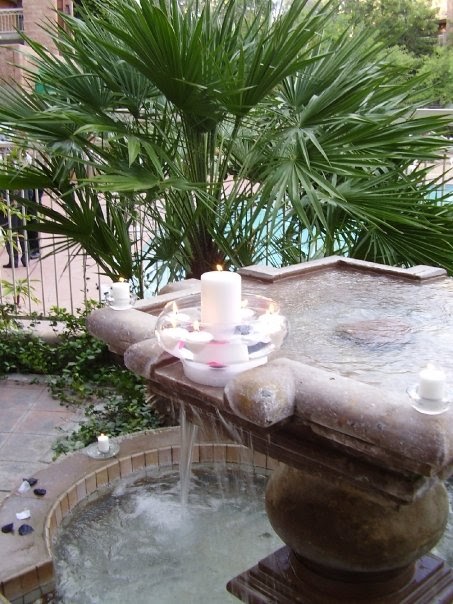
One of the things that I love most about being outdoors is the way a garden can be transformed into a beautiful event.  Last year at a friend's wedding, we went to a local Tucson hotel at Speedway and Wilmot for the reception.  I was impressed at how they had  changed a pool area into something very special.

When speaking about themes in a previous posting, these pics had come to mind from last year.  An outsider of our desert may wonder how all this is possible.....with a bit of knowledge on plants and spacing, anything is possible....anything.  That's why Arizona is such an incredible place to garden....this is what locals would call the "Arizona Room".  During this time of year when temps go down, it is very popular to eat outside at restaurants or at your own home.


One of the things I liked most was how they used a chimenea to warm up the area at night and also how they used Chinese lanterns to add a glow around the tables.  It created a very intimate setting and transported people to a magical place.  Lighting and plantings were key to this recpetion's success.
I'm not there yet to create holiday or special themes in our gardens, but I keep these images stored for down the road.  I'll show more postings like this one from several key Tucson places that have captured the outdoor magic of gardens.  Until next time, Happy Gardening!

Monday, October 25, 2010

Texan Issues in the Garden


A while back, I posted something on Texas Root Rot killing my beautiful Chinese Elm over a year ago.  During my research, I found several suitable replacement trees for that area that were resistant to root rot. If you have had Texas Root Rot, you know that you cannot plant any trees that are susceptible to this disease again in that area.  It's just a natural fact here in Arizona that the fungus lives.  It's not everywhere, but it exists.  I've met a lot of people that have had this happen.  The tree will be beautiful one moment and in the next, the leaves will be dried and curled....they won't fall....they'll just hang on the tree.  At this point, the tree has suffocated and died.  The good news is that there are plants that will grow in these spots that have Texas Root Rot....and one of them is the Texas Ebony tree.  How appropriate!  Texas Ebony for Texas Root Rot:)  The elm was green and beautiful and it crushed me when she died. But from my research, I found that Texas Ebony, which is underused here in Tucson, was a perfect fit for that very green spot in my garden. Two cons about the plants....it's slow growing and it is thorny.  The pros are that it is so green and xeric that it's just plain ol' surprising that it can grow in the dry hot desert.....but it does.  It's from the legume family which means that it will add nitrogen back into the soil and that is a good thing for your other plants. Two plants I recommend for xeric gardeners, from Texas of course:), are the mountain laurel and texan ebony.
For more information on Texas Root Rot and suggested plants for these infected areas click on the link below for more information....
Cotton root rot, caused by the fungus Phymatotrichum omnivorum, also is known by several other names such as Phymatotrichum root rot, Texas root rot and Ozonium root rot. It is one of the most destructive plant diseases and attacks more than 2,000 species. However, either the fungus infects but does not kill monocotyledonous plants (grasses, etc.), or these plants are all highly resistant. In Texas (and Arizona), the disease is economically important in cotton, alfalfa, ornamental plants, and fruit, nut and shade trees. The fungus is prevalent in calcareous clay loam soils with a pH range of 7.0 to 8.5 and in areas with high summer temperatures. Therefore, the disease is limited to the southwestern United States.
Phymatotrichum root rot has been reported in Texas counties from the Red River to the Rio Grande and from Tom Green County to the Neches River.
Disease Symptoms
Disease symptoms are most likely to occur from June through September when soil temperatures reach 28oC (82oF). The first symptoms are slight yellowing or bronzing of leaves followed by wilting. Plants die suddenly after the first symptoms of wilting. Leaves remain firmly attached to the plant. Affected plants die suddenly, often after excellent growth. Large trees and shrubs may die more slowly.

Usually roots are invaded extensively by the fungus by the time plants have wilted. When roots are pulled from the soil, root bark is decayed and brownish, and wooly strands of the fungus frequently are apparent on the root surface. Affected plants pull from the soil with little effort.
Under moist conditions, sporemats sometimes appear on the soil surface. These mats, 2 to 16 inches in diameter, are first snow-white and cottony and later tan and powdery. On large roots and tubers, there are numerous small, cushion-like sclerotia or resting bodies about the size of a pinhead. At first they are light tan but later appear dark and warty.
The fungus generally invades new areas by continually slow growth through the soil from plant to plant. Occasionally, it spreads more rapidly on the roots of infected transplanted plants. The fungus can survive in the soil for many years, and often it is found as deep in the soil as roots penetrate. Affected areas often appear as circular areas of dead plants in fields of infected crops. These areas gradually enlarge in subsequent years as the fungus grows through the soil from plant to plant. Infested areas as may increase 5 to 30 feet per year.
Hyphae and strands. The fungus produces root-like strands (rhizomorphs) that grow through the soil until they contact the descending plant roots. Strands surround a root and grow toward the soil surface. Immediately below the surface, the fungus proliferates around the hypocotyl, producing a cottony, mycelial growth. Below this mycelium, the bark is destroyed, and the fungus fills the vascular tissue of the plant. Following death of the plant, sclerotia form in the strands
Plant barriers. This technique consists of planting resistant species around an infected area. These barriers either exclude or limit the spread of the pathogen. This technique assumes that the barrier plant does not harbor the pathogen in its root system. Make ornamental plantings of cotton root rot-susceptible species with isolated plants or groups of plants rather than in continuous rows as hedges. When the disease occurs in an ornamental planting, replace diseased plants with resistant species.
Fertilizer applications. To reduce root rot, apply fertilizers high in certain nitrogen forms. When nitrogen is applied as ammonia in a manner to fumigate as much soil as possible, research shows a reduced incidence of root rot.
In some cases, valuable ornamental plants and orchard trees have been treated successfully even after root rot infection has taken place. First prune the tree (or shrub) back and build a circular ridge (equal in diameter to the top of the plant) of soil some distance from the trunk. Work 1 pound of ammonium sulfate into the soil for each 100 square feet of surface within this ridge. Fill the area within the ridge with water to a depth of about 4 inches. Repeat the treatment and watering after 5 to 10 days. Do not apply more than two treatments in the same season. Following this treatment, water frequently to prevent drought injury. Acidifying the soil with sulfur around susceptible trees or shrubs may help delay or prevent root rot infection in areas where the disease is prevalent.
Resistant varieties. Development of resistant plants using conventional breeding concepts, has been difficult due to the pathogen's wide host range. However, the following list of woody and herbaceous plants has shown resistance or tolerance to cotton root rot and should be considered by the homeowner where the disease is prevalent. The hardiness zone is given for each woody plant listed. Check the map to determine the zone in which you wish to use the plant. Use any plant with that zone number or a lower number. Plants with a higher zone number usually will not be hardy in that area. Check the list for size and foliage type to aid you in selecting the plants best suited for your particular purpose.

Sunday, October 24, 2010

Rocky Point


Things are rough right now for our friends in Mexico.  They're caught in a drug war that is crossing into the border towns of the US.  A lot of innocent people are dying all over and it is a sad fact that currently, I personally think it's too dangerous as an American to travel there.  Those of you who follow this blog regularly know how much I love this country, but from the Tucson perspective, it has gotten too dangerous with kidnappings and shootings.  There is a city that most Tucsonans love to visit besides San Diego and that is Rocky Point or Puerto PeƱasco.
It is a place for us to escape and enjoy the beautiful waters of the Sea of Cortez.  Unfortuneatly, Mexican tourism has taken a major hit this year with the increase of kidnappings and killings of Mexican and Americans alike.  A recent example is the killing of an American man on Falcon lake near the Texas/Mexican border.  Mexican pirates shot and killed him while he was on his jet ski.  The wife called the police but by the time they had arrived, he was already dead.  The Mexican authorities sent an investigator to search for the killers only to be killed himself.  His head was sent to the local authorities as a warning to stay away.  This is a sad reality right now between our Mexican friends and the US. The peaceful city of Rocky Point has also recently had some issues and attacks by night which now is warning travellers to drive during the daytime hours.
Only 4 hours away from Tucson, this city lets you escape to the ocean where you can watch dolphins jump around the waters and allow you to lazily read a book off your beach porch.  This is why it is a tragedy for all because Mexico has lost a lot of tourism.  The drug war has been ongoing over the past several years with the violence slowly increasing all over the border.  I went to Mexico last year, but for the first time in the history of my travels to Mexico, I actually don't feel it's safe to go and visit the country this year. We were going to travel the Southern loop near Chiapas, but the border between Guatemala and Mexico is having the same issues that are happening here in Tucson.
People still go however and if you do, make sure you travel by day and always with a group of people.  Lock your doors and keep your belongings secure at all times.

Rocky Point and her sister village south, San Carlos, are extremely charming places to just relax....  Personally I am a huge San Carlos fan.

San Carlos, Mexico


As you can see by the pictures, this is a beautiful place to visit....so hopefully soon our friends in Sonora will have a decrease in violence down the road because it is an incredible place to visit.....furthermore, it is the southernmost part of the Sonoran desert which has a different group of plants that only grow in that region. We have one of the most incredible lush deserts of the world....it's definitely a must see.  Happy and safe journeys!


Shaping

Bouganvillea is a wonderful plant. However if it is planted carelessly like here by people's doors, it can scar you for life....literally.  These two plants were here when I moved onto this property 3 years ago.  Anyone who works with this plant knows how thorny it is and how it can really scratch you up.  It also has a natural spreading habit.  I do like how these plants frame this stucco building....and if there is one thing that makes stucco stand out, it's bouganvillea.  For that reason, I do not want to remove these dangerous bushes.  For the first year, I cut them down to the ground, but they came back stronger, bushier, and thornier than ever.  There are blood stains to prove it.  During times of pruning, it is not uncommon for passerbys to hear me cursing under my breath at the idiot who planted these on the property....everytime you prune a branch off...several more thornier ones grow back....so what do you do to combat the issue?......shape with wire!

Rule 1....wear gloves.  You'll still get scratched and stuck but you'll minimize the bodily damage.  The picture above is bouganvillea restrained with wire.  Begin by wiring close branches together and then onto the major branches.  Wire more with twisty ties so that in case one branch lets go because of a wind storm etc, you'll have others there to prevent the branches from flying out and lashing their victims. I learned that lesson the hard way.  These plants are also anchored to the building at three levels....low, medium, and high. There is an actual anchor screwed into the building that will hold these plants in place.  That was probably the trickiest for me, but once you have the main branches anchored, the rest will all easily tie together and create a beautiful green column that won't poke anyone's eyes out.  This procedure also works with bamboo or any type of bushy plant.  The rule of thumb with bouganvillea is to plant it away from walkways or where people pass by because of the nasty thorns on the branches.  It can be dangerous so have people spot you when working at the higher levels.  When shaped or structured, bouganvillea will make a striking addition to your garden.....Here are some pointers on growing this plant.....sun, sun, sun if you want those beautiful leaves so plant in FULL sun.  It's best if they are planted near a ramada style building or against strong wiring.  Once established, this plant will rarely need watering. In fact, I don't water this plant at all.  Here is a fascinating regional fact.  In Tucson, this plant will, normally, lose its' leaves during winter while in Phoenix, this plant thrives and blooms all year round.  This heat loving plant can be seen everywhere along the interstate of Phoenix and in the gardens around this hot city.  Phoenix is hell and plants have to be tough to live there.  I may not be a fan of this city but I am jealous about two things that grow very well there .....bouganvillea and banana plants.  Banana plants here have to be protected from the frost and WIND.  However, back to my point....if you are moving to Phoenix or live there, I would highly recommend bouganvillea somewhere around your house away from entrances....it is definitely a xeric plant once established.  Until next time, Happy Gardening!!


Saturday, October 23, 2010

Persimmons Update

In the beginning of this blog back in March, I had a posting titled, "The Persimmons Mystery" and I borrowed a pretty pic from the internet because this plant is a complete mystery to me.  It was offered at our nursery for winter plantings and so I tried it out.  I've been impressed by the simple beauty of this tree.  It has grown slowly and produced only 1 fruit....the one you are looking at.....it is currently not ready to eat. It will turn an orangish/red color in November and be the last remaining thing on this deciduous plant before it turns completely bare. People love to use this word when writing about this plant...."astringent."  It has performed well during the summer heat and I am very glad to have it in the landscape.  I'm not sure what this fruit will taste like, but a final pic will be taken in November for your viewing pleasure along with my impressions of the flavor.  The fruit just turned this yellow color.  There are not many surprises anymore in life so this is something to look forward to next month:)

This week has been an incredibly busy time period for me.  I am currently working on my Day of the Dead projects with my students for an art display plus I had a SMART Board and some new furniture put into my room. As with anything, you have to bust your tookus off to get these things for your students because no one hands them over for free, but my room is now perfection.  Therefore, the blogging took a break just as things do when they get busy.  I am working currently on a lot of interesting posts that will be upcoming this week and into next.  This blogging is not only a record and journal of our grounds here at El Presidio but for me a fascinating look into the amount of things gardeners have to do besides just rake the leaves or blow the dirt off the patio......it's so much more.  Tomorrow's blog will be on shaping certain plants and appropriately titled, "Shaping:)