Tuesday, June 12, 2012

Summer Birding in Tucson

Bridled Titmouse
What's more exciting than birding in winter and spring?  Well how about birding during the summer!!!??  Yeah it's hot and miserable.  I put food out the night before and it's gone before I get up the next day which says a lot about getting up early and birding.
These pics capture the beauty of any garden full of art and nature.  This is the Bridled Titmouse checking out potted plants in a patio area.   A cooler breeze makes me happy as the sun was hot. So many of us will head to the mountains or canyons during the day.....or get up very early before the 100 degree temps start up:)
And while waiting for other birds rumoured in the area, a nuthatch joins in on the fun.
But some special guests arrive....like this cowbird.  For some, including myself, it's a lifer. Note the red eyes.  This bird lives up to its reputation.  Black with red eyes can mean many things in the bird world, but this guy is fierce.  It will kick other birds out of their nests for its own use.  How's that for vicious!?
While waiting for some more fun, a Lesser Goldfinch drops by to get a sip of juice out of this cup.
A Black Headed Grosbeak takes off in the distance.
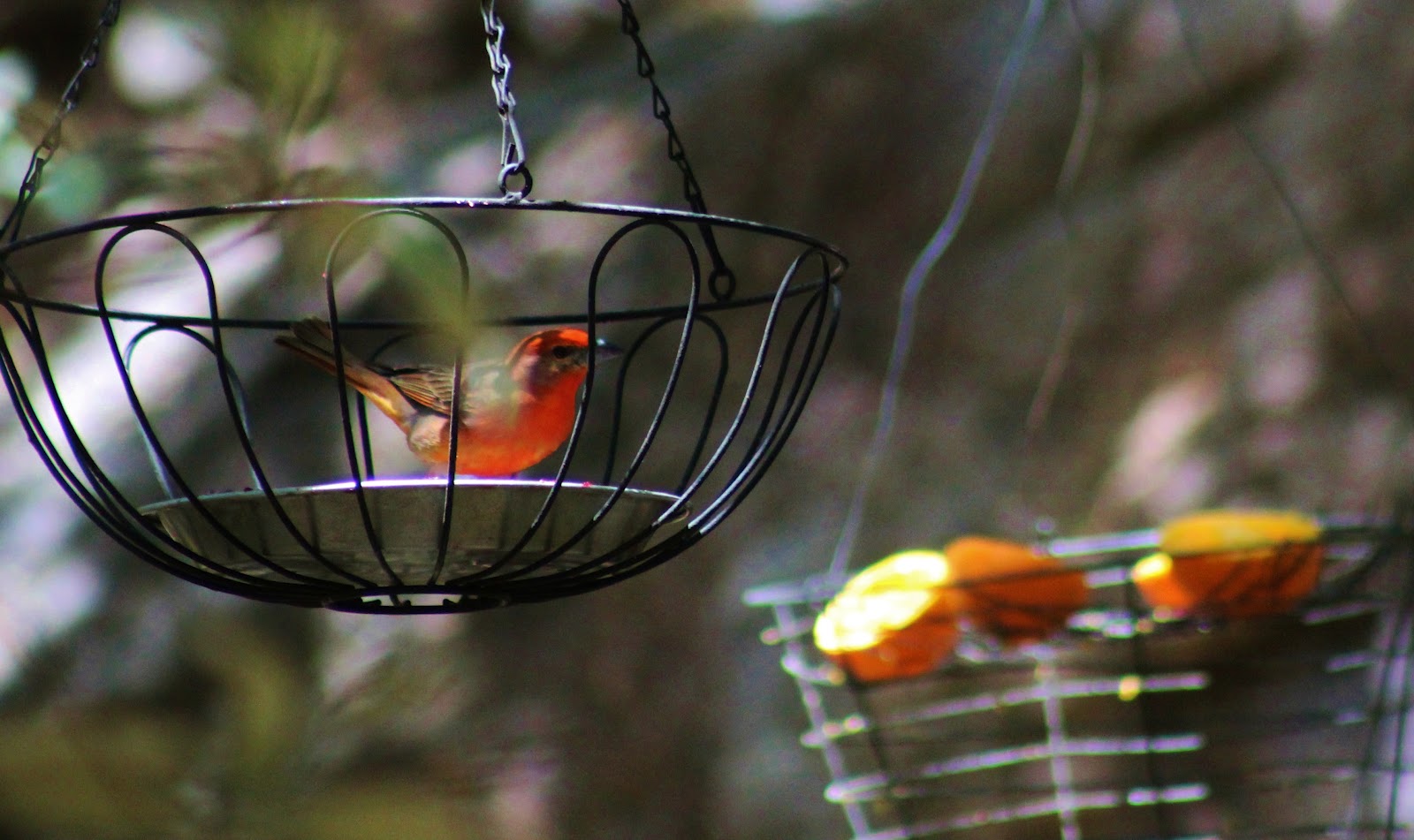
And the biggest surprise comes from this Summer Tanager.  Move over Vermillion Flycatchers and Cardinals.....there's another red bird around:) 
Yes indeed.  It twas a fun day birding during this hot summer day:) Best times to bird?  Sun up and sun down.  Best time to hike?  Before 10 AM and after 4 PM.  Please be careful with the monsoon rains coming.  Water and lighting are very powerful things here in the desert.  Be safe!  I'll be back tomorrow from our vacation and look forward to catching up with everyone.  More tomorrow....

Monday, June 11, 2012

The Chuparosa Challenge-Girl Problems

I know I know.  Tough life:)  Hey, it's a challenge.  There's nothing easy about this post today:)  So this was the 3rd Chuparosa Challenge and I was on a search for the Female White Eared Hummingbird.  This challenge would prove to be a failure.  Or would it?  The females in the hummingbird family are some of the MOST difficult to identify in the bird world.
Today I would get much better shots of the hummingbirds as I searched high and low for the female White Eared Hummer.  While the males are pretty easy to pick out, the females and juveniles provide the most difficulty.  A birder once told me that you have to look at the throat, bill, color of the bill, shape of the bill and flight patterns to figure out who is who in the world of hummers.  With only 16 hummers to identify, one would think that easy.....but it's not. Arizona is one of the only places to see all of these hummingbirds in North America. And did you know?  In South America, there are over 200 varieties of hummingbirds?  Talk about a show!
But I would capture my usual suspects.....the Broad Billed and Black Chinned Hummingbirds.
And they were pretty amazing....once again.
I am never disappointed by their grace and dignity:)
But then, I viewed the trees in the area and found my first female.  Green, dark line from eye, and orange bill.  It was a little dark at the end.  The White Eared Hummer?  No.  So it made me think....could birders have mislabeled the bird?  This female is a Broad Billed Hummer.  She has a longer bill than that of the female White Ear.  And let me tell you, I asked birders all around and they were all stumped.  After sitting down at home for several hours comparing pics and using my guide, I am convinced that this is the Broad Billed Female.  The White Ear is similiar but with a shorter bill.   Darn it!
Than I saw this female.  And my heart started racing!!!  Could it be????  No.  This is the Magnificent Female.  Long dark bill. And more importantly....you have to look at the front of the breast.
Like most of the males in the bird world, they are much more showy with brighter and brilliant colors.  Look at how this male Broad Billed Hummingbird shines a bright blue in the sun.
He is definitely a stunner!
While the females are challenging, I don't feel like this was time lost.  I am quickly learning the names of the hummers with extensive time in the field.  Today I can identify them a little bit more than the last time I wrote from the Chuparosa Challenge.  Stay tuned for more.....

Sunday, June 10, 2012

Mellow Yellow

I was determined to capture this tricky little bird on film.  I got a shot awhile back but I wasn't satisfied with it....so I needed more.  And so I returned with the sound of their voice in my head......
As I searched for the Yellow Warbler, a Ruddy Duck floats by on one of the ponds at Sweetwater.
Suddenly the chirp! Silent moment.  CHIRP! Silent moment. CHIRP! And then quickly a yellow flash in the mesquite full of yellow fuzzy flowers grabs my attention.  There are two of them flying around!  But I can barely get a decent shot of them.  They move much too quickly in and above the Mesquite.  To make things worse, the Mesquite is full of yellow flowers adding to the confusion. 


I stand for 30 or 40 minutes quietly waiting for them to come out into the open.  And finally I get my break, but the bird is way up high.  So I shoot away hoping that one shot will turn out.....
I become one of my cats as I silently stalk the bird with my camera.  Any sudden movements and the bird flies off......but I am able to get close at times.
The clearest shot of the Yellow Warbler

As I do, the bird flies off........
.....and disappears to another spot.
I am never really meant to get too close to the Yellow Warbler, but I get excited that I could track this bird down.  With Warblers, it can be tricky. On a post a while back, I told you that I had been tracking one in a Cottonwood Tree along a canyon stream but had almost stepped on a Rattlesnake.  Warblers hide well in the brush and one needs to be careful trying to get a clear shot of these beautiful birds as there is a lot hiding in the shade during a hot summer day:)
As I leave, I hear the Harris Hawk squack at sunset.  What a nice treat!
Up up and away!
 But more tomorrow....:)

Saturday, June 9, 2012

Verdin Love


I enjoy birders from outside of Arizona.  They come with hopes of capturing many birds from around our state.  They usually have a list of places they need to go.  Generally, most will find more birds than they had ever hoped for:) And so my story begins with this tiny little Verdin:)
My hummingbird feeder has been losing liquid for quite some time now.  Another nest has been built near a hummer's nest and quite interesting enough, our hummingbird feeders have been popular with the Gila Woodpecker, Verdins, and Anna's Hummingbirds! The problem with these Verdins and Gila Woodpeckers?  They sure like to move the feeders and pour out some juice for their own needs:)
These pictures were taken from my dining room window(my cat's "Plasma TV").  I've been frustrated that quite a bit of the liquid gets all over the sidewalk!  But I rinse it off with a hose and have extra hummingbird juice in the fridge to fill up during the week.
I don't know why but I do enjoy the antics of the Verdin.  They are skittish little creatures and move quickly at the slightest scare.
Now for the out of town birders.  It makes me smile while I'm on a birding mission searching for that rare bird to find others searching for the birds that I take for granted everyday.  For example, the Verdin.  3 men from California were on a bridge with their photo equipment set up excited about some bird off in the distance.  When I see a cluster of people, I become excited myself and move quickly and quietly to the location to check out the action.
They are smiling and laughing like little kids and so I ask, "What do you guys see?"  They excitedly respond, "A VERDIN!!  A VERDIN!!"  I smile to myself and say, "Have fun guys.  Hope you find lots of birds."  I give them some tips to help locate other birds that are nesting etc.  And then I think, maybe I am beginning to cross the line from amateur to something else....?  It's one thing to see a bird, but now I am using my voice and ears to locate calls from various birds.  I didn't think I would get to that stage ever, but it's happening. 
Before going on a search, I now research the bird online and listen to the calls.  I have begun to do this with the Elegant Trogon. This is yet another challenge for myself this summer as they are nesting in Madera Canyon.
But back to the Verdin.  I remember my first time hearing a different voice in my bird garden this spring.  I have gotten used to the sparrows, hummingbirds, mourning doves, thrashers, cardinals and house finches along with their calls.  When I heard the Verdin's voice for the first time, it was distinct and made me focus to attention. That was the first time I understood the value of listening.
Another post is coming up where I used only sound to help located the Yellow Warbler but more on that later.  I don't mind this Verdin messing up the sidewalk because it's a real treat to have a diverse population of birds on the grounds at El Presidio. More tomorrow....

Friday, June 8, 2012

On Top of My World

Inspired by A Garden On Sherlock Street, I decided to go on top of my roof and show you all an "aerial" view from several areas around the El Presidio Gardens.  This post is also for David from The Desert Edge.  You asked me awhile back to take a look at those Palo Verdes on the other side of our parking lot wall.....and today I'll show you what it looks like from high above.  I am scared of heights and climbing onto the hot summer roof needed to be done before monsoon.  There were beer bottles  along with lots and lots of acorns.
El Presidio is two stories high.  When I moved here 4 years ago, there was nothing here.  Look at the other side of that fence and you'll see what I had to work with......empty space!!!  This was actually beneficial for me as I was able to organize and plan out the space.  I didn't think I could have a green garden as it was all rock and ugly clay soil.  It was a battle and I remember that a lot of sweat and tears went into the physical planning.  You are looking down upon the Fern Garden.  The tree on the left is Chitalpa.  The tree on the right with the purple blooms is the Jacaranda.  The bushes behind with the red blooms are the oleander that provide a natural green screen from the ugly school behind.   The purpose of this garden was shade protection for birds.  And also for our energy bills.
Tucson is a desert.  It's one of the "greenest" deserts in the world.  We have some of the highest plant and animal diversity in our Sonoran ecosystem.   It was a hot day and I had to clean acorns off the roof.  It has taken me years of proper pruning etc to get this view.   At the end of the roof(above pic), you will note one of our very healthy Live Oaks.  To the right of that tree is a Mesquite forest and close to the front of the pic is a Euc.   Palo Verdes are yellow in the background creating a wonderful canopy for birds to nest, shade etc.
Every space requires fixing.  When I look at the space below, I see several holes.  There is a cactus that I hope will fill in that spot.  It is growing but after last years freeze, many of our cacti froze to death.  This is a transplant that is slowly moving up and out:)  If you are interested in bird gardening, it is important to provide lots of hiding areas where they can sit in the shade.  The blossoms provide food for our hummingbird and verdin populations.
But this photo best expresses what I've done to our property.   I love the desert but if you notice the adjacent property, there isn't much going on there.  There's a lovely Ocotillo and a lot of open ground with little landscaping. Most of the properties around us look like this, but I refuse to accept that landscaping in the desert HAS to be boring.  It's not.  It's quite exciting.  And our water bills are excellent.....proper planning.  My big issue will be the pruning over the years but luckily we have some great homeowners here who help out with the cuts.  Now the next set of pics are for you David:)
I'm curious.  This property is a group of Ecoconscious condos.  Note the rain barrels and Palo Verdes.  They have grown quite large over the the past 2 years!  They've added a lovely shade to our hottest exposure...the West side of the gardens. As they've grown, the trees have extended their arms onto our parking area.  Their back area is quite small and has also become a nesting ground for hummingbirds. I will say that they have really left their grounds extremely well maintained.  It is all very Sonoran and desert friendly. I'm not complaining about the Palo Verde choices, BUT were they appropriate for that tiny space?
Let's pull back a little.  Our old warm charm and their modern day charm has created a thicket of trees for birds.  The very left of this photo is a Children's Academy that has sparse vegetation. 
I'll leave you with this image here.  I'm happy with the progress of the property but I am concerned about several of these Palo Verdes growing into our parking area.  Suggestions?  Ideas?  I can tell you that once hummingbird nesting is over, I'll be asking the homeowners to do some pruning on the lower branches.  Several hummers have placed nests under the park area.  Very very smart:)  I'm making progress at El Presidio.  It's slow, but the face of our landscape is changing and every year I smile even more:)  More tomorrow.....

Thursday, June 7, 2012

Protective Jurisdiction


What would you do to save a precious plant in the garden?  Would you wrap yourself around it during a freeze?  Would you put an extra dripline around the base of the tree during the hottest summers to help it survive?  It was ill advised to put the plant in your garden space, but you didn't care because this plant mattered to you more than tacos and guacamole. And you, the gardener, master of your natural realm, KNEW better than to plant something that doesn't belong in your garden zone.....yet you did it anyway.  And so my story begins.....
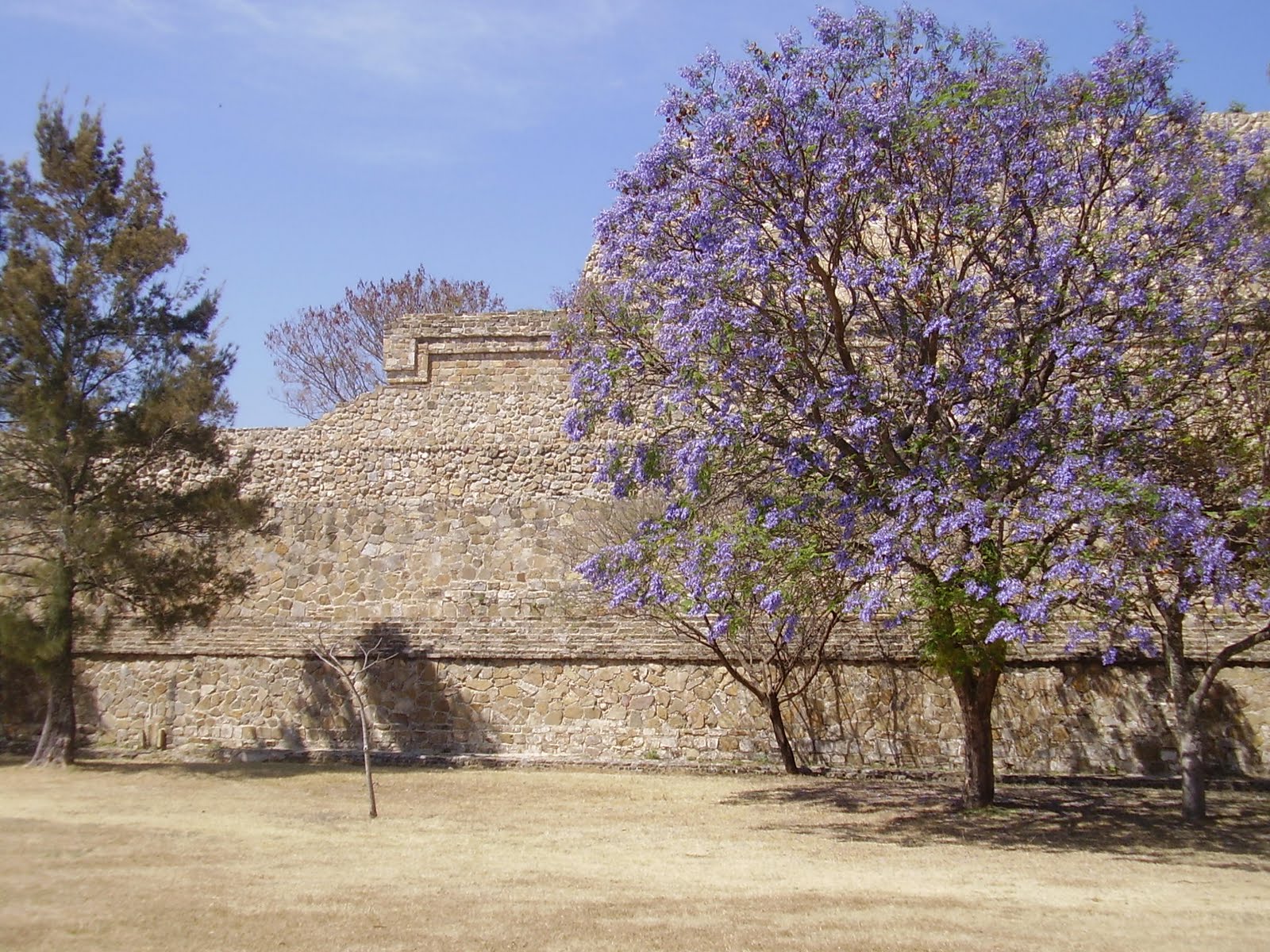
My love for Jacaranda goes back to Mexico during my travels.  On an evening walk, I saw a very large and ferny Jacaranda waving in the hot summer breeze.  Two blocks from my house, this Jacaranda flourished and stood out among all the other desert trees.  It was tropical.....green.....and oh so lavender.
Taken at Monte Alban, Oaxaca Mexico
In the beginning of my landscape project, I prepared a space JUST for this Jacaranda.  Tucson has harsh freezes at times and those temps will kill the Jacaranda.  But I live in Midtown where the microclimate is a tad warmer.  It was possible.   And so I placed my Jacaranda into the landscape outside my garden window where birds would hide in its full ferny foliage. The first year it grew large.  There were no blooms at all.
Year two, the tree would bloom for the first time and make all the residents envious of the color.  I placed it between other trees to protect it during our frost.  I loved this tree so much, I purchased two more.  At the beginning of the 3rd year(last year), a historic week long freeze would destroy the few Jacaranda trees in the Tucson area.  Most would die.  Several had been there for 30 years!!!  I freaked out and became anxious the night before the freeze would hit.  I ran to my shed and brought out house insulation and wrapped the trunk of the tree  tightly.  The freeze happened and it killed two of my 1st year Jacarandas.....but not the sacred Jacaranda outside my dining room window.  If you are a Tucson gardener reading this blog for the first time, just remember that new Jacarandas are the most susceptible their first 2 years.  I only had enough insulation for one tree.  After the first 2 or 3 years, your Jacaranda will have a stronger resistance to a freeze.
Days later, it would start oozing liquid bubbles from the bark. I was saddened and worried that I had lost my precious Jack. I went to my neighbor with the large Jacaranda tree(suffered MAJOR damage) and knocked on his door.  He answered in his underwear and I was a little uncomfortable, but I needed to know.....What should I DO???!! He said wait and be patient. And so I did.  During the late summer, the Jacaranda would rebound after I gave it a "haircut".  His Jacaranda also came back from near death. 
While hummers prefer red and orange blooms, they'll also check out the purple blooms of the Jacaranda.  Just another reason for me to plant a Jac in the yard:)
Today both trees are happy and producing beautiful lavender blooms again. The tree has doubled in size and looks great.  Do you have a plant like this in your garden?  And if so, what is it?  And why is it important to you?:)  I love my gardens but if a plant dies, I go out and try another one.  But if my Jacaranda died, I would be extremely heart broken.  Today I have heaters and other things in place.....just in case.  What do you use to protect your plants?  More tomorrow....