Living in the desert makes me yearn to be near the ocean when I have the opportunity. I guess I was also chasing Rock Sandpipers along the Oregon coast near Tillamook even if it was a little early for their arrival. It was more about enjoying the cold ocean wind. Autumn colors. Ocean. Coffee. And birds.
Tillamook is relatively close to Portland. It's an hour and something drive through beautiful misty coastal rain forest to the rocky Oregon shoreline. Between the rain and dark conditions, it was a challenge to find birds.
Beautiful Portland from on top of a dormant volcano
I often forget that most of the country is cold outside of Tucson. It's refreshing to be surrounded by misty gray skies. I'm not a fan of gray skies for more than a couple days, but I do love how they can make one sleepy and tired all the time. It's great "sleeping in" weather.
Varied Thrush are absolutely beautiful but you would never know it from the dark conditions they like inhabit
As I drove along the magical highway 6 from Portland, I'd find opportunities to stop and explore for a quick bird count in a nearby campground or parking lot. The lighting inside some of these old forest areas made taking photos difficult. The habitat though was truly unique and much different from the birding in Arizona.
I hit the peak time of autumn and everything around me was full of color. Leaves were falling. And I felt very happy.
Black Turnstone
When I arrived at the ports along the coast, I could see a very turbulent ocean with lots of high winds. The birding was still better here along the ocean than it was inland as there had been nonstop rain. Along the coast, other than the winds, it was pretty decent birding weather. I searched coves that were calm and protected from the wind. And sure enough, I'd find all the shorebirds huddled together.
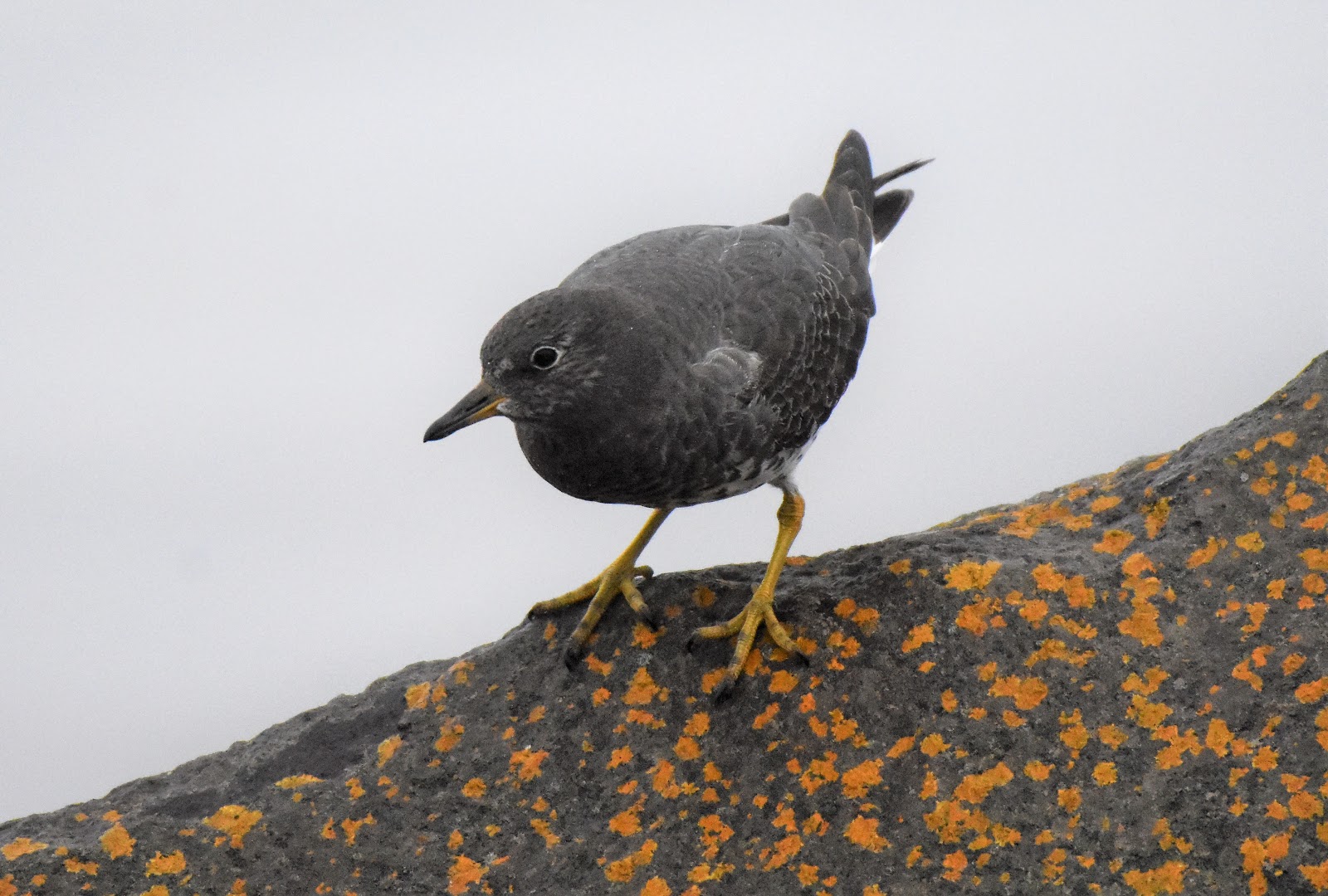
Surfbird
Originally I had planned to hike along the beach to count gulls but the waves were out of control and the tide was high. I scanned around harbors for Marbled and Ancient Murrelets but again, the water was too rough. It's amazing anything can survive those chaotic waves.
At one location, I enjoyed watching sandpipers huddle together. The wind was so loud that the birds were not spooked by my movement. I enjoyed long looks at these birds until a Peregrine Falcon flew over and caused chaos.
Least Sandpiper
I'll admit that sandpipers are not my most favorite shorebirds to observe. I like them, but I often see them through a scope. And that's rather boring. In this situation, I was able to get a few feet above them and see their field marks better.
Two slightly larger Western Sandpipers sandwich a Least Sandpiper
A new storm was heading my way and the waves began to hit the shoreline harder. I carefully walked out onto the point keeping my eyes out for rogue waves.
A bird that I don't often get to see, the Black Turnstone, was a thrill to observe.
And who doesn't love a cool looking Surfbird? I hadn't been expecting this species up in Oregon. For some reason, I think of them as a Southern California/Mexico bird, but their range extends from the top of North American to the southern tip of South America. That's pretty amazing.
The rain began to fall and the waves were now crashing against the shore and getting me wet. At one point, I put the camera away and tried to not get pushed around by the strong winds.
The highway back to Portland is absolutely beautiful. There's also a chance for birders to spy Mountain Quail and Sooty Grouse. My last lifer for the trip was the sneaky Mountain Quail.
Mountain Quail refused to pose for the camera.
I'd like to thank Khanh and Robert for their hospitality. It was the break I needed. Next week we head back to Arizona for some birding with friends. Until next time.....
Two wintering Northern Parulas are hanging out at Glendale Recharge Ponds
As we finish out this month of December, I begin to sketch out my final works for this year. The cold winds have arrived reminding us all that winter is here in the US.
Over the past several weeks, I have just wandered random trails collecting data and enjoying our birds in Arizona. Recently I have done some counts along a rocky trail on Mt. Lemmon for a friend. Yesterday, I went hiking 6 miles with another birder. We watched from the distance as a winter storm blew over our desert dwellings. The air on the mountain turned from cold to bone chilling cold. My kind of weather.
During a lunch break in a secluded fern forest alongside a tiny pool of water, we watched many birds come down to take a sip. They felt the storm coming and were actively feeding in preparation for the snow that was about to fall.
Chestnut-sided Warbler
I spoke with my birding partner about the way of the world. The frosty winds blew through the canyon in the dark woods. A Williamson's Sapsucker fed from a tree nearby.
Birds are amazing. They bring me such peace and happiness. When I'm not with them outside, I read about them inside. But during this moment in the shaded glen of perfection, I sat with my birding partner discussing the weight of the world .
This Least Sandpiper is smaller than what this pic makes it out to be
So. What I am about to write is not easy. But this is a blog about my personal reflections whilst in the process of discovering 10000 birds in this lifetime. I work with people. I watch populations of humanity. I listen. I observe my surroundings. And I feel unsettled. I know. It's not the holiday talk you might want to hear.
The wintering Zone-tailed Hawk hangs out at Reid Park for the winter.
During our conversation, we noted how the military base has been increasingly active here in Tucson. Friends of ours have been working late nights. Later than normal. A sign, perhaps, that things are coming.
Yellow-rumped Warbler
Humanity has warred with one another since the day we came to be. One would think that we would learn, but I have observed enough humanity on every side to know that not all things are equal or balanced. This year has been rough on the US and other places around the world. Fires. Hurricanes. Drought. Bombings. Shootings. Then there are the birds. I have even noticed the changes here due to our fires in the various mountain ranges. Some of us suspect that the hurricanes have altered migration patterns of warblers which is why we've had a very good eastern warbler year in Arizona. The patterns are odd.
Gambel's White-crowned Sparrow
People shop and people go about their lives like they normally would. I think about all those who have lost so much this year and it breaks my heart.
Female Summer Tanager
I sat in that wooded glen thinking about how perfect it was. And I wish I could hide forever inside of that moment, safe and protected.
My favorite pic of this series are these Red Crossbills, Type 2 from Reid Park. This has been a very good year for them here in Tucson.
After verbally putting my thoughts together out loud with this birder, I felt sad. Is there a war coming and is there no way around it? One side pushes the other. More innocent lives will be affected. I see between the lines. This isn't Iraq. This is something completely different. After our trek, my thoughts still lingered on that conversation for the rest of the day.
A Vermilion Flycatcher takes a sip from the bubbler
Anyhow, enough on this topic. I will say though that I have just shared with you some of the things that run through my head while on the trails. While you were looking at the pics(in a sense, birding with me), you were also following my thoughts. I'm pretty sure we all do it. Some birders will talk a lot while on the trails. Some birders talk to themselves:) I usually save my thoughts until we've found our birds. These are the things I process in my brain while playing detective out in the field. So thanks for reading through my thoughts here.
Canvasback
In a few weeks, my life bird hunt will take me up to Maine to visit my friend Kathie and her hubby Gus. We will be doing some casual and fun birding around the coastal area. I'm definitely looking forward to the break.
Ring-necked Duck
On a side note, I am ok. I really am. I'm just a deep thinker. I work with so many people every day that all of their worries, concerns, and stories recycle around in my mind during my off hours. It is why birding is SO important to me. It's the silence from word that I crave after these busy times. The birds I've presented today in this post are from my research and data runs for Audubon. Someone has to look over our birds:) Each of us can make a difference in their success. I'd like to encourage you to join a CBC(Christmas Bird Count) wherever you may live. It can be as easy as monitoring your backyard bird feeder or as adventurous as a long hike on a beautiful trail. Contact your local Audubon for more information. I can't change the way of the world, but I can try and make a small difference in my own little bubble. Until next time!
It's spring here in the desert. I've kept it local for several weeks because I need to budget my money for a bigger trek coming up. It has been an enjoyable challenge because I am forced to play within the perimeters of my own area. It's a different kind of birding, but it's still quite enjoyable.
Mallard duckling
Outsiders often visit the Old Pueblo in April and ask the locals, "When is your spring?" People living here KNOW that spring is subtle. Our trees leaf out and release terrible amounts of pollen:) But our trees aren't bold and tall like the ones found on the eastern part of the US. For birders, we visibly see the migration happening before our very eyes.
While waiting for my master lens to return from the shop, I took cell phone pics and used a smaller lens for some of these shots. Imagine going to your work place and finding this Great Horned Owlet staring back at you?! It was hard to focus and listen to the adults talking in the room:)
Least Sandpipers
While Tucson doesn't have a lot of watering holes, we do have a few that attract some special migrants. This time of year is good for rare sandpipers. The most common are Least, Spotted, Western and Solitary Sandpipers. Pectoral and Stilt Sandpipers are good birds but they are not always reliable. I have found that I need to be in the right place at the right time to spot these passing migrants. The key is to place yourself in those spots for a possible sighting.
Solitary Sandpiper
Staying in one area also allows for a VERY in depth look at our local birds. Take for example this Killdeer below.
Many of us know that a Killdeer parent will act injured to draw a predator away from the nest. While I am not a predator, I am clearly a danger in a different kind of way.
Almost every living creature on this planet uses some form of communication. As a birder, it's my job to interpret that communication for a better understanding of the birds. It offers a very satisfying observation as well.
In this particular case, I knew I was near a nest. I stopped quickly and scanned the area. Had I made a few more steps in the wrong direction, I might have stepped on these eggs. Thankfully, I understood what the bird was telling me. Look at how much this Killdeer's eggs look like the surrounding rocks! Nature is amazing.
I believe that Coachline, or El Río Preserve, will be one of Marana and Tucson's premiere birding spots when it's all finished. It has been a wonderful success. A walking/bike path have been put into the area making this premiere birding spot even better. There is now a parking area (with a ramada for lunch and shade). As a local, I can tell you that I am super excited about this transition. And my tires are glad as well. No more gravel/sharp rock parking:)
Several years ago, friend and birder, Magill sat with me as we did a Big Sit and counted birds under the awning at this place for the day. It was a lot of fun as we ended our observations with lots of Lesser Nighthawks flying around us.
Black-crowned Night Heron
After two weeks, my master lens returned back to me repaired and I was so excited to get the darn thing that I headed to Reid Park to film Great-tailed Grackles collecting mud. It. Was. Great. Even if they were just Great-tailed Grackles:) That's how happy I was!
But during those grueling two weeks of waiting, I did some research for our upcoming Wrenegades event. Every year, we get together to raise money for the birds of Southern Arizona. It helps support Tucson Audubon's projects.
I spiced up my treks but kept it cheap. A really nice place to bird on Mt. Lemmon is the Rose Canyon Lake area. But I didn't want to pay the hefty entrance fee so I parked off the highway and hiked down to the lake. Another woman did the same but as she was hiking down into the area, she didn't realize how far it was:) So I kept encouraging her to keep going. "Where is the damn lake? My kids better be down there." I told her not to worry. We chatted the mile hike down and got to the lake. She didn't see them but from her conversation about her kids, I guessed they'd be at the floating dock fishing. And there they were. That trek, for the day, landed me a Lewis's Woodpecker.
I also scouted around for the ducks. Again for our birdathon. There are a few wintering ducks still around....like this proud drake Ring-necked Duck.
A Round-tailed Ground Squirrel eats some refreshing Barrel Cactus fruit on a hot near 100 degree day.
And my research takes me into new areas around town locating new Burrowing Owl locations. The one at our airport is now gone which means that the construction crew destroyed the burrow:( Thankfully birders saved the birds and had them relocated. It was very sad to see them go. But it also forced me to scout out new locations which was fun.
Next week, I join up with my fellow Wrenegades to find as many birds in a 24 hour time period as we can. Will we break our old record? Stay tuned for more.....
Rarely does something as epic as a first ever mega rare bird come along and pull the entire US birding community together as quickly as the Rufous-necked Wood Rail did a few days ago. And it would happen 6 hours away(5 if you push it) from Tucson in the beautiful Bosque Del Apache Wildlife Refuge of New Mexico.
Red-tail Hawk nesting
Twitchers, people who chase these mega-rare birds, fly and drive from all over the country to find these rare gems. People doing Big Years join together and rush to the scene to get the "tick" that will possibly give them the edge in the competition. I wanted to experience this event (and possibly see this bird). But to drive all of this in one day and be back by the next day.......well that's something quite different.
Green Heron
This past week the bird has been spotted around the Marsh Loop basking and playing in the sun for hours. Birders spy upon the bird with their scopes and binoculars. The Rufous-neck Wood Rail performed several dances, a couple of songs and taught me a lesson I won't quickly forget.
Western Sandpipers
This bird, common to tropical and subtropical conditions, found its way into New Mexico. It is a US first and driving birders mad! For several days this past week, it has been out in full sight, but as we'd find out quickly, our luck would run out. We left early in the morning from Tucson and arrived at 12:45. And what's the line birders hate to hear the most? Oh yeah....."You just missed it!" But my ears could still hear it. It was still there. And I heard it fly through the reeds away from us. Then far away from us.......
Least Bittern
We spent over 6 hours with many birders searching the reeds. North. South. East. West. Nothing. Wait???!!! Is that a Least Bittern out in the open? Why yes it was!!! A lifebird. I would get distracted by these little surprises and forget about the time. But back to this bird. I've been doing this long enough to get "feelings in my gut". When the bird stopped calling from a far distance, I knew that the honeymoon was over for many of us. I spent a week hemming and hawing over going to this place. Each day the reports would come in with positive observations and I felt drawn to this event. Not drawn.....more like pulled. Eventually, I convinced myself to go with Pat. If I didn't try, I'd regret staying home for what will probably be the biggest show of the year for many birders.
Western Sandpiper-note Rufous-y Colors and patches on wings
And yet I learned a lot about the people behind "twitching". They are addicted to the hunt. One woman said that it was a "bad carbon footprint" to chase rare birds. Another said that she had a disease. I asked her if she was sick. She responded yes......"Sick in the head for chasing birds." Another told me a story about how he left to chase this bird in the middle of a family event. Yet another older woman drove alone from a far away place to find this one single bird out in the middle of nowhere. One man came from work and had a head piece that spoke directly into his head. No scope. No binoculars. Fancy clothes and a head piece. The stories went on and on like this. I discovered a whole new level of birders that I hadn't met before. True dedication.
Least Sandpiper-note yellow legs. Also the smallest of sandpipers
There was one stylish lady with a cowboy hat from Southern Arizona who made me smile on our hot and muggy hunt. She was fun to pass the time with as we waited and listened for "the bird". She had been everywhere during her life. And by no means was she finished! I really liked her. Overall, the experience was a bit overwhelming. Like any community, there are those who are cocky, hilarious, smug, humble, etc. This crowd had them all. They rattled off refuges and wildlife preserves from all around the world. They were world birders.......like me. But not me because they must have had a little money:)
While waiting for this bird, I became antsy and dehydrated. There were so many other things flying around us that captured my attention. How in the world did I stand in one place for 6 and half hours???!!!!! Well the Least Bittern was one of the reasons:)
Desert Spiny Lizard
I began to walk. Pat went to the car and saw a bird that looked like a cross between a turkey and peacock. My brain began racing. What in tarnation was Pat saying??? Big as a turkey.....but not. Like a Peacock.....but not. I pulled up my data and discovered that this peacock may be in fact a "Ring-necked Pheasant"!!! And there were coati, deer, snakes and other critters out there! Why was I wasting my time on this boardwalk??!!!
Monarch Butterfly
The people waited and waited. The sun became brighter and brighter.....hotter. Muggier. The mosquitoes became very bad.
That was it. I walked from the boardwalk and.......got lost in the world around me. I am not a Twitcher. Yes I chase birds but I will not twitch again. And yet....:) Seriously, the whole reason why I bird is because I love the hiking and wildlife photography.
Western Meadowlark
And when I did this, things became clear. No more. I'll hopefully one day see this bird down in Mexico or Central America, but for now, I will not miss out on what is PRESENT.
And that's how we found our Ring-necked Pheasant.
People are currently finding the Rufous-necked Wood Rail from the same location at the Marsh Loop area of Bosque Del Apache. It was a no show last night and this morning, but as of this write, it's back! There are lots of happy birders out there.
Eventually we ate at this place near Socorro
For the latest information on rare birds around the US, the ABA Rare Bird page can be found on Facebook. The ABA Listserv is a also a great place to find out what's going on in your area. I put the video down below from when it was first discovered by Matt Daw. Finding Least Bitterns out in the open is amazing. But having it photobombed by a rare bird? Well now that's epic. More coming up.......


 Posts
Posts