Today's post is another fascinating tidbit of research I've found through my reads. Of course all of this relates to my wetlands theme this past summer. Just when I think I've heard it all, I discover more.....and then I'll spend hours reading and researching interesting events happening around our world. My last work was on the extinct
Ivory Bill Woodpecker and Great Auk and of course, the cloning of extinct animals. These will be ongoing works as long as I blog. Today's post is on the near extinction of the Marsh Arabs and the immese wetlands that were once found in the country of Iraq.
 |
| From 2000-2009 |
Maybe many of you already knew this(I'm always a few steps behind everyone else:), but Iraq is more than just desert. Americans, and this world, have seen the pictures and film coming out of this country. And then I had Netflix and watched a special known as "Braving Iraq." It was an eye opener for me and changed how I view Iraq today. If you haven't heard this story, just wait. You'll be shocked. An ancient culture lived in marshlands along the Iraq and Iran border. These marshlands were immense and larger than the Everglades of the US but a bit smaller than the Pantanal of Brazil.
 |
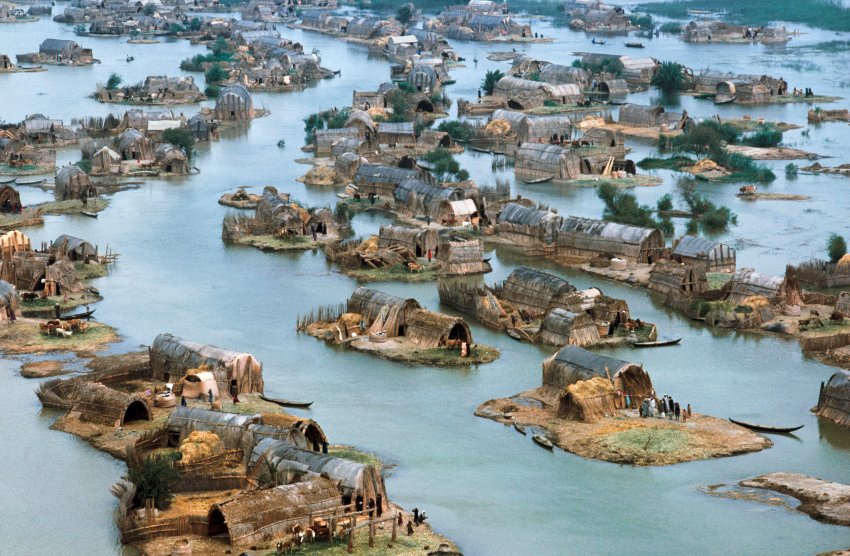
| Taken in the 1980's. A vast expanse of homes made of reeds. |
Once known as the Garden of Eden, Saddam silenced the wildlife and peoples of this area. In 1991, he began to drain the waters fed by the Tigris and Euphrates river. An ancient culture was destroyed, people were displaced, and the wetlands that fed millions of birds were also destroyed. A desert was created and by the turn of the century, the wetlands had lost the battle. A tiny area was all that was left of this once great region. By 2001, it was said that the wetlands faced an inevitable extinction. Then the Iraq war happened.

The above image is quite different from the one most Americans have of Iraq. It shows a greener country. Once known as the Fertile Crescent of the world, this half-moon shaped chunk of the Middle East was the birthplace of human civilization. Today, we associate the area with endless deserts, oil and improvised explosive devices. Then the war began. And the Marsh Arabs began to destroy the canals funneling the water back into the extremely dry lands. It was ineffective and did more damage in the long run restoring this great area. Then the United Nations stepped in and declared that the Garden of Eden would be restored once more and it would become a World Heritage Site. Saddam would be caught, tried, and hung for his crimes against humanity. And the wetlands would return but only with the help of courageous people who braved the years of the war for a better Iraq later. The Iraqi wetlands once covered tens of thousands of square miles that were home to snakes, lizards, frogs, fish, water buffalo, gazelles, jerboa, and endemic birds.

Look at the map above. All of it was green and full of life. Today the marshlands are growing larger again and expanding into their once fertile areas. Even after years of desertification, plants still found a way to grow back and thrive once more. The Marsh Arabs, many who were just children when the wetlands were drained, are returning home once more. Many of of their parents would never see their homes again and die believing that the wetlands could never be restored. But the children remembered.

When U.S. forces invaded in 2003, only some 400 square miles of marsh remained. Once Hussein’s regime was brought down, locals began destroying the dams that held water back and allowed the wetlands to flood again. Today, more than half the original wetlands have been restored, and thousands of birds and fish, as well as the Marsh Arabs, have returned to the land. Today the area faces issues of drought and dams being built in Turkey and Syria. The water isn't near the levels it used to be but the area now continues to grow and improve. And while recovery may take some time, it's nice to know that the endangered wildlife has a chance to expand again into the larger areas. If you have Netflix, type in Braving Iraq. It has a birder's take on the special but it was filmed during the war and was an eye opener for me. Another addition to my list of places to visit in the future. More tomorrow....


 Posts
Posts