Tuesday, August 20, 2013

The Winds of Change


The seasonal desert changes are subtle and in some cases, almost invisible. If it weren't for the promise of lower temps in the fall and winter, southern Arizona wouldn't be such a popular place. And so when migration commences towards the end of July into August, birders know that some incredible birds will come our way. The only thing?  The onslaught of deadly heat. This year, for the first time in my life, I can actually see the changes. 

Blue-footed Booby

Nowhere is it more apparent than with the migration of birds.  Storms still blow in rare birds like the Blue-footed Booby above.


And people still escape the heat with water.  It was this way before and forever it shall be I think until the end of our days.

On a hot day with a Mega Rare, Code 4 bird(5 is the highest), North American birders came from all over the country once again to get this first ever recorded sighting of a Blue-footed Booby in SE Arizona.  I have seen these birds in the thousands on several islands off of the coast of Northern Mexico. But for Kathie, it would be a lifebird.


I just needed to bird.....really bird.  I hadn't done so for a full week.  But as is the case during this time of year, my thoughts turned towards the future.   


I have been reading about the historical birding spots of Arizona.  Some have changed.  Some have not. And some are in danger of disappearing.  Thanks to great documentation by birders over the decades, we, today, are able to walk their footsteps and glimpse at what was, is or may become.

Kino Springs

We birded Patagonia and Kino Springs near the Mexican border.  These places, thankfully haven't changed much.

Lazuli Bunting

But as birds are now heading south, my thoughts wandered more about old birder haunts that I had read about.  Birders who are now gone.  Had the birds they had seen also changed over time?

American Coot

And then there are the birds. Those magical wonderful and random sightings that happen during migration.  I watched as a Nashville Warbler went through my garden patch in Midtown Tucson(Speedway/Alvernon).  It was a show stopper. It slowly jumped around my potted plants and while it was thrilling, I thought about the long journey ahead.  For 5 special minutes, I watched outside my living room window as it hopped out of my area picking up bugs from the ground until it disappeared for good.  And then I was sad.  In my mind, I said, "Buen viaje" or Good journey.  Never had I felt that before. I have about 15 regular birds at my feeders.  This particular bird was a first!!!  We traveled hours to find this bird in Yuma during winter. But for this time around, we didn't have to do anything but look out our window. 

Nashville Warbler
And yet our weekend was full of wonderful finds in Sonoita and Patagonia.......we discovered Grasshopper Sparrows, Buntings and more!

Eastern Meadowlark

Then we stopped at a place to watch birds.  It has been historically a birder hotspot for many decades. As with everything, change is inevitable.  The Paton's passed away and today Tucson Audubon, Victor Emanuel Nature Tours and the American Bird Conservancy are trying to save the house and property.  It's a landmark for so many people.  But will it stay open?  Time will tell.  It might very well have been my last time there. If you are interested in helping save this place, click here to make a donation. This drive will happen until October 15th.

Paton's House

I watched the Pipevine Butterfly dance across flowers.


Time has changed me.  It has made me more aware and sensitive to the subtle movements within this larger world.  One cycle ends and another begins.  But just how many cycles will I get of my own in this lifetime?  I have only scratched the surface on this lifelong world journey.


Sunday, August 18, 2013

"Bromance"


Rufous Sabrewing
"Bromance" is what my friend titled my new relationship with a fellow birder.  I wasn't sure what that was but I was thrilled to find another birder on our trip.  Together we planned a day in the nearby Finca Pilar close to the Central Park of Antigua.
An ancient cathedral surrounded by the rain forests around Antigua
His name was Justin and worked at the Earth Lodge.  He is a Scottish guy hanging out in Guatemala for awhile discovering all of the incredible birds around the area. Plus he was learning about the culture and language while doing some work at the lodge.  During my investigation for places to bird, the Earth Lodge came up on my internet search and with it a bird list!!!  And then I began to dream......
This bird is a mouthful to say.....Orange-billed Nightingale Thrush
The owners were great and emailed me back quickly letting me know that one of their employees also birded and would have a better idea about the birds in the area.  When I arrived there, I met Justin and was truly excited to hear about the birds found around his area.  He spoke "bird" and offered to take me to Finca Pilar near Antigua.
Band-tailed Pigeons
The following day we took off.  I brought my water pack as my body was still adjusting to the humidity factor.  We arrived at Finca Pilar and paid the entrance of 50 Quetzal(somewhere around 5 bucks).  I had read about this place on Ebird and noticed that there were hummingbird feeders on the property.  At the time, I didn't realize how rare this would be around Guatemala.
Golden-olive Woodpecker
As we entered through the gate, I noticed powerful looking hummingbirds.  More like hummingbirds on steroids.  Today I'd focus my efforts on a group of birds known as the Sabrewings.  Even the names were exotic sounding......something alien straight out of Star Wars.  The Rufous and Violet Sabrewings were two that came regularly to the feeders.  And they were such brilliantly colored birds with a large and wide flight pattern.  They are large Neotropical Hummingbirds.
Violet Sabrewing
These birds swung widely from one feeder to the other and cleared out the area for a few moments before the Magnificent hummers and gang returned.  Justin, who was familiar with these birds, gave me a heads up on the characters we might find.  I think on this trip I learned about how invaluable it was to have someone who knew the birds from around the area.  It would be one of the few times on our trip that I would go birding with someone who was indeed a birder.
At the hummingbird feeders of Finca Pilar
Justin moved closer to the area and filmed the birds up close.  It was a beautiful place full of wonderful trails and covered hideout areas to observe birds.  This is definitely a place for birders and A MUST VISIT!  The Violet Sabrewing was fast. It was brilliant in the sunlight as its glowing purple colors sped in and out of the covered canopy.  But oddly it wasn't the Violet Sabrewing that attracted my attention.......
In fact, the bird distracted from the other less colorful characters around the area and I had to really pay attention to who was coming in and out of the feeders. And not all of them were on the feeders.....some were going to the flowers.
Green-throated Mountaingem
The Magnificent Hummingbirds dominated the area and were EVERYWHERE!  I found comfort in that experience.  Usually in Southern Arizona, they are much fewer in number.  Common.  But not as numerous.
So I stood in one area for quite a long time and observed the hummingbirds and their habits.  There was so much going on that I had to focus on one bird at a time.  I crossed my fingers and began shooting off pictures.
Azure-crowned Hummingbird
And it was difficult.  I was still brand new to the area.  It was my 3rd day in Guatemala and we were in a new area full of new birds!  Just changing the habitat slightly brought in a whole new crew of characters!

El Mirador(lookout) from Finca Pilar
We trekked to the top of the hill where we could overlook the valley below.  It was such a beautiful and comfortable walk.  There were a lot of birds around the property but they were so difficult to spot in the dark woods.  By the time we'd get our eye on a bird, they'd fly off.  Many of the birds, while brightly colored, blend in very well with their surroundings.
Glasswinged Butterfly
There were lots of butterflies around the area, but this is one of my favorites for its transparent wings.   It's known as the Glasswinged Butterfly(Greta oto).  These insects are a real treat for me as they are quite unique looking.
Golden-fronted Woodpecker
I also enjoyed how cactus would grow on trees.  There were a lot of Night-blooming Cereus hanging from limbs.  Here the Golden-fronted Woodpecker eats the fruits(dragonfruit!) off of this plant.
Common Ground Doves were indeed true to their name and quite common in Guatemala. After our trek, we sat down and ID'd using Justin's large but extremely helpful book on Central American birds.  It's organized a bit differently than Sibley's etc, but it's certainly the best book out there for ID questions.  For those of you looking for a guide to use for this trip, I'd highly recommend this book below.....
While it's not the greatest to pack in a tight suitcase because of its massive size, it has great info on habitat and ID questions.  Luckily Justin had a copy of his own to share with me.
Finca Pilar is a fantastic place to bird.  Once we entered the gates, I felt safe to film and record birds with my camera.  Not all places are like this and at times, I would see a life bird and not be able to take a pic of it due to a sketchy area.  With Finca Pilar, there are no worries:)  But like any place, common sense is important.
My real focus for the day was to get shots of the Rufous Sabrewing.  I don't know why but I love the orange tones of this bird.  It was massive as it fed from a variety of flowers found around the property.  Flowers from the genus Heliconia are favorites.  Around the property, you'll discover Banana plants and Birds of Paradise situated in areas with high hummingbird traffic.
Rufous Sabrewing
This is definitely a place I'd like to go back and visit again.  We arrived later in the morning to bird here before the monsoon storms arrived.  Now I may have come earlier but my target birds were the Sabrewings and they enjoy sunlight.  If it got cloudy, the birds disappeared.  The 9-10 AM hours were always the best for sunny conditions.  It was funny how a cloud would darken the sky and the birds would disappear.
By the time we left, the skies had clouded over and it was time to go.  Bring a rain poncho or umbrella during the summer.  My "bromance" with my new friend Justin would have to end as we continued our trek into new and foreign areas.  I'd like to thank Justin for his time while we stayed at Earth Lodge.  It was a great place to hang out with lots of wonderful discoveries.  We made lots of friends who we won't forget anytime soon.  I told Justin that if he ever came up to Tucson, I'd repay the favor and take him around our beautiful desert and bird.  And that's the wonderful thing about birding, it's as much about meeting new people as it is about finding new birds.  More from our trek coming up.......
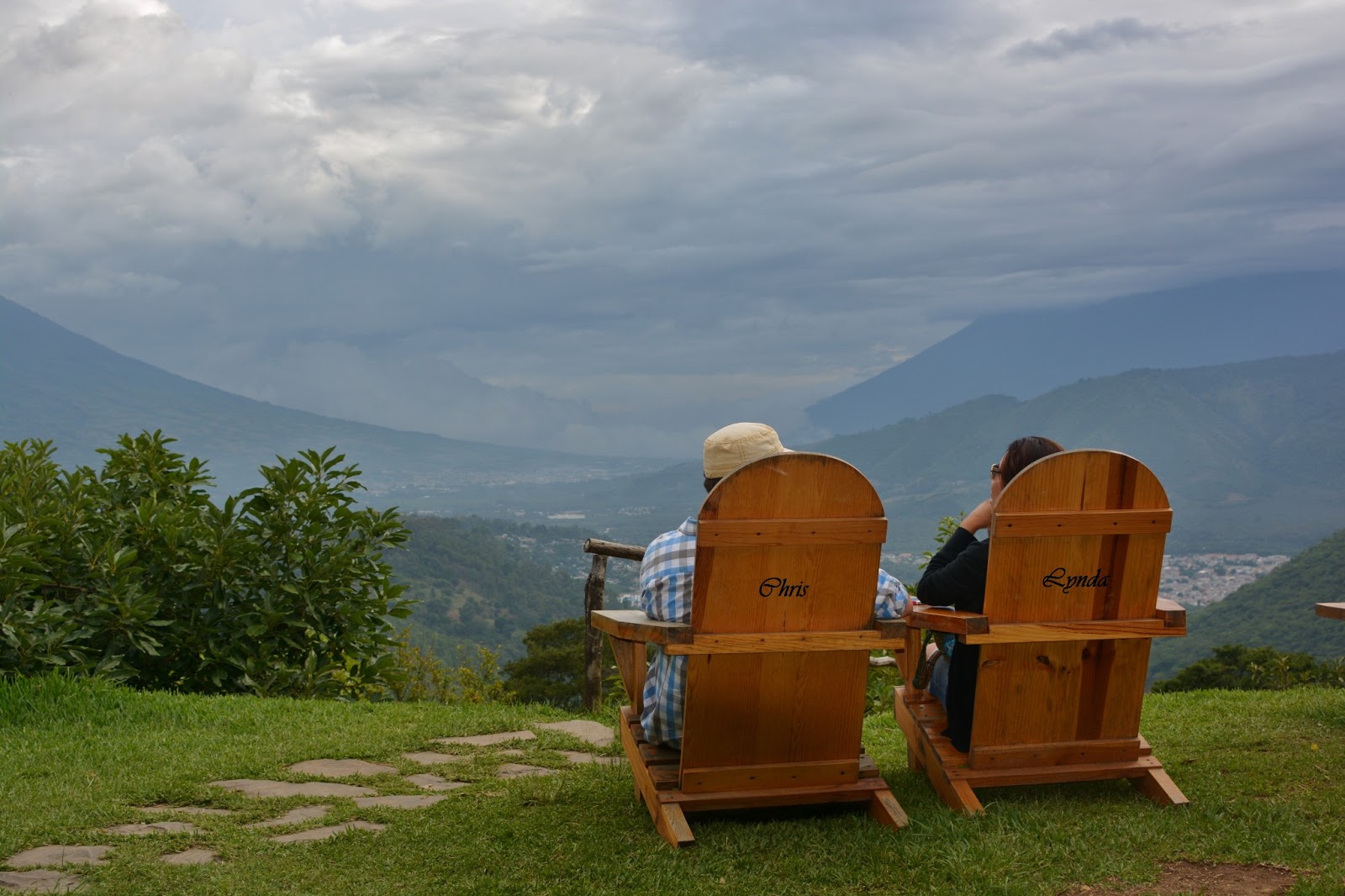
Earth Lodge overlooking the volcanoes surrounding Antigua
I'm linking with Wild Bird Wednesday.


Thursday, August 15, 2013

The Prime Directive

Pyrrhuloxia male
Taking a break from the Guatemala treks, here is a fantastic discovery closer to home.  My Aunt from Prescott came down to visit me in Tucson.  I had taken her to Sabino Canyon for a walk and possibly find some wildlife.  She wanted to know more about what I did on my free time.  And so I showed her....
And not too far from the entrance to the park did we spot our first adventure!  I noticed a lot of Pyrrhuloxia activity happening around a grove of mesquite trees.  So we moved closer to spot what all the commotion was about........and then my Aunt saw why they were going crazy........look at the pic above.
Pyrrhuloxia Female
A Coachwhip snake climbed the branches searching for the young ones in the nearby nest.  The father Pyrrhuloxia tried to distract the snake from the babies.  Meanwhile mom had food in her beak for them while she sat nearby to the young ones.  But where were the young ones?
Coachwhip Snake(Red Racer)
My question would be quickly answered as one plopped down in front of me on the road.  Now I'm not one to interfere with nature's battles, but the little ones were in danger.  Well they were out of danger from the snake, but not from the human "tram" that drove up and down the road.  So I led them back near the base of the trees while the snake climbed higher towards the nest. At least they were safe from the human traffic.
We did our part to help the little ones out, but it is my rule of thumb never to interfere with "the show" unless of course humans caused it.
We hiked to the rushing waters of Sabino and cooled off.  And for the moment, the Pyrrhuloxia family was safe.  Just one of the many dramas that unfold in nature.  More from Guatemala coming up.....

Tuesday, August 13, 2013

Secret Treasures

Guatemala is a real treat for any birder or wildlife aficionado.  The country has over 732 bird species alone!.  And there certainly are birds hidden everywhere.  My advice about when to bird in Guatemala?  Winter.  The bird population doubles as most of our North American birds migrate back down into Central America for the winter.
While there, I found 130 different species. Some I had already seen, but most were all new.  
Take for example, the Dusky-capped Flycatcher(above).  It's call makes this bird easy to identify.  It has a "meeee-ooooo" sound that stands out in the crowd.  It was fun seeing birds we have in Arizona down in Guatemala. Each bird species found was worth one imaginary birder point.  If you are going to bird a place, you challenge yourself to find as many bird species as you can. 
 And while I had seen this Yellow-winged Tanager (below) back in Antigua, I hadn't seen it in this county.  So another challenge for me was to find as many birds as I could in each place! So while the Tanager wasn't a lifebird, it was still an important find during my observations.
 Now I have to say this.  The views in this country are out of this world.  This particular post is set around Lake Atitlan.
 While we were there, I witnessed massive flocks of Lesser Goldfinches.
Something as common as American Coots were hard to find.  Only at the end of our journey, did we encounter them in very small areas around Lake Atitlan.  I was actually excited to find these birds.  Something so common back home was special here.  And it made me look at them differently when I returned back to Tucson.  I appreciate them even more.......if that's even possible. 
BUT!  I had been hearing birds that I did not recognize.  For this particular stay, I studied my birds well because there were some strange ones found here.  Take for example the Provost's Ground Sparrow.  I was coming back from dinner and caught the bird near our terrace. The bird quickly vanished.  By this point in my trip, I was exhausted.  I knew this bird from my studies and pulled out my cell phone to play the call.  When I did........Mr. Provosts came out to visit with me. 
But the hardest trial for me was the last bird.  I heard the call and instinctively knew I couldn't let this one get away.  And I pished!  AND PISHED!  My friend continued on her walk while I chased this warbler through the trees. 

 There was an intense urgency with me that I didn't understand.  But something inside my head made me instinctively recall this sound. 
I made contact with the bird and then realized why this one was special. It was a real treasure for it was the one and only Rufous-capped Warbler.  A bird found south of Tucson in the Santa Rita mountains.  However to get to them, one must make a tricky hike up a waterfall full of grasses and cactus. These warblers follow the stream up and down the canyon.  My friend Kathie almost fell off the rocks, but thankfully I blocked much of her fall. She still got some nasty bruises though!  I've searched for this bird 3 times on that dangerous trail, memorized it's call, filled my water pack for the hot trek and have plenty of stories to go with those adventures.  I remember once an old woman sitting on a stone moving her feet back and forth like a little kid.  She asked us, "Did you find the warbler?"  
"No.", we replied.
"I won't go up that rock.  It's too dangerous."
She reminded me that time is indeed ticking.  I won't always be able to do these treks. So this warbler is for all those people who can't see them on their own. After all, an adventure is best shared, isn't it? Below is a video I took to show you the kinds of habitats we explore to find those birds.  Life is truly wondrous. 
The adventure continues.....
Check out Wild Bird Wednesday for other worldly discoveries!