Saturday, March 19, 2016

Birding Ethics

The singing Black-tailed Gnatcatcher
How far would you go to get "that" shot?  Apparently for some, they'll do anything including endangering a bird's life to get that branch-free, close-up picture of their subject.  When birding in large groups (or around others), you can pick out the various degrees of birder or photographer.


The Gilded Flicker at sunset
As most of us already know, birds, in general, are tricky to capture on camera.  So finding them posing perfectly out in the open can be a wonderful opportunity. Take for example this Gilded Flicker.  At Saguaro National Park, it tends to be skittish.  When I do find the birds here, they cling closely to the Ocotillo like in the pic above.  Sometimes, they can be very accommodating like the one we found in Scottsdale below. The bird just flew in and sat on the wall staring back at us. 


Naturally we chase birds.  Sometimes playback is used a couple times.  Sometimes we pish and hope for the best. On this evening, I pished and had a curious Black-throated Sparrow come and visit me. 


Black-throated Sparrow
So here's where my story begins.  Another birder was searching for the very tricky Long-eared Owl in Arizona. To cut the time and make use of our bird schedule, we had to join this walk. I was with a lister(a person who tries to add as many species of birds as they can onto a list.  In this case, his Arizona list.) I knew of several Long-eared Owls that were being seen in a location that required a bird walk. The only drawback?  Crowds of birders! 

Female Northern Shoveler
PS.  Arizona is amazing.  If you've never been here, you've got to come and bird.  You're going to love it!  Anyhow, everyone came to the Audubon lead Arivaca-Cienaga Boardwalk on a Saturday morning to see the Long-eared Owl.  As I had anticipated, there were nearly 30 people from all over the country on this trek.  All hoping to find the owl(s).  An internal groan happened on both our parts as large groups are not our thing. But sometimes you have to do them.  However, I will say that the group was a great bunch. Sometimes they can be very talkative!  If you're talking, you're not listening or watching for the birds:)

Snowbirds enjoy the varied landscapes of Arizona
I came once before to find these owls. This time, I wanted to see if I had looked in the right area.  And I had! So that little information made me happy and confirmed my investigative powers are increasing! BUT these owls are super tricky to find because they camouflage so well into the hackberry trees/bushes along the trail.  Because we were on a tight schedule, we couldn't stay for the entire walk and had to leave early.  This is something I should have told our guide before we got on the trails.  

This is the owl that everyone got to see during our walk.  Lots of branches!  But they aren't always inside the branches. 
The word "owl" makes people go crazy.  You don't even have to be a birder to love them.  Anyhow, our guide was excellent and a very nice person.  I didn't know him nor the visiting out-of-state birders.  But we understood our guide when he told us that he didn't want to disturb the owls roosting.  We all agreed to the rules and got our quick glances and quickly moved on.  It's what I would have asked my group if I had been leading a tour.  It's what I always do when I have several visitors coming into town to find owls. 

Sometimes they perch at your campsite in the evening!
Once we saw the owl, we did some more birding with the group. However, we had to take off soon afterwards because there were several other birds we had to find for the day. Otherwise we wouldn't have been able to see everything before sundown.  While our guide was chatting with the group, we took off to stay on schedule.  I didn't want to interrupt the talk.  I had intended to email him that night and thank him for the wonderful job, etc.  

Peña Blanca Lake for the Rufous-capped Warbler

So we left to search for the Rufous-capped Warbler. Yet I felt an uneasiness in my stomach.  Not a good sign.  Then the unthinkable happened. I got word that rumors were spreading throughout the birding community that we had gone back to disturb the owls and get better photos.  My new lens has been getting a lot of attention which I hate.  They thought we were going to try for better photos.  And so did the guide!  If they knew me, they would have known better.  I am one of the most responsible birders out there. That night I sent emails out. More work for my carelessness! 


The next day I went out with my friend Cynthia to go birding. The ill rumors had still lingered and made me upset. Thankfully the guide wrote me back and we were able to clear up the misunderstandings.  So what did I learn? When in a group, I need tell the guide what our plan is before starting the trek.  From the guide's part, he apologized for assuming the worst. But honestly, I would have done the same thing. And thanks to my reputation, he discovered quickly that I was one of the "good" birders.  Your reputation is everything in the birding world.  The honor code is an unwritten book of rules that are known by all birders. Break a rule and you will quickly feel their wrath! Birders can be as ruthless as a Great Blue Heron filling up on a newly hatched nest of Red-winged Blackbirds!

And sometimes, when you least expect it, the bird will pose for you just like the Gilded Flicker did.  That's what's fun about birding.  Just be patient and it will happen. 
Like most things in life, it all comes down to communication.  Lesson learned.  I'm so used to being an independent birder that I forget how the whole group mentality works:)  And how about you?  Any similar stories or mishaps while on the birding trail with others? Until next time.....

Saturday, March 12, 2016

A Much Needed Upgrade

Violet-crowned Hummingbird
As the birder inside of me has grown, so has the need for better pictures.  When you get your first camera, you think, "WOW!  How can it get any better than this?"  Then a better lens comes along......

Broad-billed Hummingbird
......or your eyes start searching for the details that are missing in your pics.  Last year around November, Nikon came out with their new 200-500 mm lens.  Word on the trails was that it was an awesome lens for a good price. The problem? The lens was on back order because it was so popular. 


There isn't anything more exciting than finding something rare and special out on the trails.  The feeling is only heightened when I am able to capture the bird feeding or doing something interesting.  The problem?  My camera wasn't capturing what I was observing anymore. All the cool behavioral stuff came out blurred.


Since Las Aventuras began 6 years ago, I have upgraded my camera gear 5 times.  I found myself taking landscape shots with my phone instead of using my camera. However, I did use the lens for close"r" bird photos. 


My former operation was a Nikon 70-300 mm lens.  And I will admit that I have had to be stealthier to get closer to my birds.  This has helped me now with my newer lens which extends my power to 200 mm more!!!  And that is a game changer!

Verdin
During our Mexico trip, Gordon graciously let me try out the lens.  It is heavy and akin to lifting weights, but nothing my harness can't handle:)  When I snapped the lens onto my base, I instantly saw the quality of image increase. My eyes have to get used to tracking birds in flight with the new lens, but it takes time and practice.  Something I'm more than willing to do for a quality image.


All the photography rules still apply.  Better pics happen with the sun behind your back.  I now have to be careful about hitting others with the lens. People stop.  People look.  And people comment.  I honestly don't like the attention because I'm out there to find birds who generally don't like being around talking people.  While filming the Violet-crowned Hummingbird featured in today's post, I accidentally smacked my Canadian friend in the head. I heard her whisper, "Okay Rohrer..." I had a good chuckle.  Hey! It takes time to get used to the new weight and extension on the camera:)


Yellow-rumped Warbler

Some of the hardest birds are the red ones.  When I bought the lens, they were the first ones I went after:) And the tests began!  The bright sun on a Vermilion Flycatcher or Northern Cardinal can make these birds "flare" and blur in the pic.  But this lens did a great job toning it down:)

Vermilion Flycatcher

As for the smaller birds?  Excellent.  I caught this really cool Orange-crowned Warbler taking a bath in a stream.  I was at a distance and did not distract the warbler in the activity.  This is what I'm most excited about presenting to you all now on this blog.  You'll be able to "observe" with me some of the really cool behaviors I see out in the field but can never capture properly.

Orange-crowned Warbler
The detail is everything. 

Arizona Woodpecker
For now, this lens has reanimated my work out in the field.  I love the work by National Geographic and strive to be that good.  Maybe I'll never make their ranks, but I will certainly try. The one thing I DO know.  Birds. 


Next week, we investigate a botanical garden in LA for some fun exotics and cross the ocean to search for a rare(for the US) Spotted Dove.


Bridled Titmouse

For now, I'll be taking part in the annual Hawk Watch in Tubac:)  Lots of fun starting up with migration.  Until next time....


Broad-billed Hummingbird

Saturday, March 5, 2016

Laridae


Gulls. They are a most unloved species by humans.  I grew up with them in my hometown of Two Rivers and took them for granted. They are loud, obnoxious, messy and can be downright cunning! Today, I find gulls to be some of the most fascinating birds out there.

Heermann's Gull
It's not easy being a gull. People shoot at them, throw things at them and often use foul language around them at the beach.  Sure they crap on people's things, steal their beach snacks and like to congregate in large groups, but the opposite can also be said about people:) Every day gulls clean up people's messes around public areas. They also face other human threats. Take for example this near threatened Heermann's Gull.  Did the bird lose a foot to a fisherman's net?  Considered to be one of the most beautiful gulls of North America, it's one that faces declining numbers.

Left-California Gull Right-Heermann's Gull

The California Gull with its' nice round head and smaller build with both a black and red dip on the bill makes it an easier gull to ID. It's also the state bird of Utah.

Yellow-footed Gull
The Yellow-footed Gull is the most special gull of all.  Many American birders try their best to find this bird in the US so that they can count it on their ABA list.  Just a few are seen and known to breed in an area known as the Salton Sea.  Unfortunately, the Salton Sea is disappearing and these gulls could be restricted entirely to the Gulf of Mexico if this US habitat vanishes.

Herring Gull
Who has pretty pink legs?  Why this Herring Gull of course! 


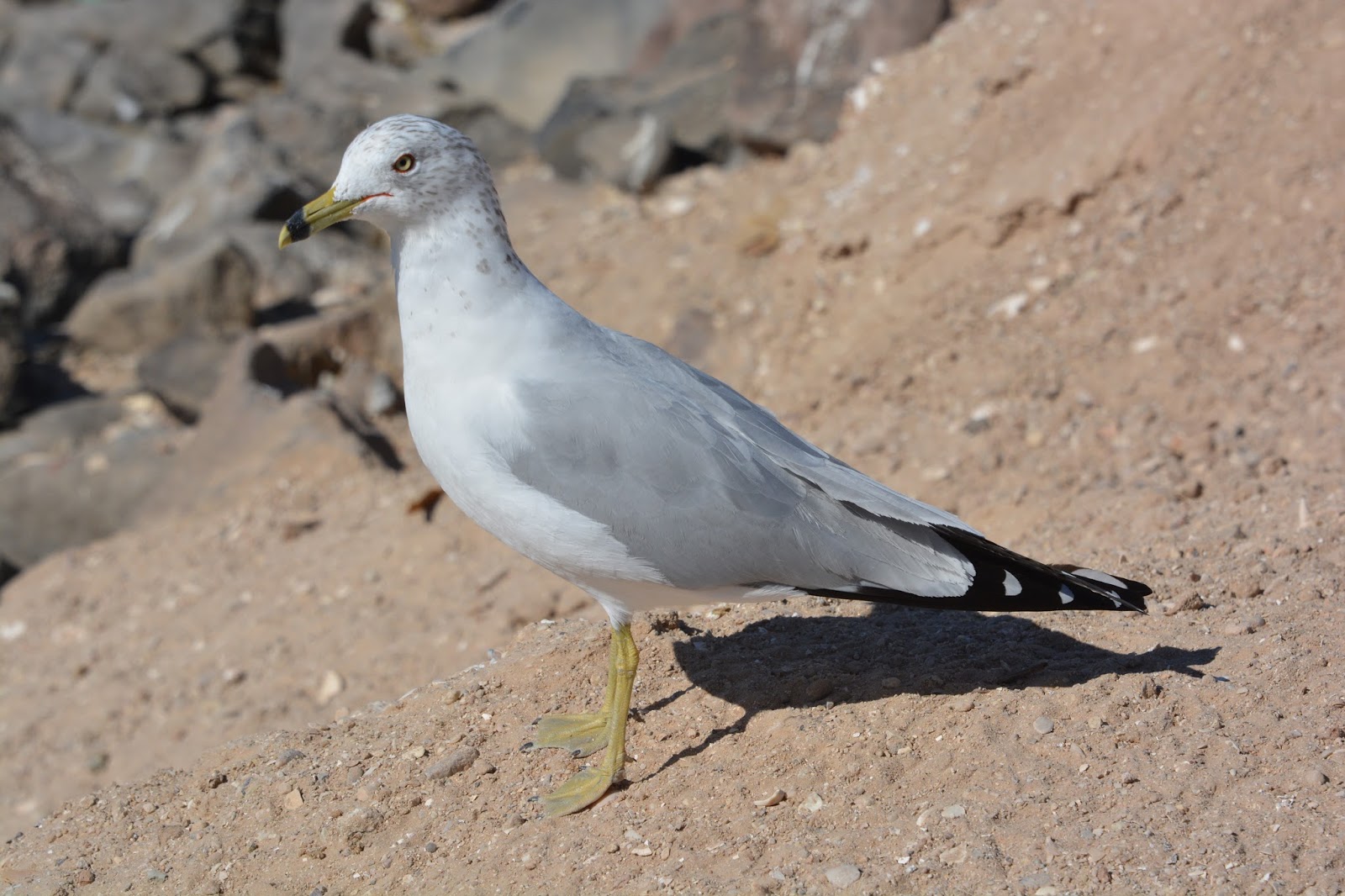
Ring-billed Gulls are everywhere and tend to be smaller than most other gulls. They are inland gulls and are quite common in many areas.

Ring-billed Gull
Many times people make the mistake and call gulls "Seagulls".  In the birding world, this is taboo.  Just use the word "Gull" and you'll be okay. Although, there are many gulls that fly over the sea.....Just saying:)

Great black-backed Gull
The Great black-backed has a VERY dark back and is rather large. Just like the name suggests:) Once they were rare off the shores of my hometown.  However, their numbers seemed to have grown around the Great Lakes area over the years during the winter months.

Great black-backed Gull
And then there are Herring Gulls.  This is the gull of my hometown.  This species can get confused with many other species of gulls such as the Thayer's and Iceland Gulls.  So what are the field marks that help distinguish one gull species from the other?

Herring Gull

Well one.  Have patience. Here are some tips......

1.  Size.  If you have other gulls around,which is often, it can help easily ID the various species that will amass on beaches or over your car. 

Bonaparte's Gull
2.  Leg color.  Are they pink, bright pink, yellow, dark yellow, etc etc.


3.  The bill and the gull dip(the color dot on the bill).  Is there a red dip or black dip or both? Is the bill strong?  Or smaller?  When juvenile gulls in their various cycles are thrown into the mix, it can get REAL tricky.  Fast:)

Laughing Gull-note black cap extends further up the head.  Orange legs are also...oranger:)
4.  The primary tail feathers. Do the edges of the end and side feathers on the wings have a dotted white or all white feature? Or no feature at all? 


Can you ID these gulls?  There are 4 species of gulls in this one shot. 
Is there any black?  If the gull is completely gray, you might have a Glaucous Gull!

Franklin's Gull
5. Head shape. Is it round? Odd shaped? The black capped gulls(or the gulls with the "hoods") can be told apart by how far their black hood extends on their head. 

Juvenile Sabine's Gull
6. Eye color, ring around eyes, head color and calls can also be helpful.  In other words, you need patience.  Or find a birder on your walk and ask:)


I found my biology mentor Dr. Sontag on the trails in Manitowoc.  He was the perfect cure for my ID ailment. 
It takes a while to figure it all out, but it's great once you do!  I still have a lot of work to do, but I enjoy gull ID very much. 


Gulls are amazing birds. They are the acrobatics of the air.  The silent stalkers from behind. The inspiration behind a painter's need to fill the skies along the sandy shores of the ocean.


When I look at gulls, I am reminded of my home.  And it makes me happy.  A world without gulls would be a very dull one.    


Tuesday, March 1, 2016

In A Galaxy Far Far Away.......


  Around the sandy dunes along the shores of the Sea of Cortez, we searched for life.  The blinding hot light of the sun bleached the vast and often barren landscape. 

Osprey
But wherever the salty ocean kissed the shores, we were able to find some very special birds. 

Red-breasted Merganser
I have observed most of the birds, like this Red-breasted Merganser above, in the bitterly cold waters of the North. To observe them swimming around a desert oasis was quite simply....amazing!


We walked the endless shores covered in sea shells.  In the distance, we found the elderly dabbling around the water for little treasures.  In the background, Surfbirds formed a large cloud and flocked to another area to find their own little treasures.... for food.

Surfbirds fly in the distance
The tiniest of crabs scurries away from the great giants towering above this almost invisible crustacean.


Alien birds. Alien landscapes.  Nowhere to phone home.  Really!  There wasn't any cell service:)

Reddish Egret
It's a harsh landscape full of drama and danger.


We are intrigued by it all. We wonder how this magnificent wildlife can survive this harsh and sometimes terribly polluted environment.

Hermit Crab
Yet somehow it manages. We are fortunate to experience it all.  


Wilson's Plover
We can look at something and say, "How can anything survive in this?"  When I look at this landscape, I think of places like Tattoine, a desert planet, from the movie Star Wars. The desert that surrounds Rocky Point, Mexico is a barren one to the naked eye. 

Bufflehead and Red-breasted Merganser
But if one takes a closer look, they will find it full of amazing life.  Until next time......