Sunday, August 14, 2011

Panama Rainforest Discovery Center

The Eurybia Butterfly
Greetings everyone from Pipeline Road in the Soberanía National Park!!  We had a lot of fun exploring this beautiful area of rain forest next to the Panama Canal. This place is internationally known for its magnificent bird sightings.  With over 525 species of birds flying around this jungle area, you can only imagine why birders love this place so much! But this forest is home to so much more including howler monkeys, ocelots, deer, and capybara. Try and identify the critters in the pics if you want to challenge yourselves.  Some posts take longer than others....this one took 3 hours!! So get your binoculars ready as we take a hike down Pipeline Road and head towards the Rainforest Discovery Center.....  
Anderida Longwing (Heliconius hecale anderida)
My birding post is tomorrow so you won't see too many pics of actual birds today.  The secret to good photography in a rain forest is to keep your eyes open and mouths shut.  You must walk lightly and look for bursts of color and movement.  It all happens so quick.  Of course you need to prep yourself well for this hike.  While it may not seem like a long hike at 3 kilometers to the center, remember that it is humid and you will be walking into a rain forest.  Bring plenty of water because a lot of people sweat and you need to keep your fluids up.  Instead of carrying a water bottle, I suggest wearing a camelpack with a large bladder so that you can keep your hands open for photography or binocular use.  Keep that camera ready because there is lots to see here.  I am proud of these photo shoots from this particular day.  Remember to focus your eyes on the small details and not the grand picture......
I spent about 5 minutes with about 20 shots of this darn spider web before I got the angle I wanted.  The rain forest is full of the little details.  An easy and short walk from Gamboa, Pipeline road is the only road that goes into the Soberanía National Park where it eventually dead ends. The park covers over 190 square kilometres with several well maintained trails.  You'll see plenty of birders.  Remember the rule.  Walk lightly.  Don't speak or whisper softly.  On this trail, everyone was extremely respectful of that rule.  Birders will spend thousands of dollars on these expeditions!!  Your chances for seeing lots of wildlife is extremely high here. They'll either cross your path or you'll cross theirs. 
Some rules for the Pipeline Road.  Two agencies are basically run here....the National Park system and the Discovery Center.  They are both separate entities.  If you walk the Pipeline road to get to the Discovery Center, you won't be charged, but if you continue all the way down the Pipeline road, you'll have to pay the National Park. At one point in the road, you'll see another road intersect with Pipeline. Take a left and follow that road to the Discovery Center.  There are also signs. It can be a full day adventure like it was for us. Or it could be a halfday, but it just depends on your itinerary. The Discovery Center charges a 15 dollar entrance fee and is open from 10 AM to 4 PM.  There are earlier times(6 AM to 10 AM) for the serious birders which will cost 20 dollars because it's the best time for viewing birds in the forest.   For current information click on http://www.pipelineroad.org/
Long-billed Hermit (Phaethornis longirostris)
Once you're in the center, you'll be swarmed by hundreds of hummingbirds!!  At this point, we took out our cameras and spent a good half hour snapping too many pictures. The above pic took me around 30 shots just to capture this species of hummingbird.  I don't know what it is about these creatures, but they do capture my attention. Use the rapid movement piece on your camera(normally used for sports events) and press the button down for a rapid fire of shots.....one of those pics will be a hit.  Just remember to delete the bad ones so that you can conserve memory on your card.
What's this little hummer squaking about?
Remember to keep your eyes open around the feeders.  Many of the hummers will sit on branches.  As you can see from this pic below, hummers blend in with their surroundings:) A safety tip for travellers to this area.  While it is very unlikely to happen, robberies have been reported every now and again.  To avoid this, hike with someone else or have an attack agouti with you:)
Blue-Chested Hummingbird (Amazilia amabilis)
The Discovery Center has a lot of lovely trails that will allow you to observe many things around the park. One trail will allow you to climb into the trees.  There is a 100 foot observation tower that will take you above the forest canopy. 
Really keep your ears open.  You may think you hear insects, but they could be frogs, lizards, birds, or mammals.  Case in point.  The pic below is from me zoning in on the chirp.  We were on the tower and I heard the sound on the very top.  I moved down one level silently and voila!! found my pic:)
Anole
Once we got off the observation tower, we headed over to the Chagres river and sat on the benches there.  Honestly, some of this stuff looks to be straight out of Avatar.  We sat there quietly watching the snail kites, jicanas, dragonflies, and other critters floating around in both air and water. Breathtaking scenery! Here's a secret to mental sanity.  When I want to scream at my students and rip their heads off, I stop and place myself in this pic pulling the memories of serenity and nature.....and then I don't feel so baaaaad:)  But seriously that's why I never scream or shout at my students.  I have lots of happy places to visit in my head. Call it crazy, but it works:)
I liked to call these reptiles "skanks" because they look like a cross between snakes and a skink.  But that's not their real name.  Does anyone know what they're really called?  If you're guessing, be careful scrolling down.  Another rain forest tip.  Listen for leaves rustling and watch for brief movements. Hold your position and don't make a move.  Stare at the patch and let your eyes adjust.  Camouflage is a powerful agent. 
Panamanian Whiptail Lizard
I love this bird!  It was everywhere in Panama and my first pic of anything bird.  And my first step into the birding world.......scary:) What is it?
The Lesser Kiskadee
There were lots of bugs in Panama. So it wasn't just the humidity that made these trips challenging, it was also the mosquitos and chitras(or sand flies!!).  My body is still recovering today from the hundreds of bites that I got from these evil creatures.  That's why this praying mantis made me happy.
Here are some shots from my friend Desiree.  I, for some reason, didn't think it was important to take shots of the Discovery Observation Tower so I'm glad she did.

Anyone know the name of this popular Panamanian bird?  The pics are "easy" to snap.  It's the hours of identification afterwards with the internet, books, and human experts that can drive me insane:)
A Snail Kite
Another shot of the tower from the ground level.......
This park is worth the visit and so is Gamboa.  If you're looking into a wonderful vacation for your family away from drunk college kids, set your sights to this beautiful area.  Or if you're a birder, why haven't you been here yet?  So how did you folks do on the quiz? If you knew a lot of these animals, you are wise beyond your years.  It was my first time meeting several of them in the wild. The massive bird post tomorrow.....

Saturday, August 13, 2011

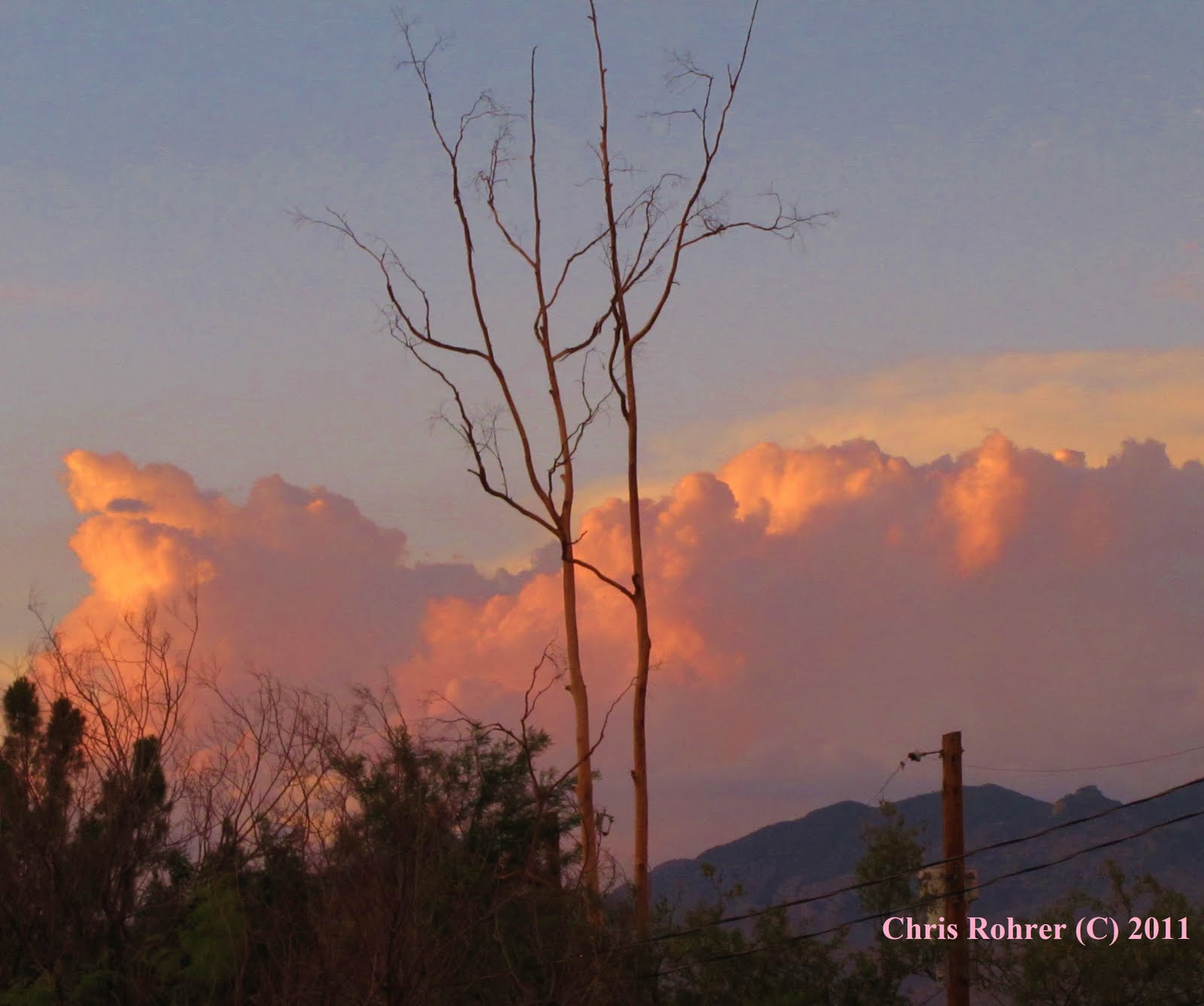
Desert Twilight

 On my way to Target and so glad I had the camera with me:)

These pics were taken from El Presidio tonight on the courtyard.  I love monsoon but not the mosquitos.  These were clouds forming over Mt. Lemmon.

LOST! in Gamboa

Sometimes magic happens when you least expect it.  We left Panama City and in 45 minutes time, we were taken back in time to the quiet community of Gamboa circa 1915.  The town was abandoned when the US turned the Canal over to Panama. Gamboa remains today a reminder of the past where Smithsonian scientists go to escape the City and some Panamanians remain to tell their stories.  A part of the Canal still functions as workers dredge the bottom of the river so vessels won't get stuck.  However, many of them don't stay in the town but instead take a bus back to Panama City. There are no real super markets except for the tiny shop behind the purple house near the bus station. There's really nothing here for urbanites and that's why the town is left alone.  So keep it secret; keep it safe:) Today's post is a fun one....pure fiction and stupidity on my part.  I didn't realize how special this place would be for me until it came time to go home. Imagine a bubble where time stopped and the ghosts of our past remained. While we were here, I was reminded of the TV series LOST!  Here is some evidence that we think created the inspiration for this show.
We were surrounded by lots of wildlife as this ghost town kisses the border to one of Panama's premier birding locations in the world.....the infamous Pipeline Road.  But iguanas weren't the only things we saw.....
We saw evidence that the "Others" lived in or near the Soberanía National Park.   It was eery to think that beyond the howler monkey situation, there were people watching us.  But it didn't stop there.....
Signs were barely visible behind all the vegetation indicating there may be some dangers lurking around us.....
The Smithsonian kept a research center on tropical plants that looked very much like the Orchid Station.....but where were the scientists?
Old structures on the verge of collapsing, which also included a Catholic church, were reminders that a civilization once lived here.
Apparently, super humans existed with great big muscles.  Were they still there?  Or were THEY "the Others" we had read about?  The back sign reads, "DEAD end".  Luckily we weren't attacked by these ball loving super human monsters.
These gorgeous Panama Canal homes just sat empty.  We tried to escape within them to protect ourselves from the race of agouti that had overrun the town, but we discovered that a lot of the wood had been rotten.  Staircases were dangerous to climb.  Therefore, we had to run elsewhere.....
Constant rain and lightening reminded us that it wasn't a good idea to remain too long on the empty streets.....
These homes had a lot of vultures around them waiting for some unsuspecting tourist to die.  NO ONE was around.....I wish I could really buy one of the old homes and fix it up. Can you believe that no one lives in them??  In the US, they would be purchased in a snap, but here in Panama they just sit.  Perhaps indications that there were crocodiles around waiting to eat humans........Best move on!!!
What is this????  The animal race known as the Agouti.  They were all over the city and today, they are the only living creatures you'll see around town. 
This is a dead leaf.  It was just cool to look at......
Final evidence that we were LOST! in Gamboa......a lighthouse full of bats!!!  Catch the video below to see the action pics......
Tomorrow we'll take a serious look at Soberanía National Park and the infamous Pipeline Road.


Friday, August 12, 2011

A Sea of Succulents

I had been waiting for this opportunity. Finally on my trip to Panama, I found the images I was looking for!! Over the course of a year, I had written twice on how to make your succulent garden look like a coral reef, but I couldn't show you an image of the coral reef because I didn't have one. Now I do:)  Here's the image I have in my head.  For you succulent and cacti lovers, look at these shapes and sizes.  Plants are great, but those of us who can work with structural plants like succulents, agaves or cacti are extremely lucky. In fact, after my trip to Panama, I came home wanting to be back in my desert!  I missed my cacti!!  Anyhow look at the coral forms in this pic.  Do you see any kinds of succulents that look similiar to these coral shapes?  
In a year, I begin my art projects around El Presidio.  One of the pieces I will be creating is a fountain of succulents/small cacti that will create my sea of succulents.  It will have to be moved in winter to protect from our evening frosts. Here's a case where nature inspires garden art.  Has anyone tried this look? 
Let me give you a start.  Match this Cereus Monstrose Rojo below with the coral in the  above pics. Do you see it?
Cereus Monstrose Rojo
Imagine.  Create.  Be inspired by the forms around you. Until tomorrow.....

Thursday, August 11, 2011

The Panama Canal

This was my favorite shot from the Canal shoots because it's history.  This metal was taken from inside the locks which have to be drained and cleaned every year. 
Sometimes we go to a country with expectations from others.  Duties.  Obligations. No one in my family really cares about what I did here except that I came back alive.  It's not to say that they don't care, but it's all mumbo jumbo....and so are the pics.  However, the question that always comes up, "Did you see the Panama Canal?"  I mean how could I go to Panama and NOT see the CANAL??  It's like going to Paris and not seeing the Eiffel Tower!!!  Can you imagine???
Well it wasn't as painful as I thought it would be.  It was still hot and muggy outside, but there was icy a/c inside the museum.  At least we were out of Panama City at this point and I knew we would be going to amazing places the following day. So I did what was expected of me. I did my civil duty as an American. It's around 8 bucks to enter. You'll get to see some amazing exhibitions and a rather blah video, but you get to sit for a few minutes. There's a better video out there from PBS titled "The Panama Canal." It's longer but really informative about the whole history which focuses on the people.  I highly recommend watching this before you go to Panama because it will enhance your experience.  The museum covers 4 floors full of fascinating information from how the locks operate to the rain forest that's located along the route.  You can also watch ships passing through the canal.  Having to leave the museum to watch the ships cross, I uncomfortably stood in the nasty humidity. Again, the stifling hot air of Panama really took its toll on me during the first part of this trip. I don't mind humidity when there is a breeze, but the air just hung.  I missed my hot and DRY desert weather from Tucson. This blog was good for me because it made me focus on the job.
                                           
Every ship that passes through the canal pays a chunk of change to use it. It's quite a hefty amount to shortcut through this man made wonder at several thousand dollars a ship. The ship that passed through on this day had to pay 6 thousand dollars. Of course the price is determined by the size of the vessel, etc. Large cargo ships pass before your eyes from one side to the other. The place draws in lots of general tourists who stay in Panama for a couple of days in the nicer hotels. You can always tell them apart from the backpackers because they are wearing lipstick with their hair done up:) I'm not one for crowds, and there were plenty of people here from all over the world.
                                         
Thousands of men and women died creating this canal. A high estimate places the total at 27.500 and the lower estimate was around 23.000. Yet other sources report 25.000. Records vary, and some people believe that the death toll was higher than 30.000 people. Either way, A LOT of people lost their lives creating this canal. Yellow fever and malaria caused much of it, but there were a lot of mechanical accidents as well.  The Culebra cut for the canal was an area that took a high amount of casualties due to the forces of Mother Nature.  Mudslides would cover workers as they blasted their way through this tricky part of the canal.  A memorial is there to remember the thousands of workers who lost their lives. When the French failed to create the canal(and almost crushed their government financially!), the US took over once President Theodore Roosevelt stepped into office. In fact, it was one of his first orders.  The canal would later aide in both World Wars. Panama was originally part of Colombia, but Roosevelt helped support a revolt by bringing in US Navy ships into the surrounding waters of what was then Colombia.  And thus Panama was created with the help of the US government.   Later President Roosevelt would admit by telling the American people, "I took the isthmus!"  This would cost the US government and taxpayers 10 million dollars in reparation to Colombia.  Imagine someone trying to do that same thing today.  Part of my anger comes from the environmental damage done to the area by a president who bullied his way into a country that wasn't his to control. Roosevelt went on to do a lot of great things, but in my opinion, this project had consequences to both Colombia, the enviroment, and the thousands of workers who lost their lives. To prevent any more deaths from malaria, a US Colonel by the name of William Crawford Gorgas was assigned in 1904 for the sanitation project.  He was able to get the disease under control and move the project forward to completion.  Many of these workers were cutting through primary forest to connect the Pacific to the Caribbean and while doing so, they were exposing themselves to the raw power of Mother Nature.  Rain also hampered much of their work creating mudslides. Mass graves were made during several digs near what is now the railroad. In fact, the railroad was built first before the project could begin. This was the deadliest and most labor intensive part of the project.  An entire area had to be blasted open to fill a large gap with water....thus creating the massive artificial Gatun lake for sea vessels to pass through and connecting the Caribbean and Pacific together.
It looks easy crossing from one end to the other, but there are a lot of mechanics that go into entering the canal.  The ships entering the locks must hand over their control to the Panamanian crew to navigate the vessels with tugboats through the various channels and locks.  There are areas on the river or lake that are not deep enough for vessels to pass, but the Panama Canal Authority have it all under control and know the route.   There are 3 main locks that ships have to cross.....the Gatun locks near Colon, the San Miguel locks near the Culebra Cut, and the Miraflores locks outside of Panama City. Today, more locks are being created for larger and wider vessels. This project should be completed by 2014.
Once the vessels reach the locks, two tractors(or what they call "mulas") attach on both sides to pull the vessel through to the other side of the lock. The US signed over the Panama Canal at noon on December 31st, 1999 to Panama. A mass exodus of US officials left behind a project that began with the French and ended with the US.  Considered one of the 7 modern wonders of the world, the canal today is successfully run by the Panama Canal Authority(ACP).
The part that moved me on this journey was really the history behind the canal. I wondered if anyone really remembered those times.  There were a few people who were still around from the canal days, but most of them were the children or grandchildren of the workers who are now in their late 80's to mid 90's.  I chose the reflective music in my video for their personal stories that now can only be found on paper and old cassette recordings. Imagine the late 1800's and early 1900's.  What had the country looked like back then?  What was it like to have a community focused on a singular task?  What dangers beyond disease did they face? What kind of music did they listen to?  One man introduced himself to me in Casco Viejo as the "Legend".  He was one of the kids who grew up in the canal communities.  His father worked during the later years on the canal project.  As you can imagine, he was older in his mid 80's but in great shape telling me stories about the canal and the community. 
The above pic shows tractors(mulas) aligning themselves along side the vessel preparing to pull the ship through the lock.  Once that is completed, the water level will rise lifting the ship up so that it can be moved into the next area.  Back in the museum, there was a computer where you could type in your family names and see if potential relatives worked on the canal.  I typed in "Rohrer" and found two workers with my last name.  Were they long lost relatives of mine?  
Water levels play an important role and help transfer the ship from the river to the ocean or vice versa. Here's a random question for you.  Even though the Panama canal is owned by Panama, which country operates most of the ports around the world including the US? The answer is China. A Hong Kong company run by Li-Ka Shing.  Yeah...this guy is rich:)
I'm thankful for my friends who made me take these pictures.  I was uncomfortable, sweaty and overwhelmed by the number of tourists in this area.  They told me, "You need proof that you were here!! You can't just take pics of the canal without your face in them.  Now smile like you really mean it!"  They were demanding, but they were also right.  So I forced a smile and pointed to the sign.  When I say humid everyone.....I mean HUMID!  If you look close enough, you'll see a sheen of sweat glistening off my face.:) Well maybe don't look too close.  However, it's why I wore my white shirt that day so you couldn't see my perspiration:) Remember to drink plenty of water.
I thought this shot was cool because it showed two ships coming and going.

Here's the last shot of me at the Panama Canal. For more information, click on the link below. The Panama Canal is a human triumph over nature or a good example of how nature and humankind can coexist together today. A project like this could never happen anymore and thank goodness! Fortuneatly, the locks couldn't operate properly without sections of rain forest being preserved.  Without the vegetation, there wouldn't be anything to hold the water in which would prevent vessels from crossing the river or lake.  It's really quite something to behold in person....imagine a large sailing vessel pass by while you're in the jungle.
                                                     http://www.pancanal.com/eng/index.html
                                         

Here's what moved me about this place.  This museum triggered a memory from the time when milkmen still delivered milk in the morning. Does anyone remember this? Maybe it was just a dream.:)  Anyhow, it wasn't just about the canal for me.  It was going back to the early 1900's when my Grandfather was a kid.  He would later,as a young man, work on Lake Michigan as a chef for cargo ships.  A lot of the Panama Canal history reminded me of the pics and stories about how the Two Rivers/Manitowoc area(my hometown) began. I have our trip to the canal to thank for stirring up those stories my Grandfather used to tell me about his own youth and how he sailed the great Lake Michigan. He's gone now like most of the people who helped create important structures for the ocean, river, or lakes.  The first pic on this post reminds me of home and takes me back to the days when I was 5 or 6 years old.  Get ready for a random flashback:) I'm with my Grandma who is hanging her sheets on the clothesline while hitting them with some sort of stick. The breeze is nice and cool that day. The smell of freshly washed linens hangs in the air. I'm playing with trucks on the lawn.  However, Grandma has to take me in their green car (which smelled of cigars) to pick Grandpa up from work. This was during the time when only one car was the norm for families.  We drove to the lakeshore and waited for Grandpa to finish up his shift at Burger shipyards (which created submarines for World War 2, tugs, ferrys or tankers). I remember the seagulls floating above us making a mess on everything below! Another carwash!  Bob(aka Grandpa) came out with his fellow coworkers in their grey uniforms with his lunch box in hand and we'd proceed back home.  That's a special memory that was triggered from this museum. I'm glad we saw the canal because it made me think of all those people who dedicated their lives, whether it be for work or desire, to create something special for future generations.  The faces of these places have changed (as have their environments), but the old bones still remain ......the only reminders of a generation now gone.

Wednesday, August 10, 2011

The Traditional Dish from Panama


I shouldn't be writing this post during lunch time because now I'm hungry. Anyhow, I thought it would be important to give a little background on some of the food you'll find in Panama and most of Central America. If you are travelling to Central America for the first time, you may be surprised to discover that the food isn't spicy or diverse....unless you are in Guatemala(yum!). From this American's point of view, many people from the US go and are disappointed that the food lacks that "Mexican" touch. Where are the nachos and salsa? The tortillas? LOL!!! I'd like to think that the American public is becoming more aware that not all Spanish speaking countries are the same. In fact, not one Spanish speaking country is the same at all, and within that same country, there are so many cultural differences. Those who know me understand that I love all food. In fact, I'll eat anything except fish. Panama, by the way, has wonderful fish and seafood. I tried eating it, but I almost got sick. Growing up on Lake Michigan made me hate eating fish. I ate some bad smokefish one day at a party and it made me sick for days. That fishy taste has never left my memory and therefore, I am damaged goods. Back in January, I wrote about my experience with pears.....same thing. 

A tradional lunch in Panama.  This pic is dedicated to my friend Carolyn who taught me the importance of taking pics of your international meal. :)  Tip. Snap the pic when no on is looking:)
Back to Panama.  The dish you see above is a traditional lunch with chicken, rice, a bit of salad, plantain(fried plantain is called patacones), and some sort of bean.  During this lunch, lentils were served. A lunch or dinner will cost around 3 to 4 bucks!  You can spend more money on other dishes if this dish gets too mundane for your taste buds.  Personally I never got sick from eating this dish.  I love beans and rice!!  To add a kick to your rice, consider using the Panamanian pepper sauce. Another word that you'll see on the menu is "sancocho" which is the national dish of Panama. It's considered a soup or stew that has bits of chicken with potato or rice.  It will also have some sort of veggie variation of culantro, squash, corn, or yucca. In my opinion, the more the better.  I bought several packets of the sancocho soup base and made this soup at home buying all the necessary veggies for the stew.  Originally from the Azuero pennisula, the stew has taken on many variations from not only Panama but in other countries as well.  A definite must!    Conservation.  Nature.  Videos. Endemic species.  Plants and Animals.  Las Aventuras will take you on one last day trip out of Panama City tomorrow as we explore the Miraflores Locks and the Panama Canal.  See you tomorrow friends!   


Tuesday, August 9, 2011

Amazon Deforestation on the Rise


View of a river crossing part of the 1.3 million hectares of the Jamanxim National …

This blog is all about Panama, indigenous people, flora, fauna and the rain forest this month.  Here is another report on some of the things that are going on in our world related to our tropical work.
"Deforestation in Brazil's Amazon accelerated in June, with more than 300 square kilometers destroyed, a 17 percent increase over the previous month, government researchers said Tuesday. The National Institute for Space Research (INPE) said 312.6 square kilometers (120 square miles) were destroyed in June, based on the preliminary analysis of satellite photos of the vast South American rainforest. May had seen a decrease in deforestation to 268 square kilometers (100 square miles) from 477 square kilometers (180 square miles) in April. In April, more than 400 square kilometers (150 square miles) of forests were destroyed in a single state, Mato Grosso, which is seen as a major agricultural frontier and is used for cattle ranches and soybean farming. At the 2009 UN climate change summit in Copenhagen, Brazil committed itself to reducing Amazon deforestation by 80 percent by 2020. Brazil, the world's fifth largest country by area, has 5.3 million square kilometers of jungle and forests -- mostly in the Amazon river basin -- of which only 1.7 million are under state protection. The rest is in private hands, or its ownership is undefined. Massive deforestation has made Brazil one of the world's top greenhouse gas emitters, and the pace of deforestation peaked in 2004 at 27,000 square kilometers (10,000 square miles) a year. By 2010, however, it had dropped to 6,500 square kilometers, thanks in part to the INPE's Real-Time Deforestation Detection System (DETER), which allows researchers to collect new satellite images on a daily basis. However, the system can only monitor areas of 25 hectares (60 acres) or more, so its results are not considered definitive." News report from Relaxnews.  Source: http://news.yahoo.com/amazon-deforestation-rise-again-brazil-160048145.html


..

Molas

Molas are sold on the street from the Kuna tribes of Panama
What is a mola?  So many people have asked me that question over the years during my teaching career.  I'd reply that they were from Panama.  Other than that I didn't know much more than that basic information.  This summer I was finally able to get the specific answers that I needed on this unique cloth created by the Kuna tribe of the San Blas islands.  Depending on the design, a mola may sell for 15, 20, or 25 dollars.  The less intricate the design; the less you'll pay.  Panama is very interesting in that many of the indigenous peoples have learned how to retain their cultural values while adapting to the ways of the modern world.  We saw Embera, Kuna, and Ngöbe(Ny-oh-be) walking around the streets.  No one seemed to notice and I found that refreshing.  The Embera stuck to their communities in the rain forest more, but the Kuna and Ngöbe people were everywhere.  I've said it before and I'll say it again....diversity is a good thing!  Just a side note....don't snap pics of people without their permission first:) I only bring this up because I saw people doing it and then the reactions people were giving them.  It's kind of a photography taboo that is full of controversy. It's difficult for photographers because when a moment presents itself, you never hesitate getting that shot.  But when it comes to people, always think twice. Imagine if random people came up to you and snapped pics.  Actually, I'd probably react two ways.....I'd laugh or be suspicious.  Why does the US government want me? LOL!  I have an active imagination.   Back to the molas:)
Molas are cool...but molas with cats are better!!  This mola is now placed above the dresser where our cats sleep at night.  It is now officially the kitty shrine.

From my interviews with several of the very polite and soft spoken Kuna at Casco Viejo and in Boquete, I discovered that this was a family process.  Women generally make the designs with family members helping out.  The young man that I purchased my kitty mola from also helped create some of the designs.  However, I got the impression that he travelled Panama selling his family molas.  He was very proud of his mother's work.  A sister also helped her sew and stitch the designs.....but always with the close eye of his mother. Molas are interesting as they require a difficult fabric layering technique that requires imagination, patience and extraordinary stitching skills. Mola designs reflect the natural environment of the Kuna, including animals, local vegetation and the shapes of Caribbean coral reefs. So it was very lucky on my part when I discovered one with a kitty design. Who knew kitties were so important to the Caribbean?  I did:)  A complicated mola can take up to 5 weeks to create! A lot of stitch work is involved to create just one design.  By the time a piece is finished, there could be thousands of hand stitches. Whether I am in France, Guatemala, Mexico, Peru, or Italy, I ALWAYS purchase fabric designs for gifts, my home, or classroom.  It's easy to carry or ship home.  Fabric goes well over furniture, the bed, on walls (framed or not), or as an accent to an appliance.  One last piece of information on this amazing art form.  Molas are created for Kuna women's blouses. When new molas are created, they unstitch the older pieces from their clothes and add the new molas to their outfit.  The older pieces are sold to the public. Who knew? Lastly, the Kuna women decide how much they will charge for each mola.  The mola that has an original creative design will go for a lot more money.  My Kuna friend also explained that the money he makes from his family molas go back to their community.  He originated from the San Blas Islands where the Kuna Yala tribe resides. More tomorrow from the amazing country of Panama......