Thursday, August 11, 2011

The Panama Canal

This was my favorite shot from the Canal shoots because it's history.  This metal was taken from inside the locks which have to be drained and cleaned every year. 
Sometimes we go to a country with expectations from others.  Duties.  Obligations. No one in my family really cares about what I did here except that I came back alive.  It's not to say that they don't care, but it's all mumbo jumbo....and so are the pics.  However, the question that always comes up, "Did you see the Panama Canal?"  I mean how could I go to Panama and NOT see the CANAL??  It's like going to Paris and not seeing the Eiffel Tower!!!  Can you imagine???
Well it wasn't as painful as I thought it would be.  It was still hot and muggy outside, but there was icy a/c inside the museum.  At least we were out of Panama City at this point and I knew we would be going to amazing places the following day. So I did what was expected of me. I did my civil duty as an American. It's around 8 bucks to enter. You'll get to see some amazing exhibitions and a rather blah video, but you get to sit for a few minutes. There's a better video out there from PBS titled "The Panama Canal." It's longer but really informative about the whole history which focuses on the people.  I highly recommend watching this before you go to Panama because it will enhance your experience.  The museum covers 4 floors full of fascinating information from how the locks operate to the rain forest that's located along the route.  You can also watch ships passing through the canal.  Having to leave the museum to watch the ships cross, I uncomfortably stood in the nasty humidity. Again, the stifling hot air of Panama really took its toll on me during the first part of this trip. I don't mind humidity when there is a breeze, but the air just hung.  I missed my hot and DRY desert weather from Tucson. This blog was good for me because it made me focus on the job.
                                           
Every ship that passes through the canal pays a chunk of change to use it. It's quite a hefty amount to shortcut through this man made wonder at several thousand dollars a ship. The ship that passed through on this day had to pay 6 thousand dollars. Of course the price is determined by the size of the vessel, etc. Large cargo ships pass before your eyes from one side to the other. The place draws in lots of general tourists who stay in Panama for a couple of days in the nicer hotels. You can always tell them apart from the backpackers because they are wearing lipstick with their hair done up:) I'm not one for crowds, and there were plenty of people here from all over the world.
                                         
Thousands of men and women died creating this canal. A high estimate places the total at 27.500 and the lower estimate was around 23.000. Yet other sources report 25.000. Records vary, and some people believe that the death toll was higher than 30.000 people. Either way, A LOT of people lost their lives creating this canal. Yellow fever and malaria caused much of it, but there were a lot of mechanical accidents as well.  The Culebra cut for the canal was an area that took a high amount of casualties due to the forces of Mother Nature.  Mudslides would cover workers as they blasted their way through this tricky part of the canal.  A memorial is there to remember the thousands of workers who lost their lives. When the French failed to create the canal(and almost crushed their government financially!), the US took over once President Theodore Roosevelt stepped into office. In fact, it was one of his first orders.  The canal would later aide in both World Wars. Panama was originally part of Colombia, but Roosevelt helped support a revolt by bringing in US Navy ships into the surrounding waters of what was then Colombia.  And thus Panama was created with the help of the US government.   Later President Roosevelt would admit by telling the American people, "I took the isthmus!"  This would cost the US government and taxpayers 10 million dollars in reparation to Colombia.  Imagine someone trying to do that same thing today.  Part of my anger comes from the environmental damage done to the area by a president who bullied his way into a country that wasn't his to control. Roosevelt went on to do a lot of great things, but in my opinion, this project had consequences to both Colombia, the enviroment, and the thousands of workers who lost their lives. To prevent any more deaths from malaria, a US Colonel by the name of William Crawford Gorgas was assigned in 1904 for the sanitation project.  He was able to get the disease under control and move the project forward to completion.  Many of these workers were cutting through primary forest to connect the Pacific to the Caribbean and while doing so, they were exposing themselves to the raw power of Mother Nature.  Rain also hampered much of their work creating mudslides. Mass graves were made during several digs near what is now the railroad. In fact, the railroad was built first before the project could begin. This was the deadliest and most labor intensive part of the project.  An entire area had to be blasted open to fill a large gap with water....thus creating the massive artificial Gatun lake for sea vessels to pass through and connecting the Caribbean and Pacific together.
It looks easy crossing from one end to the other, but there are a lot of mechanics that go into entering the canal.  The ships entering the locks must hand over their control to the Panamanian crew to navigate the vessels with tugboats through the various channels and locks.  There are areas on the river or lake that are not deep enough for vessels to pass, but the Panama Canal Authority have it all under control and know the route.   There are 3 main locks that ships have to cross.....the Gatun locks near Colon, the San Miguel locks near the Culebra Cut, and the Miraflores locks outside of Panama City. Today, more locks are being created for larger and wider vessels. This project should be completed by 2014.
Once the vessels reach the locks, two tractors(or what they call "mulas") attach on both sides to pull the vessel through to the other side of the lock. The US signed over the Panama Canal at noon on December 31st, 1999 to Panama. A mass exodus of US officials left behind a project that began with the French and ended with the US.  Considered one of the 7 modern wonders of the world, the canal today is successfully run by the Panama Canal Authority(ACP).
The part that moved me on this journey was really the history behind the canal. I wondered if anyone really remembered those times.  There were a few people who were still around from the canal days, but most of them were the children or grandchildren of the workers who are now in their late 80's to mid 90's.  I chose the reflective music in my video for their personal stories that now can only be found on paper and old cassette recordings. Imagine the late 1800's and early 1900's.  What had the country looked like back then?  What was it like to have a community focused on a singular task?  What dangers beyond disease did they face? What kind of music did they listen to?  One man introduced himself to me in Casco Viejo as the "Legend".  He was one of the kids who grew up in the canal communities.  His father worked during the later years on the canal project.  As you can imagine, he was older in his mid 80's but in great shape telling me stories about the canal and the community. 
The above pic shows tractors(mulas) aligning themselves along side the vessel preparing to pull the ship through the lock.  Once that is completed, the water level will rise lifting the ship up so that it can be moved into the next area.  Back in the museum, there was a computer where you could type in your family names and see if potential relatives worked on the canal.  I typed in "Rohrer" and found two workers with my last name.  Were they long lost relatives of mine?  
Water levels play an important role and help transfer the ship from the river to the ocean or vice versa. Here's a random question for you.  Even though the Panama canal is owned by Panama, which country operates most of the ports around the world including the US? The answer is China. A Hong Kong company run by Li-Ka Shing.  Yeah...this guy is rich:)
I'm thankful for my friends who made me take these pictures.  I was uncomfortable, sweaty and overwhelmed by the number of tourists in this area.  They told me, "You need proof that you were here!! You can't just take pics of the canal without your face in them.  Now smile like you really mean it!"  They were demanding, but they were also right.  So I forced a smile and pointed to the sign.  When I say humid everyone.....I mean HUMID!  If you look close enough, you'll see a sheen of sweat glistening off my face.:) Well maybe don't look too close.  However, it's why I wore my white shirt that day so you couldn't see my perspiration:) Remember to drink plenty of water.
I thought this shot was cool because it showed two ships coming and going.

Here's the last shot of me at the Panama Canal. For more information, click on the link below. The Panama Canal is a human triumph over nature or a good example of how nature and humankind can coexist together today. A project like this could never happen anymore and thank goodness! Fortuneatly, the locks couldn't operate properly without sections of rain forest being preserved.  Without the vegetation, there wouldn't be anything to hold the water in which would prevent vessels from crossing the river or lake.  It's really quite something to behold in person....imagine a large sailing vessel pass by while you're in the jungle.
                                                     http://www.pancanal.com/eng/index.html
                                         

Here's what moved me about this place.  This museum triggered a memory from the time when milkmen still delivered milk in the morning. Does anyone remember this? Maybe it was just a dream.:)  Anyhow, it wasn't just about the canal for me.  It was going back to the early 1900's when my Grandfather was a kid.  He would later,as a young man, work on Lake Michigan as a chef for cargo ships.  A lot of the Panama Canal history reminded me of the pics and stories about how the Two Rivers/Manitowoc area(my hometown) began. I have our trip to the canal to thank for stirring up those stories my Grandfather used to tell me about his own youth and how he sailed the great Lake Michigan. He's gone now like most of the people who helped create important structures for the ocean, river, or lakes.  The first pic on this post reminds me of home and takes me back to the days when I was 5 or 6 years old.  Get ready for a random flashback:) I'm with my Grandma who is hanging her sheets on the clothesline while hitting them with some sort of stick. The breeze is nice and cool that day. The smell of freshly washed linens hangs in the air. I'm playing with trucks on the lawn.  However, Grandma has to take me in their green car (which smelled of cigars) to pick Grandpa up from work. This was during the time when only one car was the norm for families.  We drove to the lakeshore and waited for Grandpa to finish up his shift at Burger shipyards (which created submarines for World War 2, tugs, ferrys or tankers). I remember the seagulls floating above us making a mess on everything below! Another carwash!  Bob(aka Grandpa) came out with his fellow coworkers in their grey uniforms with his lunch box in hand and we'd proceed back home.  That's a special memory that was triggered from this museum. I'm glad we saw the canal because it made me think of all those people who dedicated their lives, whether it be for work or desire, to create something special for future generations.  The faces of these places have changed (as have their environments), but the old bones still remain ......the only reminders of a generation now gone.

Wednesday, August 10, 2011

The Traditional Dish from Panama


I shouldn't be writing this post during lunch time because now I'm hungry. Anyhow, I thought it would be important to give a little background on some of the food you'll find in Panama and most of Central America. If you are travelling to Central America for the first time, you may be surprised to discover that the food isn't spicy or diverse....unless you are in Guatemala(yum!). From this American's point of view, many people from the US go and are disappointed that the food lacks that "Mexican" touch. Where are the nachos and salsa? The tortillas? LOL!!! I'd like to think that the American public is becoming more aware that not all Spanish speaking countries are the same. In fact, not one Spanish speaking country is the same at all, and within that same country, there are so many cultural differences. Those who know me understand that I love all food. In fact, I'll eat anything except fish. Panama, by the way, has wonderful fish and seafood. I tried eating it, but I almost got sick. Growing up on Lake Michigan made me hate eating fish. I ate some bad smokefish one day at a party and it made me sick for days. That fishy taste has never left my memory and therefore, I am damaged goods. Back in January, I wrote about my experience with pears.....same thing. 

A tradional lunch in Panama.  This pic is dedicated to my friend Carolyn who taught me the importance of taking pics of your international meal. :)  Tip. Snap the pic when no on is looking:)
Back to Panama.  The dish you see above is a traditional lunch with chicken, rice, a bit of salad, plantain(fried plantain is called patacones), and some sort of bean.  During this lunch, lentils were served. A lunch or dinner will cost around 3 to 4 bucks!  You can spend more money on other dishes if this dish gets too mundane for your taste buds.  Personally I never got sick from eating this dish.  I love beans and rice!!  To add a kick to your rice, consider using the Panamanian pepper sauce. Another word that you'll see on the menu is "sancocho" which is the national dish of Panama. It's considered a soup or stew that has bits of chicken with potato or rice.  It will also have some sort of veggie variation of culantro, squash, corn, or yucca. In my opinion, the more the better.  I bought several packets of the sancocho soup base and made this soup at home buying all the necessary veggies for the stew.  Originally from the Azuero pennisula, the stew has taken on many variations from not only Panama but in other countries as well.  A definite must!    Conservation.  Nature.  Videos. Endemic species.  Plants and Animals.  Las Aventuras will take you on one last day trip out of Panama City tomorrow as we explore the Miraflores Locks and the Panama Canal.  See you tomorrow friends!   


Tuesday, August 9, 2011

Amazon Deforestation on the Rise


View of a river crossing part of the 1.3 million hectares of the Jamanxim National …

This blog is all about Panama, indigenous people, flora, fauna and the rain forest this month.  Here is another report on some of the things that are going on in our world related to our tropical work.
"Deforestation in Brazil's Amazon accelerated in June, with more than 300 square kilometers destroyed, a 17 percent increase over the previous month, government researchers said Tuesday. The National Institute for Space Research (INPE) said 312.6 square kilometers (120 square miles) were destroyed in June, based on the preliminary analysis of satellite photos of the vast South American rainforest. May had seen a decrease in deforestation to 268 square kilometers (100 square miles) from 477 square kilometers (180 square miles) in April. In April, more than 400 square kilometers (150 square miles) of forests were destroyed in a single state, Mato Grosso, which is seen as a major agricultural frontier and is used for cattle ranches and soybean farming. At the 2009 UN climate change summit in Copenhagen, Brazil committed itself to reducing Amazon deforestation by 80 percent by 2020. Brazil, the world's fifth largest country by area, has 5.3 million square kilometers of jungle and forests -- mostly in the Amazon river basin -- of which only 1.7 million are under state protection. The rest is in private hands, or its ownership is undefined. Massive deforestation has made Brazil one of the world's top greenhouse gas emitters, and the pace of deforestation peaked in 2004 at 27,000 square kilometers (10,000 square miles) a year. By 2010, however, it had dropped to 6,500 square kilometers, thanks in part to the INPE's Real-Time Deforestation Detection System (DETER), which allows researchers to collect new satellite images on a daily basis. However, the system can only monitor areas of 25 hectares (60 acres) or more, so its results are not considered definitive." News report from Relaxnews.  Source: http://news.yahoo.com/amazon-deforestation-rise-again-brazil-160048145.html


..

Molas

Molas are sold on the street from the Kuna tribes of Panama
What is a mola?  So many people have asked me that question over the years during my teaching career.  I'd reply that they were from Panama.  Other than that I didn't know much more than that basic information.  This summer I was finally able to get the specific answers that I needed on this unique cloth created by the Kuna tribe of the San Blas islands.  Depending on the design, a mola may sell for 15, 20, or 25 dollars.  The less intricate the design; the less you'll pay.  Panama is very interesting in that many of the indigenous peoples have learned how to retain their cultural values while adapting to the ways of the modern world.  We saw Embera, Kuna, and Ngöbe(Ny-oh-be) walking around the streets.  No one seemed to notice and I found that refreshing.  The Embera stuck to their communities in the rain forest more, but the Kuna and Ngöbe people were everywhere.  I've said it before and I'll say it again....diversity is a good thing!  Just a side note....don't snap pics of people without their permission first:) I only bring this up because I saw people doing it and then the reactions people were giving them.  It's kind of a photography taboo that is full of controversy. It's difficult for photographers because when a moment presents itself, you never hesitate getting that shot.  But when it comes to people, always think twice. Imagine if random people came up to you and snapped pics.  Actually, I'd probably react two ways.....I'd laugh or be suspicious.  Why does the US government want me? LOL!  I have an active imagination.   Back to the molas:)
Molas are cool...but molas with cats are better!!  This mola is now placed above the dresser where our cats sleep at night.  It is now officially the kitty shrine.

From my interviews with several of the very polite and soft spoken Kuna at Casco Viejo and in Boquete, I discovered that this was a family process.  Women generally make the designs with family members helping out.  The young man that I purchased my kitty mola from also helped create some of the designs.  However, I got the impression that he travelled Panama selling his family molas.  He was very proud of his mother's work.  A sister also helped her sew and stitch the designs.....but always with the close eye of his mother. Molas are interesting as they require a difficult fabric layering technique that requires imagination, patience and extraordinary stitching skills. Mola designs reflect the natural environment of the Kuna, including animals, local vegetation and the shapes of Caribbean coral reefs. So it was very lucky on my part when I discovered one with a kitty design. Who knew kitties were so important to the Caribbean?  I did:)  A complicated mola can take up to 5 weeks to create! A lot of stitch work is involved to create just one design.  By the time a piece is finished, there could be thousands of hand stitches. Whether I am in France, Guatemala, Mexico, Peru, or Italy, I ALWAYS purchase fabric designs for gifts, my home, or classroom.  It's easy to carry or ship home.  Fabric goes well over furniture, the bed, on walls (framed or not), or as an accent to an appliance.  One last piece of information on this amazing art form.  Molas are created for Kuna women's blouses. When new molas are created, they unstitch the older pieces from their clothes and add the new molas to their outfit.  The older pieces are sold to the public. Who knew? Lastly, the Kuna women decide how much they will charge for each mola.  The mola that has an original creative design will go for a lot more money.  My Kuna friend also explained that the money he makes from his family molas go back to their community.  He originated from the San Blas Islands where the Kuna Yala tribe resides. More tomorrow from the amazing country of Panama......


Monday, August 8, 2011

Reclusive Amazon Tribe Missing

This sad story came out today from the MSN website.  I have two similiar pieces about this uncontacted tribe from last year on this blog.  It's a terrible situation. What can people do to make sure this doesn't happen?  If ever there was a time of anger and feeling helpless, it would be now.

By
   
"An uncontacted Amazon tribe that made headlines earlier this year after being filmed from the air is feared missing after presumed drug traffickers overran the Brazilian guards posted to protect the tribe's lands. According to tribal advocacy group Survival International, Brazilian officials can find no trace of the Indians in the area after heavily armed men ransacked the guard post in western Brazil about 32 miles from the Peruvian border. Like other uncontacted tribes, the Indians live a traditional life in the forest and does not have contact with the outside world.Workers from FUNAI, the government bureau  of Indian affairs, found a broken arrow in one of the men's backpacks, raising fears for the tribe's safety.  "We think the Peruvians made the Indians flee," Carlos Travassos, the head of the government's isolated Indians department, said in a statement. "Now we have good proof. We are more worried than ever." As many as 2,000 uncontacted Indians may live in the Javari Valley of the western Amazon, Survival International estimates. Brazilian officials keep an eye on tribal lands but do not force contact with the inhabitants. In February, Brazil's Indian Affairs Department released aerial photos and film of the tribe that is now missing, revealing thatched dwellings, tribe members in red body paint, and gardens full of manioc tubers and papaya. Now the Indians seem to have disappeared. According to Survival International, police found a package containing 44 pounds of cocaine in the area. That could mean that the Envira River, where the Brazilian guard post is located, is now an entry point into Brazil for Peruvian cocaine smugglers, they said.
According to local reports, police have detained one man, a Portuguese national who was arrested and deported for drug trafficking in March. Jose Carlos Meirelles, who headed the remote guard post, is now back in the area and reported that several groups of men armed with sub-machine guns and rifles are in the forest near the base. Guns aren't the only threat to uncontacted Indians. Common diseases can also kill them, because they have not built up immunity to the viruses and bacteria outside their forest home. According to Survival International's uncontactedtribes.org, there are about 100 uncontacted tribes in existence worldwide. "This situation could be one of the biggest blows we have ever seen in the protection of uncontacted Indians in recent decades," Travassos said, referring to the possible drug traffickers. "It's a catastrophe."

Monkey Business

The White Capuchin Monkey
What would a rain forest trip be without seeing monkeys?  Everyone goes expecting to see them and some people succeed.  My first time in the rain forest was the most disappointing because I NEVER got a good look at them.  They were high up in the trees and fast moving.  Over the years, I discovered that early mornings, sunsets, water and fruit were attractions for lots of monkeys.  But you had to keep your eyes open and your mouth shut.  Today is a fun post with A LOT of pics from the Wildlife Rescue and Rehab center known as La Jungla which is run by Dorothy "aka Queen of the Jungle".  She originally hails from Florida and began working the wildlife rehab in Boquete. Here are some random and fun facts from my travels abroad observing both wild and "tame" monkeys.  

First off, I have to mention that I went through massive withdrawals without my 5 cats.  So when I was at this rehab, I spent too much time with these very active monkeys.  Both of the monkeys in this particular area were former pets from owners who no longer had space for them.  They played as if they were siblings and it was really cute.  Handling monkeys is a strange experience....because they have tails that act like a 3rd hand.  They are also quite intelligent and possess skills that no ordinary dog or cat has. You have to wonder why people would kill or trap such a magnificent animal that is in so many ways like us.
Here he is on my arm for a brief moment before jumping off.  On this particular trip, I witnessed wild capuchin on Coiba Island.  They were throwing mangos at our cabin in the morning.  I'll show those pics during the Coiba highlights post.  Capuchin monkeys are very curious creatures.  In the wild, they watch from a distance.  As former pets, they are like a younger brother or sister:) I imagine my cabinets and fridge at home and the food all over the floor!!
This look(above) was for the camera....as in stop taking pics of me!  Panama has several species of monkeys which also include the very loud howler monkeys.  My first experience with a howler was with Pepe in the Amazon.  He was smelly, big, and at times dirty.  At night, he would take my underwear out of my backpack along with other clothes.  In the morning I would wake up to find them all over our bungalow!  Howlers have a very scary call that can send chills up and down your spine, but they are, for the most part, peaceful creatures.  One day we found Pepe eating out of a fruit bowl.  I filmed some video and it's on this blog from last year.  Just type in Peru and the Amazon and you should be able to find that vid.  In Panama, there are two types of howler....one is brown while the other is black and only found on Coiba island.  They are commonly found in most places where there is rain forest.
This is my friend Desiree.  Our Capuchin friend bounced all over the place because he was excited to see us.  Now that normally isn't the case in the wild.  Monkeys have been known to throw their feces at people from above.  They've also been known to bite.  In Cape Verde, during my Peace Corps years, I remember watching a green monkey attack a woman with a broom on top of her roof while trying to do her laundry.  I tried to keep a straight face while teaching the very boring English language. 

This guy was fast.  The White Faced Capuchin is also commonly found in Panama wherever there is rain forest.  While I question wildlife rescue and rehab places anywhere I go(including my own country), I do see a need for them.  Here's a thought to ponder.  It has been known that poachers will kill an animal for their fur and then discover a litter of babies.  They then take these babies to rehab centers and ask for money or they'll kill them.  I don't know what the answer to this is because my mother was/is kind of a rescue person for parrots herself.  People really need to think about what they're doing when they adopt a macaw or monkey!!  My house is full of macaws and African Gray parrots that were raised from eggs donated to my mother because the owners could no longer care for them.  My concern for this particular issue is....what happens when my parents pass?  Someone on this trip gave me the idea that I need to sit down with them and have a will made up for these magnificent birds....perhaps a local zoo where they could educate kids and live a full life?   Do you see the dilemna? If you don't know, parrots usually outlive their owners.  My 5 other siblings have expressed concern over these "other members" of our family.  I got the sense that Dorothy didn't do this kind of business, but she did say that lots of people now come to visit her because they have these animals that they no longer want.  What would you do?  I'm an animal lover and when an animal is hurt or suffering, my heart bleeds.  I'll do anything for them.  Why?  Because animals are pure beautiful beings. 
Here I am with my arms full of sand fly bites and two monkeys playing.  The bottom monkey is the "mono titi" or the squirrel monkey.  He is endangered unfortuneatly unlike his companion. They both wanted attention and were wrestling me for it.
This pic with Desiree reminds me of how my cats look at me when I am on the couch relaxing.  Look at that squirrel monkey's face!!
Human to monkey ratio.
Lots of monkey love! This little guy decided to eat banana and get it all over my shirt.  No table manners at all:)
Exhausted after playing with us for awhile.

The Jungla Rescue and Rehab is 20 minutes away from downtown Boquete. There was a black monkey that was severely beaten by its former owner and is currently in the rehab area.  There was a Tamarin monkey as well.  He was a bit shy, but I did get a nice shot of him.  Dorothy had several birds including a scarlet macaw.  Of these two species, both are critically endangered in the wild habitat of Panama.  Panama is certainly not Costa Rica in that it has decimated a lot of rain forest for agriculture. Different needs from different countries.  I'll get into more of that later on. But you do need to think about this....Costa Rica's number one focus is tourism.  Panama's is agriculture.  Only now is Panama trying to attract more tourists to the country and protecting several large and unexplored areas of rain forest....which is a postive thing.  The Tamarin monkey can still be found in the very dangerous and unexplored  Darien Gap.  We couldn't get there due to the heavy rains which flood most of this area during this time of year.  The Scarlet Macaw has a large colony that is increasing on the sacred island of Coiba.  I will be able to take you there.....all I can say is that it was magical.  When you walk into primary forest, nothing in the world prepares you for the sights and sounds of unmapped jungle.  We had a great time at Jungla and I'd like to thank Dorothy for the opportunity to get an up close and personal view of many amazing jungle critters. While we were there, several possums were being relocated to farms to help with the poisonous snake issues (because possums eat snake...and pretty much everything else:).  They found the family of possums in a home and normally they would be killed, but Dorothy convinced the homeowners that they could be relocated....and they were.    I created 4 videos that I will be presenting over the course of the next several weeks. Several video shots will include our visit to this very fun center.

the Tamarin Monkey with my Canon.....I love my camera!
This monkey is very shy in the wild. He did like marshmellows:) The Tamarin monkey is on the lower end of the totem pole when it comes to dominance in the rain forest.  Other monkeys will attack and kill these little guys.  Therefore they go to bed earlier than most monkeys.  They also sound like birds chirping in the wild allowing themselves to go unseen by predators.
Jungla Wildlife Rescue & Rehab
                                                                         Dorothy
Telephone 6968-6010
A donation is asked at the door


More tomorrow friends....

Sunday, August 7, 2011

Hostel Review: Mamallena

In our travels, we must all make choices.  Sometimes money is a factor while with other times, safety comes first....and let's not forget about comfort!! What about convenience? And while we're at it, let's look at ambience. Today's review is on Mamallena.  I am writing this post for the traveler's out there who are heading off to Panama City or Boquete.  Let me start off by saying that both places are unique and quite different from one another.  But before I look into these places, I need to explore the word "hostel" with newbies.  So let's get started...
My first artsy shot from Mamallena as I watched my camera lense fog over...steamy!
A hostel is a fun and exciting experience for many people who like being around other people.  However, let me restate what I just wrote.  It's mostly fun for younger people who are on a budget and need a place to stay.  You'll find a lot of backpackers crashing a night or two at most hostels talking about their days of adventures or misfortunes. Some even find love....although temporary.  It's interesting to note that at both Mamallena locations, I found several middle aged and retired travelers hanging out...and that was a first for me.  Hostels are not for everyone and I found several of the families and older people sometimes complaining about those "damn college kids".  It's true that I don't want to hear two(or 3) backpackers doing the mattress mambo the floor below me, but that's the hostel life at times. Some people should not stay at these places if they don't want to hear loud drunk backpackers getting excited over a near death experience. Hostels aren't for everyone and we planned accordingly giving ourselves a break here and there at B & B's around the country when there was one. 
Outside our window in Boquete overlooking the bar.  Bring an umbrella as it rains often there.
Hostels allow you to meet some fascinating people that you may not encounter in your own life circles at home.  On this trip, I met a confused lesbian, a cool blogger (who shared box wine with me), several funny Germans wearing man capris, an unfortunate Israeli girl who had her luggage peed on by a local kitty, a sex crazed Austrian who hit on every girl that entered the building, lots of students studying Spanish, 2 Koreans who were too serious for such a colorful country, a poor American girl and her mother who lost everything in an attack in Cuzco, Peru(that story still gets me angry), a Bay Area girl who found love with a "hella" hot rafting guide, a retired crazy lady with a hearing aide who ate too many onion rings.....and that's just the start.  If this doesn't sound fun to you, don't do it:) Time for the review of Mamallena in both Panama City and Boquete.  Two completely different places with a similiar approach.
Side yard area to relax at Mamallena in Panama City
Here's some general Mamallena info for both Panama City and Boquete.  The price per night within the city is your best bargain.  13 bucks for a super comfortable mattress is a great deal for the tired backpacker!  It's hot, humid and nasty in Panama City.  I was miserable for the first several weeks.  All rooms have A/C(in Panama City) that gets turned on after 9 PM and I was greatful for that service.  I had a wonderful nights sleep there.  If you want a little privacy and be away from the noise, you can reserve a private room, but make sure you do it a month in advance. The neighborhood is safer and has several small marts to buy basic food.  This is what I love about Mamallena.  Many times you are forced to eat out etc.  Not so with Mamallena.  You can buy your own food and prepare your own meals!!  I liked this a lot plus we saved a lot of money doing our own grocery shopping.  They have a free coffee and pancake breakfast available.  The only catch is that you have to make it yourself:)  Internet is free.  During the day, it's open most of the time as people are out on excursions.  The evening gets crazy as people get back from their trips and the computers are usually super busy.  Wait time is longer.  They also have a coin operated laundry service!!!!  For backpackers, this is super convenient.
Some Rohrerbot travel tips.  Always hang your wet towels or wet clothes to dry.  Never leave these things on the floor. Things take forever to dry in the humidity. And in some locations, spiders, cockroaches and other critters like to hide in your mountain of nastiness. In the middle of the rack is a garbage bag that I always bring on my trips.  It's for dirty laundry.  I also like to have several hangers to let some of my shirts unwrinkle from my backpack or suitcase.
Secured and safe courtyard area to relax in Panama City
Here are some of the differences between the Mamallena in Panama City and Boquete. 

In Panama City......

  • people usually stay a couple nights as it is a start or stopping point on their trip
  • a 25 dollar shuttle service is offered to and from the airport
  • they have a fridge next to the help desk full of drinks that range from beer to chocolate milk and of course water!
  • cold water showers only....but it's so hot and muggy there that the cold water feels good
  • staff are friendly and helpful
Recommendations.  If you want quiet, there is an escape to the lower levels. Reserve a month in advance.   However we did spend a night in the dorms and I actually had my deepest and best sleep there.  It can get loud sometimes as the younger college crowd drink their way into the early hours of the morning. It's not like that every night, but I didn't care. The conversations reminded me of my own adventures during my 20's, and in that regard, I felt a bit out of place at times when I was in a room full of the college backpackers. However a perk to being older is that you get a good nights sleep early while the college kids are still sleeping late into the morning. And therefore I can take my shower, check internet, have a cup of coffee, and not have to wait to use the bathroom facilities because everyone is still sleeping. Early bird gets the worm.  Also, this may sound weird to some people....but you can flush your toilet paper in the toilets!!!  Many times you have to throw it in the trash!  Nasty for most people. In Boquete you have to throw your TP in the basket.
The amazing Romero Supermarket.  Just two minutes away....
In Boquete.....
  • cute hostel
  • super close to an amazing super market(Romero)
  • hot water!
  • no a/c but you won't need it.....
  • travelers tend to stay longer in Boquete because the climate is much nicer
  • families, the middle aged and RETIRED!!  people were seen here.....I was floored!
  • extrememly easy to get to once off the bus...walking distance
  • fantastic restaurants, banks, and day trips....all within walking distance
Recommendations.  There is a bar next door to the place.  If you like quiet, try to reserve on the other side of the building which is much more peaceful. Patio areas can be active at night with fire dancers and smokers abound clapping and screaming. I could've sworn there was a Cirque de Soleil performance going on. A guy by the name of Martin was swinging balls of fire. That's what's cool about hostels, but again for the best quiet evening....stay on the opposite side of the bar and on the second floor towards the front of the building.  It's really a nice looking building with a lot of personality.  There are a lot of people studying Spanish in Boquete because there is a school several blocks away.  It's one of the ONLY places I actually didn't sweat.  It was so relaxing that we found ourselves spending a WHOLE week there.  If you have intense trips to the national parks like we did, it's a great way to end your journey and relax.  Both of the owners are great and very helpful.  When it gets busy, they obviously have a lot to do so that can be frustrating for some people.  They have a lot of people checking into the hostels around the evening when last minute people are trying to find a place to sleep.  It can be kind of hectic so best do your business in the morning, early afternoon or over email when things are slower.
Everything is within walking distance in Boquete...including Mamallena!
Well there you have it.  Mamallena has a lot of personality and if you are interested in more than watching birds, this is definitely the place to stay and visit with fellow travelers. It's also a great place to socialize and get ideas on places to visit in Panama, Central or South America.  Panama is the central hub to all places and you'll meet a lot of people coming from all over the place.  It's unusual in that you will encounter a variety of people on different style trips.  Normally if you travel to Guatemala, you'll find people doing the Mayan route through Belize into Southern Mexico.  But in Panama, it was a bit of everyone which was fun.  Most people, in general, stop in Panama for awhile, but quickly leave because the country can be hard on their wallets.  If you plan well, you'll be able to see and do a lot within this fantastic country.  It's all about the research and planning.  But I'll do a quick comparison for a backpacker.....we spent around 2500 dollars(includes plane ticket cost) for about a month in Panama.  I spent 800 dollars for the same amount of time in Guatemala.  Costa Rica and Panama have become "expensive" places for the backpacker.  I put that word in quotes because nothing compares to the cost of travel in France or Spain!!!  Europe is a total cash hog for the American tourist.  For my fellow bloggers, nature and history are on the menu for the next several weeks.  I apologize for this write, but I have a responsibility to help fellow travelers out who are planning their trips now. I rely on their writes when planning for my own trips.  Europe will soon be on holiday. Until tomorrow... 
Here is the link to Mamallena.....

Saturday, August 6, 2011

The Smithsonian Tropical Research Institute

Off the Amador Causeway and secluded in a rare patch of dry rain forest
Ever heard of the Smithsonian?  Well, if you are like me, you only hear about this institute in places like the National Geographic. And isn't there a Smithsonian in D.C.?  It just shows you how ignorant I am about this powerful institution so I'll stick with what I know:)  In fact, every national park in Panama that we went to visit had a Smithsonian operation going on....it was almost like a secret cult.  Yes...the Cult of Smithsonian.  They keep to themselves, own secret islands and patches of area in beautiful tropical places.....and for good reason!  After this trip, I have a better understanding of the organization.  They aren't big on random people visiting their sites.  Scientists are reporting from all over the world to do studies on various animals, marine life, plants, or other environmental issues.  In Gamboa, the Smithsonian ran a plant facility.  They own a beautiful island called Coibita(more on this later) for marine and virgen rain forest studies. And in Bocas del Toro, they have a station to study endemic frog species etc.  Basically Panama and the Smithsonian have a long history together and it has been around in Panama for 100 years!  So let me come full circle with this story. In Panama City on the Amador Causeway off Isla Naos, the Smithsonian gives outsiders a rare glimpse into marine life.  It's a lovely visit on a little preserved patch of the endangered Pacific dry rain forest called Punta Culebra.  This was my only chance to see the Smithsonian up close and actually meet some of the members! 
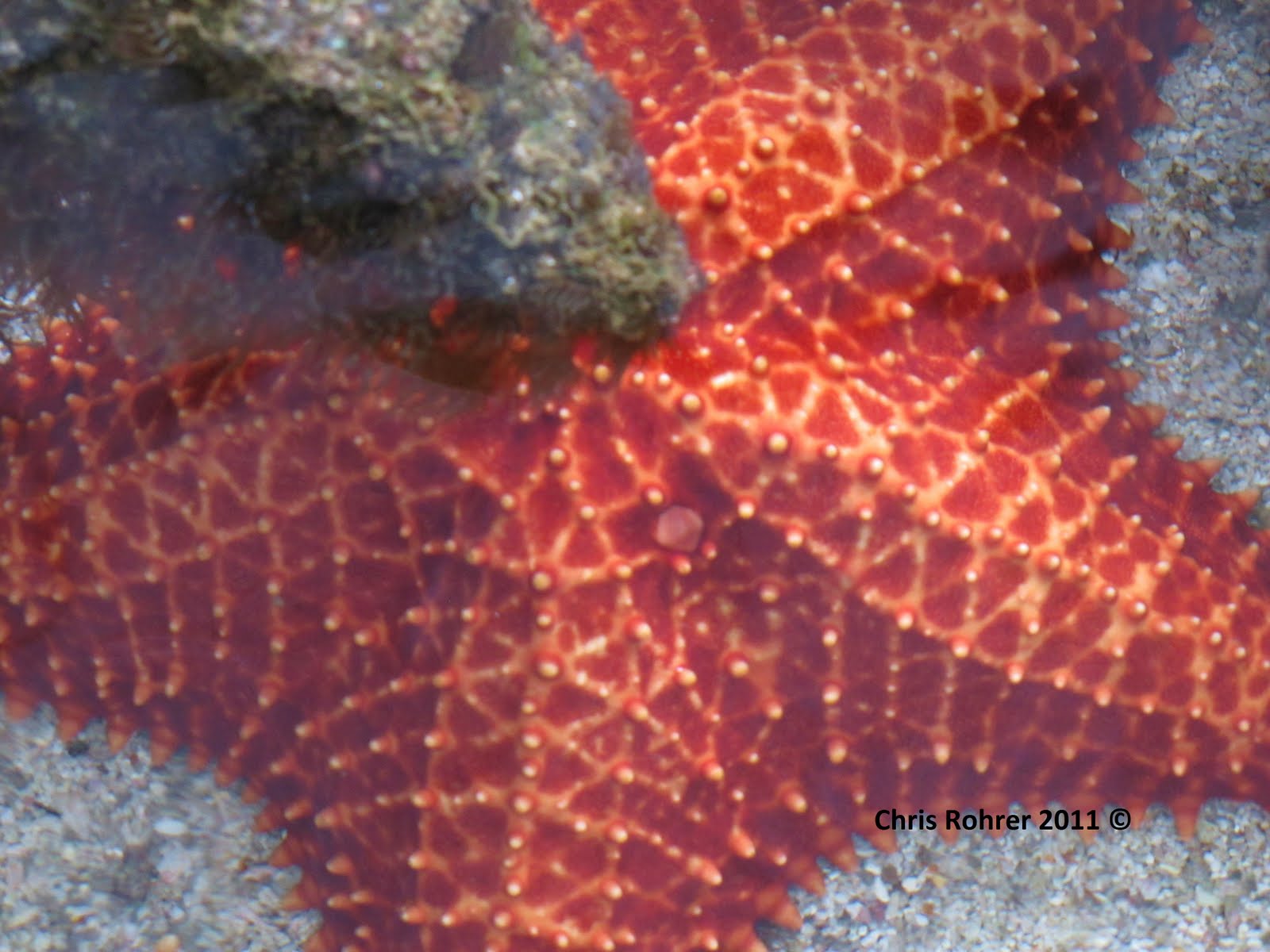
This park sized area has several smaller and larger aquariums around the property with turtles, fish, starfish, and other interesting marine life.  It's also a place that a former dictator named Noriega used to have drinks with friends.  That's random.  Anyhow, it cost 5 bucks to enter and the hours for the research station were a bit strange so I'm glad I read the memo ahead of time.  It opened at 1 o'clock on the nose!  Don't even think about getting there early or you'll be sitting on the bench waiting!  So here is how I broke down my day.  I started my morning in Casco Viejo and then grabbed a taxi to the Amador Causeway to do some walking. These two places are located close in proximity and it made sense putting these two activities together.  Stopped and had lunch.  Around 12:45, I headed down the riverwalk towards Isla Naos which is connected to the causeway.  Got there and had to wait a couple minutes to enter.  The people, like most Panamanians, were super friendly and we passed the time chatting.  Sidenote:  I have to admit that Tucsonans,in general, are very standoffish because you don't know if the people are going to kill you, steal from you, sell you drugs, etc.  In fact, you don't usually say hello to people on the streets because that's creepy and strange.  For this former Wisconsinite who was used to saying hello to strangers all the time, it was a bit of culture shock to have to undo that politeness in Arizona.  So it was nice to chat with random people again and not be considered a criminal.....Arizona is a great place, but the people have a lot to learn about manners. 
So back to Panama.  It's a great place to bring kids as they can pick up starfish(after washing their hands of course!) and other sea critters.  Marina, who I would later see again in the magical ghost town of Gamboa), was our guide.  She was a woman with intense blue eyes covered in tattoos. I instantly liked her because she gave off a good people vibe. Marina spoke English and Spanish, but she knew other languages as well.  Anyhow, she would show up in our adventures later on in the trip and it was always great to see her.  The tree pic for the day is below.  I found it on a short trail up on a hill.
This tree was massive and reminded me of Avatar.  Imagine walking on the branches!!  Anyhow, I thought it was a sexy tree. I've got several more tree shots that caught my attention below. 
The STRI(that's what I'm calling them now) occupies former military bunkers atop the rocky Punta Culebra. But keep your eyes open for sloths, iguanas, armadillos, and a variety of birds.  You can also get a great view of ships coming out of the Panama Canal.  Here is my opinion, and some of you may differ as you enjoy the urban landscape a bit more...and that's okay.  It's just my opinion:)  The Causeway is ugly and full of plastic American type yacht clubs and restaurants.  There are 3 islands, 2 of which seem untouched by the tacky development.  The Causeway is a hit for Panamanians because they get to drive their cars fast up and down the road.  The walk is nice because there is a breeze, but you'll occassionally see some trash off to the side.  What is it with people not throwing their garbage away?  In some places, the water had a lot of garbage floating around in it.  This is the part of Panama I didn't like, but the trash issue doesn't compare to that of Mexico.  I think Mexico is still the "trashiest" country I have ever visited.  Sorry Mexico...I love you.  You have my heart, but you could learn a thing or two about picking up after yourselves. You're getting better, but there's still more to do.  Once we left Panama City, everything cleaned up quite a bit.
Museo de la Biodiversidad
I thought I'd leave you with two parting shots as I left the STRI.  This building above will be a major importance for Panama City.  I'm going to say that this is the Eiffel tower or Sagrada Familia of Panama.  It's going to be huge, but right now it's set to open in October.  However, the dates have changed over the years due to construction issues.  It is called the Museo de la Biodiversidad created by designer Frank Gehry.  It's a joint effort of the STRI, University of Panama, and the Interoceanic Regional Authority....3 powerhouses in Panama.  Its 8 halls will feature multi-media exhibitions showcasing Panama's astonishing biodiversity, from its oceans to its cloud forests.
Finally friends, here is the other cool pic I promised from the Amador Causeway. Do you believe in Ents(tree people)? After seeing this pic, I do.  You'll believe in them more on August 24th as I discuss some walking trees. 
Sites to check out........
For the Punta Culebra Nature center(the STRI), contact puntaculebra@si.edu
or call 507-212-8793/507-212-8760
Open Tuesday through Friday from 1:00 PM to 5:00 PM
Saturday and Sunday from 10:00 AM to 6:00 PM 
"The Smithsonian Tropical Research Institute, a non profit unit of the Smithsonian Institution, Washington D.C., is headquartered in Panama City, Panama, and is dedicated to furthering the understanding of tropical nature and its importance to human welfare, training students to conduct research in the tropics and promoting conservation by increasing public awareness."
El Museo De La Biodiversidad
Tel: 314-1395

Friday, August 5, 2011

Escape from the Urban Life!


Two words. Parque Metropolitano. I'm going to be honest.  The only reason I arrived early in Panama City was to hike this trail to the top of the hill and get the city vistas.  There is also another hill which is much more popular with tourists called ANCON that has the Panamanian Flag on top.  However, this park fascinated me and looked less populated. It was a great introduction for me as the humidity was terrible!  I don't know how I got through this trip alive.  Central America is a beautiful place but it was also super uncomfortable.  I love rain, and Panama didn't disappoint.  While we were there, it rained almost everyday and sometimes for hours.  This little hike would warm me up for some of the major treks we would take throughout the country.  Looking back at it all, this was one of the easier hikes. From downtown Panama City, I took a taxi that cost around 3 bucks.  Once I arrived at the beautiful park entrance, I paid 2 dollars to get in. For updated information, click on http://www.parquemetropolitano.org/

This is a great place to visit if you have half a day.  It was quiet and nice to be away from the city noises. What's unusual about this park is that you have a rain forest located in the middle of the city!! This is tropical america's only fully fledged wildlife refuge and forest environment within city limits.  Here you can see a lot of birds and animals in one of the last patches of the Pacific's seasonally dry forest. I would recommend going early in the morning for best wildlife viewing.  I saw a lot of birds in the trees, several turtles and lizards, but I wasn't lucky enough to catch a sloth, white tailed deer, or Geoffrey's tamarin on this visit.  However, I did catch them later on in our journeys:)  This 655 acre park was established in 1985.
Revolution Tower captures everyone's attention entering the city. It was created by a Panamanian architect named Pinzon Lozano. 
There are several trails in the park that range from easy to moderate.  I met some wonderful visitors along the well marked paths and they made me smile. There's the Sendero La Momótides(0.4 mile), Sendero La Cienaguita, and Camino del Mono Tití.  Don't let these Spanish words scare you off....."Sendero" or "Camino" just mean "path" or "trail".  Mr. Sweaty, that's me, was super happy to reach the top at Cerro Cedro because there was a wonderful breeze that made me sit down for several minutes.  The worst part is knowing that you have to go back down into the humid hell of the city.  So I just enjoyed the moment with my new friends on the trail and the incredible vistas
I had a fun morning hiking the trails.  The trees in the rain forest have so much personality.  Here's my tree pic for the day.  This would be the day that I got "my green on" and went crazy shooting pics of green plants all over. Here's a desert traveller's tip.  Focus on what's important.  Like any amazing place on this planet, including the Sonoran desert, cameras won't catch the feel of vistas as they do with the actual living moment.  What am I talking about?  People come to the desert and shoot pics because it's a cool place, but when they get their pics developed, everything looks just drab and boring.  The same goes with the rain forest.  Coming from a dry place that is rocky and brown to a place full of emerald green is quite overwhelming. Be careful wasting shots when there are bigger and better shots just waiting around the corner.  I have some incredible pics coming up.  Memory cards and batteries are a premium.  Purchase a lot of batteries before travelling to another country because the quality of batteries in many places are terrible! I bought an emergency pack that lasted 2 minutes in my camera!! Edit your pics everyday before you go to bed. This warm up hike was just a taste of what was to come. One last thought before I end this post.  Nature is beautiful, but by the end of the trip, I realized something for the first time in my life which had never happened before until now.....the rain forest is an amazing place, but I found myself appreciating the desert more. I missed the cactus world and would get excited seeing one in Panama. It made me look forward to going back home and working at El Presidio again. Until tomorrow friends.....