Showing posts with label Varied Bunting. Show all posts

Saturday, July 28, 2018

Abscondito


One of my "unofficial" duties every year is to survey the bird life at Rancho El Aribabi during the month of July.  It is usually hot, miserable and the best time to find amazing birds!

a male Varied Bunting comes into the pasture for a drink
This year was NO exception.  Located 45 minutes south of the international border in the state of Sonora, Rancho El Aribabi holds many of the Sonoran species that we have in Southern Arizona.  This is also the land of the Jaguar and Ocelot.  While I did my bird surveys, Jim did his tracker work on the cats.  In the process, we found each other data for the ranch.  A recent report was released to the public about the recent death of the Huachuca Jaguar of Southern Arizona near our survey site. Last year, another Jaguar of the Santa Rita mountains IN Arizona, was killed for its fur without much public outcry.  How this recent Mexican kill had more traction than the one is the US is beyond me?!  The Santa Rita Jaguar was recorded by National Geographic and tracked by a UA research group, which included a dog team member. What I write here is just speculation. A poacher must have used the landmarks from the video in the Santa Rita mountains to track the animal while utilizing illegal wildlife cameras with a GPS tracking signal to find this extremely secretive cat. Once a wildlife camera is tripped, a signal is sent to the owner via wireless means. From that point, s/he can check from their computer and see where the animal had recently passed. 


a cicada sheds his form to grow wings and fly
It is beyond my comprehension why such savagery happens.  When a person, who studies cats like the Jaguars, finds one of these rare gems in the wild, it's hard to hold back this exciting information.  For every 10 great people out there, there are always 1 or 2 terrible people who will break the law.  And this is the danger of revealing this information to the public. Not everyone is a good egg.


Finding a Jaguar is a privilege and many times, quite a bit of work on the researcher's part. In my opinion, this information should be kept secret from the public.  I've only seen 2 in my lifetime but I hid their exact locations when recording the data.  The data should ALWAYS be recorded.  I do the same with rare birds.  And I am super protective of any endangered species.  In the beginning, I assumed most people were honorable.  Then I discovered otherwise.  That's when I changed as an observer. 


On my trip to the Amazon years ago, I discovered that I wanted more from my camera.  These poor photos of the Jaguar helped motivate me buy a better camera.  My 6th sense had gone off on this day.  I remember that I was on a canoe.  The small crew was quiet and I noticed two vultures curiously looking at something. As we silently floated around the bend, we found this male Jaguar along the banks for a brief moment.  Our guide was shocked. This time I was ready with my camera for the Jaguar.  Today, on the ranch, several people and organizations track these endangered mammals. Finding a Jaguar is a gift and a curse at the same time. The wildlife official knows s/he will have to release the information at some point. And when that happens, everyone wants to take credit for the person's find. Meanwhile poachers, secretly take this public information and plot a course. 


If you've seen the original Jurassic Park, you'll remember the large guy getting chased by a small dinosaur.  That was me.  This bird kept making a coo-coo call in random spots around my survey point.  It was creepy but made me laugh.  I took the coo coo call as the bird telling me there was a nest nearby.  So I carefully walked out of the area keeping my eye out for the Greater Roadrunner's nest
These are just my words, but you can read the article link above and form your own opinion. These good people are just trying to protect the corridor of these magnificent beasts from human development (and also because they are in love with the chase and possible first time discovery of these rare cats).  I'm a birder first.  I get it.  We seek the impossible.  And if we find something rare, the personal rewards from all the risk taking made the difficult trek absolutely worth it. It's like winning the lottery. You want to share your excitement, but you know that if you do, there will be consequences. 


a sexy male Rufous Hummingbird
One of the notable things we saw on this trek were high numbers of Violet-crowned Hummingbirds.  MANY people from all over the world come to Southern Arizona with hopes of spotting this beauty.  Here at the ranch, they were THE most common hummingbird at the feeders.  The Rufous male hummingbirds were also present indicating that migration has begun.  

dolphins with wings, the Violet-crowned Hummingbirds
For me, seeing a Rufous Hummingbird in July is like watching the first fall migration of Sandhill Cranes in Wisconsin.  It reminds me that seasons do change and life continues in its cycle.  The monsoon storms grew over the mountains while we were there. The firefly show blinked all around us. And even on me! Yet another sign that the "seasons" have changed in our beautiful Sonoran desert. 


Broad-billed Hummingbirds sparkled in the brief moments of morning sunlight. 


the brilliant gem known as the Broad-billed Hummingbird
As a rule, we did most of our surveys in the morning when critters were SUPER active. And it was cooler.  In the afternoon, I hung out with Kathy and Mary Ann on the patio away from the intense sun and muggy conditions.  It was a special weekend as we were experimenting with a catered event provided by Carlos' sons.  They did an amazing job. And made our work easier.  Kathy, who normally did all of our food prep in the past, got so bored that she went for a hike!  

a mummified Pallid Bat
The usual birds were present.  We also discovered a grim scene inside one of the rooms.  Mummified Pallid Bats were found all around the fireplace.  I plugged my nose as Jim picked up these poor mammals.  Apparently, there was no escaping back up the chimney where they came.  

the western subspecies of the Yellow-breasted Chat
Yellow-breasted Chats were chatty.  Thick-billed Kingbirds were cheer-eeping. Sinaloan Wrens were rattling POPS! And the mournful cries of the Gray Hawk could be heard up and down the canyon. 

Thick-billed Kingbirds
I was dying from heat exhaustion. At one point, I almost passed out because I went outside of the safe zone and ran out of water. So I hustled it back to headquarters before anything bad happened. One evening in my tent, it was unbearable. I couldn't sleep at all!  I have enjoyed sleep in my a/c  run home whenever I can. For the first summer in a long while, I have traveled most of it outside of Arizona. Some of the nights were challenging in the various places. After several weeks back from this adventure, I have fond memories of our trip.  If you had asked me during this particular weekend how I felt, I might have said something else:) 


Carne Asada never tasted better
For it was on this survey that some incredible things happened.  For one, we discovered several more species for the ranch.  During a morning coffee, watching the hummingbirds, I noticed a green bunting under the feeder.  A female Painted Bunting!!!  Later Jim and I were trying to relocate a Northern Jacana that I had seen earlier in the wetlands.  I thought this bird would be rare but it turned out the Willow Flycatcher was even rarer! FITZ-BEW!  Jim was shocked.  I thought it was unusual but nothing like the Northern Jacana.  And it didn't end.  Later we found Flame-colored Tanagers along the riparian corridor!  Talk about amazing!  July is the best time to visit Aribabi and it's the reason I go every year to do my counts at the ranch.  

I call a Gray Hawk over to my location by making a mournful whistle
Every year, Jim finds some nasty bug hiding in the couch or somewhere nearby that I'd rather never know about. This trek was no different.  On this little adventure, a Windscorpion, apparently not poisonous, was under the cushion of a couch.  Gross! How is that thing not deadly?  Look at those pinchers for a mouth!

nasty alien bug from a group known as Windscorpions, not poisonous
On Saturday night, we celebrated our last finds together with a nice bottle of wine and an excellent Mexican dinner.   


For every in depth research project, there should be a fun birding expedition after wards.  Everything in my life continues to change.  Every experience away from what I know, changes me.  Nothing is black or white anymore. Over the next several weeks, we'll explore the island of Maui. 28 new bird species were added to the list towards the 1,000 bird marker I've set for this year, but what I saw, or didn't see, changed me in ways that I hope I will be able to write down properly.


Leila Empress
As I did my research for Hawaii, I made notes without any feeling. Reading about something is completely different than experiencing it. Needless to say, the experiences with birds between Trinidad and Maui were night and day and it changed me.


For the El Aribabi Report, click here. Next week we explore the beautiful world of Hawaii.  For now, I'll leave with a Sunday Morning moment I had during my survey along the Cocospera Riparian corridor. I wanted to sleep in this spot.  It was so relaxing. 


Sunday, September 3, 2017

Three Betrayals You Will Know

Canyon Wren

As the Canyon Wren inspected my binoculars, I pondered the meaning of it all.  Somehow we made it.  And thank the bird gods we did.  I'm not sure what we would have done had we been alone. 


This trip showed signs of trouble from the start.  Kathy's truck met a river for a road.  We tried to get around the river but got stuck in the mud.  And later it happened again! But this time in the Cocospera river!  Had it not been for Jim's tow cable, I'm not sure we would have gotten out.  

Violet-crowned Hummingbird
I looked over and saw the Canyon Wren again.  This time on the backpack.  We took our walk and again I counted birds once more for this ranch.


As we hiked down the trail, we noticed a new road cutting through pristine desert habitat.  This ranch?  Was it even protected anymore?


I still noticed the birds.  They were all still there. But something was different this time.  

female Varied Bunting
They checked their jaguar cams.  I recorded.  This time we noticed mesquites cut down. The cameras picked up service workers from the state doing the cutting. On this ridge, where Jaguars survey their large territory, we witnessed the incredible Sky Islands.  We could see the Santa Rita Mountains in Arizona from Mexico!  This spot was magical as we could see every major sky island. I now could piece together the bird migration puzzle.  It all made sense. 


And this time around, there were more cattle. Once upon a time, the ranch owner was sensitive to the number of cattle on his land.  But it seems he has lost this battle as well.


The old couches sat outside on the patio now as if to be taken away at some point.  There the Canyon Wren sat. 


I watched an adult Cliff Swallow feed the baby. 

Cliff Swallow
Nothing lasts forever.  There comes a breaking point when one says enough is enough.  Not only was the ranch going through some changes; so was I. At my work, a friend betrayed my trust.  After 16 years of working together, it was a hard slap in the face and it broke my heart. It's now strictly business.  My life has become a complicated and wonderful thing.  And the same is happening for my other half.  I share my adventures with people and they wonder how I am able to balance it all together.  It's hard.  But I have kept this motto ever since I first heard the words from Principal Art Johnson. "Work hard; Play hard." And it can be done with the proper management of time.  AND it's also the same reason that I have written in the past that we are only given a certain amount of time.  Do we spend our time living in the negative moments?  Or do we live our lives to the fullest? 


Vermilion Flycatcher
I've now cut the last threads of negativity out of my life. Life changes. We change. When you can't trust a friend with personal information, they no longer are friends. 


At night, we walked muddy roads discovering more bugs than reptiles.  I thought more about betrayal. Maybe this is how the rancher also felt.  He thought he could trust the Mexican government to do the right thing.  He thought he could trust the conservation groups to keep his efforts going.  And in all his efforts, he kept running into obstacles. 

Wolf Spider
Several of us swallowed bugs.  Something big ran across my foot. The air was saturated with insects! Clouds of winged things formed around us under the starry sky.  They were in our hair, on our skin and in our mouths. It was quite the experience. Sometimes I shined my light on one of my friends and they couldn't figure out why they were getting attacked by all the bugs. I needed a good laugh to get through this hellish bug nightmare. We were walking through the poopy stream where the cattle were now hanging out. It was gross. 

Antlion
In the darkness, it's difficult to see with human eyes.  Thankfully our head lights illuminated these incredible alien looking bugs.  Our ears could detect Great Horned, Barn, Elf and Western screech-owls.  Eventually we hit the muddy river of a road where we first got stuck.  I was not walking through that mess again. 


Tarantula
Jim checked traps for snakes and other reptiles. This guy is fearless!  

A sleeping Pacific-slope Flycatcher
Meanwhile, I counted the sleeping birds in the trees while Tim and Robyn tried finding snakes climbing up those trees. 


Hummingbird migration was at full force.  


The Canyon Wrens jumped onto my chair.  I had a good laugh.  How many people struggle to see these wrens when they come to visit?  Sure, I often hear them but to have them come right up to me was a nice change. Talk about an armchair tick!


And I continued counting birds while running into more cattle.  No decision is ever simple.  More cattle equals more money.  It's obviously where the cash is made. But surely there is a way for conservation to be equally profitable beyond the hunting sector?

Wilson's Warbler
I came back and found these two wrens getting into more mischief.  At one point, someone left the truck door open and one of the birds went into the vehicle!!!  So I obsessed about the bird until it flew out.  


For years, I tried to believe that the ranch owner was trying to make a difference.  And I think at some point he did maybe try a little. During our last visit, we witnessed things on the ranch that seemed to be reversing the conservation trend. 

Blue Grosbeak
I've listened to the ranch owner tell stories about how the government and town were not pleased that he wasn't putting more cattle on the ranch.  And that whenever he tried to move forward in the various conservation areas, he was blocked by someone or something.  It must have been frustrating. 

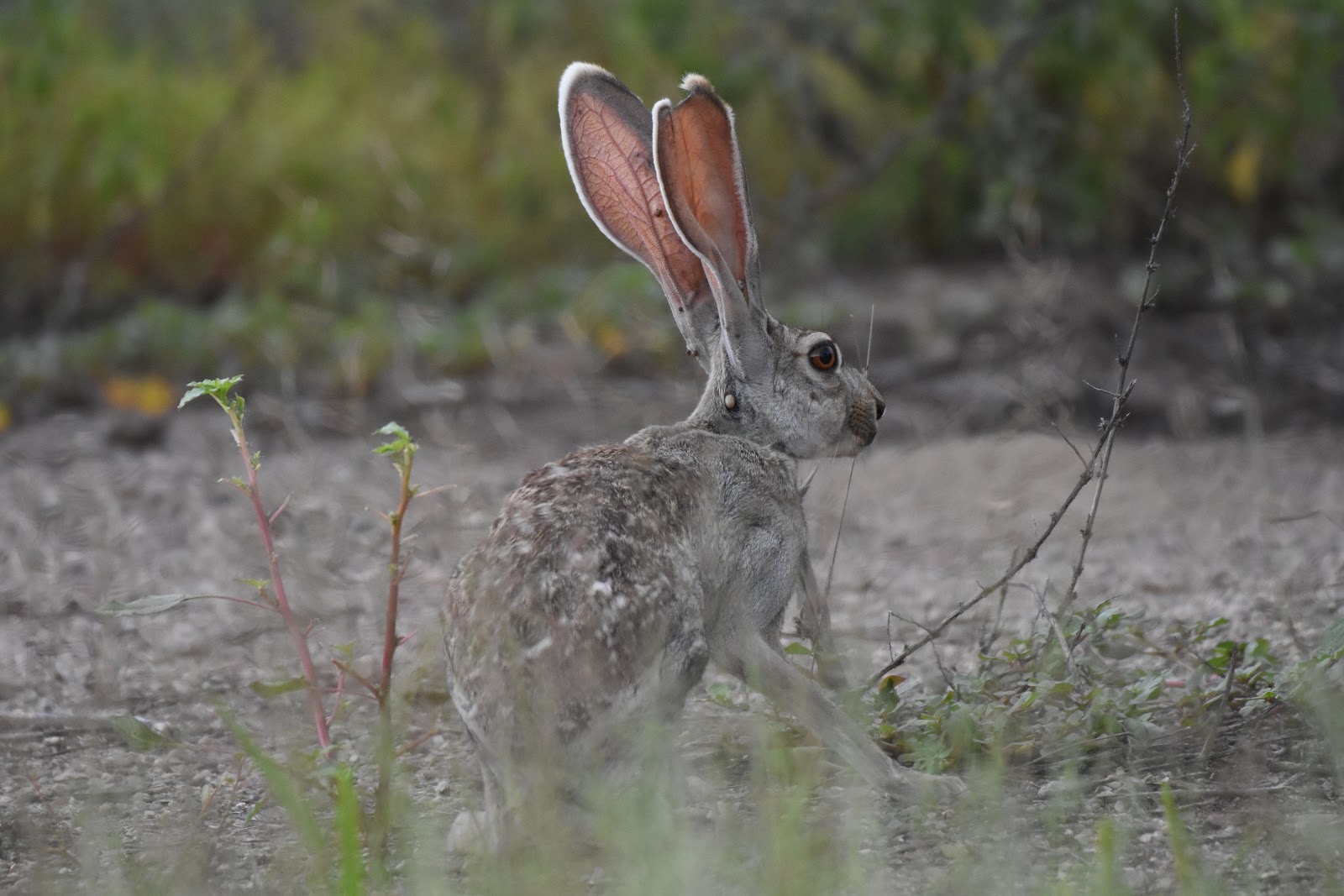
Antelope Jackrabbit
And then there's my point of view.  I've been to the ranch when we didn't have electricity because he forgot.  Or he didn't tell us that he changed the gate lock even though he knew we were coming.  This last time?  He forgot to turn on the water AND we had to find a way around the gate because the locks were changed yet again. Then there were the bad conditions of the road. It wouldn't be so bad if people didn't have to pay money.  But they did. So how serious is he really about conservation work and attracting people to the ranch?  


I fear that soon there will be no one coming to do research at this ranch.  I understand that people need to survive and make money.  I also know that the people on our end work their tails off to do excellent research.  They have offered to help expand the organization but it has been met with lukewarm reception.  People like Kathy believe in this place.  She always has. 


Our glue, Ms. Kathy, can't keep this going forever. She has been the organizer for all these trips for so many years.  Both she and her daughter have spent MANY hours prepping for these trips so that people could experience the ranch.  It has been a magical journey and I've met some of the most incredible people.  But sadly, it looks like those days are coming to an end as the ranch owner ends his conservation attempts to protect the Cocospera Riparian area.


As I look out at the ranch one last time, I wonder what will happen. Only one weekend before this trip, I had heard a speaker talk about this rancher and what an amazing job they both had done creating this conservation friendly ranch. There were half truths spoken.  Old conversations with the ranch owner about this speaker suddenly surfaced. I watched the audience believe his every word.  In the back of my mind, I heard the rancher's voice.  And I listened intently to what this man had to say.  What the speaker didn't tell his audience was that he is not allowed back on that rancher's property anymore because he betrayed the rancher's trust. Again, the word "betray". To me, this speaks volumes about the relationship issues between conservation groups and ranchers.  I can't speak for the ranch owner as I have never been a ranch owner.  I've not been in his shoes boots, but I can tell you that I wouldn't want irresponsible people on my lands. 


Sleepy Orange
The people below continue to be optimistic and I will try my best to keep an open mind.  Some will keep trying for as long as they can. 


But here's the kicker.  Who speaks for the wildlife on this ranch?  Who will protect them if no one cares?  The bird gods must have heard my troubled thoughts because several days after our trek, I received a letter requesting the use of one of my photos I took on the ranch a couple years ago of the Crawford's gray shrew.  Jim was looking under wooden panels on a cold cold day and discovered this tiny mammal.  Perhaps these organizations will put Aribabi on the conservation map and help this ranch owner out?  Only time will tell.  How does that saying go?  One step forward; three steps back. 


I have watched "change" happen all around me in the desert. I've silently watched the major characters in conservation interact with their audiences and also between their egos.  Three Betrayals I have learned during this past month of August. A betrayal of land, friendship and intent. I remember a time before birding when everything was so black and white.  When birding entered my life, it fused itself into my being and changed everything.  And I changed.  I can't save the world but I can be the best citizen scientist possible.  I have to believe that we, as the shepherds of this planet, can do better. Until next time.....


Tuesday, June 6, 2017

Shadowhunters

Babs enjoys a nice scope view of the Rose-throated Becards with a kind birder.
 I have been wanting to write a little bit about birding Arizona during our intensely hot summer months. Specifically, the month of June. When guests come to visit, I have very little energy to go with them during a whole day and find birds.  Our temps average around 104-115 degrees during the month of June.  And while those temps are dangerous, there are things you can do to avoid dying on the trails. 

Varied Buntings breed in Arizona during the summer months
 It is NO secret that Arizona birding is one of the best places in the world to go and find unique and beautiful species of bird.  But the same can be said of our herpes, bugs and mammals.  Our summer months offer excellent opportunities to find rare and unique southwestern flora and fauna.   


With that being said, I often lack the energy to wake up and explore.  Why?  Well, sunrise here begins around 4:30 AM.  And the birds begin their song at that time.  So what can a birder do to make their visit to Southern Arizona more comfortable?


Bring a friend/s.  They help motivate.  For myself, I groan at the 4:30 AM wake up call but I am always excited about the incredible discoveries we made afterwards in the field.  Also, if there is an injury on one of our rugged trails, you'll have someone who can get help.  I cannot tell you how many times people will get heatstroke or nearly pass out after their first day out.  They overextend their birding excitement and wear out quickly.  This brings me to......

Canyon Tree Frog
 Water.  You MUST bring water with you at all times.  If your car breaks down, have water with you.  Put a water pack on your back and drink drink drink!  You'll prevent the severe headaches at night by staying hydrated.  And speaking of evening.....

Coue's Whitetail Deer
 It's one of the best times to go birding for rare and exciting nightjars, mammals, owls and more!  Again bring a buddy because there are many wild elements here in the desert.....like snakes.  Snakes love to hunt at night.  So do most of our critters.  

Lophocampa mixta, Tiger Moth.  Thanks Margarethe for the ID
As mentioned before, go early in the morning.  Best time to bird is anywhere from 4:30 AM until 10 or 11 AM.  Stay in the shade as often as you can.  Go to higher elevations or shady canyons to make your birding experience much more enjoyable. 


American Snout
Try to stay in a local area and bird so that you don't waste that valuable birding time in the car. For example, you could stay in Sierra Vista and then bird the many canyons and riparian hotspots around the city. As the day gets hotter, the bird activity dies down. Most birders at this point take a nap or get lunch. 


BUT if you are in your car, you can also bird.  How?  Well check this out.  Birding from your vehicle is a real thing.  My Wisconsin peeps often bird during the cold winter months from their warm vehicles.  It's no different here.  Places like Saguaro National Park(East Rincon Unit) offer a 9 mile loop where you can drive and park at your leisure for birds and critters.  For lunch, you can stop at the Javelina Picnic area under the shaded ramadas.  Birds, like the Canyon Towhee, Gilded Flicker or Black-throated Sparrows, will casually hang out and watch you relax and chow down.  


Western Screech Owl
So what is my technique?  Well I love the cold temps of our winter months here so I really utilize my time wisely outdoors.  When summer comes, I call up friends to go out for some early morning  birding.  If I don't, I sleep in and waste away inside my house. 

Blue Grosbeak
I tend to go later in the afternoon, around 5 or 6 PM when the intensity of the sun is less.  Temps are still hot but a breeze usually starts up and makes it a bit tolerable. 


Scaled Quail
 I also tend to hit the higher elevations and canyons for shade. And in the desert, I park and scan from my car.  

Gambel's Quail
 This past week was a fun one.  I went one evening to Madera Canyon and watched birds at the feeders.  There were a lot of great birds but the one everyone was thrilled to see at the feeders was the Varied Bunting.  They can be tricky to capture on camera because of the lighting conditions. Their colors are so wild that the camera often has issues sorting them out. 


Gila Woodpecker
And this past and current week should be titled the week of the "BLUE GROSBEAK".  They were most numerous around the San Pedro Riparian area.  We could not get over the dozens of blue dots flying around the feeders. 


Blue Grosbeak
We also stopped at Ramsey Canyon on an overcast day and did a survey in the humid, yet wonderful, shade of that canyon.  

Giant Mesquite Bug
An early morning trek with Babs lead us to a happy observation.  Rose-throated Becards are breeding in AZ again.  We suspect they were there last year but no one saw them. An old nest hangs nearby their current one suggesting that they were most likely present last year. While that trail has been there for some time, it wasn't as fixed up as it is now. While we were on the trail, there were some workers cleaning up the area for better access. It has been a good year for this species in AZ after not having many reports of them over the past several years.  

Nesting Rose-throated Becards-finally!

June is also the best month to escape the heat and take a holiday/vacation.  Many Arizonans head to San Diego or Rocky Point, Mexico during this time to enjoy the ocean and cool temps. If I take a vacation in June, I always make sure I'm home for July because the monsoon show is spectacular. Below I have several reports from our treks around Southern Arizona this past week.  Until next time...... 

For the Rose-throated Becards, click here.

For the Flame-colored Tanager and Ramsey Canyon, click here.  

For the Rufous-capped Warblers in Florida Canyon, click here.  This is the trail you need to explore early and with a friend.  It can be moderate to difficult due to the trail above the dam area.  The trail is steep with loose rock in some areas.  A walking stick is advised as is a water pack.  So why go?  It's one of the birdiest. Just be careful around the dam area.  

For the easy Varied Bunting add at the Santa Rita Lodge, click here

For the Blue Grosbeak excitement, click here