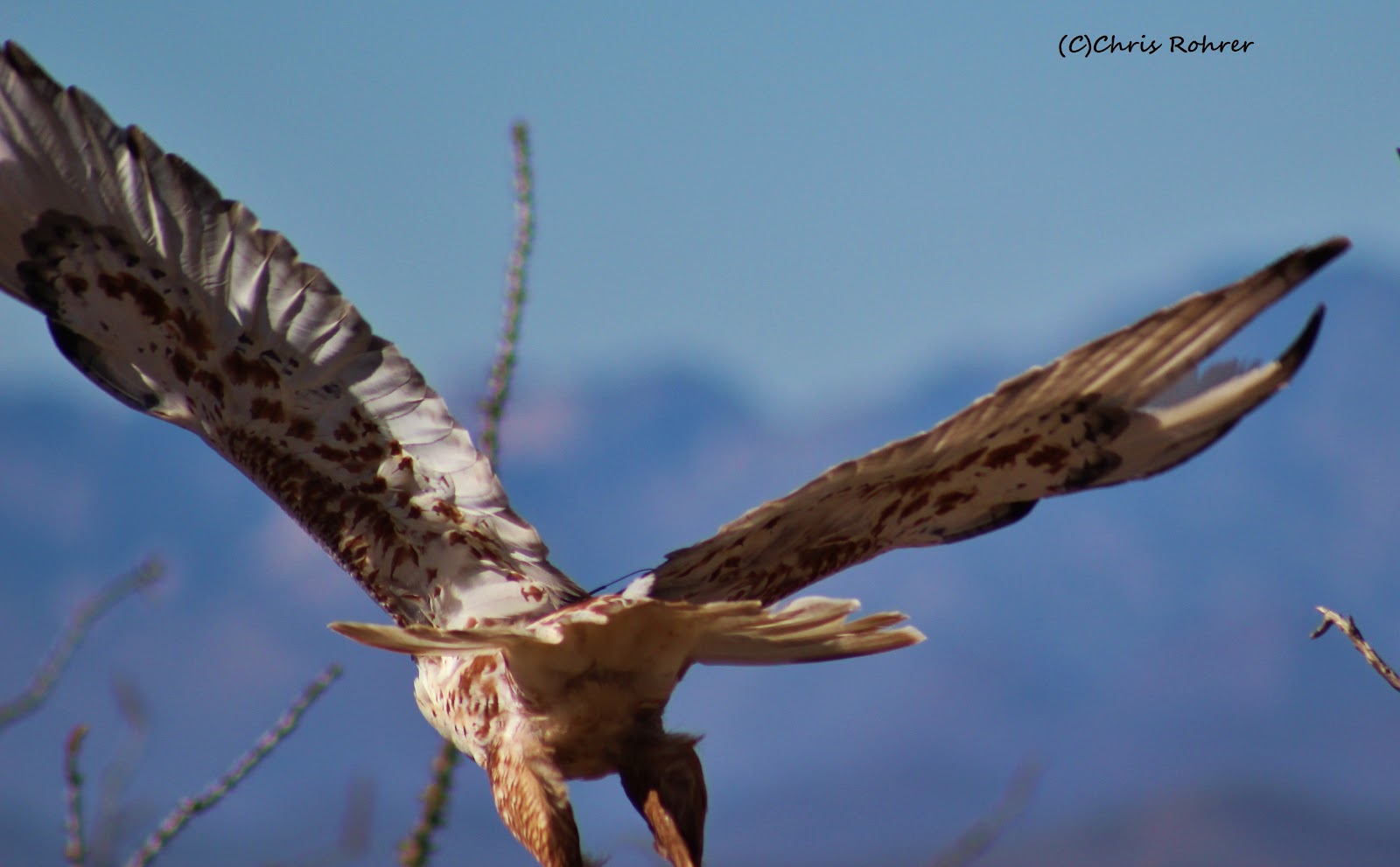
I think one of my favorite hawks is the Ferruginous Hawk. The way the hawk flies, glides, and moves in general is rather interesting. In some ways, this hawk reminds me more of an Eagle. Some people will mistake this hawk for the Golden Eagle.
Here in Arizona, this bird is losing range due to mining and other disturbances within the land. It is a particular hawk and unlike other hawks, if the lands are disturbed, it will not return back to the same spot. It will completely leave altogether. While the country has the Ferruginous Hawk listed as "Least Concern", here in Arizona, it is threatened.
The preferred habitat for Ferruginous Hawks are the arid and semiarid grassland regions of North America. The countryside is open, level, or rolling prairies; foothills or middle elevation plateaus largely devoid of trees; and cultivated shelterbelts or riparian corridors. Rock outcrops, shallow canyons, and gullies may characterize some habitats. These hawks avoid high elevations, forest interiors, narrow canyons, and cliff areas.
The flight of the Ferruginous Hawk is active, with slow wing beats much like that of a small eagle. Soaring with the wings held in a strong dihedral has been noted, as well as gliding with the wings held flat, or in a modified dihedral. Hovering and low cruising over the ground are also used as hunting techniques. The wing beat has been described as "fluid" by some observers. See the pics below....

The Ferruginous Hawk primarily hunts small to medium-sized mammals but will also take birds, reptiles, and some insects. Mammals generally comprise 80 to 90 percent of the prey items or biomass in the diet with birds being the next most common mass component. The diet varies somewhat geographically, depending upon the distribution of prey species, but where the range of the Ferruginous Hawk overlaps, the black-tailed jackrabbit is a major food species along with ground squirrels and pocket gophers. Depending upon the relative abundance of jackrabbits and ground squirrels, the latter could become the major food source. The white-tailed jackrabbit are occasionally prey and weigh about twice as much as a Ferruginous Hawk.

These birds search for prey while flying over open country or from a perch. They may also wait in ambush outside the prey's burrow. Hunting may occur at any time of the day depending upon the activity patterns of the major prey species. A bimodal pattern of early morning and late afternoon hunting may be common. The hunting tactics can be grouped into seven basic strategies.
Perch and Wait – perching is on any elevated natural or man-made site
Ground Perching – the hawk will stand on the ground at a rodent burrow after initially locating it from the air. As the burrowing animal reaches the surface, the hawk rises into the air and pounces upon it even while it is still underneath the loose earth.
Low-level Flight – birds will course over the landscape within a few yards of the ground and pursue in direct, low level chases, or they will hunt from 40 to 60 feet (12 to 18 m) above the ground.
High-level Flight – birds will hunt while soaring, but the success rate is generally low.
Hovering – using quickened wing beats, often in times of increased winds, the birds will search the ground and drop on the prey.
Cooperative Hunting – mates have been known to assist each other.
Piracy – the Ferruginous Hawk has been observed gathering around a hunter shooting prairie dogs, and to claim shot "dogs" by flying to them and mantling over them.
In its "strike, kill, and consume" type of predation, the prey is seized with the feet and a series of blows may be meted out, including driving the rear talon into the body to puncture vital organs. Biting with the beak may also take place. Before bringing prey to the nest, the adults will often eat the head. At the nest, birds are plucked and mammals torn into pieces before being fed to the young. Food caching has been noted, but not generally near the nest.
At times the Ferruginous Hawk has been considered threatened, endangered, or of concern on various threatened species lists but recent population increases in local areas, coupled with conservation initiatives, have created some optimism about the bird's future. It was formerly classified as a Near Threatened species by the IUCN, but new research has confirmed that the Ferrugineous Hawk is common and widespread again. Consequently, it was downlisted to Least Concern status in 2008.

Declines are mostly due to loss of quality habitat. Although flexible in choosing a nest site and exhibiting a high reproductive potential, this bird's restriction to natural grasslands on the breeding grounds and specialized predation on mammals persecuted on rangelands may make conservation a continuous concern. Historically, the birds entirely disappeared from areas where agriculture displaced the natural flora and fauna; for example it was noted in 1916 that the species was "practically extinct" in San Mateo County, California. Studies have found that prairie dogs can be a main prey item for Ferruginous Hawks, linking them to the populations of prairie dog towns in the mid-west and southwestern United States, which have been declining in recent years. This bird may also be sensitive to the use of pesticides on farms; they are also frequently shot. Threats to the overall population include:
cultivation of native prairie grassland and subsequent habitat loss
tree invasion of northern grassland habitats
reductions in food supply due to agricultural pest management programs
shooting and human interference
Toxic chemicals have not been suggested as a significant threat to the Ferruginous Hawk. Management strategies must include the retention or reclamation of native grasslands for breeding as well as on the wintering grounds. Maintenance of high populations of prey species in wintering areas seems critical to the hawks' abilities to move onto the summer range in breeding condition. The integration of agricultural practices and policies into the management strategies is a crucial component of any overall scheme for conservation. The provision of nesting platforms has had positive effects and should be a part of local strategies. Public education and the elimination of persecution and human disturbance must be an important part of the overall conservation program.
Source
More tomorrow.....


 Posts