Showing posts with label Rose-bellied Bunting. Show all posts

Sunday, December 20, 2015

The 700 Club

Green Jay-in Chiapas, the Green Jays have yellow eyes.  In Texas, Green Jays have dark eyes.
If there's one thing about a growing life bird list, it's learning that you have to be patient.  The first and middle part of 600 was not easy at all.  And I have to admit, I was doubting I'd hit my year goal of 700 by the end of December. 


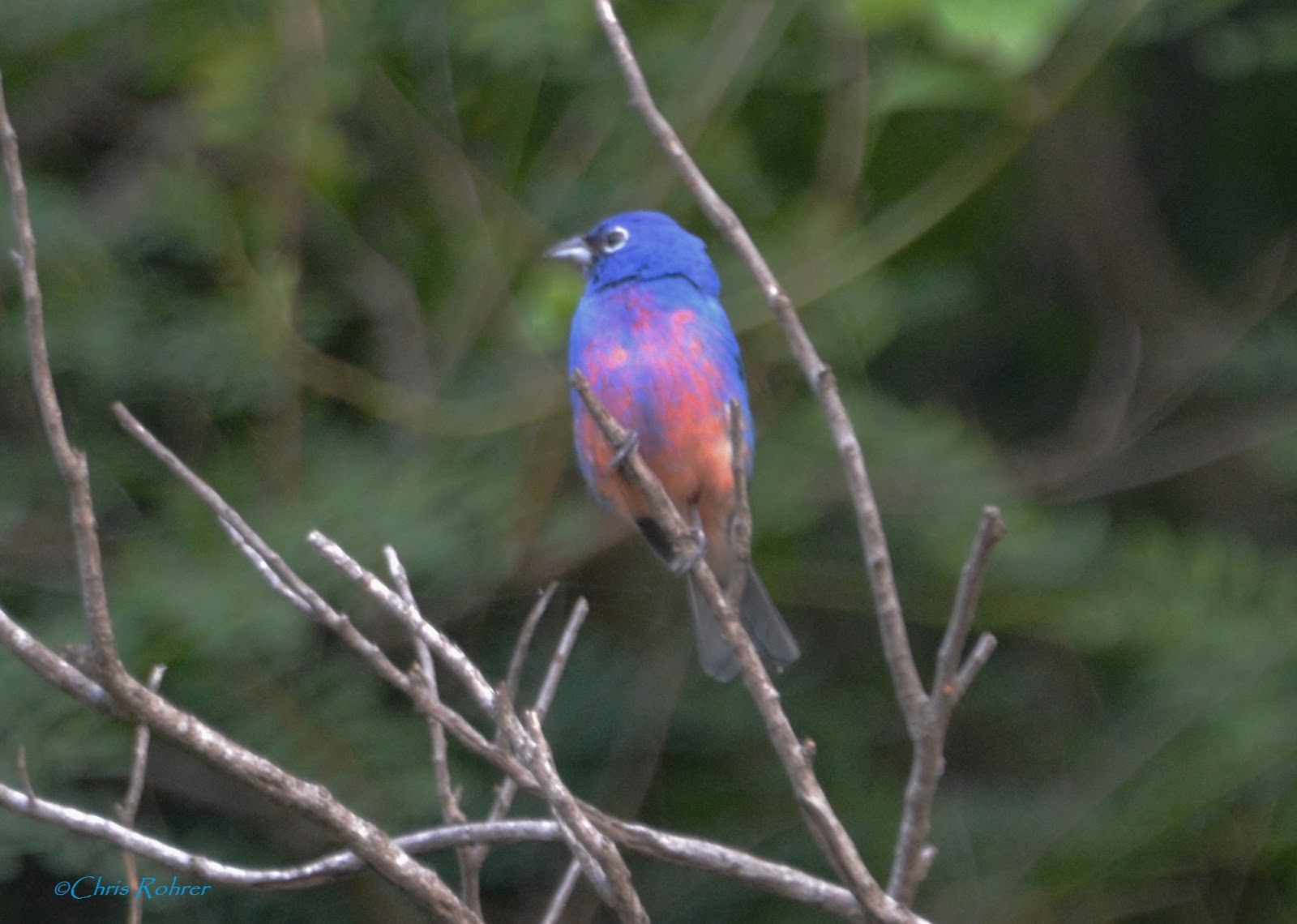
Rose-bellied Bunting or as it was once called, Rosita's Bunting
Many of the birds on my 600 list are neotropical birds.  They are some of the hardest birds to spot.  And while I'd like to say I'm getting better at finding them, I'm not:) 

White-winged Tanager
So I learned some valuable things on my personal journey to the 700 Club.  No more large groups.  I know I will have to do this down the road again, but I do not prefer large numbers of people.  While I enjoyed their company, knowledge and friendship, I much prefer the quiet and slow methods I use in the field alone or with friends.  And there's something special about ID'ing a new life bird on your own....

Stripe-throated Hermit
Every day there was something new flying past me and I couldn't keep up!  It was exhausting and fun.  The one thing I loved about our organized tour in Mexico?  The transportation.  It was nice to be told to meet the leaders at their buses each day at a certain time. When I do these treks alone, I always have to think about how I will attack the bird challenge.  Many times I stay in one spot for a week and really bird the heck out of it both day and night.  On our trek into Chiapas, it was FIVE new locales in FIVE days! 

Crimson-collared Tanager
It was amazing and the leaders were wonderful.  The reason for this important trek into Chiapas was for the endemic and difficult to find birds like the Nava's Wren, Pink-headed Warblers, Blue Seedeater and Long-tailed Sabrewing.  These were the birds I needed help finding because some of the birds were on private lands or in hard to access areas.  So in the shadows of the forests, we searched and searched for these brilliant birds. 

Barred Antshrike
Along the way, I found lots of other cool birds like this Olive Sparrow below.  The sparrow species make me smile and they are one of my favorites.  

Olive Sparrow
We saw trogons, motmots, chachalacas, guans and curassows, and lots of other brightly colored birds. 

Russet-crowned Motmot
So what am I feeling right now at the 700 level?  It's hard to explain, but I feel like I'm sinking into a birder stereotype that I fear most.  It's the one where I become a much more serious person.  It's the one where I lose human emotion and isolate myself in a space only filled with birds.  I'll try and fight that inner lifeless scientist away because birds are more than just data. I still will be a scientist in my own right....just one who laughs and enjoys the adventures along the way. I've met a lot of birders who can be too serious for their own good! The experience to 700 is completely different than the one I took to 100, 200 or even 300.  I'm a sharper knife now.  And with every moment free, I find myself engrossed in a bird book or TV program or studying new areas around the US and world. 


Great Curassow
As I sit in my car, fly in a plane or read reports, I separate the good and bad observations happening out in the field.  I add some of my own rare birds.  Others report their rare birds.  And so on and so forth....

Northern Bobwhite
But 700 was difficult.  I'm not going to lie.  It was the hardest challenge yet. 

Ruddy-breasted Seedeater
Sometimes it was the culture.  Utah challenged me with its 1950's culture of "Keeping Up With The Joneses".  Yuck! And California made me yearn for the open lands back in Arizona. There are too many people in that state!  However, when I spotted a new California endemic bird, I forgot about all of it and just smiled. 

Streak-backed Oriole
Mexico made me smile because I truly love this country and our time in Chiapas flew by so quickly there. It's been years since I visited this country's interior due to the drug trafficking and kidnapping. I can say that Mexico has become safer again for travel!  But still, I'm not taking any chances.  I'll always travel with a group of people now to this country. In February, Las Aventuras will return to Sonora, Mexico for another bird trek!

White-fronted Parrot
Then there were the birds!  Mexican birds hid.  Sea birds zipped past our vessels.  Other birds were perfectly camouflaged! 

Nava's Wren
And some birds challenged my patience!  This bird above is the number one success story of the year. The Nava's Wren hides in the dark shadows of Mexico's dry rain forest. It's habitat is very tight.  There are only 9 locations where this bird can be found and it's in some rather remote areas. We waited and waited and waited for this bird.  Some birders were super sick due to food poisoning, but by the bird gods, everyone made sure they saw the Nava's Wren.  One man collapsed onto the ground waiting to see this bird.  Now that's dedication!

Lesser Roadrunner
Four years ago I began this journey.  There are over 10,000 birds on this planet which leaves me approximately 9,300 more birds to find:) Oh may the BIRD GODS be good to me!  I'll certainly die trying to find them all!

Plain Chachalaca
A lot of strategic planning goes into everything I do. I like the planning part a lot.  It's the budgeting I hate!

Green Violetear
For next year, I'm planning on setting my life bird goal at 800....maybe 850.  I'm tossing around ideas like Canada, Alaska, the Pacific Northwest, Cuba, Florida...or just a simple summer, vacationing in my beautiful home state of Wisconsin.  And of course, I will do my mandatory pelagic like I do each and every year. But who knows where that will take place. 

Blue Seedeater-a difficult bird to find!
There are many California birds I still need to find.  There are still many Wisconsin birds I need to find.  But overall, North America is starting to shrink:) Yet still....there are hundreds of new birds that need to be found.  Some birds require their own trek!

Long-tailed Jaeger
Casual ocean treks will now be very focused and calculated. 

Sooty Shearwater
A Bay Area trip, with a Monterrey or Half Moon Bay stop, will be needed. But that is something I want to do with Micheal. 

Pomarine Jaeger
North America is a great big continent to explore.  One could easily spend a lifetime here discovering everything there is to know about our wildlife. I can't believe how much I've learned in such a short amount of time.  But my mind is like a sponge.  I'm a detective on a case. 

California Quail
I imagine I am the bird sometimes.  This helps me figure out where they may be hiding.  And quite a few of these birds like to hide!

Chukar
As this chapter of "Americano" comes to an end; another will begin.  Where will it take us?  Your guess is as good as mine.  But it's sure going to be a fun ride!  Over the next several weeks, at least until the end of the year, Las Aventuras will be leaving the desert once more to find a few more new bird species. In January, I will feature the highlights of 2015. Until next time.... 

The Pacific Wren
Number 700 was the Pacific Wren.  It was seen in the snow with most excellent company.  Birds take us to fantastic and magical places.  You never know where you'll wind up.  Until next time!


Wednesday, August 12, 2015

GIANT Expectations

White-nose Coati at Zoomat
After a long stressful week of intense birding, we ended it all with the Wonder Team, Matt Hale and Francesca Albini.  They worked so well together that I had thought they were married! Their amazing teamwork made the last day very special.  


Matt sets up the scope to begin the search for buntings
Out of the 10 participants scheduled, 4 of us remained.  It was by far the easiest and best day for birding and photography.  I had been looking forward to this day since we arrived.  Why?  Well, I have never birded the Pacific Lowlands before.  And even though there were birds I had already observed, I wanted to see them again!  It was a magical day out for our group.  The heat was oppressive but the birding and crew were some of the finest!


We spot our first White-nosed Coati in the wild.  There are several in the background. 
We headed into the protected Sepultura Reserve which is southwest of Tuxtla Gutierrez.  And then, the show began. White-nosed Coati walked out on the limbs of trees.


White-throated Magpie Jay
At sunrise, we stopped at a great overlook area with a beautiful view of protected rain forest that went as far as the eyes could see.  A gentle breeze blew through the canyon. I also saw dinosaurs, but I'm keeping their gps location secret.  However, I will report some very special bird sightings.....:)


La Sepultura at dawn
Even in the darkness, I could make out something blue and pink flitting around the leafy canopy. Francesca silently moved towards the bird and pointed.  Matt directed the scope towards her aim.  And then.....


The majestic male Rose-bellied Bunting(formerly named Rosita's bunting) made an appearance!  People just dropped their jaws and uttered things like "WHOA!", "That is one beautiful bird.", "#%^!", or "My milkshake brings all the boys to the yard, and they're like..." Just kidding on that last part. It was a real make out session with this bunting. 

Rose-bellied Bunting(formerly called the Rosita's Bunting)
I wished this moment would last forever.  Gorgeous weather.  Beautiful views.  Fascinating wildlife. And wonderful people. Yeah, I'd like to write, "Perfect moment."  There.  I just did it:)


But it wasn't just enough to find one group of gorgeous buntings.  We had to find ANOTHER!  Both were in the same area.  As a birder, I can tell you that I've never had a "Bunting Day" like this one.  We went down the slope further and there, from within the forest, a gorgeous Orange-breasted Bunting appeared. 

Orange-breasted Bunting
As a child growing up, these bunting's colors were my personal favorites.  And if I had to choose between the two, I think I like the color scheme better on this one.  But it's a hard call.  Both were very beautiful birds. 

Great Egret
I knew water was near when the group had an unexpected flyover by a Great Egret. It just came out of nowhere.  But it was hanging out somewhere, I imagine, near a hidden stream. 

Bare-throated tiger heron
As we moved further down into the lowlands, I could feel the steamy oppressive heat that made many locals shed their clothes.  My skin had a beautiful shine to it from all the sweat.  I engaged my "water pack". As an Arizonan, I am familiar with this nasty type of heat.  Me and the Gordon filled up our packs with ice in the morning and were refreshed the entire trip.  I'm glad we brought our camel packs with us on this trek.  It felt good observing awesome birds without feeling heat exhaustion. Ice and a water pack. They are the answer to all of your hot travel woes my friends. 


We stopped at a local pond and had the most amazing show of birds and reptiles. 

Ruddy-breasted Seedeater

There were so many awesome birds in one spot that it made it difficult to focus. It was a bird bonanza and we stayed here for a long time soaking up all the incredible that was this pond.  Rose-throated Becards, Ruddy-breasted seedeaters, Groove-billed Ani's, Crested Caracaras, and Northern Jaçanas.  Finally, I got my answer to how one pronounces this last bird's name.  I always pronounced the word in Spanish as Ha-Ka-Na.  But Mr. Matt said it was a Portuguese word and that would mean it was pronounced Ja-Sa-Nah. 


Of course, life would not be complete without a gnatcatcher sighting.  They are another favorite of mine. 

White-lored Gnatcatcher
No such thing as Mallards down there.  I put one into ebird just for fun to see if the bird was rare.  And indeed it was!  So who was the duck-of-the-day?  Well, the Black-bellied whistling duck took their place:) Not a bad duck to see over and over again:)


Black-bellied whistling ducks with Bare-throated tiger heron
We had a couple of friendly local people warn us not to get into the water because there was a family of caiman swimming around the pond.  I would never enter any water near mangrove areas because I learned the hard way in Panama, thanks to Tito, a Saltwater Croc, who decided to interrupt my birding session on the beach.  That's when I learned that there were bigger reptiles out there who wouldn't mind the taste of "gringo". 

Gordon could've taken this caiman on:) 
In time, I knew I would eventually see the Ferruginous Pygmy-Owl.  They barely make it into Southern Arizona and the ones that do are kept secret.  This owl is considered rare in our state and is protected by law.  I know a couple sites but they are located in several sketchy areas that are several hours away from Tucson.  For now, our sightings of this bird in Chiapas will suffice. 

Ferruginous Pygmy-Owl
Finally today, I'd like to introduce the bird that brought us here on this trek, the Giant Wren.  It is a large and spectacular wren that is endemic(there's that word again) to this region. 

Giant Wrens
Eventually it was time to turn around and go back home.  I didn't want to return.  I wanted to stay in Puerto Arista and see the estuary that had Roseate Spoonbills, Magnificent Frigatebirds, Tricolored Herons, Wood Storks, etc flying over the waterways.  It. Was. Incredible. 


Wood Stork
While not the greatest collage I've put together, here's a Magnificent Frigatebird going after a Great Egret for dinner.  The bird is trying to get the Egret to spit out or vomit whatever it has in its' gullet. They are known as the pirates of the sea. Sorry about writing the word "vomit".  It sounds vile, but the Magnificent Frigatebird loves it:)


Unfortunately, this day had to come to a close, but there were still many adventures ahead for us that we would take on our own.  As the group tours ended, we took to the trails ourselves and came up with some great birds on our last two days.  Stay tuned for more.