

 Posts
Posts


Each year, Tucson Audubon has their annual CBC(Christmas Bird Count). And each year, I participate. However this year something changed. I became a group leader for the first time. And so our team had a mission to find common and rare birds in Area 23 or as we like to call it.....Winterhaven.
Winterhaven is a wonderful urban forest full of old trees and landscape. It's also a place Tucsonans visit to get into their holiday spirit!
To make the task less daunting, I was joined by friend Gordon Karre and Jan Wilson. It was a crazy weekend full of scouting for the "big day". While none of us expected life birds, we did find lots of wonderful birds just a couple miles away from my house.
On Friday, I went with Jan to scout several parks within our area. Our mission was to cut some time on Sunday and find the reported Bronzed Cowbirds, a roving Cassin's Kingbird, several Great Horned Owls and a family of Harris's Hawks. Together, with the help from the local neighborhood, we were able to pinpoint known locations of their infamous feathered and VOCAL residents. Some of the people actually replicated their calls! Not bad at all! I asked them questions about what kinds of things they saw. One lady described a group of hawks hanging out together in a group. Then I asked her, "Were they brown? Did they have yellow legs?" And she invited us to come into her backyard to have a look. Our hunch was correct. Harris's Hawks.
On Sunday, we were able to find all of them. It was early to rise for the Great Horned Owl! And it was our first bird for the day as a team! We also had a Red-breasted Nuthatch in the neighborhood on Friday. But come Sunday, we weren't able to locate the bird again. Instead, we found a White-breasted Nuthatch!
Saturday, Gordon drove down from Phoenix. Here in Tucson it rained all morning! We tried to find the reported Baltimore Oriole and ended up looking at the fantastic waterfowl around the Sweetwater Wetlands and Reid Park. After a cold and fun day out in the field, we had a nice dinner at a local Thai restaurant.
Then Sunday came. Being titled "Area Leader" is bit scary. It's a big responsibility that required me to pull up the map and really focus on areas with the most birds that were inside our area. Time is a major constraint on these counts. We also worked on some hunches. Some worked out; some didn't. I know Area 23 well as I drive it everyday to work. But it's still a bit overwhelming to lead and guide a team. I didn't want to fail in the eyes of the Master Planner, Mr. Rich Hoyer. For two years, he took the time and showed me how a birder must scout for birds in both known and unknown locations. He KNOWS the routes and areas of his CBC circle well. Not all CBC count leaders are like this. Afterwards, we had a wonderful potluck. Rich made a delicious chili. Everyone eagerly listened to those rare bird reports from around town. And there were quite a few!
As I sat with these birders, I thought about how amazing they were. I may not know many of them in person, but I read their reports daily. There were so many stories, secret birding spots and bird behaviors shared during this dinner. I went home wanting to know more. Do more! As birders, we learn crazy things from each other. We are our best teachers.
A personal goal for me on this count was to explore one of the last wild stands of cholla(pronounced ch-oh-ya) in the neighborhood. Our Cactus Wren population within the city is disappearing. Their populations are either declining or stable(depending on which end of the city you're on) due to habitat loss from housing developments. Many homeowners don't want this plant around their property.
I notice that wherever there isn't cholla cactus, Cactus Wrens are either not present or there are very few. I have them nesting at my work site in Oro Valley within a healthy preserved section of Sonoran desert. There these birds nest every year in several chollas. Curve-billed Thrashers will also use this very important cactus for nesting.
Humans, however, hate this "jumping cactus" as it can be quite painful on the skin. It will hook onto anything that passes by and if that happens, you won't forget the sensation. That is how it spreads:) We had good news on our count that day as we found 3 Cactus Wrens! That was my highlight from our trek around Area 23 for the day.
Overall we found 43 species for the day which is higher than past CBC reports from our area. We added 6 new species to the list! Love was in the air as we observed Red-tailed Hawks "in the mood" and a Costa's Hummingbird showing off for his lady friend. He danced high above us with his high pitched whir.
We discovered all birds on our lists from Friday and Sunday minus the Brewer's Blackbirds, Townsend's Warbler, Rufous-winged Sparrows and Hutton's Vireo. The top birds from our area that were "must finds" for the count were the American Pipits, Bronzed Cowbirds, and Vermilion Flycatchers. All achieved!
Our first team bird wasn't the dreaded Rock Pigeon but the Great Horned Owl! Our last bird for the day was a beautiful Red-naped Sapsucker.
The most common birds were easily the Lesser Goldfinches(181 birds), House Finches(359 birds), and Mourning Doves(318). Overall we had a wonderful weekend outdoors!

Target birding is back on for the next two weeks and should be interesting. How interesting? You'll have to stay tuned for more! As one year of goals finishes up, a new one will begin and it will take me to far away places:) Opportunities, like this CBC, give me a better insight about what's going on locally with our birds. When we take this sliver of data and add it to what's happening globally, all of us involved begin to see the bigger picture. To get involved in the US with the Christmas Bird Count, contact your local Audubon and find out when they have their CBC. They need volunteers who can hike or just sit in their house and count birds at their feeders. It's really a great experience! More next week....
 |
| From my photo series called, "Holiday Rush" back in 2011. The blur represents this crazy time of year and also how fast this CBC went this year! |
 |
| Some of the largest Aleppo Pines can be found in this neighborhood. Nesting hawks, owls, and ravens use these trees to nest. |
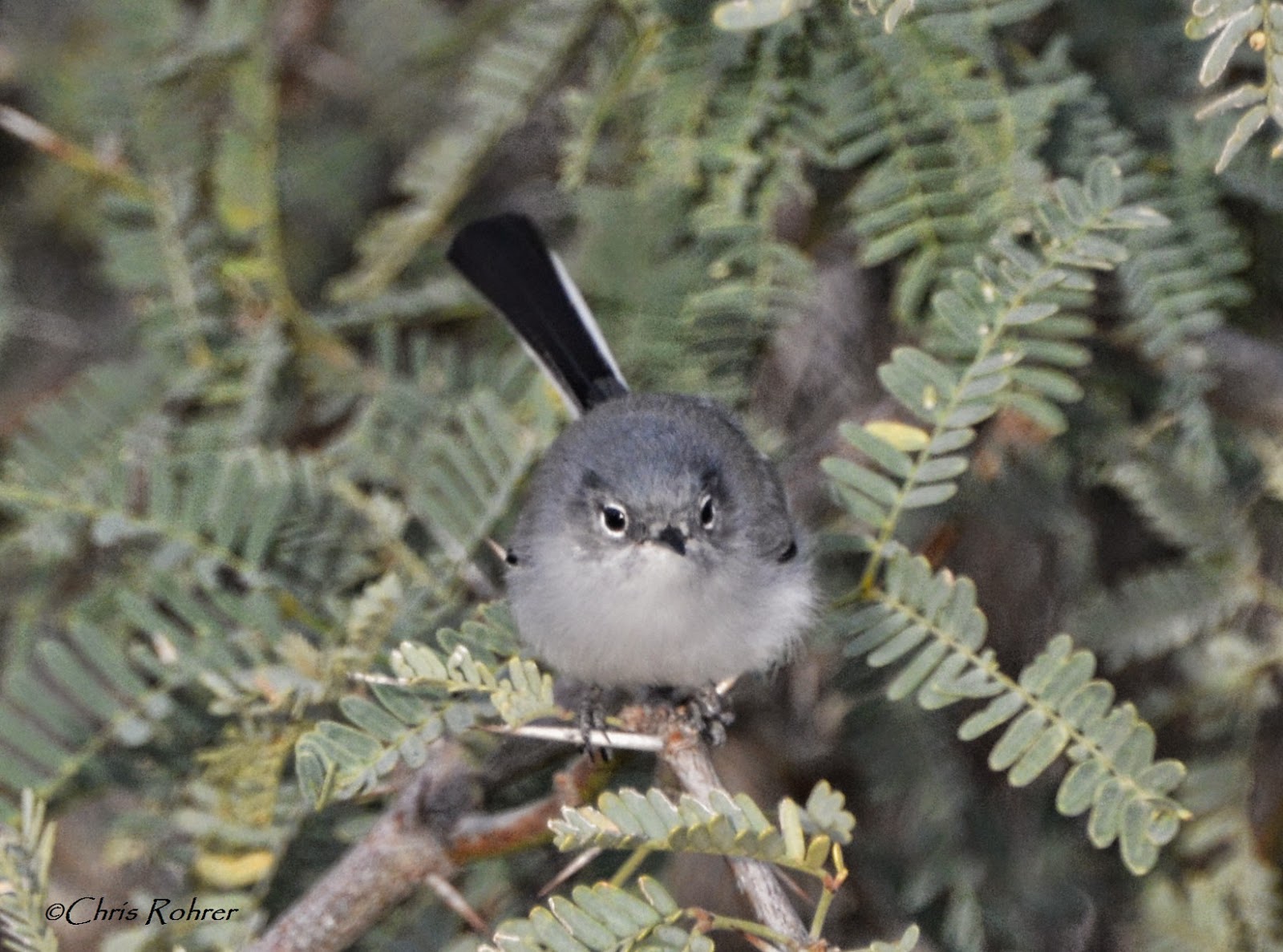 |
| Black-tailed Gnatcatcher |
 |
| Harris's Hawk |
 |
| A Redhead! And yet our Tucson CBC circle dipped on two of these birds! Had I known, we could have poached another group's area to add them to our list! These were seen on Saturday night! But midnight Sunday is when the count officially begins. |
 |
| Canvasbacks |
 |
| A Red-tailed Hawk watches us |
 |
| Pied-billed Grebe |
 |
| Cactus Wren |
 |
| A Curve-billed Thrasher nests in a most protective Teddy Bear Cholla |
 |
| My favorite pic from the day! Gordon is TALL and so are these Cholla Cactus! What a trooper! No Cactus Wrens were seen in this area. There was some nesting evidence in a couple. As Gordon went deeper into the patch, he didn't notice much in the way of old nest material but he did find plenty of Mourning Doves hiding! |
 |
| Female Costa's Hummingbird |
 |
| Bronzed Cowbird |
 |
| Eurasian-collared Dove |
Target birding is back on for the next two weeks and should be interesting. How interesting? You'll have to stay tuned for more! As one year of goals finishes up, a new one will begin and it will take me to far away places:) Opportunities, like this CBC, give me a better insight about what's going on locally with our birds. When we take this sliver of data and add it to what's happening globally, all of us involved begin to see the bigger picture. To get involved in the US with the Christmas Bird Count, contact your local Audubon and find out when they have their CBC. They need volunteers who can hike or just sit in their house and count birds at their feeders. It's really a great experience! More next week....

