Showing posts with label Cactus Wren. Show all posts

Sunday, March 15, 2020

A Novel Approach


Costa's Hummingbird
With a global pandemic upon us all, the Covid-19 virus has really turned everything upside down. Spring break has been extended until the end of the month for students. I don't think I've wrapped my head around all of it yet. 

A beautiful walk.  No people.  Just nature. 
Last week I prepped my work to go out of the classroom with my students in case we have to go online. Of course no one told us to do this, but common sense told me to prepare for the inevitable. 

Inca Dove
In Tucson, it's more of a blessing than a curse. Warm weather. Great outdoor scene. Migration happening.  What's not to love? One. I get to be home every day during migration? What??!! Two. It's the nicest time of year here so do I work on house projects or bird?  Three. Cancelled events that bring in way too many people to Tucson?! YES! Thank you corona! And sports have been cancelled?  That's like the cherry on top of the sundae! What will people do with their free time?  Hopefully get out and reflect.  Take a nice hike or bike and go somewhere wonderful in nature. 

A rare Townsend's Solitaire
And my garden!  I can work on my garden!  

Rufous-winged Sparrow
Sadly, yet smartly, my friends from Wisconsin cancelled their trek to Arizona.  It sucks.  I was looking forward to their visit, but I completely understand.  I would have done the same thing. Being on a plane or cruise is just plain dumb right now.  Even after telling my students about the dangers, they still went to Italy, Hawaii and elsewhere.  Now they are having a nightmare of a time getting back.  No one listens to the teacher.  I give them an "F" for not listening to my lectures. The congestion in the airport alone would make me go mad.  And the exposure rate is MUCH greater. Yikes.   

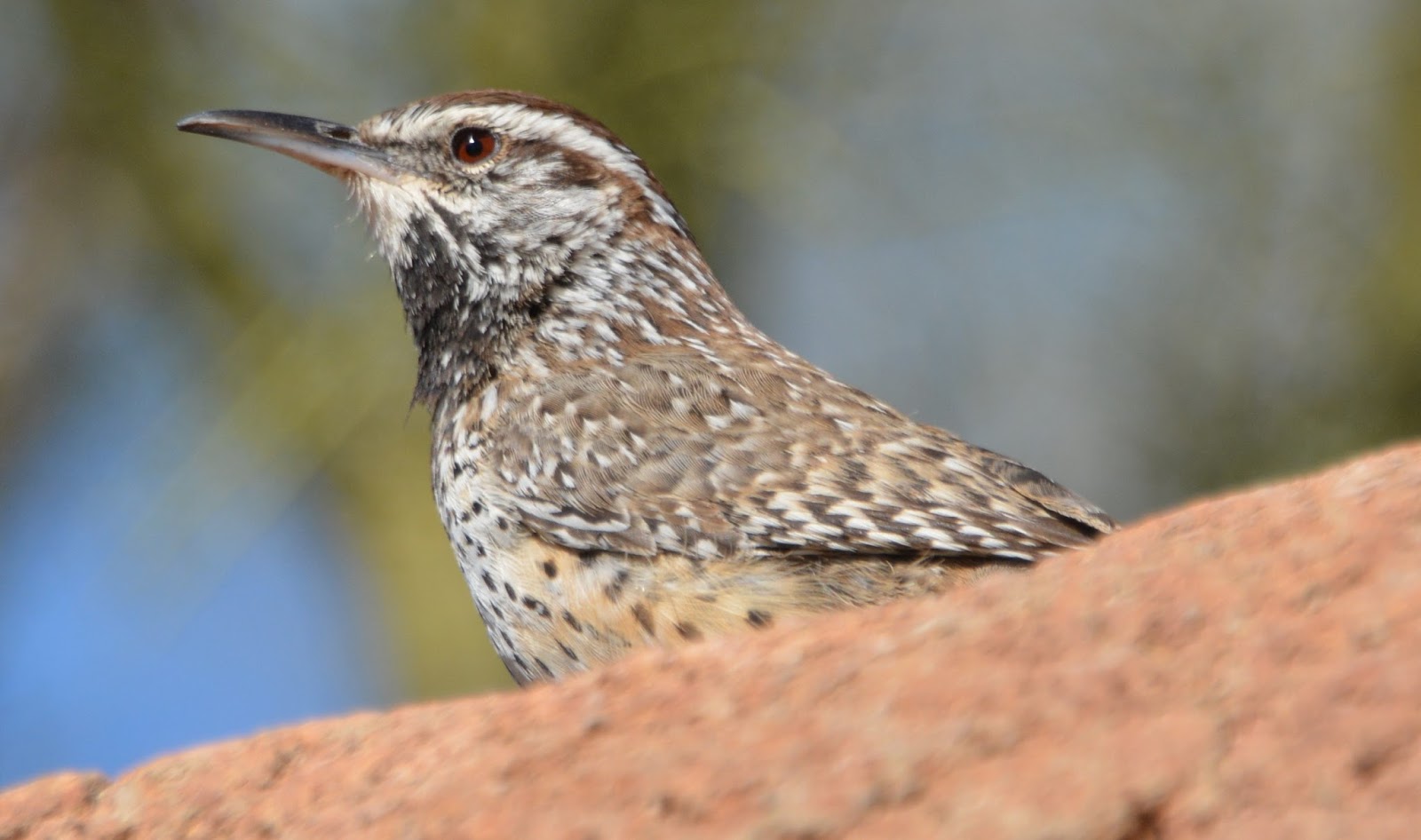
a nesting Cactus Wren
I am bothered that there isn't any toilet paper available in the stores.  And if you have someone who always uses up the last toilet paper roll in the house and doesn't tell you, like my other half, then it makes it even worse!  We had to go to 4 stores to find ONE package of toilet paper!

Pipevine Swallowtail
I guess being a bird has its advantages.  They don't need toilet paper.  This virus has put a hold on everyone's lives.  Birders have had trips cancelled. But in a way, I'm thankful for this time out.  It really forces us to appreciate the beauty around us.  I actually got drunk from the sunshine over the past couple days. If this is what it's like to be retired, I'm all for it. 

Gila Woodpecker in nest
We had rains last week and the ground is nice and soft to put in new plants for the year.  

Black-throated Gray Warbler
Warblers, hawks, vireos and other birds are making their move north. Never in my career have I been given 2 weeks to linger around the natural corridors of Arizona at free will.  It's kind of a gift. I can sleep in late if I want. 


Stay safe. Be smart. And enjoy the solitude if you can.  Spring is here and the birds are moving north.  It'll certainly take your mind off of things.  


It doesn't matter where you are.  Nature is there. Until next time. 

Monday, June 11, 2018

Parts Unknown

These two Cactus Wrens gave me a good laugh at sunset. 
During these past few hot Arizona days, I've been walking around nearby parks and practicing with my light settings in the dark conditions to prepare for Trinidad.  This will be my final post from Tucson for awhile. 

Our monsoon may start early this year. 
As I walk the known, I prepare mentally for the unknown.  It is part of the life journey we all take.  Sometimes we do it alone.  Sometimes we share it. This is the way of all things. 


There are nights when I lose sleep because I am both excited and anxious.  Everything has been set up and yet still, I wonder, What am I forgetting? What's out there?!

Round-tailed Ground Squirrels live the life in this terrible heat
Would I ever have gone to Trinidad in my lifetime if it weren't for the birds?  Probably not. I am forever addicted to the Spanish and Portuguese speaking cultures. But if I am to find birds on this planet, I can't limit myself to what is comfortable. I am forced into parts unknown. Trinidad is close to Venezuela and is known as the gateway to the South American birding world while still maintaining a fantastic blend of Caribbean birds. The place I will be visiting, from my research, suggests that I'll be living the island culture similar to what I experienced when I lived on the islands of  Cape Verde, West Africa.  It is different. The words for the dances are different.  Instead of Praia's(Cape Verde) Funana, it will be the Trinidadian Calypso.  Instead of the secretive martial art dances of Capoeira, they practice a similar form known as Kalinda.  


Making my favorite meal.....Cachupa on the Cape Verdean island of Santiago
My experience on Cape Verde sheds a little insight on the cultural similarities where in history, island slave trade had happened. But Trinidad was also a huge trading center for many other things like spice. Today, Trinidad is truly a blend of so many different cultures weaved into one. While the days of old are gone, we can still find history hidden in the language spoken.  In Cape Verde, it's the Portuguese based kriolu. Not quite Portuguese at all.  And not a written language!


I was more teacher than birder during this time of my life.  I did look at birds and try to take pics of them with my terrible camera at the time:)  We still used FILM!!!
My very first chapters as a teacher began training students and teachers alike in language and language design for the classroom on the islands of Santiago and then later Sal. Now I will go to Trinidad, another island with similar histories. I'm always fascinated by what makes the culture different from other places I've been. I purposely rented an apartment for one week out of the nature area to study language, food and the people. It's more than just birds.  For me, it's also about the community that surrounds the birds. While English is spoken there, the familiar words are peppered with strange and new exotic ones.  An English based creole!


Black-crowned Night Heron
And here's the thing.  I can play it safe.  Or push myself to do better.  Be better.  This is the nature of birding.  It's a bittersweet emotion knowing that it may be the only time in this life of mine that I'll be visiting this island.  So I need to make it count. Rushing into an area to see the birds and then leave isn't fun at all.  I want the "cultural flavor" from the birding experience. 

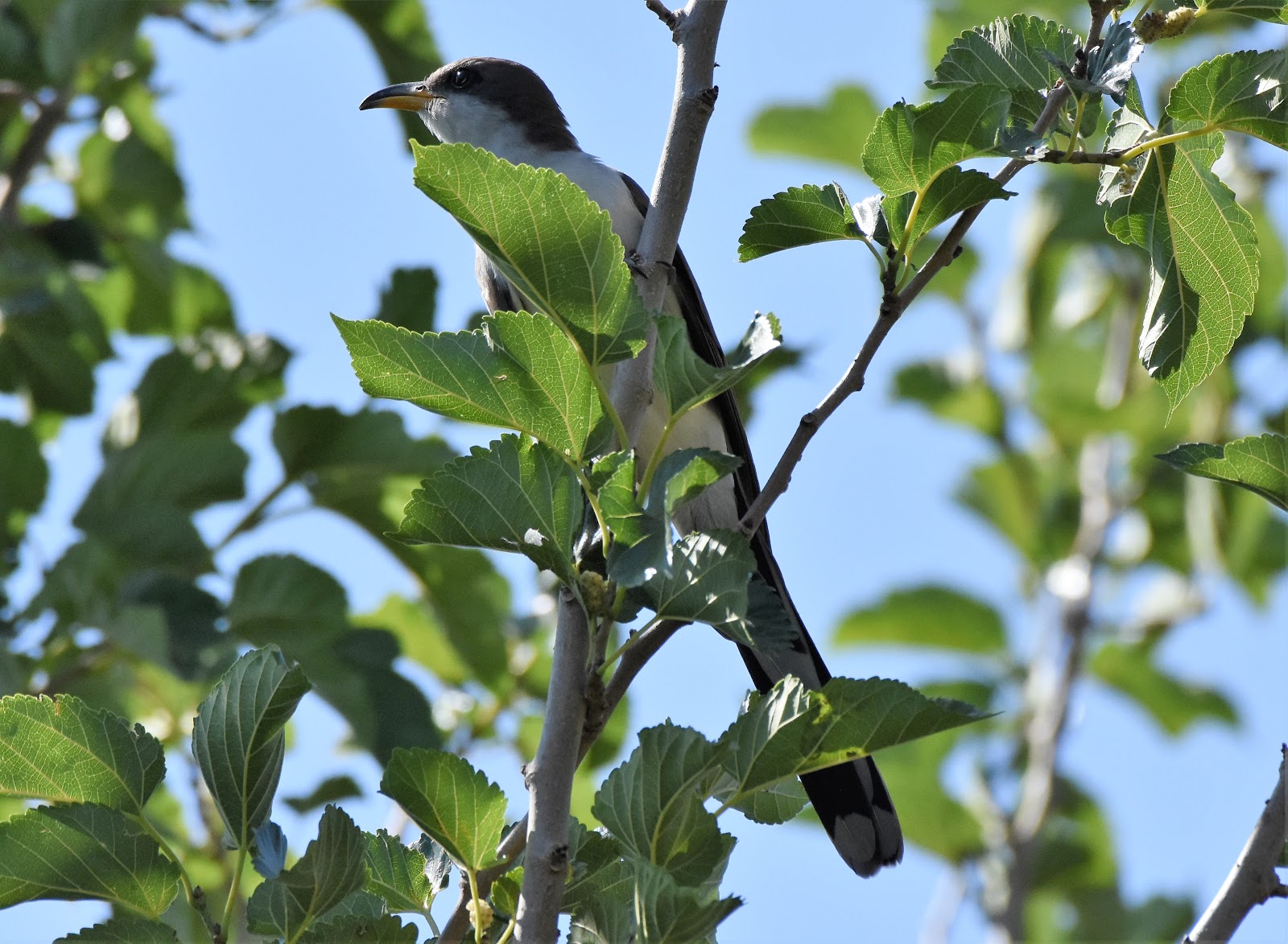
An early and exciting Yellow-billed Cuckoo, a favorite bird of mine
I have my office space and desk.  I have my big meeting with the nature center getting all my birds set up.  It's a rather civilized approach to birding.  Meals are all prepared.  Transportation is there.  All I have to do is go outside my room and they take me away to the birding hotspots. It seriously is a great deal for birders.  Asa Wright can be a bit pricey but after the stress I had this year, I am treating myself to a birder's version of a "massage".  There's even tea time and some of this island adult flavored fruit punch:) So I'll be one week at Asa Wright and one week in Arima doing my cultural studies(and some light birding). 

I'll miss my girls.  Callie rests her head on my chest during the early morning hours.
This summer we'll be exploring island culture on Trinidad and Hawaii during the months of June and July.  I'll be meeting with people and their birds.  I have found that understanding culture is also key to the success of optimal birding.  Now, the birds are pushing me into unknown lands.

A Cassin's Kingbird at a local park
When we speak another language, whether it be bird, Spanish, Russian, Mandarin, etc, we have a deeper meaning of their behaviors and culture.  Something always gets lost in translation, but when I speak Spanish or Portuguese, it gives me a deeper insight into the culture.  But as the birds and non-latin countries go, I am forced to start all over again.  

During the day, I am bored and trapped inside my house waiting for the terrible heat to subside. Instead I clean and research for the trip. PS. Catnaps are sacred.
On my last days in Tucson, I walk the familiar parks saying good-bye to my birds and play with light settings for a cave journey I'll be making for the Oilbird colony at the Asa Wright Nature Center. At first birding is easy. Then one has to travel (and) it's still relatively easy if you go to new areas.  But the nature of birding gets trickier the longer we play the game.  The hard part is picking up the endemics(which there are several on Trinidad) 


The tables that changed my life forever.  A balmy fire fly lit night near the Pipevine Road at our stay introduces me to birders who share their excitement and discoveries with us. 
My life's journey is about understanding people, their culture and the birds surrounding it all. The picture above is an important one. I snapped the pic to remember the clarity of thought that happened in this moment during our Panama visit. 


A Snail Kite sits next to me near our bench at the Pipevine Road
7 years ago, this month, I began my serious journey into the birding world. I changed. This blog changed. The photography changed. I let most of my negative attachments go in this world. My job became my job. And the birding and human experiences became my passions.


I discover the dangers of birding and realize that I loved it. On Coiba Island
I watched two birders have a candle lit dinner at a table next to ours in that Panama Canal style home. It was that specific moment that changed the way I saw everything. After our stay in Gamboa, Panama, we went to Coiba Island and discovered manakins. And that's where the addiction began! I know that wherever I go, I will fall in love because there are birds. I am a gypsy at heart.  One who likes good mole, a smoke filled tapas bar, a nice spicy bowl of kakik, and/or a simple breakfast of gallo pinto.  Now the cuisine will change.  The languages will be difficult in both bird and human forms. And I will somehow figure it all out.  The Trinidad adventures begin next week.  This post is dedicated to the memory of Anthony Bourdain.  I recently watched his show on Trinidad to give me a little background on Trinidadian cuisine and culture. He will be missed. 

Tuesday, December 5, 2017

History(And Birds)

Mexican culture is alive at the La Fiesta de Tumacácori

Years ago I moved to Arizona.  Then I traveled the world just to confirm how cool Tucson really was. Maybe there was some place even more amazing?  But after all my adventures, it was Tucson that I would, without a doubt, call home. As I have invested myself into the community over the years, I have become part of the Tucson fabric.


My first true passion, before birds, was the Hispanic culture, specifically the Mexican one. 


The closest I could get to Mexico (and still be in the US) was Arizona.  I didn't want Texas, New Mexico or California.  I wanted Arizona.  My 8th grade trip to Flagstaff forever changed my life.  When I went back to Wisconsin after that magical summer in the canyons and mountains, I knew that one day I would leave my hometown for good.  Then during another magical trip to Mexico City my Senior year of high school, I altered my course once again.  Spanish. As I did my research, I discovered a little city(at the time) known as Tucson. This city had the best of both worlds.

Cactus Wren
This weekend, we took the history club around Southern Arizona to visit all of our amazing landmarks. It was such a fun time.  Not only did we combine the old missions and the mining towns of Tombstone and Bisbee, we were also able to watch live performances of traditional Mexican dance.  (And on the side), I had the students point out the birds that they were observing. It was the ultimate wildlife, historical and Mexican heritage tour ever.  Seeing Southern Arizona through their eyes reminded me of my love for this state. 

The Earps meet in Tombstone at the OK Corral
The trip was organized by my friends Lori and April who then invited me along for the fun. They hadn't been to many of these places before and I had mentioned that I often go to bird around these historical sites.  Once we packed the students up in the vans, our adventures began!

Common Raven
How often do I pass these places and not really look at the majestic churches or old towns?  Well in my defense, I'm forever looking for or at birds:)


the mission of San Xavier Del Bac
During our trip, I ran into a former student who graduated with a Natural Resource and Spanish degree (and was working at Saguaro National Park!)  My dream job!  She was at a booth in the festival promoting National Parks. I was so proud.  She told me she earned her Spanish degree because of my class. And that's always good to hear. Better than a paycheck. Then a current student met with my now much older former student and it was so strange! I saw the beginning of the end.  The teacher becomes the student again. And his former student becomes a mentor with wonderful advice about getting into the national parks system. 

Lark Sparrow at the Tubac Presidio Museum
 The current students had fun role playing at the Tubac Presidio.  Imagine being in this old classroom.  It has style!  I'd love to have a classroom like this!


I introduced the students to Mexican Jays. Or was it the other way around?:) Jays are always cooperative birds....with a little food.  Again, a student brought Ritz crackers and was munching on them when the jays heard the crinkle of the package and then........we had pretty blue jays all around us.  

Mexican Jay
We strolled along the roads of Bisbee doing a little holiday shopping in the wonderful fall like temps. 

the old mining town of Bisbee
Wherever we had wildlife, we stopped to look at it just like we would if we were on a tour in a mine or museum. 

White-tailed Deer at the Chiricahua National Monument
It was a beautiful weekend out. 

Lori and April at Tombstone
On a side note, if these posts feel like they are up and down emotionally, they are.  During this trip, my Grandma's husband finally passed away. Life doesn't care.  It forces me to keep going but it's amazing how I can go from laughter to tears each day. Between my Grandma, her husband Bob, my cat, the political scene here, conservation attacks, tours, it's amazing I haven't gone bonkers.  But writing has helped me process all of these emotions. This past weekend I took a bad spill on a road while hiking.  I was telling a student to be careful and as I said it, I tripped and did an acrobatic feat that I didn't even know I could do.  My training has taught me to roll.  So instead of breaking a bone, I have some nice scrapes and bruises on the left side of my body. I always wondered how people fell.  Now I know. It sucks.


I am reminded that life is full of surprises and I have to roll with the punches(and scars:). I do know that we had an amazing experience this weekend and I'm grateful for those moments. There is yet so much more work to be done and by educating our youth about these historical and wild spaces, we are helping the young understand the importance of these much needed landmarks. They are, after all, why I moved to Arizona in the first place. Until next time.....

Friday, February 12, 2016

Budgeting The Birds


Silently, I walk through the grasses. Thinking. And thinking.  I began this quest 5 years ago with a Manakin.  This challenge grew into something bigger than me and so began the expedition of the heart and mind.  A newbie.  Everything fresh.  Everything strange. 

Rock Wren
Trapped by my own faults, I am forced to take these personal local courses over and over again.  No real challenges other than the one at home.  Freeing myself of student loan debt.  Cursed.  Stupid.  Debt. I absolutely hate it. Education is important, but so is my lifetime sanity:)  I'm so close to having my total freedom back. I can't help but think of all the other "newer" students with this financial weight that will follow them for decades into the future. 

Cactus Wren
The Cactus Wren rattles away.  He is mischievous as he calls to his partner after finding a patch of food.  She responds and follows him into the prickly shrubs chasing off the House Sparrows.


I was doing my annual survey of the Cactus Wrens around their various locations. BUT, I wanted something juicy and challenging.  So I made some side treks to make it all happen.  They were million dollar birds for cheep:)


Brown birds.  Lots and lots of brown birds fascinate me.  A flock of Brewer's Blackbirds hang near a bush.  One flies into the shadows of a larger Ocotillo. 

Brewer's Sparrow
In a way, I'm no longer that kid who is asking for help anymore.  I'm now helping out others and it feels good. It feeds the teacher part inside of me.  A snowbird with binos asks me at the Desert Museum why our Cardinals are black.  My response, "Ahhh, how exciting!  You've found a Phainopepla guarding his patch of desert mistletoe!"  She's now discovered a new Sonoran desert bird and plant species.  


Phainopepla-male
We play of course.  Crowds are shy around the Desert Museum's new and awesome Vulture Culture. They have a Black and Turkey Vulture on display there. Micheal is a sport and has fun. Once adults see us goofing around and laughing, they do the same. It's funny how humans are pack animals.  What's socially acceptable?  And what's not?  When it comes to learning, I think we should all have fun. 


Micheal makes a convincing Turkey Vulture but strangely he doesn't like leftovers
As we have fun and enjoy the outdoors, I am careful not to let the birds take over unless they are doing something really cool:) But I continue my annual studies and record data for nesting Cactus Wrens, Barn Owls as well as keep tabs on the many wintering grassland species.  I keep my distances.  And I keep my reports secret. 


Everything I have done; I have done my myself. That doesn't mean I've done it alone, quite the contrary. There have been countless people who I would call "teachers". Without their guidance and training, I wouldn't be where I am now. I refer, of course, to my own planning and studies with others.  Currently, I am researching the Spotted Dove.  Recently through my work with California birders, I found out that there is a healthy population of Spotted Doves on Catalina Island.  Before they could only be found in a nasty neighborhood of LA which birders have said is NOT ideal for birding. So I like safe and scenic. It should be an easy find. And to be honest, it should be a wonderful vacation. So in a month, we leave for Avalon and I can't wait to continue my work on the Pacific Ocean.  


No educational institution taught me how to speak Spanish or be a teacher or be a birder. For the first two titles, they certainly charged money for it.  Lots and lots of money.  Degrees are no more than pieces of paper.  And in the end, it means absolutely nothing.  It's what you bring to the table.  For my students, I tell them to take control of their education.  A degree in Spanish means nothing if you don't speak Spanish.  LIVE in a Spanish speaking country.  Theories and books won't make you a teacher.  You are born one or not.  So volunteer and work with people for EXPERIENCE.  


First spot.
The same is true in the birding world. The true test of the Arizona birder's ID course falls upon the sparrows, flycatchers, longspurs and pipits. Birding can be as simple as a Cardinal or as difficult as a Sprague's Pipit.  Last year, I went with my friends to find a Sprague's Pipit.  We saw it, but someone from outside my group called out the ID before I could do the ID myself.  All I had to do was look at the bird and count it.  I wanted to EARN that bird.  


I wish this one has turned out better but I was excited seeing the bird. Next time I will be much more relaxed.
On a recent trek out to the Santa Cruz Flats, I helped another birder get his nemesis Sprague's Pipit.  I gave him the field marks and together we walked the path.  We counted many American Pipits and Mountain Plovers in the fields, but it was the solitary bird that held my interest. No bobbing.  Just mousing around the grasses.  Behavior. 


My first spot
Then a ray of light hit the pipit-looking bird and revealed bright pink legs. Field marks. We got our poor ID pictures for evidence, but it was an amazing experience to observe a bird without the fear of other birder parties flushing this secretive pipit into a further field. Our Sprague's Pipit casually walked from one field into the next, crossing the road with it's very large feet.

Brown birds are as cool as the ones with color. Tricky to separate from the numerous American Pipits.  BUT solitary from the flocks of AMPI, streaky back, pink legs, NO bobbing tail but it did bob the head back and forth; overall lighter in color with light streaking on the front.  It can be difficult.
 Distance was important.  We were close enough with our binos yet far enough away to not disturb the bird. And that's what I remembered from our first observation as it was an issue. At least for me. One group would get too close and flush the bird into another field much further away. While I may have had my lifer Sprague's Pipit last year, I felt for the first time that I EARNED my bird. It's a pretty special feeling.  But even better?  Helping someone find their nemesis bird while enjoying wonderful observations of a naturally very secretive bird in the field. 


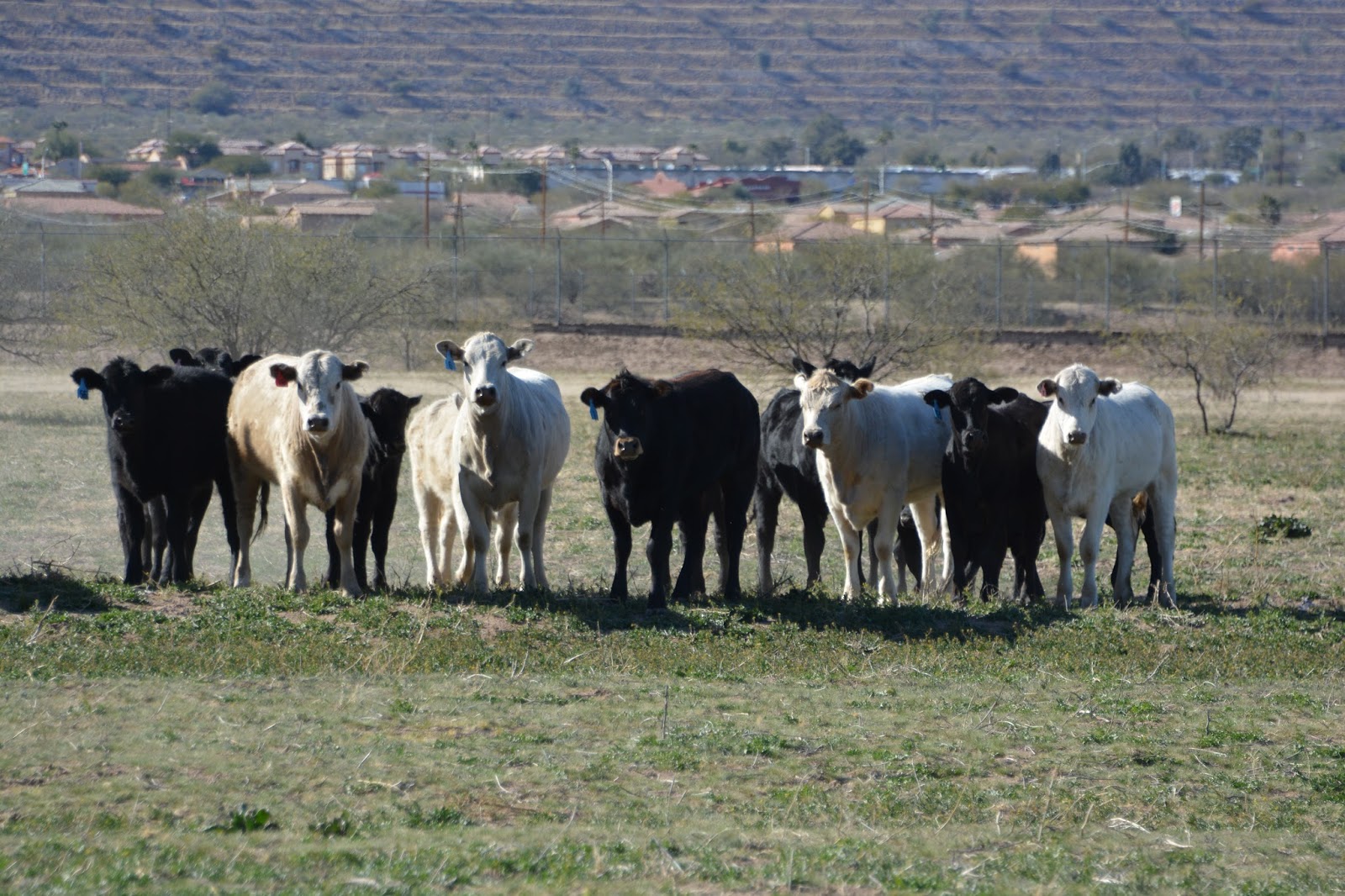
Cattle "helping us" find/flush our lonspurs:)
The same cannot be said about the McCown's Longspur.  Generally, longspurs are one of the most difficult birds to photograph. This was like a homework assignment I kept putting off. Grassland birds are my favorites, but they sure do require patience and focus. 


While it wasn't planned, I met up with another birder who had been there for an hour trying to locate the longspurs.  We dealt with extreme wind and dust.  Other birders were there and it was interesting to watch the various individuals.  Some wanted the "gimme" lifer but didn't help at all with the search.  Others simply gave up and left.  But if you give yourself up completely to the moment, anything is possible.  Forget about home, forget about work, forget about the sunset:)  Just be in the moment.  Become the flock. Forget the stinging dust. The frigid wind. And the glaring sun.  Just focus on the energy that is "the flock". My watering eyes did hurt after the observations (which was then followed by a headache), but it was worth the intense search.


McCown's Longspurs-overall a rather dull bird.  For Arizona birders, this is a Master's level bird.
Within a half hour, I was able to help my friend lock on to these very difficult birds.  They were mixed into a flock of several hundred Horned Larks and Lark Buntings.  And there were just two of them!  And they were small.  Brown birds at their very best!


Random Slider Turtle photo

While none of this is easy work; it has become a simpler task. Understanding a simple word like "warbler" or "longspur" will usually imply certain behaviors and often involve a headache later on:) After an hour of cracked dry lips, sore eyes and being all covered in dust, it was time to go home. The mission complete. It was exciting.  The way I imagine a final exam to be in the field studies of AZ Ornithology.  I heard one birder say, "It's what separates the boys from the men." And I'm guessing the girls from women? The birds from the birders?:) I'll just restate it in my own geeky way, "I passed this Jedi test."  


Renee, a creative and funny soul who loved Star Trek as much as I do.
I am constantly reminded that life is not a given.  It should not be taken for granted, ever.  This past week, I received my first check ever for guiding a bird tour and it was VERY nice.  But I also lost a friend.  She was someone who I loved visiting with every year at our Thanksgiving dinners. Renee Sampson, you are loved and will be missed. 


Chestnut-collared Longspurs in Willcox, AZ
I'll be back in the grasslands again thinking some more while helping Tucson Audubon save our declining populations of Chestnut-collared Longspurs.  Once, the McCown's Longspurs were commonly found in small numbers in Southern Arizona.  Today, they are extremely rare to find around their former habitats.  This could also happen to our Chestnut-collared Longspurs if we are not careful.  What's bigger than any of us?  Saving our planet. 


Meanwhile our Jaguar roams the Santa Rita mountain range. Our secret was released by National Geographic just a couple weeks ago.  Hopefully with our combined efforts from all the conservation groups, we will help bring once common wildlife back into our area.  The Jaguar is a wonderful example of what could be once again if we are not reckless.  


At the Buenos Aires Wildlife Refuge with Bruce Berman
As you can see, even though I have financial matters to consider now, Arizona is a GREAT place to be broke.  For a birder:) Until next time.....