Wednesday, December 16, 2015

Blow A Kiss, Fire A Gun

Sweetwater Wetlands in Tucson
December.  It's the month of crazy as we kiss the year good-bye.  Birders rush to get their birds before the year is over. Holiday shoppers clog the highways up.  And duck hunters are out shooting ducks. This time of year brings everyone together whether we like it or not. 

Pied-billed Grebe
It's always weird going back to work after an intense weekend. I'm constantly studying birds out in the field whenever I get the chance. I began on Friday evening at Sweetwater.  I needed to clear my mind and think about my options. I stood observing several birds for a long time deciding how I'd tackle the weekend. When I left, I had a plan. Possible life bird in sight! On Saturday, we headed up to Prescott to visit friends Cynthia and Roger. 

Green Heron
It was cold and rainy.  Perfect weather for a Tundra Swan.  So I kicked Micheal out of bed and we took a road trip up to find this not always present bird:)


Saturday was a really fun day.  It felt like the holidays!  I was lazy with the camera but thanks to Cynthia, I have photos to share from our visit to Prescott!  

Cynthia, Roger and Micheal
We eventually relocated the swan giving me a rare Arizona Swan Trifecta for the year!  Earlier this year, a pair of Trumpeter Swans came to Sweetwater Wetlands.  Then we got our non-countable(for AZ) Mute Swans.  This weekend, we finished the swan chase with the beautiful Tundra below. 

Tundra Swan-note yellow lores/Photo by Cynthia White
I wore my "old man" outfit.  I didn't care.  It felt SOOO comfortable!

At Willow Lake searching for the swan.  Photo by Cynthia White
However, the clock ticks and it was off again on Sunday for a very important bird known as the Rusty Blackbird. It was still hanging out along the Salt River.  So Sunday came and another early morning began. 


We reached the Coon Bluff area and were greeted by many Rock Wrens including the one below. This wren decided to perch on top of someone's tent.  Or maybe the bird owned the tent?

Rock Wren at Coon Bluff Campground
Once we got onto the trail, I spotted the infamous gang of wild horses.  For now the horses are safe.  At one point, they were going to be taken off these lands, but public outcry kept them from "disappearing". It has been a very controversial topic between environmentalists and the public. This wild locale is also a recreational space for many people living in the Phoenix area. Birders were birding.  Photographers were capturing with their cameras a pair of Bald Eagles nesting.  Horseback riders were crossing the creek. Hikers hiked. And fisher people fished.  This recreational area was getting plenty of use on Sunday.  All was calm. Until....


The last wild horse population in Arizona
Bullets flew past our heads!  I was with Magill at the time and we were very angry. These irresponsible "hunters" almost hit the photographer to the right.  Another photographer came out and asked if the guy was okay.  The hunters shot what they thought was a dove.  Turns out they were complete idiots.  They killed a Greater Yellowlegs! A NO NO!  Not a duck or a dove. Looks like these morons need to read and study up on what they are killing. It was all senseless.  It's duck season right now and there is hunting allowed in this area but most hunters were further down the river away from the crowds of people.  It's these kinds of people who give hunters a bad name.

Irresponsible Hunters
Calls were made to Game and Fish and the Sheriff's Department. They didn't apologize to the guy and when they saw the camera, they took off. The whole incident really made us upset and ruined a perfectly beautiful morning.  IRRESPONSIBLE!  We were okay as were the others.  It could have been a lot worse.  That morning we dipped on the Rusty Blackbird.  One of these days I will find this beauty but it was wasn't meant to be on this day. I'm just thankful we're okay.  These guys shot at ground level and through thick vegetation not looking to see if there was anyone in the vegetation.  Photographers like to hide in a natural or created "blind" to capture wildlife in action.

White-throated Sparrow
Over the past two weekends, we've added several sightings of rare sparrows from our walks. While the Rusty may have been a "no show", we were able to add on a juvenile Golden-crowned Sparrow. It was a first for my state list. I never pay attention to that stuff but all the birders have been asking me where my state list is at right now?  Still don't know. I first saw this (at the time) life bird in New Mexico at the magical Bosque Del Apache. While these photos are NOT of the bird we observed, the bird appeared similar to the juvenile below with the gold crown forming.

Golden-crowned Sparrow-Juvenile
The weekend was a success.  I would have to say that I was more of a birder than a photographer this time around.  And if we had a dollar for every time someone asked us if we had seen the Bald Eagles, we'd be rich. They ARE beautiful birds and our national symbol.  Don't think for a minute that I don't stop and enjoy their presence. It's just that a Rusty Blackbird is also quite amazing.  Its' populations are in severe decline and ornithologists still haven't been able to figure out what is happening with this species of blackbird.


For now, I wait.  I'll chase a local bird or two, but the year is not over.  And there's a job to do. For now, I'm staying away from areas full of weapons. Gun rights?  Not for everyone.  The US needs to get its' act together and screen people better.  Until next time. 

Summer Tanager-female

Tuesday, December 8, 2015

光心臟者長壽

Coon Bluff
Finishing a year of travel and birding is always stressful and sad at the same time because come January 1st, birders begin again.

Cedar Waxwing
So why keep doing it over and over again?  Sometimes it's the challenge while with other times it's curiosity.  For me, it's always about the birds and it's always about bettering myself.  I will say that I have become much more relaxed now in the field than I used to be.  

Greater Yellowleg
It certainly makes for fun birding.  During this past weekend, I joined up with Gordon once again to find rare birds, fun birds and every other bird in between. One of our stops was at Coon Bluff along the Salt River in Arizona.  While we dipped on a rare Reddish Egret, we observed many Greater Yellowlegs and Long-billed Dowitchers in their natural settings and not at some artificial water treatment plant.  That was amazing.

Gordon searches for something rare on his birthday!
And then we headed over to Gilbert Water Ranch and enjoyed the bird show over there. 

Red-breasted Sapsucker
Eventually we moved over to Scottsdale and enjoyed the company of a Red-breasted Sapsucker.  And for fun.....

Mandarin Duck
....we went to find a random wintering Mandarin Duck.  These ducks are not native to Arizona OR the US, but there are several feral populations.  In Arizona, they aren't ABA countable, but since I don't follow that list, it doesn't matter.  ABA stands for the American Birding Association.  If you play their game, you can only count the birds that they have listed as "legit" from their list. While I understand their logic behind the birds considered "countable", I don't follow it because ABA only works for Canada and the US.  It should count for Mexico, but it doesn't.  So I don't agree with that bit.  If you're doing North America, do ALL of it.  Some birders don't waste their time on non-countable ABA birds.  For someone like me, that thinking is rather confining especially when I consider myself a world birder. Anyhow, this non-countable Mandarin Duck is one of many birds that spark a debate between birders every time:)


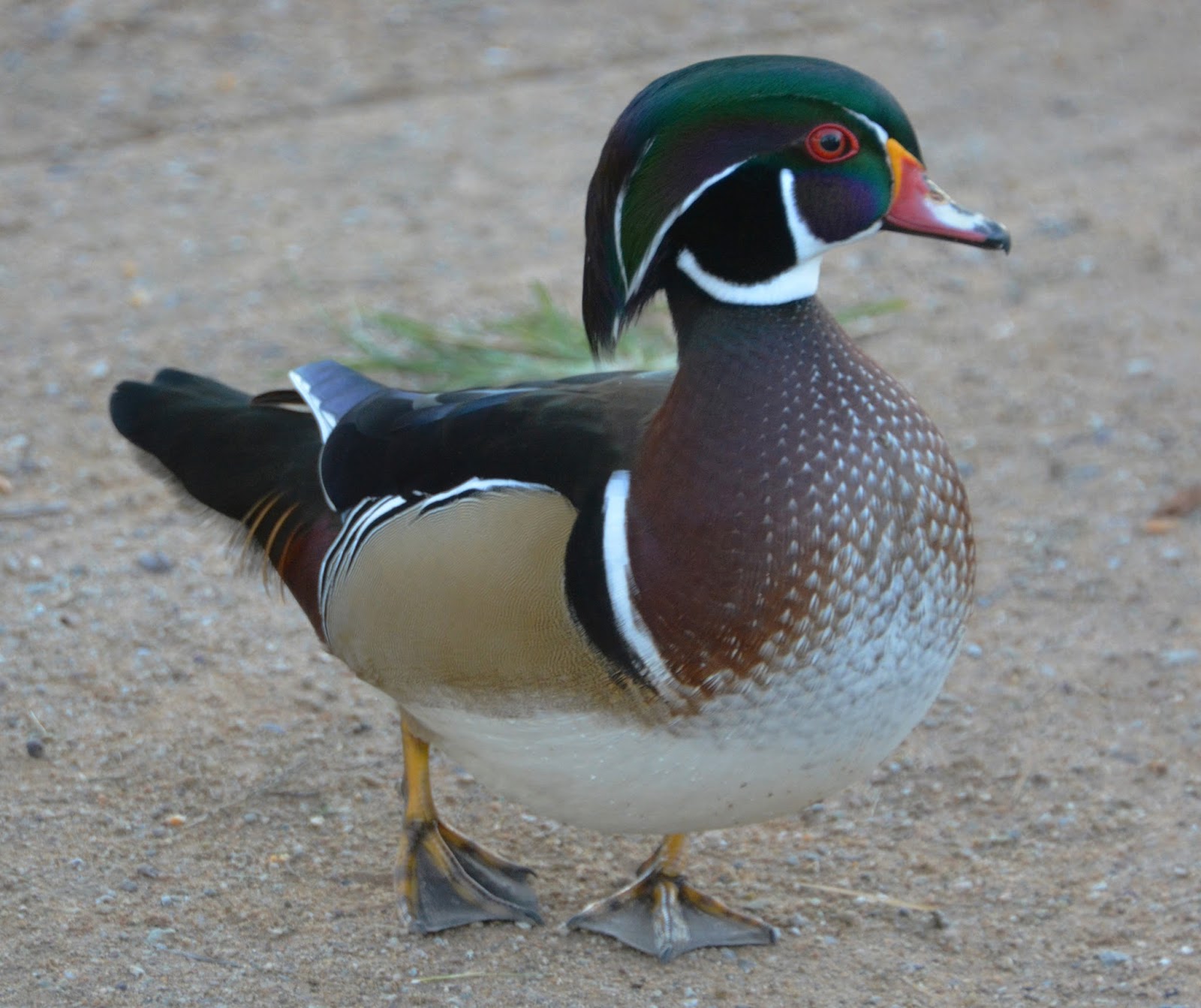
Mandarin Ducks are found in east Asia but their populations are in decline in countries like Russia and China.  Japan has a healthy population at about 5000 pairs.  In the US, these birds found in the wild are considered either part of isolated feral populations or birds who have "escaped".  There is a small population in Sonoma, California and it is quite possible that their range is expanding according to recent reports.  Either way, this is one beautiful duck!  It's closely related to our Wood Ducks here in the US. 

Wood Duck
 And while I've been out having fun in the world of birding, I've totally been neglectful of my garden!  When I went to go get my mail, I found this one single persimmon fruit on a lonely branch!  It was VERY exciting!  This tree hasn't produced fruit for two years!

Persimmons Fruit-variety Fuyu
So I honored the plant and ate the fruit:)  Then it was off to find a Brown Pelican in the desert. 

Brown Pelican
In December, Arizona birding is quite hot (in the good meaning of the word) and is often overshadowed by the holidays.  There are several people doing "Big Years" in Arizona and I know how stressful it can be during this month.  Last year I did that challenge for the US!  My challenge for this year has been to find as many birds as I can in North America which includes Mexico! It has been a lot of fun, but my days are numbered:) For the ladies competing for that top number one spot, good luck!  I think you're all pretty great. Best of luck to Susan, Barbara, and Janine!


And when it's dark outside, I sit back and reflect on those exciting challenges that have happened over this past year. 


I'm not finished yet, but for now, I sit back and enjoy the wonders of the wild.  And this beautiful piece of owl art from my friend Kathie Brown!!!  This is simply awesome!  Thank you!!  And below, I have taken some video of these two rare and special birds. Until next time!


 The post title means,  "A Light Heart Lives Long".  It's Mandarin for Mandarin:)

Tuesday, December 1, 2015

When Tomorrow Comes

First off, I'd like to wish everyone a wonderful holiday season!  For my US readers, I hope you all had a peaceful and delicious Thanksgiving dinner with family and friends. 

Gordon searches the skies for birds in the cold morning temps
On our last survey for the year, the Mexico team returned back to Rancho Aribabi in the state of Sonora to replace batteries and cards on the wildlife cams.  We continue to monitor this area for the elusive jaguars.  We know they are there, but jaguars are notorious for their invisibility powers:)  

Rural Skipper
Our trek for this visit was very much needed as the highway commission was thinking about placing a road through this important conservation area.  It had many people worried, but thankfully, everyone involved saw how important this riparian habitat was. Protecting an area from development is A LOT of work and it's something the ranch owner has to deal with every day.  

The Highway Commission visits
Our group had members studying plants, mammals, birds, reptiles, amphibians, and bugs.  We haven't really had any specialist in the fish area, but hopefully someone will join our team down the road.  Needless to say, this area is a rich biodiverse  corridor. 


During the course of 3 days, we surveyed every nook and cranny around the Cocospera River.  It's one of the few riparian corridors within the Sonoran desert and an important area for migrating birds, endemic amphibians and of course, mammals like the Coati, Jaguar, etc. 


The group is a fantastic bunch of experts brought together by our leader Kathy Cooper.  She feeds the crew with her wonderful cooking.  And while everyone does quite a bit of hiking, we still seem to add several pounds after each trip:)

Greater Roadrunner
The birders, Gordon and myself, surveyed the area for our feathered friends.  Of course, we kept our eyes open for other critters. Our current bird species count is at 151 birds. There have been two bird species that I have not been able to ID.  Both are night birds and continue to puzzle me. One sounds like an owl and the other sounds very much like a grouse. Ebird records began in 2005 for this area.  Today, there are 17 lists submitted for this relatively new hotspot. I'll continue to monitor this "patch" as we will inevitably return. 


I must always keep my eyes open around this ranch as the critters can be very active.  I've almost been attacked by a momma Javelina. On this trek, an oddly patterned Hooded Skunk popped out in front of us.  

An oddly patterned Hooded Skunk
The nights were extremely cold and froze many of us in our tents. Herpers during the winter months have to pick up rocks and logs to look for snakes and lizards. However, I suspect many snakes went further underground to keep out of the freezing temps. 


Herper specialist Jim Rorabaugh searched near a corral for anything with scales.  I smiled to myself.  Any respectable birder knows better:)  One doesn't go lifting up rocks and rotting wood unless you're up for a sudden heart attack:) But on this rare occasion, we found something softer and "cuter".....

Desert Shrew
This Desert Shrew was a sensation!  Everyone began to document this difficult to find mammal. Afterwards the shrew signed autographs.  We then returned this little cutie back to its secure and hidden spot. 


The desert is full of life.  You just need to know where to look.  The only problem is that there are things that bite back:) Cacti, lizards, and snakes are just a few of the obstacles that a Sonoran birder faces.  But it's so worth it.  Snakes are cool.  I just don't like surprises! 


Karina is another herper and she also likes to pick up spiders.  This is a tarantula looking Huntsmen Spider.  However, it's not a tarantula and completely safe to handle. I'll pass:)


Our leader, Kathy, joins us for a nice hot cup of coffee.  


The next set of pictures are not mine but from the crew during this past weekend.  We all share our data and finds.  At night during dinner, photo cards are loaded into laptops.  Everyone crosses their fingers for a jaguar sighting, but we love seeing the coati, ocelote, bobcat, bear, coyote, fox, deer, javelina and oh so much more!

Lowland Leopard Frog, Photo courtesy of Jim Rorabaugh
There is always lots of interesting data to share.  

Gray Flycatcher, Photo courtesy of Jim Rorabaugh
I'd like to thank Dean Goehring for giving me permission to use his photo below.  There are many Mountain Lions in this area.  Here is a mother with her cub/juvenile.  There is another cub not in the picture.  The work that we do on this ranch is very important and if it wasn't for the dedication of others, I'm not sure where this ranch would be today. Cut down for a highway?  Clear cut for development?  Carlos, the current ranch owner, is a strong believer in conservation.  Without his dedication and love for this land, Aribabi might look a lot different today. 

Mountain Lion photo courtesy of Dean Goehring
For now, I leave you with a video that continues to make me laugh.  It's a skit from Saturday Night Live.  If your dinner conversation turns into chaos, just remember this moment:) Until next time....


Saturday, November 21, 2015

Waiting to Exhale


Anna's Hummingbird with Pyracantha in the background
When you've seen all there is to see, you begin to study better what you already know.


It's that deeper understanding of habitats and bird behaviors that can be quite satisfying.


Such was the case during a trek out to the Santa Cruz flats.  Instead of chasing new birds, we just observed the ones present.

American Kestrel
 The scope comes out and we begin to scan. 

Magill scans the sod farm for Mountain Plovers
Of course, we try and search for that special rare bird or two. But on the Flats, it's always the wintering Mountain Plovers that steal the show.

First decent photo documentation of a Mountain Plover
 Rare or not, I'm never disappointed because I love birds. And it's so relaxing and fun trying to find as many birds as we can while we're out in the field.

Juvenile Black Crowned Night Heron
I especially love birding with good friends.   Add to the experience cold rainy weather and you've got a great day outdoors.  For a desert dweller recovering from the sweltering hot summer temps, it's nearly perfection:)

Male Vermilion Flycatcher
Subtle visitors come back to visit us during the winter like the Sagebrush Sparrow.  You won't see them unless you take the time to stop and smell the sage.  They aren't shy birds, but they do blend in well with their surroundings. And if you don't know they are out there, you'd never know they existed:)

Sagebrush Sparrow
A Greater Pewee migrates down to the lower elevations and hangs out at a local watering hole.

Greater Pewee
And a hesitant Broad-tailed Hummingbird sticks around longer than normal.

A late Broad-tailed Hummingbird
The holidays are coming and my work is not done. For now, I have a house to clean and final exams to prepare. I am one bird shy of my 700 life bird goal and I wonder which bird species it will be. But for now, during the "in between", I relax and revisit my favorite spots in Southern Arizona when I can squeeze in the time. Until next time.....