Showing posts with label Brown Pelican. Show all posts

Sunday, November 4, 2018

The Caravan


Our trek to Organ Pipe was interesting, but it was the work in Mexico that had me more interested.  A lot of birders signed up for a gull workshop with AZFO's Lauren Harter and David Vander Pluym.  And on the last day of the conference, a large caravan of birders crossed the border into Mexico.

Magnificent Frigatebird
We planned on staying the night in Rocky Point or Puerto Peñasco.  Many of the birders wanted to go with the caravan together.  No matter how many times I write this, there are still birders who are afraid to cross the border even though it's completely safe to travel to Rocky Point.  Like everything else, people need to use common sense. 

30+ birders scour the ocean with their scopes
We spent our morning with scopes and gulls.  But we also had our own agenda.  I wanted to do a count around Morúa or the Pinto Estuaries so we broke away from the group after lunch to do our own counts. I've been doing work around those areas for several years now and had never birded the area in October.  We rented a place on the Morúa estuary and really had a nice hike full of excellent birds there.


AZ Fish and Wildlife's Troy Corman and Wrenegade team member Tim H scope the horizon for possible rare birds

It's hard to navigate areas with large groups of people.  Many were there to spot the Yellow-footed Gull which is a bird of interest for many people.  These gulls live around the Sea of Cortez in good numbers.

Yellow-footed Gull
We said our good-byes and then were off to our sector of Rocky Point to get some work done.

At Morúa Estuary, we do a major bird count
The first bunch of birds we crossed paths with were plovers.  Snowy Plovers were everywhere.  They are the cutest of the bunch.   

Snowy Plover
Another common plover along the Pacific waters is the Black-bellied Plover.  Most of the shorebirds are in their winter plumage right now so they all look rather gray together.  Some can be downright tricky!


Black-bellied Plover
Another special bird that people come to see in Rocky Point is the Wilson's Plover.  They have a big bill and are the sassiest of the bunch.  In the pic below, the bird is throwing a little "tude" at an oncoming Snowy Plover. 

Wilson's Plover is the sassiest of the bunch
Even though it is cooler and pleasant, the sun can be quite strong as it bleaches the landscape.  In the pic below, we arrived at the mouth of the estuary where the bird life was at its highest.  I discovered my first Black Skimmers for Mexico here.

The bright light of the dunes and the ocean create a bleaching of color affect
Another great bird to see was the Elegant Tern.  They were the most common tern in this area next to the Forster's Tern. This species is listed as Near Threatened.

Elegant Tern
There were schools of fish everywhere.  And where there were large numbers of fish, there were hundreds of birds diving into the waters. Heermann's Gulls closely followed Brown Pelicans and tried to steal the food from their bills. 


A near threatened Herrmann's Gull sits on the back of this Brown Pelican
On Sunday morning, Gordon wanted to do his survey at Cholla Bay.  So he showed a couple birders how he likes to do his count.  As always, we had a great time and finished our counts with a nice list of bird species there.  The key is to go at low tide if you're a photographer.  At high tide, Cholla Bay is great with a scope.  


Short-billed Dowitchers
Short-billed Dowitchers had to be carefully ID'd by listening to their flight call.  As they flew, we were quickly able to ID them as Short-billed and not Long-billed.

Birding Cholla Bay at low tide is great for photographers wanting to get up close to the birds
As the bay drains of water, shorebirds, like the Red Knot below, go crazy on the crabs. 

A dull winter plumaged Red Knot forages for food
I've seen Red Knots in a lot of places but they are often too far to get clear views. One of my goals for this visit was to observe this species better. And it was great! 


Western Willet
Our special find, and definitely off my radar, was this gorgeous Fox Sparrow, the Sooty-colored subspecies. At the Morúa and Pinto Estuaries, there are specific green spaces or migrant traps that have green lawns and mesquite bosques.  I looked over at the trash bin and saw a bird scratching on the ground.  At first I thought it was a towhee until we put our bins on it!  HOLY COW!  We ended up with a Fox Sparrow on our Mexican life list. I also added a Dark-eyed Junco which was yet another bird I had not expected for Mexico.  Anyhow, the migrant traps around the hotels are great near the estuaries!!  I've had so many surprise warblers and sparrows show up in these green spaces. 

A rare Fox Sparrow
Our adventures continue......

Saturday, June 2, 2018

Estero El Soldado


Originally I scheduled a trek out to San Pedro Island, but the water was too choppy and the trek was cancelled.  These things are to be expected during hurricane season. So I followed up on Plan B, the mangrove estuary of El Soldado between San Carlos and Guaymas. 


If a birder is looking to get away and enjoy the beach life for a bit, s/he should check out San Pedro Island, the El Soldado Tidelands(or Estero El Soldado), and along the rocky beaches of San Carlos. 


When the island trek was cancelled, I started going over this area with my friend Tami because there were several requirements for our group on this day.  A little bit of swimming, drinking, eating and hiking along the water's edge.  The Estero provided all of those things easily.  


There was a resort nearby that also had gardens.  And birds.  Lots and lots of birds.  There were ocean ones, and coastal ones and garden ones.  And MANGROVE ones!

Genus Callinectes
 It's not often I get to bird a mangrove living in the desert.  And it often shocks me to know that even in the harshest of climates, the miracle of a small mangrove can happen in the craziest of climates. For a moment, I was transported to the tropics.  In fact, San Carlos and Guaymas are truly the beginning ranges of neotropical birding.  It is here we find such wonderful birds like the "mangrove" Yellow Warbler, Mangrove Swallows and Great Kiskadees.  It is exciting. 


Ocean birds won't disappoint either!  While none of these birds were lifers, they were a thrill to see again.  

Royal Tern
One of my favorite groups of the birds, the gulls, were in good numbers.  Terns, Royal and Elegant, were also seen in good numbers along the coast. 


As I laid under these palms while the group went out for a swim, I watched the world pass by me.  I closed my eyes to the cool shade breeze and smiled.  We all agreed that this was a great way to kick start the summer.


Laying on my back, I aimed my camera up into the air and shot pics of birds flying just several feet above me. 


I loved this place so much that next time, we're staying down here in the resort along the estuary.  


A Magnificent Frigatebird hung right over my head in hover mode, defiant against the strong winds. I love these birds.  You could see fleets of these air pirates off in the distance over the rocky coastal crags.


And while this was an excellent birding spot, our group was humbled by an observation between the estuary and ocean.  An adult Brown Pelican defended a recently deceased fledgling/juvenile and tried protecting the body from intruders like beach walkers and vultures. Nature can be very cruel, even from within the artificial boundaries of "paradise".  We like to humanize things when we see such terrible moments in the animal world.  But to watch this adult defend this lifeless body made us a bit somber. 


The thing I love about birding now is that when I see something like this, I have a deeper understanding of the bird world.  Our human side says, "See! These creatures do have emotions!" My scientific side says its instinctual.  Maybe they're both right. There are so many "experts" out there and they all have their professional opinions.  For me, the important part was to gather notes on this observation and learn. 


I heard someone say that they were going to chase that Turkey Vulture away.  Then it was time to explain to that person that nature has to play out.  It's not the Turkey Vulture's fault that the fledgling died.  It has to eat as well.  They are Mother Nature's natural garbage disposals. They play a role as well.  Most of you know this but for those of you who don't, here goes. Why don't Vultures have feathers around their heads?  Well if they eat dead and rotting things, then having feathers would be a bad thing.  They'd pick up diseases and bugs, etc from the carcass.  So no feathers.  Nature is cool!


This summer is going to be an absolute thrill.  Two months of exotic trails on different islands will hopefully yield lots of new and interesting birds. My first trek begins in a few weeks to Trinidad and Tobago.  I need this vacation after this stressful Spring. Much like my Monterey, CA trek a few years ago, I'll be in a private cabin at the Asa Wright Nature Center for a week.  Then I've rented a wonderful apartment in Arima for other area visits.  I can't wait to get out of this heat!


For the Estero El Soldado checklist, click here.  Summer is just beginning and it's time to cross the 1000 bird mark. Can we achieve it this summer?  Stay tuned for more!

Tuesday, December 8, 2015

光心臟者長壽

Coon Bluff
Finishing a year of travel and birding is always stressful and sad at the same time because come January 1st, birders begin again.

Cedar Waxwing
So why keep doing it over and over again?  Sometimes it's the challenge while with other times it's curiosity.  For me, it's always about the birds and it's always about bettering myself.  I will say that I have become much more relaxed now in the field than I used to be.  

Greater Yellowleg
It certainly makes for fun birding.  During this past weekend, I joined up with Gordon once again to find rare birds, fun birds and every other bird in between. One of our stops was at Coon Bluff along the Salt River in Arizona.  While we dipped on a rare Reddish Egret, we observed many Greater Yellowlegs and Long-billed Dowitchers in their natural settings and not at some artificial water treatment plant.  That was amazing.

Gordon searches for something rare on his birthday!
And then we headed over to Gilbert Water Ranch and enjoyed the bird show over there. 

Red-breasted Sapsucker
Eventually we moved over to Scottsdale and enjoyed the company of a Red-breasted Sapsucker.  And for fun.....

Mandarin Duck
....we went to find a random wintering Mandarin Duck.  These ducks are not native to Arizona OR the US, but there are several feral populations.  In Arizona, they aren't ABA countable, but since I don't follow that list, it doesn't matter.  ABA stands for the American Birding Association.  If you play their game, you can only count the birds that they have listed as "legit" from their list. While I understand their logic behind the birds considered "countable", I don't follow it because ABA only works for Canada and the US.  It should count for Mexico, but it doesn't.  So I don't agree with that bit.  If you're doing North America, do ALL of it.  Some birders don't waste their time on non-countable ABA birds.  For someone like me, that thinking is rather confining especially when I consider myself a world birder. Anyhow, this non-countable Mandarin Duck is one of many birds that spark a debate between birders every time:)


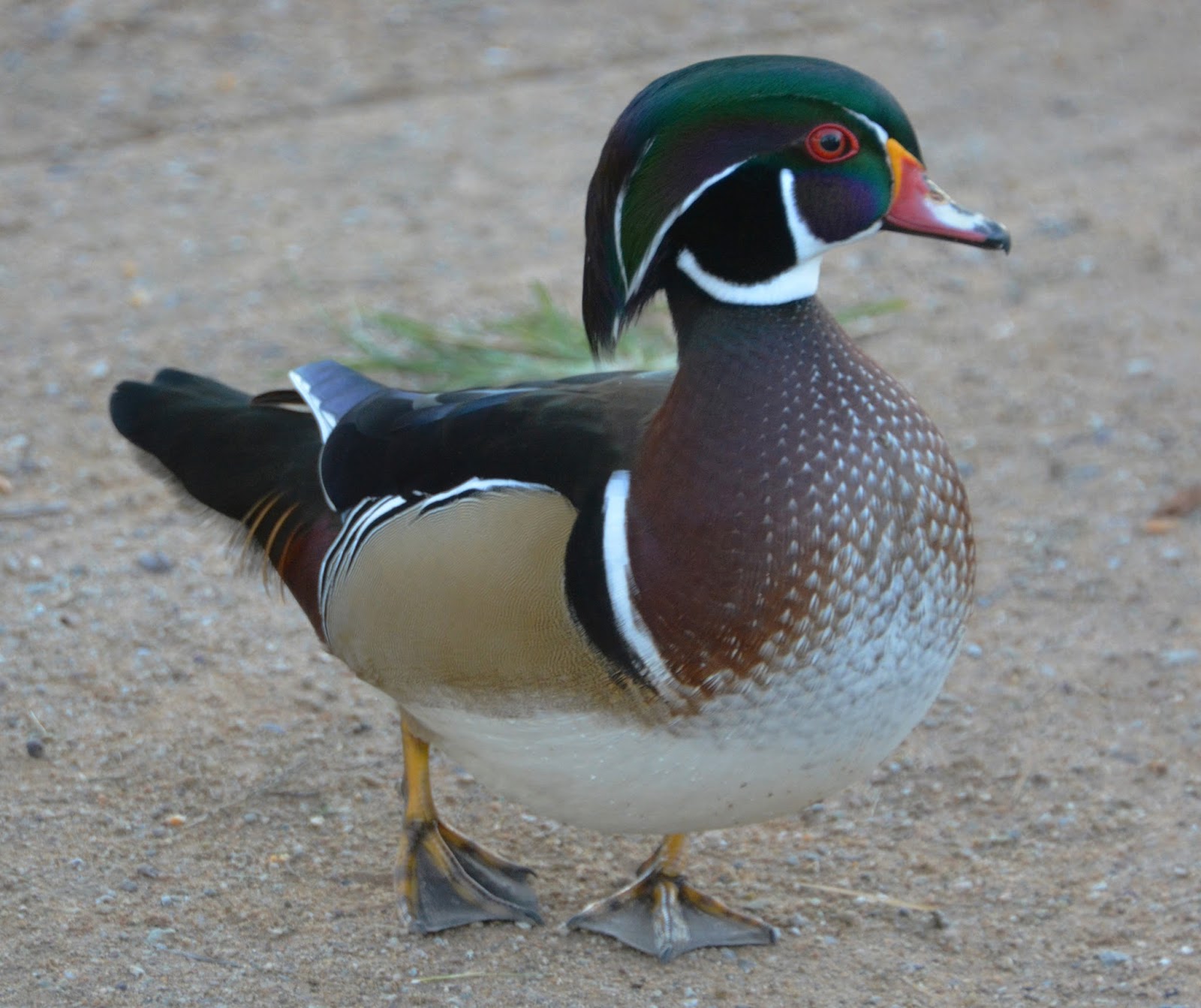
Mandarin Ducks are found in east Asia but their populations are in decline in countries like Russia and China.  Japan has a healthy population at about 5000 pairs.  In the US, these birds found in the wild are considered either part of isolated feral populations or birds who have "escaped".  There is a small population in Sonoma, California and it is quite possible that their range is expanding according to recent reports.  Either way, this is one beautiful duck!  It's closely related to our Wood Ducks here in the US. 

Wood Duck
 And while I've been out having fun in the world of birding, I've totally been neglectful of my garden!  When I went to go get my mail, I found this one single persimmon fruit on a lonely branch!  It was VERY exciting!  This tree hasn't produced fruit for two years!

Persimmons Fruit-variety Fuyu
So I honored the plant and ate the fruit:)  Then it was off to find a Brown Pelican in the desert. 

Brown Pelican
In December, Arizona birding is quite hot (in the good meaning of the word) and is often overshadowed by the holidays.  There are several people doing "Big Years" in Arizona and I know how stressful it can be during this month.  Last year I did that challenge for the US!  My challenge for this year has been to find as many birds as I can in North America which includes Mexico! It has been a lot of fun, but my days are numbered:) For the ladies competing for that top number one spot, good luck!  I think you're all pretty great. Best of luck to Susan, Barbara, and Janine!


And when it's dark outside, I sit back and reflect on those exciting challenges that have happened over this past year. 


I'm not finished yet, but for now, I sit back and enjoy the wonders of the wild.  And this beautiful piece of owl art from my friend Kathie Brown!!!  This is simply awesome!  Thank you!!  And below, I have taken some video of these two rare and special birds. Until next time!


 The post title means,  "A Light Heart Lives Long".  It's Mandarin for Mandarin:)

Monday, January 5, 2015

Las Aventuras: Across America


I woke up on the New Year's Day both happy and sad.  It was over. How can a year fly by so quickly?!  That part is still hard to get over.  What an amazing journey it has been!  But I am also happy to stop the doubled efforts of chasing birds I have already seen.   My purpose for last year's event was to load up on my North American birds.  Here are some fun facts from my journeys to California, New Mexico, Colorado, Florida, the New England states, and of course, Arizona. 


Pied-billed Grebe

I began the year with a Pied-billed Grebe in southern California and ended the year with a rare(for AZ) Red-necked Grebe.  In the US, I found 468 species of birds.  For North America, I found 476 birds.  I've been doing some work down in Mexico again and it will be my focus this year.  I am surrounded by bird ID books from these regions!  As of now in the US, I rank 62 for the 2014 year.  Some birders haven't entered all their lists into ebird yet so it could slightly alter the ranking.  But I have secured myself within the top 100 for the year and achieved my goal set back in January. In the state of Arizona, I ranked number 2 thanks in part to all the birds found in the state and for this reason, it kept me on top of their list. 


But those are just numbers.  The true purpose of my birding is to live the birding adventure and find as many of our world's birds as I can before I visit the green pastures:) Or sadly, before they disappear. My current life list stands at 586.  And it's hard!  It was so easy a few years back adding birds to the list.  Now, it takes a lot of planning and good use of my time. With the night studies, my full-time job, a partner and regular life duties, I was able to add 127 life birds to the list in 2014.  Not a bad haul. 


What were the highlights?  Each place was special and so much fun.  But let's look at the bird discoveries......


The most exciting camping trek?  
There is no doubt at all here on this one. Although our Greer trip comes close! It was our AZFO camping trip to the North Rim of the Grand Canyon.  Here we did a survey of nesting birds around the area.  We had an amazing crew, did some rough camping, and worked incredibly well together.  Everyone still talks about that trip up there.   I hope to join my AZFO group again this year as we explore Organ National Monument down by the border.  


The North Rim of the Grand Canyon
The most frustrating experience?
I think Kathie Brown can vouch for this one.  The Bicknell's Thrush.  I will say this about the Mt. Washington Auto Road.  It sucks.  Beautiful scenery but full of cars and annoying people. And the entrance fee is overpriced. This bird was the trickiest to sort out with the constant traffic. My ears are VERY important when locating birds and this trek was very difficult thanks to all the noise pollution. I still have a bad taste in my mouth about the experience.  I remember how quiet and uncomfortable I made everyone feel in the car by my quiet anger.  I am not proud of that moment, but I was determined. There were many thrushes in the area which also made listening to the Bicknell's call a challenge.  We did manage to spot a couple of the BITH.  However, I will never go on that road again.


The gorgeous mountains of New England
The craziest experience?
We went for the Atlantic Puffin along Maine's coast on very rough waters.  This is where Kathie and Micheal lost it!  The rocking of the waves were too much for them. The Audubon guide was hit left and right during his presentation with ice cold ocean water!  For me, I felt like a giant dancer capturing all the amazing terns, puffins and guillemots around the Eastern Egg Island while the ship rocked back and forth. 


Eastern Egg Island
The most sacred of moments?
Whispering to the Florida Scrub-Jay.  In a magical moment, the captain of the jays flew to the top of my hat and kept lookout while his company flew all around me to feed on the ground.


Florida Scrub-Jay
Best couple activity?
Camping on the Channel Islands for the Island Scrub-Jay!  There we watched migrating whales, tiny foxes and orcas around our island while spending a couple nights on Santa Cruz Island. 


Strangest bird?
The Upland Sandpiper.  The call alone was cool!


Upland Sandpiper
Rarest sighting?
A Snowy Owl in Kennebunkport, Maine in the middle of summer!


Snowy Owl
Best study sessions?
The AZFO fall get together in Globe and grassland sparrow banding with Dr. Janet Ruth. 


Janet releases a Savannah Sparrow
Most epic moment?
While observing Lesser Nighthawks, a Scissor-tailed Flycatcher flew past me at sunset.  I couldn't believe my eyes!  And it was all experienced alone after a really bad day at work.  This bird made me forget it all. 


Scissor-tailed Flycatcher
Most painful?
While observing the endangered Piping Plover on Bunche Beach, FL, I was attacked by thousands of chiggers.  I suffered an entire month after a trip to that beach.  


Piping Plover
Most studied birds?
The Montezuma Quail and Bell's Sparrow.


Montezuma Quail
Favorite place to bird?
The grasslands of Southern Arizona


The bitter dip?
The Gunnison sage-grouse!  I'll find you!  The weather was NOT cooperative on this day!


Most overlooked place to bird?
New Mexico!  For those people who say there is nothing there, I challenge you to look again.  WOW!  Plus best food stops this year!  Green chiles......


Most scenic?
Road trek up to Gunnison, CO!  WOWSA!


The worst decision?
Perhaps not the greatest place to bird. One team member discovered a man shooting up in the bushes. All of us had seen the bird in other parts of the country but we wanted it on our Arizona list:) It would have required us to hike a wash full of broken glass, used needles and possibly encountering other nasty things. We decided to leave the area for safety issues.  However, we knew the birds were hiding in that wash. And so we dipped on this bird.  Later in the year on our way to Gunnison, we passed through that same area sans the visit to what I now label "Drug User's Wash" and found the bird around a housing area.  Much safer!


Black-billed Magpie
And finally.  Favorite bird of the year?
The Rhinoceros Auklet.  


I'd like to thank all the people involved this year with Las Aventuras.  The treks have been amazing and without the people, many of the adventures would have been lonely ones. 


When I think about birding in Central and South America, and of course, Mexico, my heart beats a little faster.  It's why I do what I do in the real world. It has taken me to the most amazing and breathtaking places on this planet.  This year, my goal is to explore Mexico again, do a pelagic and spend time with my family back in Wisconsin.  And then there is our wedding at Rocky Mountain National Park this next year. Will I find a White-tailed Ptarmigan while I say, "I do.....love birding."?:)  Or will I get myself into trouble under the eyes of Mother Nature for trying to bird and marry at the same time?  Only time will tell:)  Happy New Year to you all!  


This year's photo album
Birds, birds, birds......check out the amazing Wild Bird Wednesday collection from around the world each.....Wednesday:)