Showing posts with label Yellow-footed Gull. Show all posts

Sunday, November 4, 2018

The Caravan


Our trek to Organ Pipe was interesting, but it was the work in Mexico that had me more interested.  A lot of birders signed up for a gull workshop with AZFO's Lauren Harter and David Vander Pluym.  And on the last day of the conference, a large caravan of birders crossed the border into Mexico.

Magnificent Frigatebird
We planned on staying the night in Rocky Point or Puerto Peñasco.  Many of the birders wanted to go with the caravan together.  No matter how many times I write this, there are still birders who are afraid to cross the border even though it's completely safe to travel to Rocky Point.  Like everything else, people need to use common sense. 

30+ birders scour the ocean with their scopes
We spent our morning with scopes and gulls.  But we also had our own agenda.  I wanted to do a count around Morúa or the Pinto Estuaries so we broke away from the group after lunch to do our own counts. I've been doing work around those areas for several years now and had never birded the area in October.  We rented a place on the Morúa estuary and really had a nice hike full of excellent birds there.


AZ Fish and Wildlife's Troy Corman and Wrenegade team member Tim H scope the horizon for possible rare birds

It's hard to navigate areas with large groups of people.  Many were there to spot the Yellow-footed Gull which is a bird of interest for many people.  These gulls live around the Sea of Cortez in good numbers.

Yellow-footed Gull
We said our good-byes and then were off to our sector of Rocky Point to get some work done.

At Morúa Estuary, we do a major bird count
The first bunch of birds we crossed paths with were plovers.  Snowy Plovers were everywhere.  They are the cutest of the bunch.   

Snowy Plover
Another common plover along the Pacific waters is the Black-bellied Plover.  Most of the shorebirds are in their winter plumage right now so they all look rather gray together.  Some can be downright tricky!


Black-bellied Plover
Another special bird that people come to see in Rocky Point is the Wilson's Plover.  They have a big bill and are the sassiest of the bunch.  In the pic below, the bird is throwing a little "tude" at an oncoming Snowy Plover. 

Wilson's Plover is the sassiest of the bunch
Even though it is cooler and pleasant, the sun can be quite strong as it bleaches the landscape.  In the pic below, we arrived at the mouth of the estuary where the bird life was at its highest.  I discovered my first Black Skimmers for Mexico here.

The bright light of the dunes and the ocean create a bleaching of color affect
Another great bird to see was the Elegant Tern.  They were the most common tern in this area next to the Forster's Tern. This species is listed as Near Threatened.

Elegant Tern
There were schools of fish everywhere.  And where there were large numbers of fish, there were hundreds of birds diving into the waters. Heermann's Gulls closely followed Brown Pelicans and tried to steal the food from their bills. 


A near threatened Herrmann's Gull sits on the back of this Brown Pelican
On Sunday morning, Gordon wanted to do his survey at Cholla Bay.  So he showed a couple birders how he likes to do his count.  As always, we had a great time and finished our counts with a nice list of bird species there.  The key is to go at low tide if you're a photographer.  At high tide, Cholla Bay is great with a scope.  


Short-billed Dowitchers
Short-billed Dowitchers had to be carefully ID'd by listening to their flight call.  As they flew, we were quickly able to ID them as Short-billed and not Long-billed.

Birding Cholla Bay at low tide is great for photographers wanting to get up close to the birds
As the bay drains of water, shorebirds, like the Red Knot below, go crazy on the crabs. 

A dull winter plumaged Red Knot forages for food
I've seen Red Knots in a lot of places but they are often too far to get clear views. One of my goals for this visit was to observe this species better. And it was great! 


Western Willet
Our special find, and definitely off my radar, was this gorgeous Fox Sparrow, the Sooty-colored subspecies. At the Morúa and Pinto Estuaries, there are specific green spaces or migrant traps that have green lawns and mesquite bosques.  I looked over at the trash bin and saw a bird scratching on the ground.  At first I thought it was a towhee until we put our bins on it!  HOLY COW!  We ended up with a Fox Sparrow on our Mexican life list. I also added a Dark-eyed Junco which was yet another bird I had not expected for Mexico.  Anyhow, the migrant traps around the hotels are great near the estuaries!!  I've had so many surprise warblers and sparrows show up in these green spaces. 

A rare Fox Sparrow
Our adventures continue......

Saturday, June 2, 2018

Estero El Soldado


Originally I scheduled a trek out to San Pedro Island, but the water was too choppy and the trek was cancelled.  These things are to be expected during hurricane season. So I followed up on Plan B, the mangrove estuary of El Soldado between San Carlos and Guaymas. 


If a birder is looking to get away and enjoy the beach life for a bit, s/he should check out San Pedro Island, the El Soldado Tidelands(or Estero El Soldado), and along the rocky beaches of San Carlos. 


When the island trek was cancelled, I started going over this area with my friend Tami because there were several requirements for our group on this day.  A little bit of swimming, drinking, eating and hiking along the water's edge.  The Estero provided all of those things easily.  


There was a resort nearby that also had gardens.  And birds.  Lots and lots of birds.  There were ocean ones, and coastal ones and garden ones.  And MANGROVE ones!

Genus Callinectes
 It's not often I get to bird a mangrove living in the desert.  And it often shocks me to know that even in the harshest of climates, the miracle of a small mangrove can happen in the craziest of climates. For a moment, I was transported to the tropics.  In fact, San Carlos and Guaymas are truly the beginning ranges of neotropical birding.  It is here we find such wonderful birds like the "mangrove" Yellow Warbler, Mangrove Swallows and Great Kiskadees.  It is exciting. 


Ocean birds won't disappoint either!  While none of these birds were lifers, they were a thrill to see again.  

Royal Tern
One of my favorite groups of the birds, the gulls, were in good numbers.  Terns, Royal and Elegant, were also seen in good numbers along the coast. 


As I laid under these palms while the group went out for a swim, I watched the world pass by me.  I closed my eyes to the cool shade breeze and smiled.  We all agreed that this was a great way to kick start the summer.


Laying on my back, I aimed my camera up into the air and shot pics of birds flying just several feet above me. 


I loved this place so much that next time, we're staying down here in the resort along the estuary.  


A Magnificent Frigatebird hung right over my head in hover mode, defiant against the strong winds. I love these birds.  You could see fleets of these air pirates off in the distance over the rocky coastal crags.


And while this was an excellent birding spot, our group was humbled by an observation between the estuary and ocean.  An adult Brown Pelican defended a recently deceased fledgling/juvenile and tried protecting the body from intruders like beach walkers and vultures. Nature can be very cruel, even from within the artificial boundaries of "paradise".  We like to humanize things when we see such terrible moments in the animal world.  But to watch this adult defend this lifeless body made us a bit somber. 


The thing I love about birding now is that when I see something like this, I have a deeper understanding of the bird world.  Our human side says, "See! These creatures do have emotions!" My scientific side says its instinctual.  Maybe they're both right. There are so many "experts" out there and they all have their professional opinions.  For me, the important part was to gather notes on this observation and learn. 


I heard someone say that they were going to chase that Turkey Vulture away.  Then it was time to explain to that person that nature has to play out.  It's not the Turkey Vulture's fault that the fledgling died.  It has to eat as well.  They are Mother Nature's natural garbage disposals. They play a role as well.  Most of you know this but for those of you who don't, here goes. Why don't Vultures have feathers around their heads?  Well if they eat dead and rotting things, then having feathers would be a bad thing.  They'd pick up diseases and bugs, etc from the carcass.  So no feathers.  Nature is cool!


This summer is going to be an absolute thrill.  Two months of exotic trails on different islands will hopefully yield lots of new and interesting birds. My first trek begins in a few weeks to Trinidad and Tobago.  I need this vacation after this stressful Spring. Much like my Monterey, CA trek a few years ago, I'll be in a private cabin at the Asa Wright Nature Center for a week.  Then I've rented a wonderful apartment in Arima for other area visits.  I can't wait to get out of this heat!


For the Estero El Soldado checklist, click here.  Summer is just beginning and it's time to cross the 1000 bird mark. Can we achieve it this summer?  Stay tuned for more!

Wednesday, May 30, 2018

San Carlos, Mexico


Over the past weekend, to celebrate the end of the school year, we headed out to San Carlos, Mexico.  It's a 5 and 1/2 hour drive south of Tucson. 


We arrived exhausted and were greeted by this California Praying Mantis.  Carefully I took this critter out to the patio.  


During our time in San Carlos, we relaxed a bit and had some drinks along the beach.  I did some light birding along the coast focusing on gulls. 


The Yellow-footed Gull of the Baja Pennisula is an endemic.  Here in San Carlos, this bird was the most common gull present. 


The Sonoran Desert ranges all the way into the state of Sinaloa.  It's a fascinating region of desert. Here you can find the iconic Saguaro Cactus growing next to areas of Cardon and Organ Pipe Cacti.  


As the vegetation changes the further south you go, so does the birding.  Here we not only see traditional Sonoran birds with typical ocean birds, but we begin to see Neotropic birds show up like the mangrove subspecies of Yellow Warbler, Mangrove Swallows and Great Kiskadee.  It is here that you can find other strange birds(not often seen in the northern Sonoran desert region) like White Ibis, Roseate Spoonbills, Wood Storks and Little Blue Herons.  There are Reddish Egrets and Tricolored Herons. The Sonoran Desert is an amazingly diverse area. 


One of my favorite species of birds, the Bronzed Cowbird, was seen in good numbers almost every place we went.  In fact, I searched high and low for a Brown-headed Cowbird.  No luck. 


Let's talk safety.  Getting to San Carlos is relatively easy.  We headed south down to the Nogales Mariposa port of entry and stopped near the Circle K to purchase some insurance.  Then we headed down to get the visa for the vehicle.  Don't take your chances.  If you get into a wreck and don't have the visa along with that insurance, they could impound your vehicle.....forever!  And you only need that visa if you pass Hermosillo.  Places, nearest the border, like Rocky Point(or Puerto Peñasco), don't require this visa. 


San Carlos is a clean and sleepy little ocean village.  It's worth the extra hours of driving.  It's cheap to rent a beautiful place.  In fact, I came back with money from this trek!  That rarely ever happens.  As for safety.  Always use common sense.  Lock up things, etc.  Now let's talk Mexico. 


Another favorite gull of mine is the Heerman's Gull.  Easy to ID and a beautiful bird to observe along the coast!  Having traveled Mexico this year(and the last), I must mention a couple things that I've heard from my Mexican friends and US workers down in this country.  I've been going to the safe tourist "corridors" of the country that are easy to travel and away from the drug cartel lanes. It's why I hired a guide in Mexico City this past spring due to being close to another state(Morelos, not on the list but a known drug corridor nonetheless).  Here is the latest Mexican Travel Advisory . 
"Exercise increased caution in Mexico due to crime. Some areas have increased risk. Read the entire Travel Advisory.
Violent crime, such as homicide, kidnapping, carjacking, and robbery, is widespread.
The U.S. government has limited ability to provide emergency services to U.S. citizens in many areas of Mexico as U.S. government employees are prohibited from travel to these areas.
U.S. government employees are prohibited from intercity travel after dark in many areas of Mexico. U.S. government employees are also not permitted to drive from the U.S.-Mexico border to or from the interior parts of Mexico with the exception of daytime travel on Highway 15 between Nogales and Hermosillo.

Do not travel to:
  • Colima state due to crime.
  • Guerrero state due to crime.
  • Michoacán state due to crime.
  • Sinaloa state due to crime.
  • Tamaulipas state due to crime."


However, we did notice some cartel activity in San Carlos in various spots because they own beach homes.  And it makes sense.  San Carlos is fairly close to the state of Sinaloa, known by Mexicans and the US, as a not-so-safe state to visit.  The cartels run their major operations out of this state and several others listed above. 


BUT with that said, San Carlos was safe. MANY Americans and other foreign nationals vacation in San Carlos. In Mexico, always travel by day and with others. It's the same in several areas of the US. So just use common sense. We had a blast.  Plus the birds were amazing!


I had several places I wanted to check out while we were there.  One included the San Pedro island for the nesting ocean birds and the other was the El Soldado Estuary between San Carlos and Guaymas.  Unfortunately, hurricane winds put a kibosh on our pelagic trek out to the island. 


However, I was able to do a count around the tidal areas and see lots of great ocean birds like a fast moving Black Storm-Petrel.  There weren't any life birds on the table here except maybe a Gull-billed Tern.  For me, this was more about connecting the dots in another sector of the Sonoran Desert.  Plus, my birding focus has shifted to the state of Sonora now. 


And when I wasn't counting birds around the town, we were celebrating the start of summer. I will say that I added Yellow-crowned Night-Heron and White Ibis to my Mexico list bringing my total national Mexican list up to 428 birds seen in the country.  In the next post, we'll explore the beautiful El Soldado Estuary. 

We had to keep an eye on Tami with that tequila.  We all got a little crazy:)
Now it's time for a margarita:)  Until next time.....

Saturday, March 5, 2016

Laridae


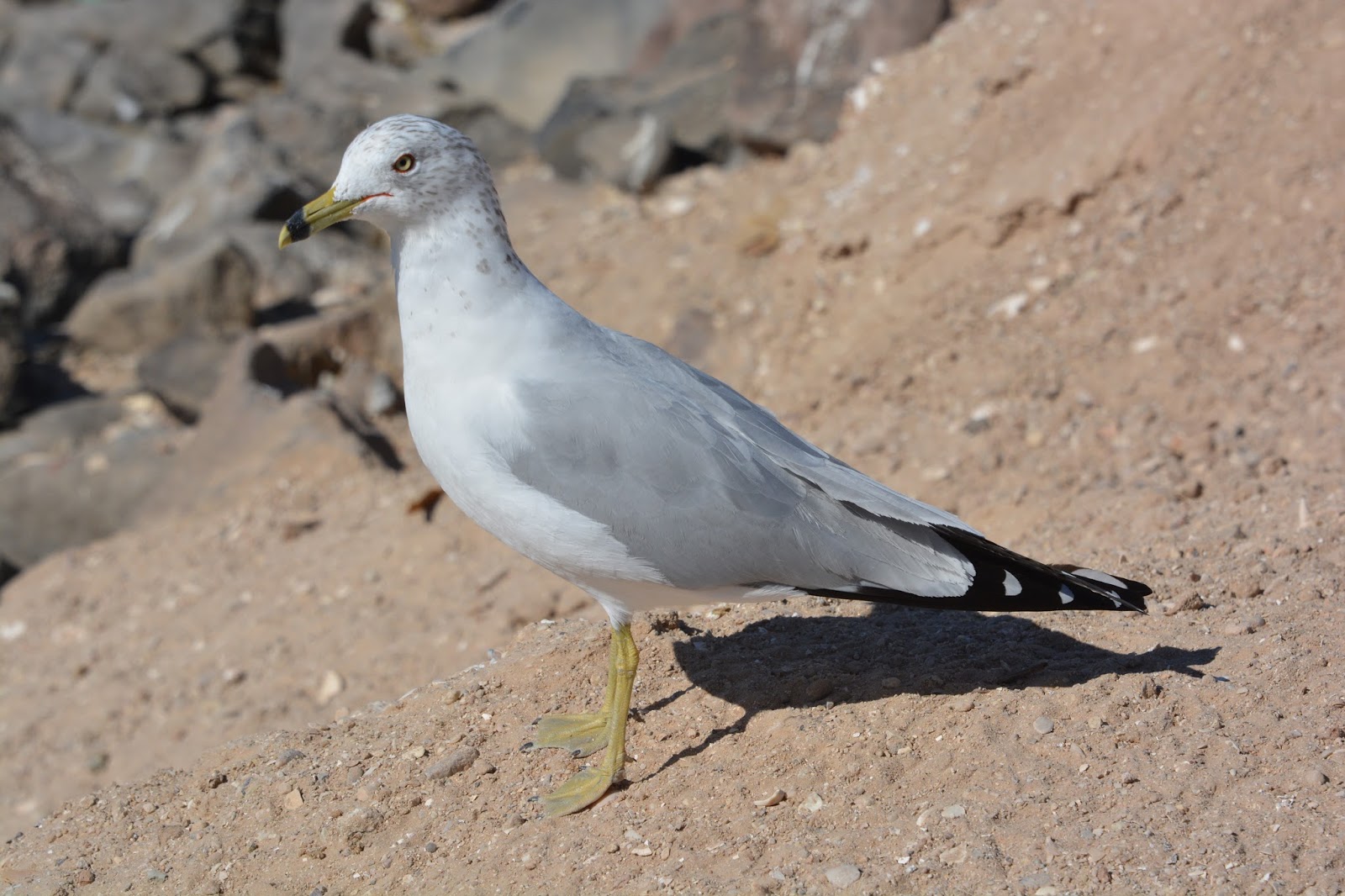
Gulls. They are a most unloved species by humans.  I grew up with them in my hometown of Two Rivers and took them for granted. They are loud, obnoxious, messy and can be downright cunning! Today, I find gulls to be some of the most fascinating birds out there.

Heermann's Gull
It's not easy being a gull. People shoot at them, throw things at them and often use foul language around them at the beach.  Sure they crap on people's things, steal their beach snacks and like to congregate in large groups, but the opposite can also be said about people:) Every day gulls clean up people's messes around public areas. They also face other human threats. Take for example this near threatened Heermann's Gull.  Did the bird lose a foot to a fisherman's net?  Considered to be one of the most beautiful gulls of North America, it's one that faces declining numbers.

Left-California Gull Right-Heermann's Gull

The California Gull with its' nice round head and smaller build with both a black and red dip on the bill makes it an easier gull to ID. It's also the state bird of Utah.

Yellow-footed Gull
The Yellow-footed Gull is the most special gull of all.  Many American birders try their best to find this bird in the US so that they can count it on their ABA list.  Just a few are seen and known to breed in an area known as the Salton Sea.  Unfortunately, the Salton Sea is disappearing and these gulls could be restricted entirely to the Gulf of Mexico if this US habitat vanishes.

Herring Gull
Who has pretty pink legs?  Why this Herring Gull of course! 


Ring-billed Gulls are everywhere and tend to be smaller than most other gulls. They are inland gulls and are quite common in many areas.

Ring-billed Gull
Many times people make the mistake and call gulls "Seagulls".  In the birding world, this is taboo.  Just use the word "Gull" and you'll be okay. Although, there are many gulls that fly over the sea.....Just saying:)

Great black-backed Gull
The Great black-backed has a VERY dark back and is rather large. Just like the name suggests:) Once they were rare off the shores of my hometown.  However, their numbers seemed to have grown around the Great Lakes area over the years during the winter months.

Great black-backed Gull
And then there are Herring Gulls.  This is the gull of my hometown.  This species can get confused with many other species of gulls such as the Thayer's and Iceland Gulls.  So what are the field marks that help distinguish one gull species from the other?

Herring Gull

Well one.  Have patience. Here are some tips......

1.  Size.  If you have other gulls around,which is often, it can help easily ID the various species that will amass on beaches or over your car. 

Bonaparte's Gull
2.  Leg color.  Are they pink, bright pink, yellow, dark yellow, etc etc.


3.  The bill and the gull dip(the color dot on the bill).  Is there a red dip or black dip or both? Is the bill strong?  Or smaller?  When juvenile gulls in their various cycles are thrown into the mix, it can get REAL tricky.  Fast:)

Laughing Gull-note black cap extends further up the head.  Orange legs are also...oranger:)
4.  The primary tail feathers. Do the edges of the end and side feathers on the wings have a dotted white or all white feature? Or no feature at all? 


Can you ID these gulls?  There are 4 species of gulls in this one shot. 
Is there any black?  If the gull is completely gray, you might have a Glaucous Gull!

Franklin's Gull
5. Head shape. Is it round? Odd shaped? The black capped gulls(or the gulls with the "hoods") can be told apart by how far their black hood extends on their head. 

Juvenile Sabine's Gull
6. Eye color, ring around eyes, head color and calls can also be helpful.  In other words, you need patience.  Or find a birder on your walk and ask:)


I found my biology mentor Dr. Sontag on the trails in Manitowoc.  He was the perfect cure for my ID ailment. 
It takes a while to figure it all out, but it's great once you do!  I still have a lot of work to do, but I enjoy gull ID very much. 


Gulls are amazing birds. They are the acrobatics of the air.  The silent stalkers from behind. The inspiration behind a painter's need to fill the skies along the sandy shores of the ocean.


When I look at gulls, I am reminded of my home.  And it makes me happy.  A world without gulls would be a very dull one.