The beauty that comes from both nature and birds is so exciting for me. It inspires art.
Lazuli Bunting
This was a lazy outing after several hikes. I popped open a bag of my favorite cheesy ruffled potato chips and sat on the ground near the feeders and watched the bird show for over an hour. The indigo blues of the migrating Lazuli Buntings mesmerized!
It's that time of year in the desert when many of our "flashier" and "colorful" birds return to Arizona. Our wildflower and cacti show also delights with its subtle yet bright colors.
Globemallow
Birds actively collect nesting material OR feed their young.
nesting male Black-capped Gnatcatcher
The birds are very vocal. Take for example this nesting Black-capped Gnatcatcher(above) and Northern Beardless Tyrannulet(below). While on the trails, they could be heard rather easily as they noisily flew from one bush to the other.
Northern Beardless Tyrannulet
It's an amazing time of year for so many things.
As my work winds down, I prepare for bigger things. Some nights, I just go birding alone to relax my mind.
Lesser Nighthawk
Sometimes, it's about studying several birds better that I don't always get to see. The Vaux's Swifts are a first for my photo collection at Las Aventuras. Swifts are difficult to get on camera. The sun was setting quickly and I had a few moments to get these next two shots.
Vaux's Swift-the cigar with wings
Sometimes, like in this case here, you get one shot. As the sun was setting, I knew I had just a minute to get these birds on camera. Observation time for this bird was less than a minute!! I watched the skies for 45 minutes observing hundreds of swallows buzz around quickly. During this time, I was searching for a different flight pattern to help me lock onto at least one bird.
Then I saw something that looked like a bat flying but as it banked to the side, I knew I had my swift.
As the sun set, I planned for the next day.
Green-tailed Towhee
It's always fun to go somewhere new and look for wonderful birds.
Lark Sparrow
Because during spring migration, anything and everything is possible! You can find lots of exciting birds in your local parks, at your work site, etc.
Dusky-capped Flycatcher
For all you Eastern birders, why aren't you checking out those trees for those amazing migrating warblers? It's May my friends:) Get ready! They are about to come through your area if they haven't started already! For me? Well, I'm keeping my eyes open down here for something rare:) Until next time.....
Where are you? I can hear you. But where are you? Where are you?
Olive-throated Parakeet
Oh green!!! How I love and hate you at the same time!!!! I know you're out there!
No one talks. No one dare say a word. The photographer is afoot! He cannot be distracted. Life bird on the loose!
I studied many calls which included the Melodious Blackbird. And all it took was their call to make me drop what I was doing and run with my camera. Birding by ear at its best.
Melodious Blackbird
There are some calls that I recorded inside my brain before the trip. And it was interesting because I had forgotten that I had done it.
I had studied several calls of birds that would likely be seen during our trip and I found something interesting happen while staying at our places. I'd hear the call and move without realizing why I was doing it. I did this instinctively and didn't figure out why until I had my eye on the bird. Then I'd smile and realize why I had run in the first place.
Clay-colored Thrush
And the calls would happen at crazy times.
Dusky-capped Flycatcher
The bird below was the one that made me act the craziest. The Rufous-browed Peppershrike had called the previous day but I was in the shower. When I ran out in my towel, I saw the bird looking back at me but again.....no camera!!!! Of course, it flew off and wouldn't return until the next day.
Rufous-browed Peppershrike
This time when the bird called, I wouldn't be caught with my pants down again! Sorry...couldn't help it:) The Peppershrike's call was so wired into my brain that I moved quickly like a firefighter responding to a fire. If it wasn't for my ear on this trip, I'd have missed out on many of the birds that like to disappear into the vegetation.
And that's some of the fun challenge behind birding in a tropical area. I'm linking up with Wild Bird Wednesday because there are so many amazing birds out there! More coming soon.....
Guatemala is a real treat for any birder or wildlife aficionado. The country has over 732 bird species alone!. And there certainly are birds hidden everywhere. My advice about when to bird in Guatemala? Winter. The bird population doubles as most of our North American birds migrate back down into Central America for the winter.
While there, I found 130 different species. Some I had already seen, but most were all new.
Take for example, the Dusky-capped Flycatcher(above). It's call makes this bird easy to identify. It has a "meeee-ooooo" sound that stands out in the crowd. It was fun seeing birds we have in Arizona down in Guatemala. Each bird species found was worth one imaginary birder point. If you are going to bird a place, you challenge yourself to find as many bird species as you can.
And while I had seen this Yellow-winged Tanager (below) back in Antigua, I hadn't seen it in this county. So another challenge for me was to find as many birds as I could in each place! So while the Tanager wasn't a lifebird, it was still an important find during my observations.
Now I have to say this. The views in this country are out of this world. This particular post is set around Lake Atitlan.
While we were there, I witnessed massive flocks of Lesser Goldfinches.
Something as common as American Coots were hard to find. Only at the end of our journey, did we encounter them in very small areas around Lake Atitlan. I was actually excited to find these birds. Something so common back home was special here. And it made me look at them differently when I returned back to Tucson. I appreciate them even more.......if that's even possible.
BUT! I had been hearing birds that I did not recognize. For this particular stay, I studied my birds well because there were some strange ones found here. Take for example the Provost's Ground Sparrow. I was coming back from dinner and caught the bird near our terrace. The bird quickly vanished. By this point in my trip, I was exhausted. I knew this bird from my studies and pulled out my cell phone to play the call. When I did........Mr. Provosts came out to visit with me.
But the hardest trial for me was the last bird. I heard the call and instinctively knew I couldn't let this one get away. And I pished! AND PISHED! My friend continued on her walk while I chased this warbler through the trees.
There was an intense urgency with me that I didn't understand. But something inside my head made me instinctively recall this sound.
I made contact with the bird and then realized why this one was special. It was a real treasure for it was the one and only Rufous-capped Warbler. A bird found south of Tucson in the Santa Rita mountains. However to get to them, one must make a tricky hike up a waterfall full of grasses and cactus. These warblers follow the stream up and down the canyon. My friend Kathie almost fell off the rocks, but thankfully I blocked much of her fall. She still got some nasty bruises though! I've searched for this bird 3 times on that dangerous trail, memorized it's call, filled my water pack for the hot trek and have plenty of stories to go with those adventures. I remember once an old woman sitting on a stone moving her feet back and forth like a little kid. She asked us, "Did you find the warbler?"
"No.", we replied.
"I won't go up that rock. It's too dangerous."
She reminded me that time is indeed ticking. I won't always be able to do these treks. So this warbler is for all those people who can't see them on their own. After all, an adventure is best shared, isn't it? Below is a video I took to show you the kinds of habitats we explore to find those birds. Life is truly wondrous.
As the list narrows, the searches become more difficult. As a birder, I find warblers most frustrating. They are a gift to me once spotted. Some are easily found while others move around too much in the canopy of the trees. But one bird still eludes me....the Elegant Trogon. However, this time it's different.
Cooper's Hawk
On a hike into Madera Canyon, I located several nesting areas for the first time. It was a lot of fun. There were other birders on the trails. One man sat devastated on a rock. I asked him what was wrong. He replied, "I cannot locate the Yellow-Eyed Junco!" He was from the south and had never seen one before, but I smiled and pointed to the bush where one was hiding. "You mean that one over there?" His eyes flashed that excitement that birders get when finding a lifebird for the first time. I was super thrilled for him. I called the bird out and he was able to get wonderful shots. Some say that this bird is a "Junk bird". I don't like that term because it sounds like it's no big thing. The simple truth is that we can't take any one species for granted.
I walked the trails more....finding flycatchers, mammals, bugs and more. And I came upon another group who had thought they heard the Spotted Towhee. I had seen it on the way up. The bird's call is unmistakable, but it also is a master of cloak and disquise. It will disappear quickly. However, it wasn't quick enough to hide from us this time. The group was able to find their Towhee. A lifebird for most of them. I continued on my trek up the mountain trail.
Along the way, I found a Hutton's Vireo above and the House Wren below. The bird above was confusing to me. It acted like a Dusky. My gut said Hutton's but I needed ID help. Most agree it was a Hutton's and yet..... Since the time of this shoot, I have found the Dusky several times and have been able to get nice clear shots of the bird. It will be featured in a post coming up next week. I'd just like to thank everyone for their input when I need that extra help.
House Wren
There is a lot of sexy time going on between the birds. I walked upon two Arizona Woodpeckers having a moment. Luckily these were birds and not my parents.
Copulating Arizona Woodpeckers
Hummingbirds. Who doesn't love them? The Broad-tail below made me smile. It's bell-like rattle swung around feeders noisily as he fed.
Broad-tail Hummingbird
I wandered.....and wandered taking it all in carefully. Truth be told, I was hoping for Flycatchers. And found them I did!
And I picked myself up the Dusky-capped Flycatcher. Smallest of the three similiar flycatcher species, it prefers to be near running water(check) in oak scrub(check) and near the ground to middle branches of the tree(check). But the easiest way to ID this bird?? The call. I heard the sad "pee-ur" sound associated with the bird. The bird also lacks the distinct rufous edging on the sides of the wings(like the Ash-throated). It's probably one of the most difficult birds to ID. I have several shots to compare this bird with the others I've seen out in the field.
Dusky-capped Flycatcher
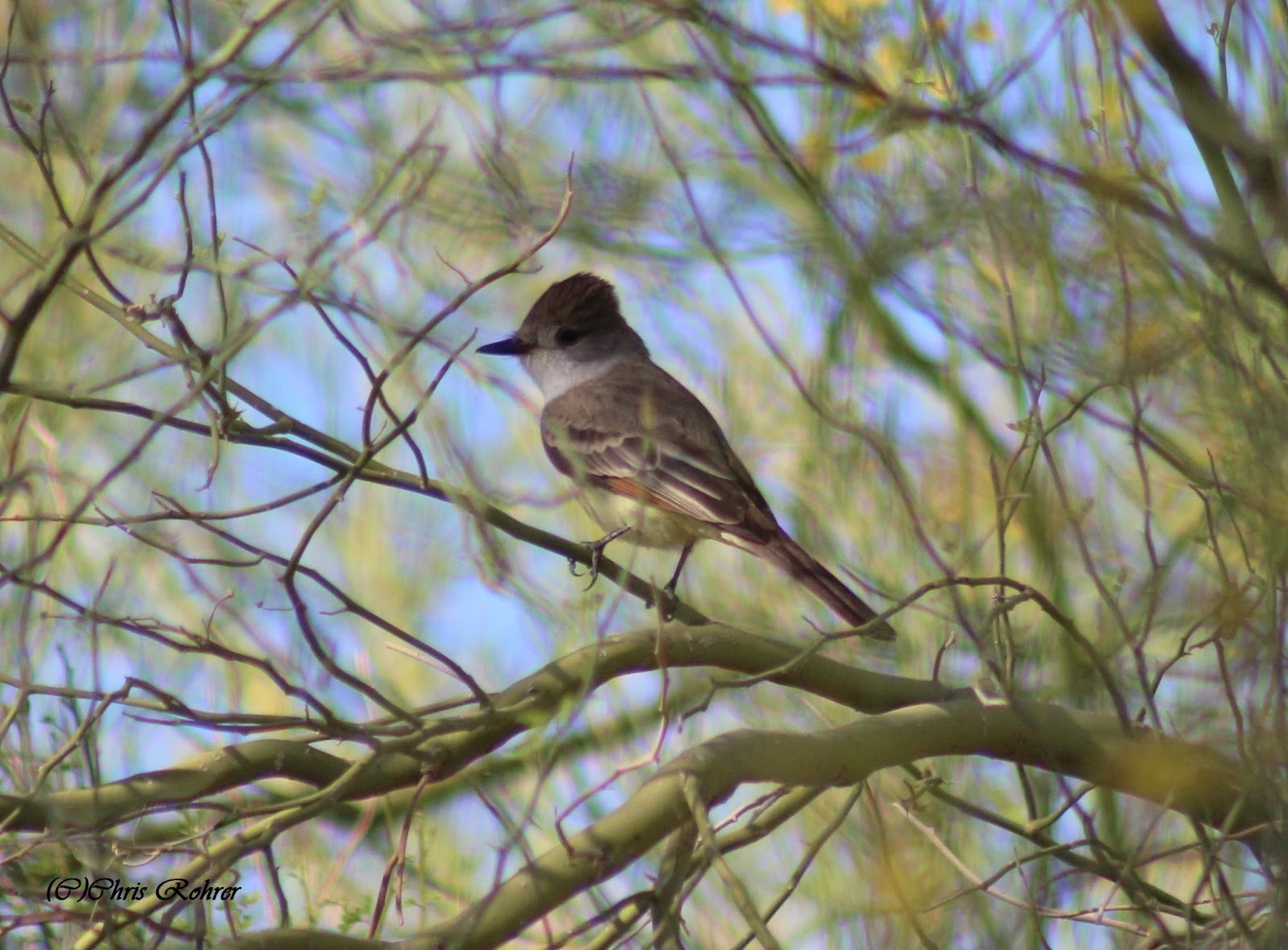
Many times it comes down to observation. The Ash-throated below is much larger and has rufous coloring along the edges of the wing. They prefer to hang around dry washes like their much larger counterparts the Brown-Crested Flycatcher. The calls are very different as well.
Ash-throated Flycatcher
So after awhile, it's nice to go back to easier species to ID. And yet in this post, I've placed several of the trickier birds for people to ID. Is it a Coopers or a Sharp-Shinned? Is it a Dusky Flycatcher, Ruby-Crowned Kinglet or Huttons? Body posture is everything on these birds. Is it a Dusky-capped Flycatcher, Ash-throated Flycatcher, or Brown-Crested Flycatcher? Habitat and calls for these birds. And there are certainly many more birds that are very similar in appearance.
And so when I see the Elegant Trogon, there won't be any doubt in my mind what the bird looks like:) I have the image burned into my memory. Perhaps someone will help me find my new nemesis bird one of these days? Or maybe the bird will just appear quietly as it always does while I'm alone on the trails.


 Posts
Posts