Thursday, March 1, 2018

The Transitional Slide

Northern Cardinals sing their hearts out this time of year to attract a mate
As winter fades into spring, the wintering birds begin their migration.

White-crowned Sparrow
February in Arizona is relatively a quiet time in the birding world.  Some rarities show up, but overall, it's a great month to catch up on yearly ticks in a relaxing manner.

The San Francisco Peaks
This year, so far, has been great for early hummers.

Anna's Hummingbird
During our trek out to the Desert Museum, we find several Costa's Hummingbirds actively feeding around the gardens.

Costa's Hummingbird
Their brilliant purple dazzles the naked eye.


But even rarer?  A male Allen's Hummingbird is hanging out with the Costa's in the area.

A rare male Allen's Hummingbird
February, March and April are busy times for bird guides.  While I am not an official bird guide, I find myself with many birders needing our Arizona specialties.  It's fun.  I meet new people and I get to watch their reactions to their "new" birds. One day, I'll be able to guide full time, but for now, it's stick to the program:)


During a tour to the Heard Museum, I found this Native American painting.  It accurately depicts a Great Horned Owl's preference for skunk. I imagine the meat is quite aromatic.

Verdin
With my parents at Boyce Thompson Arboretum, we notice Verdins and feeding Anna's Hummingbirds.


At the Desert Museum outside of Tucson, my parents admire the unique looking cacti and succulents.


While we visit all these amazing places, I stop and count birds whenever I can.


At one location, I discover a rare White-throated Sparrow.

rare White-throated Sparrow
At Saguaro National Park, we admire the moon in the background of a beautiful Saguaro.


This is the time of year when I begin to question why I'm sitting on my butt instead of chasing life birds.  Well, soon.  Very soon I'll be taking you all to a special place in search of several special birds while visiting with friends.  For now, I sit at a holding pattern. Until next time....

Tuesday, February 13, 2018

For The Journeys Ahead

Northern Harrier
Sometimes we wait in a holding pattern.  But it's the anticipation of the next big adventure that excites the imagination. 

The Knob Hill Fire burns in the Dragoon Mountains
In the meantime, I scout areas and collect data for several birders who will be coming to Southern Arizona for their own adventures.  They too are excited about finding new birds to add to their life lists. It's a job I take seriously.  

Sandhill Crane comes in for a landing. 
The winter months are the only times we are able to observe certain birds.  Every year, I head down to Willcox and Cochise Lake to be among the Sandhill Cranes.  Everyone says to go to the Whitewater Draw.  I love it there too, but it's not the same as Willcox.  If you are a photographer, you head to Willcox.  The birds fly right over your head and land just a few feet away.  It's pretty spiritual. 


Our wildfire season is early this year.  Fire started this weekend on private property and spread over 2 thousand acres on the Dragoon Mountains. While observing the cranes, we watched the fire spread over a section of the mountain.  


Another fun challenge was finding ONE Eurasian Wigeon in the near thousand population of American Wigeons. 

American Wigeons
Can you find the bird?:)

A Eurasian Wigeon
I have written this before and I'll write it again.  I wish I could bird in this weather all the time. It was comfortable.  


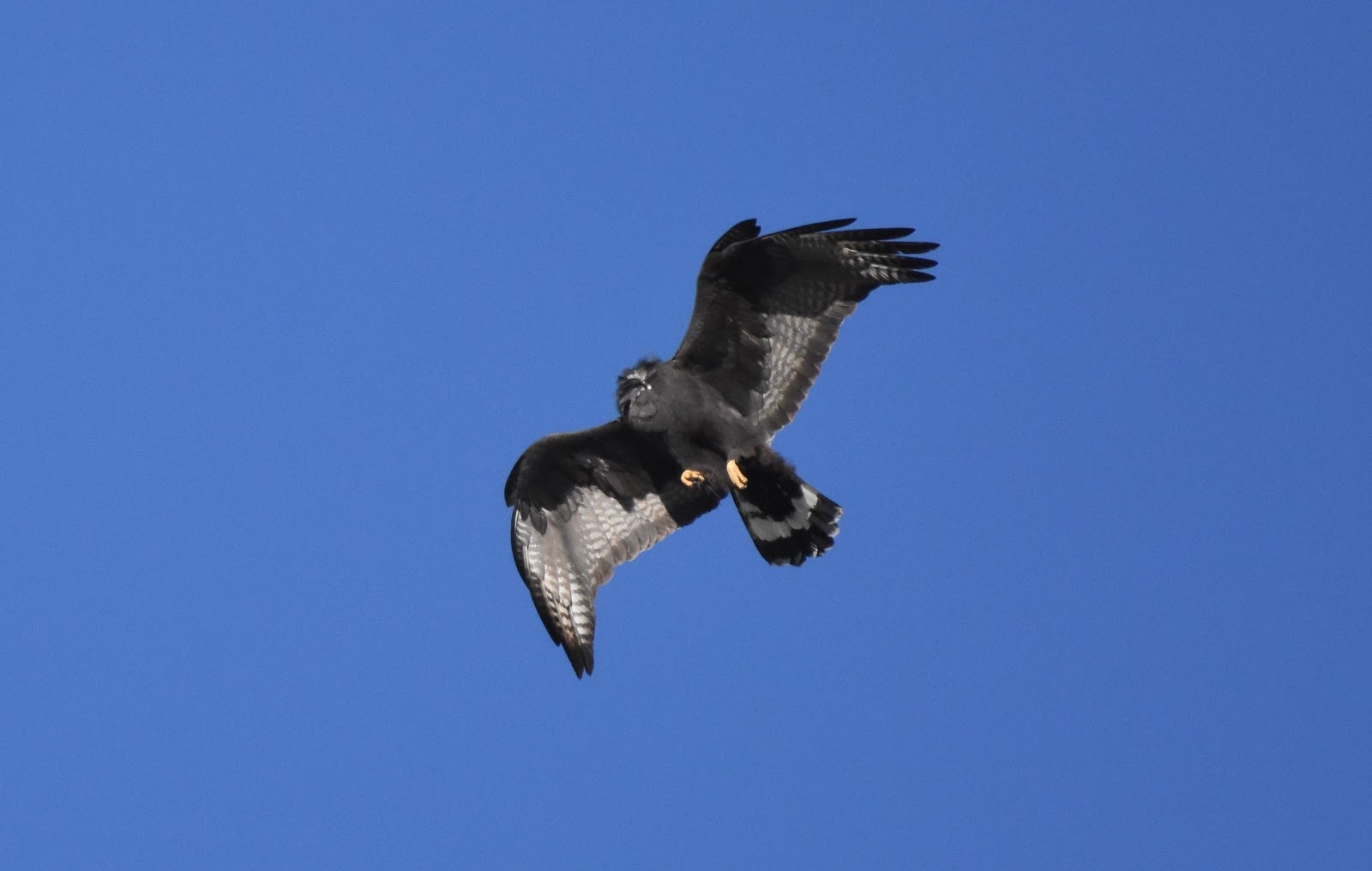
On my weekly observation at Reid Park in Tucson, I watched our beautiful wintering Zone-tailed Hawk take flight and stay in the air for nearly 2 hours!  Often it flew right over my head looking for prey. Other times it looked like it just wanted to fly for enjoyment. 

Zone-tailed Hawk
During one moment, I thought the bird had lost its head. 


However, the hawk was just preening.  This is the second observation that I've seen of this species preening in flight. This bird is an acrobat!


On another outing during the week day, I just wanted to bird in a different location.  So I went to Agua Caliente Park for an evening count. 

Agua Caliente Park
I hadn't researched this location.  I just wanted to bird.  Birding keeps my skills sharp for the people who rely on me to find their birds.  Maybe you've noticed this about yourself with certain species of birds?  I tend to glance over some species while with others, I look at more closely.  Such is the case with sparrows. My gaze lingers a little longer with these bubbly happy-go-lucky birds. 

a beautiful Swamp Sparrow
I enjoy sparrows.  I don't know why. Most people don't get into these birds but I could spend hours watching them hop around bushes.  During that evening, there were a couple Lincoln's Sparrows in the area and I was enjoying their fine plumage design when I noticed this Swamp Sparrow(above and below) next to them!  Wow!  It's a rare bird for Pima County in the winter, but it was a most welcome sight!


We went on other adventures, mostly for the walk.  I just needed to bird pretty spaces after those past couple weekends of gross agricultural habitat.  It was really really nice. 

We take a lovely stroll in Ramsey Canyon of the Huachuca Mountains
While up on Mt. Lemmon, I met two people who signed up for our trip with Tucson Audubon to the Huachucas in August.  I had a blast getting to know them and we had a great time finding birds. It was fun hearing their excitement as I got them on great birds. My reports are below. 

Northern Flicker
This year's theme is all about family and friends in other places.  I am working on one trip now and looking forward to the challenges ahead.  While I wait, I will continue to count birds around the state.  I try to balance it all out. People in my life will sometimes say, "I wish I could travel like you do."  A lot of them could, but often it seems like it's outside of their personal comfort zones. I've just made it a personal mandate.  I've earned it.  There's no looking back.  Only forward.  You only get one life.  Own it and find happiness.  Until next time.....

For Agua Caliente Park, click here
For Willcox Lake, click here
For Mt. Lemmon, click here
For Reid Park, click here

Sunday, February 4, 2018

Dirty Work

Feedlots have some amazing birds.  Keep out of the way of workers and look for great birds in the Santa Cruz Flats!
This week's addition of Arizona birding is strictly for the birds.  I don't often visit certain places around the state because they are gross and smell like %&^!.  But I had a friend who needed some state birds for his list and we made the trek to several international AZ birding hotspots where people can find unique and specific birds.  I swore that once I had found my LeConte's Thrasher, I'd never go back to that spot again, but I was wrong. Several years later, I found myself back at this Mad Max Beyond Thunderdome location. "Two men enter, one man leaves!"  Thankfully that wasn't the case this time. Let's begin with our first stop, the infamous Thrasher Spot near the town of Buckeye outside of the Phoenix area. 


The nuclear wasteland known as the Thrasher Spot
Sure.  You're saying to yourself, That's pretty. Nope.  That's just the artist in me trying to make the location pretty:)  The thrasher spot is truly a unique experience.  BUT.  It's the one place in the US, you can get all your thrashers at one stop.  Well, most of them.  Here you can find the beautiful LeConte's Thrasher, near threatened Bendire's Thrasher, Crissal Thrasher, Sage Thrasher and even Curve-billed Thrasher. 


The first and last time I've gone after a LeConte's Thrasher.  Beautiful bird in a very ugly habitat. 
Two of these thrasher species, the LeConte's and Crissal, are often very secretive and difficult to observe.  During our visit, Steve needed the LeConte's Thrasher for his AZ list.  Most of the time, a birder can just drive to the spot and easily add Crissal and Bendire's Thrasher to their lists. Well, not on that day. 


A "secretive" Crissal Thrasher
The best time to visit this location is towards the end of February until the first or second week of April when the thrashers are actively calling during their breeding season.  The important part is that you arrive early. Sometimes they are singing and other times, they need a little time to get going. 


the near threatened Bendire's Thrasher
We walked through broken sink fixtures and torn up bed mattresses like you'd see in the movie, Mad Max.  This location is also known for many Sagebrush Sparrows and a few Bell's Sparrows.  Sparrows are my specialty so we were able to find both species to add to Steve's state list.  Thrashers on the other hand were difficult!  We had to work for our Bendire's Thrashers.  It would have been embarrassing to leave the "Thrasher Spot" without a Thrasher.  We had both Bendire's and Sage but NO Crissal or LeConte's!  The Thrasher group can be a tough one.  Patience.  Lots and lots of patience is needed for these birds. Often, a return trip is required. I had that experience this past week with my Streak-backed Oriole in my neighborhood.  It took 11 attempts before I saw that blasted bird!


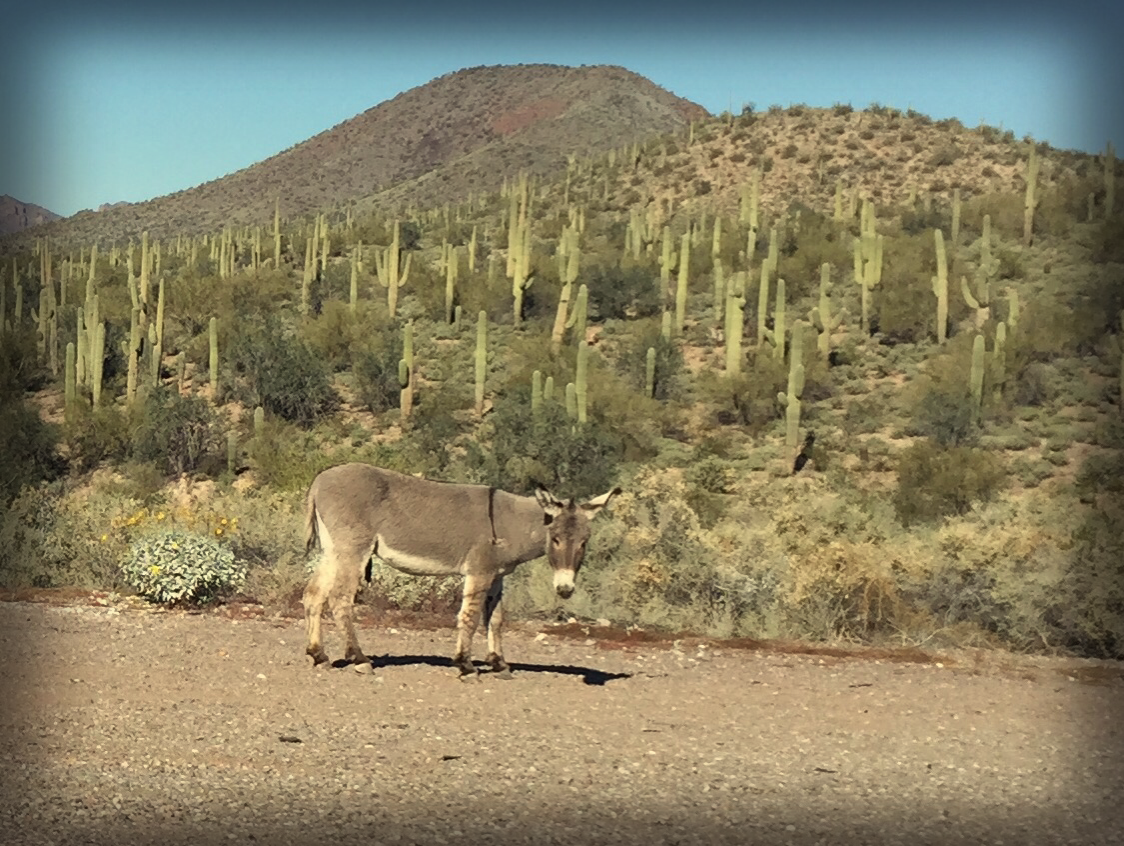
Burros are commonplace in the Lake Pleasant.  Be careful driving the highways there
Our next stop was another place I hadn't visited in a long time.  In fact, the last time I went was during my 2014 Big Year in the US. I needed several scoters for the state and one for my national list, the White-winged Scoter.  This location is known for lots of great ocean birds during the winter months. In fact, the one and only time I was there, I was able to capture a White-winged Scoter in flight.  The pic was published in the Birds of Phoenix and Maricopa County by Janet Witzeman, Troy Corman and Tommy D. It's a great guide for birding in Maricopa county.  And this Pima County birder was able to help:) I should mention that if you're looking for a human bird guide, there's a great guy by the name of Gordon Karre who does a lot of these treks to the spots I'm writing about today. He's situated in Maricopa and knows this county best.  I think his spirit bird is the Gray Vireo which he has a knack for finding.  In fact, he's often asked for assistance with Rosy-faced Lovebirds, LeConte's Thrashers, Gray Vireos and Black-chinned Sparrows along with the many other AZ birds. He's on Facebook and he's an excellent bird guide.  So if you're in the area and need a guide, look him up.  


Back to our challenge at hand.  So we went to this Lake Pleasant to find the Barrow's Goldeneye.  If you are new to this hotspot, I'd recommend a scope. Many of the birds are often far out in the lake and require a scope to find them. There are several points all around the park for a person to bird.  There's even burros:)


female Common Goldeneye
There were quite a number of goldeneyes in the area.  The ONLY male Barrow's Goldeneye was near the shore. 

Barrow's Goldeneyes are common in winter further north of the state.  To have one in the Phoenix area was nice

It was an easy add and a new bird for my Maricopa list and a state bird for Steve. 

Easiest Barrow's Goldeneye ever near Scorpion Point at Lake Pleasant
Then it was more gross birding in poop.  Nasty, gross poop. So we headed to the feedlot. I dreaded lowering my window. But sometimes you gotta bite the bullet. Our noses were assaulted with the stench of fecal matter. I think I need to buy breathing masks for these treks:) Doves.  They are beautiful but they do like poopy areas. 

Inca Dove

Steve needed Ruddy Ground-Doves which are very common in Mexico but rare for Arizona.  They can show up anywhere but they seem to like garbage areas around the state that don't have the most "scenic" habitat. We made an educated guess and found the doves hanging out with cattle. 


Ruddy Ground-Dove
We drove off with the lingering smells trapped inside our noses. 


So for every dirty stinky birding trek, I have to balance it out with some beautiful and scenic Arizona scenery.  And that's just what I did.  Either way, it was a fun bird outing with Steve. Until next time....

Tuesday, January 30, 2018

Hermit Thrush In Tempe!

Prairie Warbler is super rare to the state of AZ.  Currently, it's been showing well at Saguaro Lake near Phoenix, AZ.  State bird!
People always wonder how I find rare birds.  Well, it's a little bit of me and it's a whole lot of birders working together reporting their findings around the state, country and world. We are all a big part of the "network". On a daily or hourly basis, we can receive an email with rarity reports from the AZ Listserv or ebird. 

During a rain event, we targeted the grasslands for a Short-eared Owl and we got our sights on TWO!  They are difficult birds for Arizona.  Another state bird and Arizona nemesis NO MORE!
Anyone who subscribes to the AZ listserv will recognize the title of this post. Everyone has at least one of these birders in their community. While it is significant to their backyard patch, it is not significant to the overall community.  It's a tiny piece of a larger puzzle that we, as individual birders monitor in our own worlds.

Arizona Song Sparrow has unique rufousy tones when compared to the other subspecies of Song Sparrow
I'll get a buzz on my phone. Ooooo!  What is it?  A Trumpeter Swan in Tucson?  An Eared Quetzal on the Carrie Nation Trail?  A Prairie Warbler at Saguaro Lake? Nope. Just a Hermit Thrush on private property in Tempe.  WTF!  Even if that were a rare bird for this time of year, it's on private property!  So why even post it?


It's not a Louisiana Waterthrush.  That's rare. 

I finally have excellent views of a beautiful Louisiana Waterthrush
It's not a Red-breasted Sapsucker.  That's significant. 


A Hermit Thrush is up there with a Ladder-backed Woodpecker(at least in AZ). It's one of our most common birds found around the state.

Ladder-backed Woodpecker
If it were an American Bittern at Sweetwater, one should probably mention it. That's a rarity. 

An American Bittern holds still in the reeds at Sweetwater Wetlands. 
But do you know what's not a rarity?  A Pied-billed Grebe. Or Hermit Thrush. 

A Pied-billed Grebe out of water
When an email is sent out about the Hermit Thrush in their backyard, birders give each other the look and ask the question in a most cynical tone, "Are you going to chase that Hermit Thrush in Tempe?" We have a laugh.  Don't they know that a Hermit Thrush isn't rare?  Hasn't anyone told them? S/he seems like a nice person. And I do love their excitement.  But still.......

Rufous-winged Sparrow at my work site
If it were a Red-breasted Nuthatch at Reid Park in Tucson, THAT is newsworthy. 

A rare wintering Red-breasted Nuthatch at Reid Park in Tucson
A wintering Zone-tailed Hawk in Tucson is worth a chase!

A wintering Zone-tailed Hawk hangs out at Reid Park in Tucson
Even the casual, yet still rare, Northern Parula is worthy of a shout out. 

A Northern Parula
A Gila Woodpecker in Arizona, however, is not a rare bird and should never be reported on the listerv for Tucson or Phoenix.  Now if one was found in Florida, then birders should absolutely, without a doubt, report that miraculous sighting. 

A male Gila Woodpecker feeds from pecans
And while Pyrrhuloxias are cool, they are not rare for several parts of the state.  If it was found outside of its habitat range, then THAT is news worthy. 

The Desert Cardinal or Pyrrhuloxia
A Rufous-backed Robin should always be reported. Because it's rare ANYWHERE!

Rufous-backed Robin
And while a Hermit Thrush is NOT rare in Tempe during the winter months, it *might* be a significant find during our hot summer months.  One summer, I remember finding American Robins on a green patch in Phoenix, AZ. That was rare. And do you know what else I found?  A Hermit Thrush. Unusual.  But not rare:) 


A Prairie Falcon
Now this person has been doing this for years.  I don't know if they are a man or woman.  I just know that if I see that post, HERMIT THRUSH IN TEMPE! one more time, I will scream. If you are new to an area, observe what local birders are posting as "rare".  


A Hermit Thrush NOT in Tempe
The whole purpose of this write?  Well, it makes me more conscious about what I should and should NOT post when reporting birds to the community.  Very rarely is it appropriate to report a rare bird if it's on private property UNLESS birders can legally chase the bird from the road or have permission to enter the property.  Currently, a homeowner in Tucson is ok with birders coming to her house and looking at her rare Streak-backed Oriole. On a side note, don't post your exact sightings of owls. I've watched people go crazy over owls and they do some inappropriate things. However, it's okay to post your sightings of a Hermit Thrush:)  Most people wouldn't chase it. Until next time......