Showing posts with label Northern Harrier. Show all posts

Sunday, January 5, 2020

The Christmas Bird Counts


The team spies Mexican Jays across the lake
The CBC, or Christmas Bird Count, has been around for 119 years.  It has been a long lasting tradition for many birders around the United States during the months of December and January. And it continues to grow in popularity. And before I get started, I hope everyone had a wonderful start to their New Year! 


Orange-crowned Warbler along a remote lake
Each year I try to do at least 2 CBC's.  Anything more than two is too much:)  The CBC is a great way to meet birders from all over.  It's also a chance to explore areas that are generally off limits to the public or too difficult to enter.  There are several Arizona "circles" where the birding is rather difficult due to the remote unmarked and rough dirt road conditions. Often the leaders are given permission to get onto private land. This "circle" requires a lot of powerful vehicle driving and 4 wheel driving is a must. There's a bit of danger involved which is why it's exciting.  One of my favorite places to bird is in the Atascosa Highland area as it has some of the wildest spaces in Southeastern Arizona. But getting there is no easy task. Getting lost is a given and a road map is needed!


a secret lake in the middle of nowhere in the Atascosa Highlands
This area is also excellent for a secretive species of quail known as the Montezuma Quail. If you are going to see them well, you have to be quiet.  We were not. 


And that's why a covey flushed off into the dry wash.  Not only did we find these birds, but we also had sightings of Townsend's Solitaires and many other bird species.


This CBC count is special because it's right along the border.  You'll find water depots and buckets with food for people looking to call the US home. Every year, I have fun doing this count because I get to explore new areas that I normally don't visit.  This year we explored Apache and Jalisco Canyons.  At one point, a road became a small running creek.  There was no cell service so we packed our things well.  

Sharon spies a Hermit Thrush on a hill across the lake
The CBC is a great way to meet new people in the birding community and true to form, I met 2 new birders on this count.  

A Bewick's Wren greets us
Unfortunately, I couldn't stay for the dinner party at Wisdom Cafe because I had several doctor's appointments to attend the following day.  However, it was a lot of fun.  

The gray ghost, a male Northern Harrier
Then for the second CBC, because I only do two, I helped my friend Gordon with his area.  We went into the Buckeye area full of agricultural lands and canals.  On that day it was wonderfully cold and rainy.  I learned several new things about Maricopa birding.  I don't often bird around the Phoenix area and while Buckeye is outside of the Phoenix area, it's still in Maricopa County.  

One of the 14 Common Ground Doves we discovered along a Palm nursery
I never knew this but two rather difficult-to-find doves in Arizona are somehow breeding in this area.  We went into a palm tree nursery and found a lot of Common Ground Doves.  I can see why they'd breed in this area as it has the scrubby palm orchard necessary for cover. 


The gray skies made photography almost impossible, but on rainy days, at least for Arizona, the birds can be quite active.  However heavy wind and rain can make birding a challenge.  Our big challenge for the day was not to get stuck in the mud which there was plenty!


Long-billed Curlew
 Phoenix birders get to see certain birds more frequently than we do around the Tucson area.  Tucson gets colder than Phoenix in winter and we don't have the amount of water that Phoenix does. So finding birds like White-faced Ibis, Long-billed Curlews and Black-necked Stilts made me happy. 

Black-necked Stilt
While we were on the road, Gordon ran into some friends looking for the second rare ground dove of the day, the Ruddy Ground Doves.  Apparently these birds are at this property year round!  What the heck?  I never knew that.  All I knew was that Ruddy Ground Doves once bred in the Phoenix area, but housing projects destroyed their habitat and watering holes. I know this first hand because I researched old ebird reports where ancient birders reported hundreds of them. The old hotspots are now replaced with cookie cutter homes.


We were thrilled to spy 5 Ruddy Ground Doves on this day. So many people come to see these birds and they often dip.  Thankfully Gordon's friends were spared that feeling of a dipping disappointment. 


Ruddy Ground Dove
CBC's are wrapping up across the United States.  It will be interesting to see what their results will find.  If you are interested in the data collected, click here

Botta's Pocket Gopher
There's more to birding than just counting birds or finding new species.  During our time out in the field, we saw a small tornado forming.  To our knowledge, it never touched down but it was fun to watch. 


The rain kept the dust down around our count areas and made for some optimal birding.  Ferruginous Hawks are one of my favorite buteos. During our counts, we found several around the area. 

Ferruginous Hawk
Have you thought about doing a CBC?  If you've done one or more, where did you do it?  And what was the craziest bird you found? Below, I took a video of thousands of blackbirds getting ready to eat out in the ag fields. Until next time.....


Tuesday, February 13, 2018

For The Journeys Ahead

Northern Harrier
Sometimes we wait in a holding pattern.  But it's the anticipation of the next big adventure that excites the imagination. 

The Knob Hill Fire burns in the Dragoon Mountains
In the meantime, I scout areas and collect data for several birders who will be coming to Southern Arizona for their own adventures.  They too are excited about finding new birds to add to their life lists. It's a job I take seriously.  

Sandhill Crane comes in for a landing. 
The winter months are the only times we are able to observe certain birds.  Every year, I head down to Willcox and Cochise Lake to be among the Sandhill Cranes.  Everyone says to go to the Whitewater Draw.  I love it there too, but it's not the same as Willcox.  If you are a photographer, you head to Willcox.  The birds fly right over your head and land just a few feet away.  It's pretty spiritual. 


Our wildfire season is early this year.  Fire started this weekend on private property and spread over 2 thousand acres on the Dragoon Mountains. While observing the cranes, we watched the fire spread over a section of the mountain.  


Another fun challenge was finding ONE Eurasian Wigeon in the near thousand population of American Wigeons. 

American Wigeons
Can you find the bird?:)

A Eurasian Wigeon
I have written this before and I'll write it again.  I wish I could bird in this weather all the time. It was comfortable.  


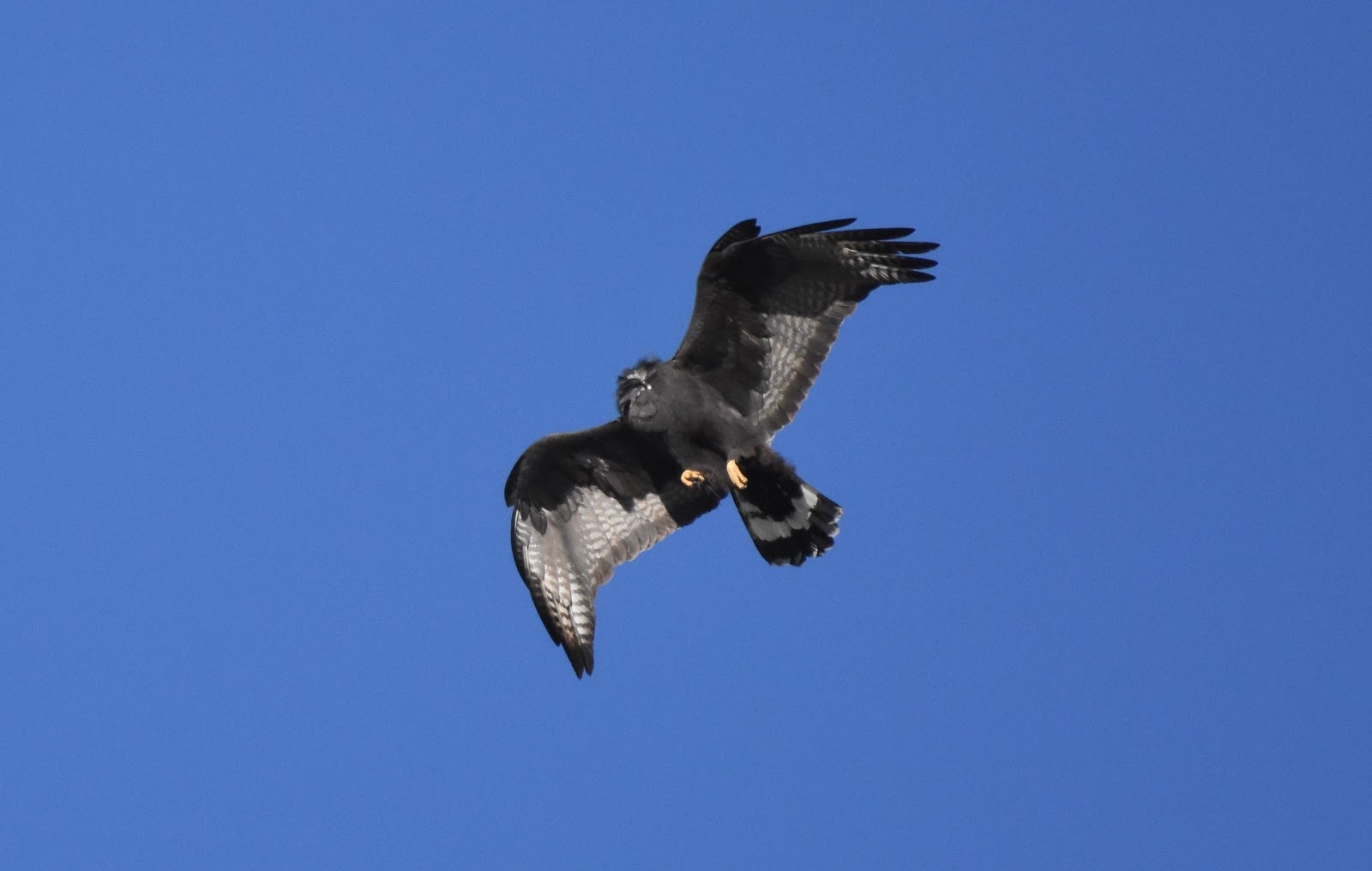
On my weekly observation at Reid Park in Tucson, I watched our beautiful wintering Zone-tailed Hawk take flight and stay in the air for nearly 2 hours!  Often it flew right over my head looking for prey. Other times it looked like it just wanted to fly for enjoyment. 

Zone-tailed Hawk
During one moment, I thought the bird had lost its head. 


However, the hawk was just preening.  This is the second observation that I've seen of this species preening in flight. This bird is an acrobat!


On another outing during the week day, I just wanted to bird in a different location.  So I went to Agua Caliente Park for an evening count. 

Agua Caliente Park
I hadn't researched this location.  I just wanted to bird.  Birding keeps my skills sharp for the people who rely on me to find their birds.  Maybe you've noticed this about yourself with certain species of birds?  I tend to glance over some species while with others, I look at more closely.  Such is the case with sparrows. My gaze lingers a little longer with these bubbly happy-go-lucky birds. 

a beautiful Swamp Sparrow
I enjoy sparrows.  I don't know why. Most people don't get into these birds but I could spend hours watching them hop around bushes.  During that evening, there were a couple Lincoln's Sparrows in the area and I was enjoying their fine plumage design when I noticed this Swamp Sparrow(above and below) next to them!  Wow!  It's a rare bird for Pima County in the winter, but it was a most welcome sight!


We went on other adventures, mostly for the walk.  I just needed to bird pretty spaces after those past couple weekends of gross agricultural habitat.  It was really really nice. 

We take a lovely stroll in Ramsey Canyon of the Huachuca Mountains
While up on Mt. Lemmon, I met two people who signed up for our trip with Tucson Audubon to the Huachucas in August.  I had a blast getting to know them and we had a great time finding birds. It was fun hearing their excitement as I got them on great birds. My reports are below. 

Northern Flicker
This year's theme is all about family and friends in other places.  I am working on one trip now and looking forward to the challenges ahead.  While I wait, I will continue to count birds around the state.  I try to balance it all out. People in my life will sometimes say, "I wish I could travel like you do."  A lot of them could, but often it seems like it's outside of their personal comfort zones. I've just made it a personal mandate.  I've earned it.  There's no looking back.  Only forward.  You only get one life.  Own it and find happiness.  Until next time.....

For Agua Caliente Park, click here
For Willcox Lake, click here
For Mt. Lemmon, click here
For Reid Park, click here

Sunday, November 27, 2016

Winter Has Come

Verdin
It is now a quieter time of birding here in Arizona. This is not to say that there isn't any great birding.  Far from it!  But with most people distracted by the holidays, many public and natural areas have less human traffic thanks in part for their need to shop. 


Great deal on Friskies Pate!
For birders, we just need to keep our eyes on the road for erratic driving.  I already have had someone dent my car from the Black Friday madness.  All I wanted was some pate for my cats!:) We, of course, forgot it was Black Friday and by that time, it was too late for us to escape. 


Lesser Scaup
The cooler temps and storms begin to usher in a new group of wintering ducks, cranes and raptors. 

Canvasback
Birders change their focus from mountain tops to water areas. We begin to head to local watering ponds to search for such rarities as Long-tailed Ducks or Horned Grebes. Maybe even a rare gull?

Cooper's Hawk
Some birds that are naturally difficult to see during the summer become a bit more visible as they feed from seed that has fallen to the ground. 


One of my favorite bird groups, the sparrows, begin to arrive back in great numbers.  This Brewer's Sparrow(below) is so plain and yet I think it's a gorgeous bird. 

Brewer's Sparrow
We also begin to scour the ag fields in places like Avra Valley or the infamous Santa Cruz Flats.  When I first began birding, these places were intimidating to me because their areas were so vast.  Today, it's all second nature. 

A random Osprey at the sod farm of Tweedy and Pretzer roads
As we comb the sod farms, groves of pecan trees, cattle ranches, drainage areas and barren desert expanses, we discover that all of our regular wintering guests such as the Mountain Plovers and Crested Caracaras have come back. 

Northern Harrier
We also note that there are several hundred Lark Buntings feeding from the miles of sorgum along the stretches of dirt roads.  

Crested Caracara

Cotton trucks cover us in layers of dust as we try to get a fix on the nearly invisible Mountain Plovers zig-zagging on the sod farms.  They are perfectly camouflaged as they feed from the lingering green vegetation. 

Mountain Plover
 As we exit the Santa Cruz Flats, we stop at Arizona City Lake.  Over the years, I have tried to figure out this strange community.  It is built around an artificial lake. The homes all looked rather nice at one time, but there appears to be some wear and tear now.  The fountain at the center of the lake no longer sprays regularly and now acts more like a desert island for cormorants, gulls and pelicans.  Yes, this is a great birding hotspot. 

A rare Horned Grebe. Normally rare, but this year it seems like there are more Horned Grebes than the similar looking  winter molts of the Eared species
 It's a fantastic spot for lots of rarities such as this Horned Grebe above.  Every time I see the now defunct fountain, I imagine it's where the residents bury their dead.  


The Arizona City Lake fountain used to look like this.....but not anymore.  Now it just sits like an ancient pyramid where they bury their dead. 
Well.  I do have an active imagination. The truth? It was too costly for them to run all this water all the time. Plus it's a waste of water. If residents individually want the fountain to run, they can pay for it themselves and will sporadically do so.  But I think, burial ground makes it more interesting:)


Yes, winter has finally arrived here in Arizona.  Joggers can jog.  Bikers can bike. Birders can bird. And everyone can smile and not worry about dying from heat exhaustion after 15 minutes of outside exposure:) Birders can sleep in late until 7 AM(when the sun rises) and bird until 5(when the sun sets). With a little more than a month to go before the year ends, Las Aventuras will try to make it to the 500 bird mark.  I'll leave you all with some recent visits to three of the places we visited this past week.  

Count 1. The Avra Valley area

Snow Goose in Blue Molt
Count 2.  The Santa Cruz Flats


A stunning male Vermilion Flycatcher
Count 3.  Arizona City Lake


Until next time........