Blue-winged Warbler-a pair came out of the grasses towards us at Mill Bluff in Portage County
Sometimes you never know when something amazing will happen. I think that's one of the best parts of birding anywhere at anytime. When you go to a place without expectations and find something wonderful, it really enriches the entire birding experience.
Brown Thrasher-a pair is feeding a nest. These birds are often difficult for pictures
They can be life birds, old birds or birds you never had great views of the first time you saw them. It's finding that secret forest in a new place. Or discovering a new little spot full of birds.
Red-winged Blackbird
It's the joy that comes from exploration.
Common Ringlet
It's the joy that comes from, "Oh my gosh, isn't that cute?!"
Red Squirrel
Or it's that shocking moment when an American Bittern suddenly flushes from the reeds! I don't get to see that often!
American Bittern
It takes but a moment........
......before the bird returns back into the vegetation and completely disappears.
Each day. Each place. Each experience holds something new. If you are open to it, you'll find it.
Close to my home and near my heart is the magical world of Horicon National Wildlife Refuge. It's a large area full of incredible birds and peaceful walks.
Eastern Wood-Pewee
As a child, I remember taking the winding country roads through aging little towns with my grandparents. Returning as a birder, I saw so much more!
There were so many stops along the way that I forget where we saw all of our birds. I just remember having a good time spotting several species that are often difficult to photograph in Arizona.
Eastern Kingbird
On this day, we would search for Gordon's lifer Bobolink. And we found plenty:)
Bobolink
While we search for the Bobolinks, a soggy Song Sparrow pops up to see what we are doing in the prairie grasses.
Song Sparrow
Tree Swallows shine like sapphires against the bright sunlight.
Tree Swallow
And Black Terns fish along our gravel path.
Black Tern
My heart gets beating when I see one of these birds in breeding plumage. I quickly walk forward.......
......and almost trip over this rock......
......WAIT! NOT ROCK! A Snapping Turtle!
Thanks Gordon for the heads up:)
We had a great morning out at Horicon National Wildlife Refuge. It's a large area so it definitely requires many more visits.
During our Wisconsin adventures, it came time to find Gordon his first ever Whooping Crane. A great place to see these birds is at the Necedah National Wildlife Refuge.
Whooping Crane
On a rainy day, we drove the wet roads and had killer views of a nesting pair foraging along the waterways. You may notice the tracking devices on the legs. This is an endangered bird which is very much like our California Condor in Arizona. It is tracked and monitored across the US during migration.
But unlike the Kirtland's Warbler, it doesn't have the same type of security and monitoring because there are two separate populations(the Western and Eastern flocks) in the US.
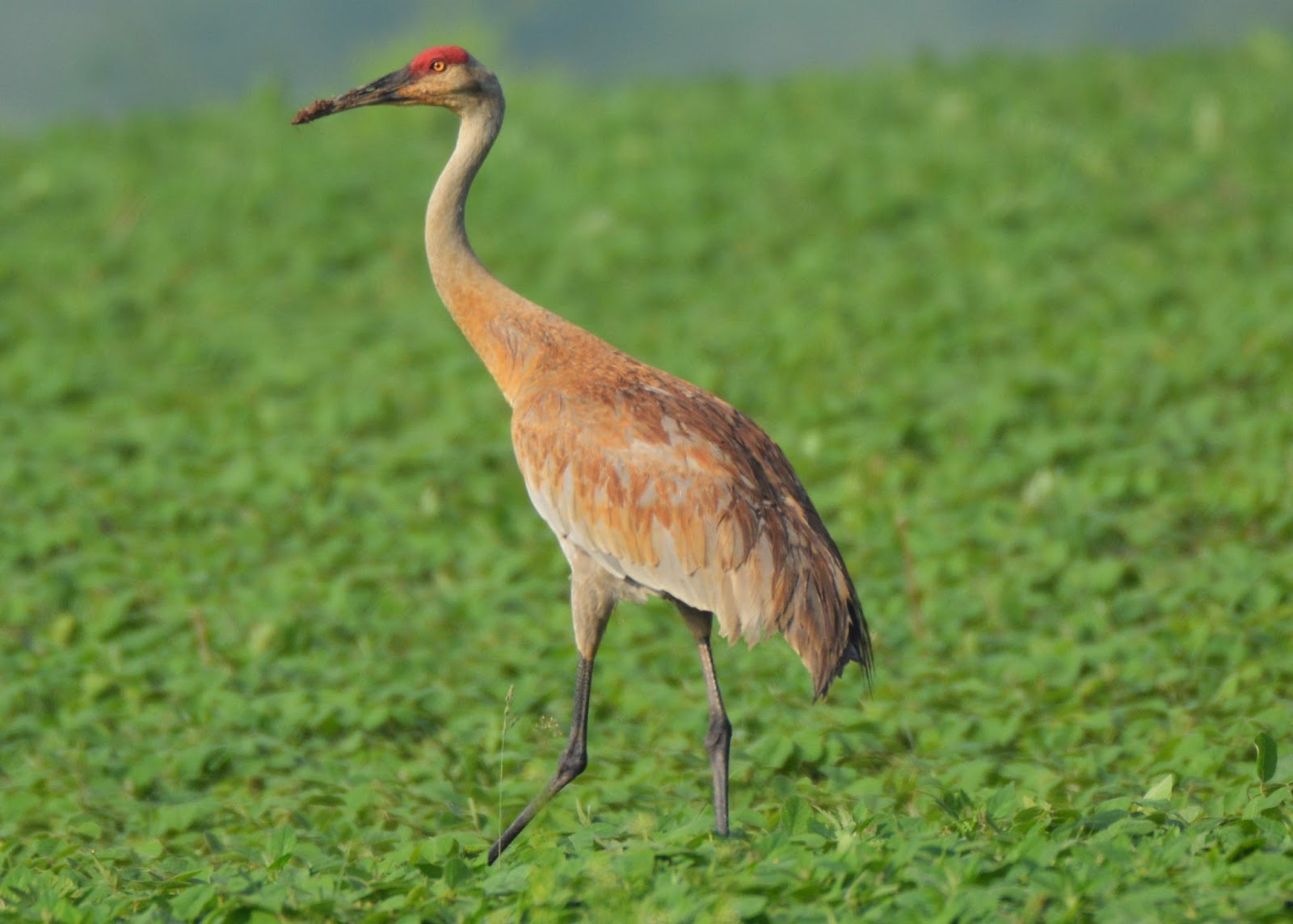
And like the California Condor, these cranes almost went extinct. Thanks to conservation efforts, their population has slowly grown over the decades. With continued support, perhaps this crane will one day cloud the skies like the Sandhill Crane!
And what's a place without an awesome visitor's center? I really liked their set up here. Great displays, comfortable furniture in front of big windows with bird feeders, a boardwalk nearby, friendly park rangers and a gift shop!
I snapped a shot of this blanket and kinda wished I had purchased it. But I think it was up for auction so I just snapped a shot of this beautiful quilt work. I did however purchase a stuffed Whooping Crane for my office:) In the background, my Dad chats away with Gordon. My sister looks like she wants to fall asleep:) I realized that on this trip, my parents are both night owls. Me on the other hand? Not so much. I'm an early riser. Staying up past 9 PM is way too late:)
Anyhow, back to Necedah. I had never been to this place. But there were lots of great wildlife stops around the area! So we toured Necedah and surrounding towns. Restaurants were not so good. I wish we would have packed a lunch for this trip. We were excited about trying out the Little Crane Cafe but were turned away without a reason. We were a little bummed out. The owner has since apologized. Part of the birding fun is trying out new places to eat. And that did not happen on this day.
Indigo Bunting
While at the refuge, we had beautiful views of Indigo Buntings and a Yellow-throated Vireo.
Yellow-throated Vireo
The vireo can be tricky to spot since it likes to hang out high in the canopy of trees. We heard plenty in Wisconsin, but I think I only saw it once! And here is that one time:)
Another tricky bird that is very vocal but difficult to see is the Least Flycatcher. It wasn't a lifer for me but it was the first time I had a decent visual of the bird.
Least Flycatcher
And of course a photo:) Its' vocalizations are fast and make it an easy flycatcher to ID.
We headed to the Buena Vista Grasslands afterwards. While the heat and humidity were a bit intense, we had a great time finding lots of wonderful birds.
How beautiful is this Grasshopper Sparrow below? What a treat to see this bird out in the open! Usually they are secretive and hiding in the grasses! In Arizona, they are very tricky!
Grasshopper Sparrow
It's interesting to note that this subspecies of Grasshopper Sparrow is lighter with a bit more yellow color tone. In Arizona, our subspecies of Grasshopper Sparrow is darker, streakier and richer in color.
The Arizona Grasshopper Sparrow-from a banding project two years ago
^^The above pic shows the dark colors of the Arizona Grasshopper Sparrow. The pic below is the more yellow and lighter Wisconsin version.
After the grasslands, we went to the Sandhill Wildlife area to finish off our birding adventures. What a lovely area! Although, there were plenty of ticks and deer flies to keep us on our toes!
Black-billed Cuckoo
These pics were exciting but I lost a lot of blood to get them. Hey, I guess that's part of the fun. What's not part of the fun? Leaving your car windows open for all the bugs to enter.
Veery cool!
It was exciting to see a Veery up close. It's not everyday we get to see these birds.
One of the warblers that I didn't know much about, the Golden-winged Warbler, was present in this location in good numbers. It was a lifer for both of us and a very good looking bird. This warbler is in trouble due to habitat loss and the hybridization with Blue-winged Warblers. If you look closely at the pic, you'll see a band around the bird's leg. It's another warbler of concern.
Golden-winged Warbler
We had a successful time out. Gordon found both rare birds, the Kirtland's Warbler and Whooping Cranes. When I go birding, I always have a strategy in mind. We find the rare or endemic birds first. Everything else will fall into place. News came to us at a late hour, but apparently, a Whooping Crane was only ten minutes from my parent's house! What??!! So we drove to the location. Sure enough! There it was!
I leave you with one of our nesting Whooping Cranes at the Necedah National Wildlife Refuge.
And if you're in Texas or going to Texas, you need to check out this video on the Whooping Cranes(the Western Flock). Until next time......
I was so excited to take Gordon to one of my favorite places to bird in Green Bay. PLUS! We were officially going birding during the summer here. Something I had never done before. We went on an overcast day to the Bay Beach Wildlife Sanctuary. It turned out to be a great outing full of amazing birds! A lot of wild birds call this park their home because it's full of great habitat!
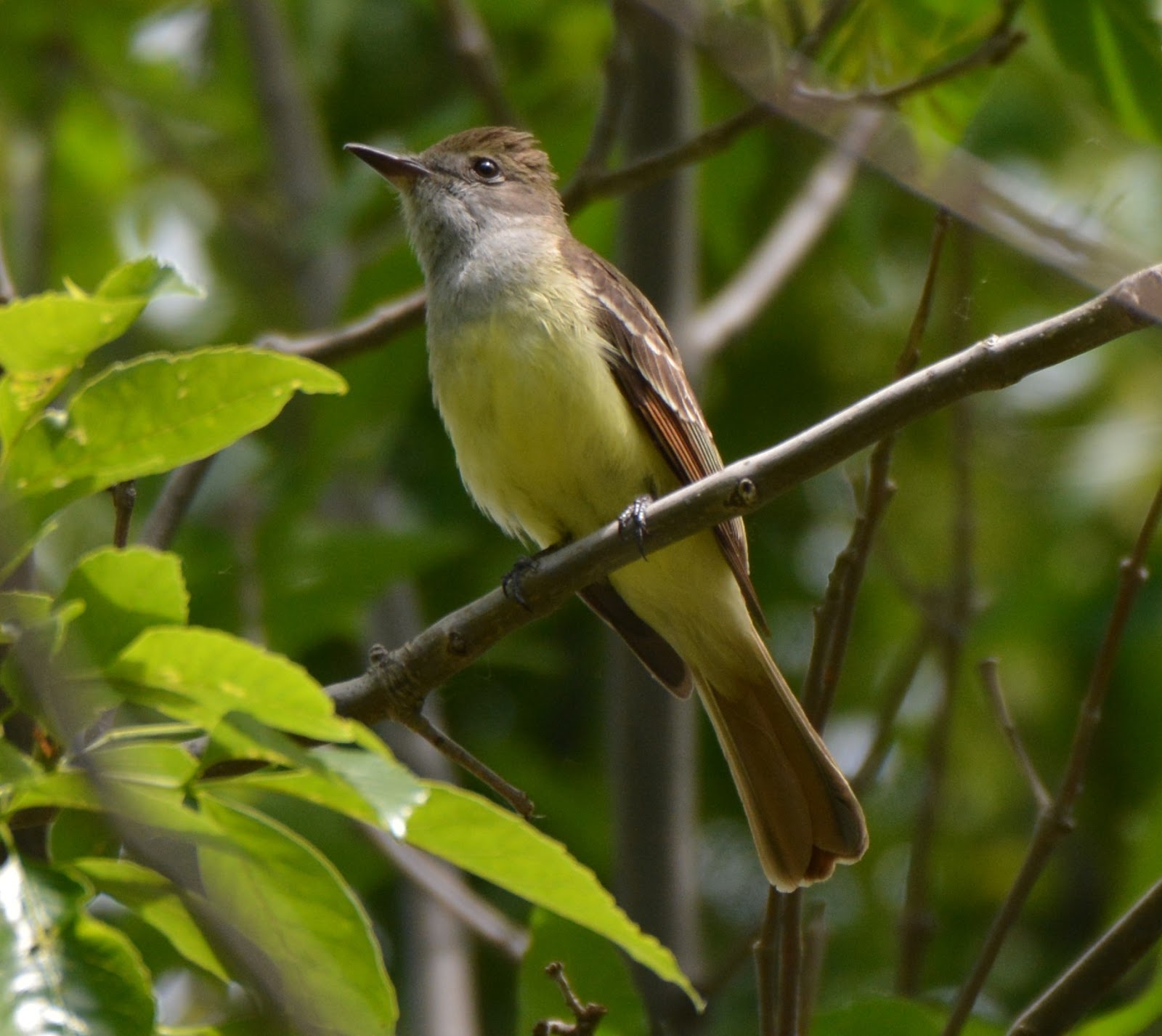
Great Crested Flycatcher
Gordon needed the American Black Duck on his lifelist. From my experiences with these ducks in various states, they can be difficult for photos. I've been in many areas where they are swimming a mile away from shore. Sometimes they are behind the reeds and difficult to see. But at Bay Beach, they come right up to you! I was excited to add data to the lacking information at this site about these ducks for the month of June.
At Bay Beach Wildlife Sanctuary, the ABDU walk up SO close to people because people love feeding the ducks...and geese...and swans?!?! They sell bags for a dollar at the desk:) I checked records on this duck and there weren't any for this spot during the month of June! So it was a gamble. This could be a disappointment or a fun find for Gordon. It was a lifebird and that was our goal. For me, I was just super thrilled to bird the area again. During the winter, many of the waterfowl come to hang out along the river shore near the rehabilitation center. It's quite a show!
Tree Swallow
We started off with some amazing birds all around us. If you are a birder, you should definitely give this place a look. If you're not a birder, you should still go and take the family. It's a large preserve funded by the city of Green Bay. It's also free to visit! How sweet is that? Your kids are going to love it!
There were so many birds calling and we were still trying to figure out the various calls. It was after all, a whole new group of bird song we had to learn!
Rose-breasted Grosbeak
I let out a sigh of relief when we found 3 of the ducks still hanging around the area. Granted, they aren't in large number during the summer because they are breeding in the lake, but I knew there had to be some hanging out. Thank the bird gods! Once the target bird was found with excellent observations, it was time to just have fun and bird. The American Black Duck is a bird species showing a decline in numbers due to hybridization with Mallards.
American Black Duck
I nearly crapped my pants when I surveyed the area and discovered SWANS in the area! At first I clumped them all together and called them Tundra Swans. Gordon takes a closer look and discovers a Trumpeter mixed in for the fun!!! They are rare for this area during the summer months, but a few remember this place as home and have stayed around the grounds where there is plenty of food and hospitality:) Most of the Tundra swans are breeding in Canada and Alaska while the Trumpeter Swans have a more diverse range.
Hey, what species are you? You look like me, but something is not quite right.
Okay. Ready for your bird lesson? I've put both similar looking swans together. There are two noticeable differences with these birds. Can you see what they are?
Tundra Swan
Now look carefully. Hint. The field marks are with the bill.
Trumpeter Swan
Did you figure it out? Or did you give up and just feed the swans instead?:) The yellow lore(near the eye) is a great field mark for the Tundra Swan. It's not always clear due to the distance so sometimes we have to look at the bill(which is the second field mark), the way the bird flies or more importantly, listen for their distinct calls.
Another bird of interest for me was the Purple Martin. There are several pairs here that nest. In the photo below, you'll notice House Sparrows taking over the nest boxes. I apologize to my European readers for what I am about to write. These aggressive sparrows are a nuisance and have taken over much of the Martin space. Native vs Non-Native species. In some cases, House Sparrows and European Starlings are "removed" from the area so that the native birds can nest. These Purple Martins seem to be "tolerating" their neighbors for the moment.
House Sparrows and Purple Martins
A beautiful songbird that comes to the feeders in the eastern half of the US is the American Goldfinch. It's a stunner with that brilliant yellow coloring. I had to laugh while entering the data. First off, most of the eastern birds either have the words "Eastern" or "American" in front of them. They were like foreign words to me while I was jotting down the info. Arizona bird lingo would pop up and eventually I'd just cut to the word...Goldfinch! Or Towhee! Or Duck!


 Posts
Posts